Thank you for visiting SNEWPapers!
Sign up free
Editorial
May 26, 1815
Daily National Intelligencer
Washington, District Of Columbia
What is this article about?
An American editorial reviews the Edinburgh Review's November issue essay on the War of 1812, praising its arguments against continuing the war for conquest, highlighting British defeats, financial burdens, desertions, and long-term risks to Anglo-American relations, advocating peace and mutual friendship.
Clipping
OCR Quality
98%
Excellent
Full Text
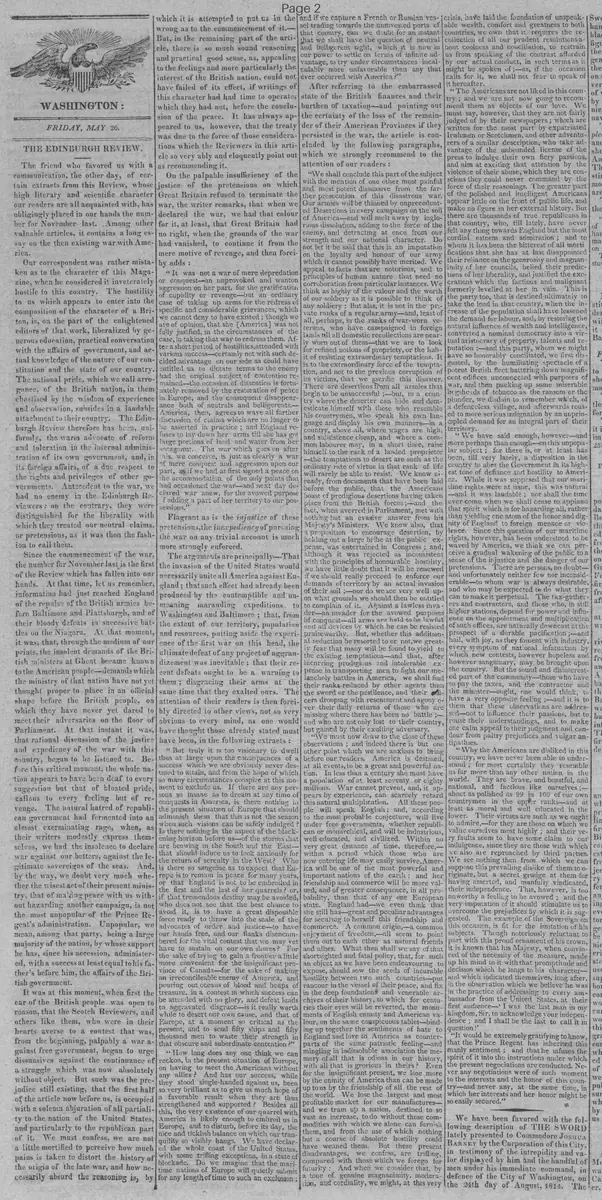
THE EDINBURGH REVIEW.
The friend who favored us with a communication, the other day, of certain extracts from this Review, whose high literary and scientific character our readers are all acquainted with, has obligingly placed in our hands the number for November last. Among other valuable articles, it contains a long essay on the then existing war with America.
Our correspondent was rather mistaken as to the character of this Magazine, when he considered it inveterately hostile to this country. The hostility to us which appears to enter into the composition of the character of a Briton, is, on the part of the enlightened editors of that work, liberalized by generous education, practical conversation with the affairs of government, and actual knowledge of the nature of our constitution and the state of our country. The national pride, which we call arrogance, of the British nation, in them chastised by the wisdom of experience and observation, subsides in a laudable attachment to their country. The Edinburgh Review therefore has been, uniformly, the warm advocate of reform and toleration in the internal administration of its own government, and, in its foreign affairs, of a due respect to the rights and privileges of other governments. Antecedent to the war, we had no enemy in the Edinburgh Reviewers: on the contrary, they were distinguished for the liberality with which they treated our neutral claims, or pretensions, as it was then the fashion to call them.
Since the commencement of the war the number for November last is the first of the Review which has fallen into our hands. At that time, let us remember, information had just reached England of the repulse of the British armies before Baltimore and Plattsburgh, and of their bloody defeats in successive battles on the Niagara. At that moment it was, that, through the medium of our prints, the insolent demands of the British ministers at Ghent became known to the American people—demands which the ministry of that nation have not yet thought proper to place in an official shape before the British people, on which they have never yet dared to meet their adversaries on the floor of Parliament. At that instant it was that rational discussion of the justice and expediency of the war with this country, began to be listened to. Before this critical moment, the whole nation appears to have been deaf to every suggestion but that of bloated pride, callous to every feeling but of revenge. The natural hatred of republican government had fermented into an almost exterminating rage, when, as their writers modestly express themselves, we had the insolence to declare war against our betters, against the legitimate sovereigns of the seas. And, by the way, we doubt very much whether the wisest act of their present ministry, that of making peace with us without hazarding another campaign, is not the most unpopular of the Prince Regent's administration. Unpopular, we mean, among that party, being a large majority of the nation, by whose support he has, since his accession, administered, with a success at least equal to his father's before him, the affairs of the British government.
It was at this moment, when first the ear of the British people was open to reason, that the Scotch Reviewers, and others like them, who were in their hearts averse to a contest that was, from the beginning, palpably a war against free government, began to urge dissuasives against the continuance of a struggle which was now absolutely without object. But such was the prejudice still existing, that the first half of the article now before us, is occupied with a solemn abjuration of all partiality to the nation of the United States, and particularly to the republican part of it. We must confess, we are not a little mortified to perceive how much pains is taken to distort the history of the origin of the late war, and how necessarily absurd the reasoning is, by which it is attempted to put us in the wrong as to the commencement of it.
But, in the remaining part of the article, there is so much sound reasoning and practical good sense, as, appealing to the feelings and more particularly the interest of the British nation, could not have failed of its effect, if writings of this character had had time to operate which they had not, before the conclusion of the peace. It has always appeared to us, however, that the treaty was due to the force of those considerations which the Reviewers in this article so very ably and eloquently point out as recommending it.
On the palpable insufficiency of the justice of the pretensions on which Great Britain refused to terminate the war, the writer remarks, that when we declared the war, we had that colour for it, at least, that Great Britain had no right, when the grounds of the war had vanished, to continue it from the mere motive of revenge, and then forcibly adds:
"It was not a war of mere depredation or conquest—an unprovoked and wanton aggression on her part, for the gratification of cupidity or revenge—but an ordinary case of taking up arms for the redress of specific and considerable grievances, which we cannot deny to have existed; though we are of opinion, that she [America] was not fully justified, in the circumstances of the case, in taking that way to redress them. After a short period of hostilities, attended with various success—certainly not with such decided advantage on our side as could have entitled us to dictate terms to the enemy had the original subject of contention remained—the occasion of dissention is fortunately removed by the restoration of peace in Europe, and the consequent disappearance both of neutrals and belligerents. America, then, agrees to wave all farther discussion of claims which are no longer to be asserted in practice; and England refuses to lay down her arms till she has got large portions of land and water from her antagonist. The war which goes on after this, we conceive, is just as clearly a war of mere conquest and aggression upon our part, as if we had at first signed a peace on the accommodation of the only points that had occasioned the war and next day declared war anew, for the avowed purpose of adding a part of her territory to our possessions."
Flagrant as is the injustice of these pretensions, the inexpediency of pursuing the war on any trivial account is much more strongly enforced. The arguments are principally—That the invasion of the United States would necessarily unite all America against England; that such effect had already been produced by the contemptible and unmeaning marauding expeditions to Washington and Baltimore; that, from the extent of our territory, population and resources, putting aside the experience of the first war on this head, the ultimate defeat of any project of aggrandizement was inevitable; that their recent defeats ought to be a warning to them; disgracing their arms at the same time that they exalted ours. The attention of their readers is then forcibly directed to other views, not so very obvious to every mind, as one would have thought those already stated must have been, in the following extracts:
"But truly it is too visionary to dwell thus at large upon the consequences of a success which we are obviously never destined to attain, and from the hope of which so many circumstances conspire at this moment to exclude us. If there are any persons so insane as to dream at any time of conquests in America, is there nothing in the present situation of Europe that should admonish them that this is not the season when such visions can be safely indulged? Is there nothing in the aspect of the blackening horizon before us—of the storms that are brewing in the South and the East—that should induce us to look anxiously for the return of serenity in the West? Who is there so sanguine as to expect that Europe is to remain in peace for many years, or that England is not to be embroiled in the first and the last of her quarrels? or, if that tremendous destiny may be avoided, who does not see that the best chance to avoid it, is to have a great disposable force ready to throw into the scale of the advocates of order and justice—to have our hands free, and our flanks disencumbered for the vital contest that we may yet have to sustain on our own shores? For the sake of trying to gain a frontier a little more convenient for the insignificant province of Canada—for the sake of making an irreconcileable enemy of America, and pouring out oceans of blood and heaps of treasure, in a contest in which success can be attended with no glory, and defeat leads to aggravated disgrace—is it really worth while to desert our own cause, and that of Europe, at a moment so critical as the present, and to send fifty ships and fifty thousand men to waste their strength in that obscure and subordinate contention?"
"How long does any one think we can reckon, in the present situation of Europe, on having to meet the Americans without any allies? And has our success, while they stood single-handed against us, been so very brilliant as to give us much hope of a favorable result when they are thus strengthened and supported? Besides all this, the very existence of our quarrel with America is likely enough to embroil us in Europe, and to disturb, before its day, the nice and ticklish balance on which our tranquility so visibly hangs. We have declared the whole coast of the United States, with some trifling exceptions, in a state of blockade. Do we imagine that the maritime nations of Europe will quietly submit for any length of time to such an exclusion; and if we capture a French or Russian vessel trading towards the uninvested ports of that country, can we doubt for an instant that we shall have the question of neutral and belligerent right, which it is now in our power to settle on terms of infinite advantage, to try under circumstances incalculably more unfavorable than any that ever occurred with America?"
After referring to the embarrassed state of the British finances and their burthen of taxation—and pointing out the certainty of the loss of the remainder of their American Provinces if they persisted in the war, the article is concluded by the following paragraphs, which we strongly recommend to the attention of our readers:
"We shall conclude this part of the subject with the mention of one other most painful and most potent dissuasive from the farther prosecution of this disastrous war. Our armies will be thinned by unprecedented Desertions in every campaign on the soil of America—and will melt away by inglorious dissolution, adding to the force of the enemy, and detracting at once from our strength and our national character. Do not let it be said that this is an imputation on the loyalty and honour of our army which it cannot possibly have merited. We appeal to facts that are notorious, and to principles of human nature that need no corroboration from particular instances. We think as highly of the valour and the worth of our soldiery as it is possible to think of any soldiery: But alas, it is not in the private ranks of a regular army—and, least of all, perhaps, in the ranks of war-worn veterans, who have campaigned in foreign lands till all domestic recollections are nearly worn out of them—that we are to look for refined notions of propriety, or the habit of resisting extraordinary temptations. It is to the extraordinary force of the temptation, and not to the previous corruption of its victims, that we ascribe this disaster. There are desertions from all armies that begin to be unsuccessful; but, in a country where the deserter can hide and domesticate himself with those who resemble his countrymen, who speak his own language and display his own manners—in a country, above all, where wages are high, and subsistence cheap, and where a common labourer may, in a short time, raise himself to the rank of a landed proprietor—the temptations to desert are such as the ordinary rate of virtue in that rank of life will rarely be able to resist. We know already, from documents that have been laid before the public, that the Americans boast of prodigious desertions having taken place from the British forces;—and the fact, when averred in Parliament, met with nothing but an evasive answer from his Majesty's Ministers. We know also, that a proposition to encourage desertion, by holding out a large bribe at the public expense, was entertained in Congress; and, although it was rejected as inconsistent with the principles of honourable hostility, we have little doubt that it will be renewed if we should really proceed to enforce our demands of territory by an actual invasion of their soil;—nor do we see very well upon what grounds we should then be entitled to complain of it. Against a lawless invader—an invader for the avowed purposes of conquest—all arms are held to be lawful and all devices by which he can be resisted praiseworthy. But, whether this additional seduction be resorted to or not, we greatly fear that many will be found to yield to the existing temptations—and that, after incurring prodigious and intolerable expense in transporting men to fight our melancholy battles in America, we shall find their ranks reduced by other agents than the sword or the pestilence, and their officers drooping with resentment and agony over their daily returns of those who are missing where there has been no battle;—and who are not only lost to their country, but gained by their exulting adversary.
We must now draw to the close of these observations; and indeed there is but one other point which we are anxious to bring before our readers. America is destined, at all events, to be a great and powerful nation. In less than a century she must have a population of at least seventy or eighty millions. War cannot prevent, and, it appears by experience, can scarcely retard this natural multiplication. All these people will speak English; and, according to the most probable conjecture, will live under free governments, whether republican or monarchical, and will be industrious, well educated, and civilized. Within no very great distance of time, therefore,—within a period which those who are now entering life may easily survive, America will be one of the most powerful and important nations of the earth: and her friendship and commerce will be more valued, and of greater consequence, in all probability, than that of any one European state. England had—we even think that she still has—great and peculiar advantages for securing to herself this friendship and commerce. A common origin,—a common enjoyment of freedom,—all seem to point them out to each other as natural friends and allies. What then shall we say of that shortsighted and fatal policy, that, for such an object as we have been endeavouring to expose, should sow the seeds of incurable hostility between two such countries—put rancour in the vessel of their peace, and fix in the deep foundations and venerable archives of their history, to which for centuries their eyes will be reverted, the monuments of English enmity and American valour, on the same conspicuous tablet—binding up together the sentiments of hate to England and love to America as counterparts of the same patriotic feeling—and mingling in indissoluble association the memory of all that is odious in our history, with all that is glorious in theirs? Even for the insignificant present, we lose more by the enmity of America than can be made up to us by the friendship of all the rest of the world. We lose the largest and most profitable market for our manufactures—and we train up a nation, destined to so vast an increase, to do without those commodities with which we alone can furnish them, and from the use of which nothing but a course of absolute hostility could have weaned them. But these present disadvantages, we confess, are trifling, compared with those which we forego for futurity: And when we consider that, by a tone of genuine magnanimity, moderation, and cordiality, we might, at this very crisis, have laid the foundation of unspeakable wealth, comfort and greatness to both countries, we own that it requires the recollection of all our prudent resolutions about coolness and conciliation, to restrain us from speaking of the contrast afforded by our actual conduct, in such terms as it might be spoken of;—as, if the occasion calls for it, we shall not fear to speak of it hereafter.
The Americans are not liked in this country; and we are not now going to recommend them as objects of our love. We must say, however, that they are not fairly judged of by their newspapers; which are written for the most part by expatriated Irishmen or Scotchmen, and other adventurers of a similar description, who take advantage of the unbounded license of the press to indulge their own fiery passions, and aim at exciting that attention by the violence of their abuse, which they are conscious they could never command by the force of their reasonings. The greater part of the polished and intelligent Americans appear little on the front of public life, and make no figure in her external history. But there are thousands of true republicans in that country, who, till lately, have never felt any thing towards England but the most cordial esteem and admiration: and to whom it has been the bitterest of all mortifications that she has at last disappointed their reliance on the generosity and magnanimity of her councils, belied their predictions of her liberality, and justified the execrations which the factious and malignant formerly levelled at her in vain. This is the party too, that is destined ultimately to take the lead in that country, when the increase of the population shall have lessened the demand for labour, and, by restoring the natural influence of wealth and intelligence, converted a nominal democracy into a virtual aristocracy of property, talents and reputation; and this party, whom we might have so honorably conciliated, we first disgusted, by the humiliating spectacle of a potent British fleet battering down magnificent edifices unconnected with purposes of war, and then packing up some miserable freights of tobacco as the ransom or the plunder, we disdain to remember which, of a defenceless village, and afterwards roused to more serious indignation by an unprincipled demand for an integral part of their territory.
We have said enough, however—and more perhaps than enough—on this unpopular subject: for there is, or at least has been, till very lately, a disposition in the country to abet the Government in its highest tone of defiance and hostility to America. While it was supposed that our maritime rights were at issue, this was natural—and it was laudable: nor shall the time ever come when we shall cease to applaud that spirit which is for hazarding all, rather than yielding one atom of the honor and dignity of England to foreign menace or violence. Since this question of our maritime rights, however, has been understood to be waved by America, we think we can perceive a gradual wakening of the public to a sense of the injustice and the danger of our pretensions. There are persons, no doubt—and unfortunately neither few nor inconsiderable—to whom war is always desirable, and who may be expected to do what they can to make it perpetual. The tax-gatherers and contractors, and those who, in still higher stations, depend for power and influence on the appointment and multiplication of such offices, are naturally downcast at the prospect of a durable pacification;—and hail, with joy, as they foment with industry, every symptom of national infatuation by which new contests, however hopeless and however sanguinary, may be brought upon the country. But the sound and disinterested part of the community—those who have to pay the taxes, and the contractor and the minister—ought, one would think, to have a very opposite feeling;—and it is to them that these observations are addressed—not to influence their passions, but to rouse their understandings, and to make one calm appeal to their judgment and candour from paltry prejudices and vulgar antipathies.
Why the Americans are disliked in this country, we have never been able to understand; for most certainly they resemble us far more than any other nation in the world. They are brave, and boastful, and national, and factious like ourselves;—about as polished as 99 in 100 of our own countrymen in the upper ranks—and at least as moral and well educated in the lower. Their virtues are such as we ought to admire,—for they are those on which we value ourselves most highly; and their very faults seem to have some claim to our indulgence, since they are those with which we also are reproached by third parties. We see nothing then from which we can suppose this prevailing dislike of them to originate, but a secret grudge at them for having asserted, and manfully vindicated, their independence. This, however, is too unworthy a feeling to be avowed; and the very imputation of it should stimulate us to overcome the prejudices by which it is suggested. The example of the Sovereign on this occasion, is fit for the imitation of his subjects. Though notoriously reluctant to part with this proud ornament of his crown, it is known that his Majesty, when convinced of the necessity of the measure, made up his mind to it with that promptitude and decision which belongs to his character—and which indicated themselves, long after, in the observation which we believe he was in the practice of addressing to every ambassador from the United States, at their first audience—'I was the last man in my kingdom, Sir, to acknowledge your independence; and I shall be the last to call it in question!'
It would be extremely gratifying to know, that the Prince Regent has inherited this manly sentiment; and that he infuses the spirit of it into the instructions under which the present negociations are conducted. Never any negotiations were of such moment to the interests and the honor of this country—and never any, at the same time, in which her interests and her honor might be so easily secured."
The friend who favored us with a communication, the other day, of certain extracts from this Review, whose high literary and scientific character our readers are all acquainted with, has obligingly placed in our hands the number for November last. Among other valuable articles, it contains a long essay on the then existing war with America.
Our correspondent was rather mistaken as to the character of this Magazine, when he considered it inveterately hostile to this country. The hostility to us which appears to enter into the composition of the character of a Briton, is, on the part of the enlightened editors of that work, liberalized by generous education, practical conversation with the affairs of government, and actual knowledge of the nature of our constitution and the state of our country. The national pride, which we call arrogance, of the British nation, in them chastised by the wisdom of experience and observation, subsides in a laudable attachment to their country. The Edinburgh Review therefore has been, uniformly, the warm advocate of reform and toleration in the internal administration of its own government, and, in its foreign affairs, of a due respect to the rights and privileges of other governments. Antecedent to the war, we had no enemy in the Edinburgh Reviewers: on the contrary, they were distinguished for the liberality with which they treated our neutral claims, or pretensions, as it was then the fashion to call them.
Since the commencement of the war the number for November last is the first of the Review which has fallen into our hands. At that time, let us remember, information had just reached England of the repulse of the British armies before Baltimore and Plattsburgh, and of their bloody defeats in successive battles on the Niagara. At that moment it was, that, through the medium of our prints, the insolent demands of the British ministers at Ghent became known to the American people—demands which the ministry of that nation have not yet thought proper to place in an official shape before the British people, on which they have never yet dared to meet their adversaries on the floor of Parliament. At that instant it was that rational discussion of the justice and expediency of the war with this country, began to be listened to. Before this critical moment, the whole nation appears to have been deaf to every suggestion but that of bloated pride, callous to every feeling but of revenge. The natural hatred of republican government had fermented into an almost exterminating rage, when, as their writers modestly express themselves, we had the insolence to declare war against our betters, against the legitimate sovereigns of the seas. And, by the way, we doubt very much whether the wisest act of their present ministry, that of making peace with us without hazarding another campaign, is not the most unpopular of the Prince Regent's administration. Unpopular, we mean, among that party, being a large majority of the nation, by whose support he has, since his accession, administered, with a success at least equal to his father's before him, the affairs of the British government.
It was at this moment, when first the ear of the British people was open to reason, that the Scotch Reviewers, and others like them, who were in their hearts averse to a contest that was, from the beginning, palpably a war against free government, began to urge dissuasives against the continuance of a struggle which was now absolutely without object. But such was the prejudice still existing, that the first half of the article now before us, is occupied with a solemn abjuration of all partiality to the nation of the United States, and particularly to the republican part of it. We must confess, we are not a little mortified to perceive how much pains is taken to distort the history of the origin of the late war, and how necessarily absurd the reasoning is, by which it is attempted to put us in the wrong as to the commencement of it.
But, in the remaining part of the article, there is so much sound reasoning and practical good sense, as, appealing to the feelings and more particularly the interest of the British nation, could not have failed of its effect, if writings of this character had had time to operate which they had not, before the conclusion of the peace. It has always appeared to us, however, that the treaty was due to the force of those considerations which the Reviewers in this article so very ably and eloquently point out as recommending it.
On the palpable insufficiency of the justice of the pretensions on which Great Britain refused to terminate the war, the writer remarks, that when we declared the war, we had that colour for it, at least, that Great Britain had no right, when the grounds of the war had vanished, to continue it from the mere motive of revenge, and then forcibly adds:
"It was not a war of mere depredation or conquest—an unprovoked and wanton aggression on her part, for the gratification of cupidity or revenge—but an ordinary case of taking up arms for the redress of specific and considerable grievances, which we cannot deny to have existed; though we are of opinion, that she [America] was not fully justified, in the circumstances of the case, in taking that way to redress them. After a short period of hostilities, attended with various success—certainly not with such decided advantage on our side as could have entitled us to dictate terms to the enemy had the original subject of contention remained—the occasion of dissention is fortunately removed by the restoration of peace in Europe, and the consequent disappearance both of neutrals and belligerents. America, then, agrees to wave all farther discussion of claims which are no longer to be asserted in practice; and England refuses to lay down her arms till she has got large portions of land and water from her antagonist. The war which goes on after this, we conceive, is just as clearly a war of mere conquest and aggression upon our part, as if we had at first signed a peace on the accommodation of the only points that had occasioned the war and next day declared war anew, for the avowed purpose of adding a part of her territory to our possessions."
Flagrant as is the injustice of these pretensions, the inexpediency of pursuing the war on any trivial account is much more strongly enforced. The arguments are principally—That the invasion of the United States would necessarily unite all America against England; that such effect had already been produced by the contemptible and unmeaning marauding expeditions to Washington and Baltimore; that, from the extent of our territory, population and resources, putting aside the experience of the first war on this head, the ultimate defeat of any project of aggrandizement was inevitable; that their recent defeats ought to be a warning to them; disgracing their arms at the same time that they exalted ours. The attention of their readers is then forcibly directed to other views, not so very obvious to every mind, as one would have thought those already stated must have been, in the following extracts:
"But truly it is too visionary to dwell thus at large upon the consequences of a success which we are obviously never destined to attain, and from the hope of which so many circumstances conspire at this moment to exclude us. If there are any persons so insane as to dream at any time of conquests in America, is there nothing in the present situation of Europe that should admonish them that this is not the season when such visions can be safely indulged? Is there nothing in the aspect of the blackening horizon before us—of the storms that are brewing in the South and the East—that should induce us to look anxiously for the return of serenity in the West? Who is there so sanguine as to expect that Europe is to remain in peace for many years, or that England is not to be embroiled in the first and the last of her quarrels? or, if that tremendous destiny may be avoided, who does not see that the best chance to avoid it, is to have a great disposable force ready to throw into the scale of the advocates of order and justice—to have our hands free, and our flanks disencumbered for the vital contest that we may yet have to sustain on our own shores? For the sake of trying to gain a frontier a little more convenient for the insignificant province of Canada—for the sake of making an irreconcileable enemy of America, and pouring out oceans of blood and heaps of treasure, in a contest in which success can be attended with no glory, and defeat leads to aggravated disgrace—is it really worth while to desert our own cause, and that of Europe, at a moment so critical as the present, and to send fifty ships and fifty thousand men to waste their strength in that obscure and subordinate contention?"
"How long does any one think we can reckon, in the present situation of Europe, on having to meet the Americans without any allies? And has our success, while they stood single-handed against us, been so very brilliant as to give us much hope of a favorable result when they are thus strengthened and supported? Besides all this, the very existence of our quarrel with America is likely enough to embroil us in Europe, and to disturb, before its day, the nice and ticklish balance on which our tranquility so visibly hangs. We have declared the whole coast of the United States, with some trifling exceptions, in a state of blockade. Do we imagine that the maritime nations of Europe will quietly submit for any length of time to such an exclusion; and if we capture a French or Russian vessel trading towards the uninvested ports of that country, can we doubt for an instant that we shall have the question of neutral and belligerent right, which it is now in our power to settle on terms of infinite advantage, to try under circumstances incalculably more unfavorable than any that ever occurred with America?"
After referring to the embarrassed state of the British finances and their burthen of taxation—and pointing out the certainty of the loss of the remainder of their American Provinces if they persisted in the war, the article is concluded by the following paragraphs, which we strongly recommend to the attention of our readers:
"We shall conclude this part of the subject with the mention of one other most painful and most potent dissuasive from the farther prosecution of this disastrous war. Our armies will be thinned by unprecedented Desertions in every campaign on the soil of America—and will melt away by inglorious dissolution, adding to the force of the enemy, and detracting at once from our strength and our national character. Do not let it be said that this is an imputation on the loyalty and honour of our army which it cannot possibly have merited. We appeal to facts that are notorious, and to principles of human nature that need no corroboration from particular instances. We think as highly of the valour and the worth of our soldiery as it is possible to think of any soldiery: But alas, it is not in the private ranks of a regular army—and, least of all, perhaps, in the ranks of war-worn veterans, who have campaigned in foreign lands till all domestic recollections are nearly worn out of them—that we are to look for refined notions of propriety, or the habit of resisting extraordinary temptations. It is to the extraordinary force of the temptation, and not to the previous corruption of its victims, that we ascribe this disaster. There are desertions from all armies that begin to be unsuccessful; but, in a country where the deserter can hide and domesticate himself with those who resemble his countrymen, who speak his own language and display his own manners—in a country, above all, where wages are high, and subsistence cheap, and where a common labourer may, in a short time, raise himself to the rank of a landed proprietor—the temptations to desert are such as the ordinary rate of virtue in that rank of life will rarely be able to resist. We know already, from documents that have been laid before the public, that the Americans boast of prodigious desertions having taken place from the British forces;—and the fact, when averred in Parliament, met with nothing but an evasive answer from his Majesty's Ministers. We know also, that a proposition to encourage desertion, by holding out a large bribe at the public expense, was entertained in Congress; and, although it was rejected as inconsistent with the principles of honourable hostility, we have little doubt that it will be renewed if we should really proceed to enforce our demands of territory by an actual invasion of their soil;—nor do we see very well upon what grounds we should then be entitled to complain of it. Against a lawless invader—an invader for the avowed purposes of conquest—all arms are held to be lawful and all devices by which he can be resisted praiseworthy. But, whether this additional seduction be resorted to or not, we greatly fear that many will be found to yield to the existing temptations—and that, after incurring prodigious and intolerable expense in transporting men to fight our melancholy battles in America, we shall find their ranks reduced by other agents than the sword or the pestilence, and their officers drooping with resentment and agony over their daily returns of those who are missing where there has been no battle;—and who are not only lost to their country, but gained by their exulting adversary.
We must now draw to the close of these observations; and indeed there is but one other point which we are anxious to bring before our readers. America is destined, at all events, to be a great and powerful nation. In less than a century she must have a population of at least seventy or eighty millions. War cannot prevent, and, it appears by experience, can scarcely retard this natural multiplication. All these people will speak English; and, according to the most probable conjecture, will live under free governments, whether republican or monarchical, and will be industrious, well educated, and civilized. Within no very great distance of time, therefore,—within a period which those who are now entering life may easily survive, America will be one of the most powerful and important nations of the earth: and her friendship and commerce will be more valued, and of greater consequence, in all probability, than that of any one European state. England had—we even think that she still has—great and peculiar advantages for securing to herself this friendship and commerce. A common origin,—a common enjoyment of freedom,—all seem to point them out to each other as natural friends and allies. What then shall we say of that shortsighted and fatal policy, that, for such an object as we have been endeavouring to expose, should sow the seeds of incurable hostility between two such countries—put rancour in the vessel of their peace, and fix in the deep foundations and venerable archives of their history, to which for centuries their eyes will be reverted, the monuments of English enmity and American valour, on the same conspicuous tablet—binding up together the sentiments of hate to England and love to America as counterparts of the same patriotic feeling—and mingling in indissoluble association the memory of all that is odious in our history, with all that is glorious in theirs? Even for the insignificant present, we lose more by the enmity of America than can be made up to us by the friendship of all the rest of the world. We lose the largest and most profitable market for our manufactures—and we train up a nation, destined to so vast an increase, to do without those commodities with which we alone can furnish them, and from the use of which nothing but a course of absolute hostility could have weaned them. But these present disadvantages, we confess, are trifling, compared with those which we forego for futurity: And when we consider that, by a tone of genuine magnanimity, moderation, and cordiality, we might, at this very crisis, have laid the foundation of unspeakable wealth, comfort and greatness to both countries, we own that it requires the recollection of all our prudent resolutions about coolness and conciliation, to restrain us from speaking of the contrast afforded by our actual conduct, in such terms as it might be spoken of;—as, if the occasion calls for it, we shall not fear to speak of it hereafter.
The Americans are not liked in this country; and we are not now going to recommend them as objects of our love. We must say, however, that they are not fairly judged of by their newspapers; which are written for the most part by expatriated Irishmen or Scotchmen, and other adventurers of a similar description, who take advantage of the unbounded license of the press to indulge their own fiery passions, and aim at exciting that attention by the violence of their abuse, which they are conscious they could never command by the force of their reasonings. The greater part of the polished and intelligent Americans appear little on the front of public life, and make no figure in her external history. But there are thousands of true republicans in that country, who, till lately, have never felt any thing towards England but the most cordial esteem and admiration: and to whom it has been the bitterest of all mortifications that she has at last disappointed their reliance on the generosity and magnanimity of her councils, belied their predictions of her liberality, and justified the execrations which the factious and malignant formerly levelled at her in vain. This is the party too, that is destined ultimately to take the lead in that country, when the increase of the population shall have lessened the demand for labour, and, by restoring the natural influence of wealth and intelligence, converted a nominal democracy into a virtual aristocracy of property, talents and reputation; and this party, whom we might have so honorably conciliated, we first disgusted, by the humiliating spectacle of a potent British fleet battering down magnificent edifices unconnected with purposes of war, and then packing up some miserable freights of tobacco as the ransom or the plunder, we disdain to remember which, of a defenceless village, and afterwards roused to more serious indignation by an unprincipled demand for an integral part of their territory.
We have said enough, however—and more perhaps than enough—on this unpopular subject: for there is, or at least has been, till very lately, a disposition in the country to abet the Government in its highest tone of defiance and hostility to America. While it was supposed that our maritime rights were at issue, this was natural—and it was laudable: nor shall the time ever come when we shall cease to applaud that spirit which is for hazarding all, rather than yielding one atom of the honor and dignity of England to foreign menace or violence. Since this question of our maritime rights, however, has been understood to be waved by America, we think we can perceive a gradual wakening of the public to a sense of the injustice and the danger of our pretensions. There are persons, no doubt—and unfortunately neither few nor inconsiderable—to whom war is always desirable, and who may be expected to do what they can to make it perpetual. The tax-gatherers and contractors, and those who, in still higher stations, depend for power and influence on the appointment and multiplication of such offices, are naturally downcast at the prospect of a durable pacification;—and hail, with joy, as they foment with industry, every symptom of national infatuation by which new contests, however hopeless and however sanguinary, may be brought upon the country. But the sound and disinterested part of the community—those who have to pay the taxes, and the contractor and the minister—ought, one would think, to have a very opposite feeling;—and it is to them that these observations are addressed—not to influence their passions, but to rouse their understandings, and to make one calm appeal to their judgment and candour from paltry prejudices and vulgar antipathies.
Why the Americans are disliked in this country, we have never been able to understand; for most certainly they resemble us far more than any other nation in the world. They are brave, and boastful, and national, and factious like ourselves;—about as polished as 99 in 100 of our own countrymen in the upper ranks—and at least as moral and well educated in the lower. Their virtues are such as we ought to admire,—for they are those on which we value ourselves most highly; and their very faults seem to have some claim to our indulgence, since they are those with which we also are reproached by third parties. We see nothing then from which we can suppose this prevailing dislike of them to originate, but a secret grudge at them for having asserted, and manfully vindicated, their independence. This, however, is too unworthy a feeling to be avowed; and the very imputation of it should stimulate us to overcome the prejudices by which it is suggested. The example of the Sovereign on this occasion, is fit for the imitation of his subjects. Though notoriously reluctant to part with this proud ornament of his crown, it is known that his Majesty, when convinced of the necessity of the measure, made up his mind to it with that promptitude and decision which belongs to his character—and which indicated themselves, long after, in the observation which we believe he was in the practice of addressing to every ambassador from the United States, at their first audience—'I was the last man in my kingdom, Sir, to acknowledge your independence; and I shall be the last to call it in question!'
It would be extremely gratifying to know, that the Prince Regent has inherited this manly sentiment; and that he infuses the spirit of it into the instructions under which the present negociations are conducted. Never any negotiations were of such moment to the interests and the honor of this country—and never any, at the same time, in which her interests and her honor might be so easily secured."
What sub-type of article is it?
War Or Peace
Foreign Affairs
What keywords are associated?
War Of 1812
Edinburgh Review
British Policy
American Independence
Peace Negotiations
Desertions
Anglo American Relations
What entities or persons were involved?
Edinburgh Review
British Government
Prince Regent
Americans
Ghent Negotiations
Editorial Details
Primary Topic
Edinburgh Review Essay On War Of 1812 And Arguments For Peace
Stance / Tone
Supportive Of Peace And Critical Of British War Continuation
Key Figures
Edinburgh Review
British Government
Prince Regent
Americans
Ghent Negotiations
Key Arguments
War Became Unjust After European Peace Removed Original Grievances
Continued War Is Conquest And Aggression By Britain
Invasion Would Unite Americans And Lead To Inevitable Defeat
British Defeats At Baltimore, Plattsburgh, Niagara Warn Against Persistence
Desertions From British Army Due To Temptations In America
Future American Power Makes Friendship Vital For Britain
Enmity Loses Britain Its Largest Market And Sows Long Term Hostility