Thank you for visiting SNEWPapers!
Sign up free
Editorial
December 25, 1787
The New York Journal, And Daily Patriotic Register
New York, New York County, New York
What is this article about?
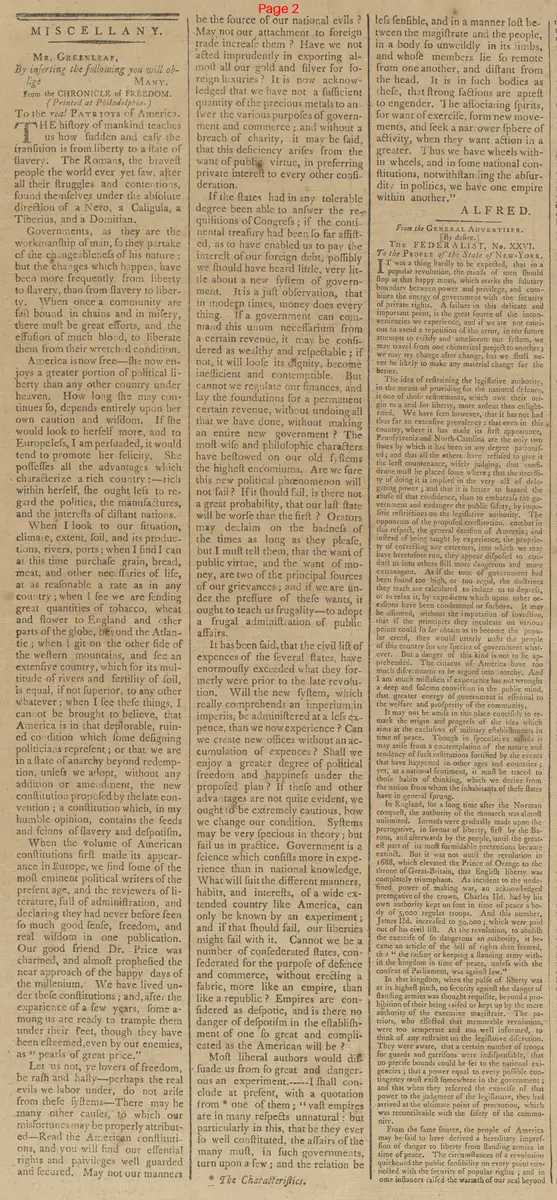
An anonymous essay signed 'ALFRED' cautions American patriots against adopting the proposed federal constitution, warning it risks despotism like Roman emperors, praises existing state constitutions, attributes woes to lack of public virtue and finances, and advocates frugality over radical change.
Clipping
OCR Quality
98%
Excellent
Full Text
MISCELLANY.
MR. GREENLEAF,
By inserting the following you will oblige
MANY.
From the CHRONICLE of FREEDOM.
(Printed at Philadelphia.)
To the real Patriots of America.
The transition is from liberty to a state of
slavery. The Romans, the bravest
people the world ever yet saw, after
all their struggles and contentions,
found themselves under the absolute
direction of a Nero, a Caligula, a
Tiberius, and a Domitian.
Governments, as they are the
workmanship of man, so they partake
of the changeableness of his nature:
but the changes which happen, have
been more frequently from liberty
to slavery, than from slavery to liberty.
When once a community are
fast bound in chains and in misery,
there must be great efforts, and the
effusion of much blood, to liberate
them from their wretched condition.
America is now free—she now enjoys
a greater portion of political liberty
than any other country under
heaven. How long she may continue
so, depends entirely upon her
own caution and wisdom. If she
would look to herself more, and to
Europe less, I am persuaded, it would
tend to promote her felicity. She
possesses all the advantages which
characterize a rich country:—rich
within herself, she ought less to regard
the politics, the manufactures,
and the interests of distant nations.
When I look to our situation,
climate, extent, soil, and its productions,
rivers, ports; when I find I can
at this time purchase grain, bread,
meat, and other necessaries of life.
at as reasonable a rate as in any
country; when I see we are exporting
great quantities of tobacco, wheat
and flour to England and other
parts of the globe, beyond the Atlantic;
when I get on the other side of
the western mountains, and see an
extensive country, which for its multitude
of rivers and fertility of soil.
is equal, if not superior, to any other
whatever; when I see these things, I
cannot be brought to believe, that
America is in that deplorable, ruined
condition which some designing
politicians represent; or that we are
in a state of anarchy beyond redemption,
unless we adopt, without any
addition or amendment, the new
constitution proposed by the late convention;
a constitution which, in my
humble opinion, contains the seeds
and scions of slavery and despotism.
When the volume of American
constitutions first made its appearance
in Europe, we find some of the
most eminent political writers of the
present age, and the reviewers of literature,
full of admiration, and
declaring they had never before seen
so much good sense, freedom, and
real wisdom in one publication.
Our good friend Dr. Price was
charmed, and almost prophesied the
near approach of the happy days of
the millennium. We have lived under
these constitutions; and, after the
experience of a few years, some among
us are ready to trample them
under their feet, though they have
been esteemed, even by our enemies.
as "pearls of great price."
Let us not, ye lovers of freedom,
be rash and hasty—perhaps the real
evils we labor under, do not arise
from these systems—There may be
many other causes, to which our
misfortunes may be properly attributed.
Read the American constitutions,
and you will find our essential
rights and privileges well guarded
and secured. May not our manners
be the source of our national evils?
May not our attachment to foreign
trade increase them? Have we not
acted imprudently in exporting almost
all our gold and silver for foreign
luxuries? It is now acknowledged
that we have not a sufficient
quantity of the precious metals to answer
the various purposes of government
and commerce; and without a
breach of charity, it may be said.
that this deficiency arises from the
want of public virtue, in preferring
private interest to every other consideration.
If the states had in any tolerable
degree been able to answer the requisitions
of Congress; if the continental
treasury had been so far aided,
as to have enabled us to pay the
interest of our foreign debt, possibly
we should have heard little, very little
about a new system of government.
It is a just observation, that
in modern times, money does every-
thing. If a government can command
this unum necessarium from
a certain revenue, it may be considered
as wealthy and respectable; if
not, it will lose its dignity, become
inefficient and contemptible. But
cannot we regulate our finances, and
lay the foundations for a permanent
certain revenue, without undoing all
that we have done, without making
an entire new government? The
most wise and philosophic characters
have bestowed on our old systems
the highest encomiums. Are we sure
this new political phenomenon will
not fail? If it should fail, is there not
a great probability, that our last state
will be worse than the first? Orators
may declaim on the badness of
the times as long as they please.
but I must tell them, that the want of
public virtue, and the want of money,
are two of the principal sources
of our grievances; and if we are under
the pressure of these wants, it
ought to teach us frugality—to adopt
a frugal administration of public
affairs.
It has been said, that the civil list of
expenses of the several states, have
enormously exceeded what they formerly
were prior to the late revolution.
Will the new system, which
really comprehends an imperium in
imperio, be administered at a less expense,
than we now experience? Can
we create new offices without an accumulation
of expenses? Shall we
enjoy a greater degree of political
freedom and happiness under the
proposed plan? If these and other
advantages are not quite evident, we
ought to be extremely cautious, how
we change our condition. Systems
may be very specious in theory; but
fail us in practice. Government is a
science which consists more in experience
than in theoretical knowledge.
What will suit the different manners,
habits, and interests, of a wide extended
country like America, can
only be known by an experiment;
and if that should fail, our liberties
might fall with it. Cannot we be a
number of confederated states, confederated
for the purpose of defence
and commerce, without erecting a
fabric, more like an empire, than
like a republic? Empires are considered
as despotic, and is there no
danger of despotism in the establishment
of one so great and complicated
as the American will be?
Most liberal authors would dissuade
us from so great and dangerous
an experiment.-----I shall conclude
at present, with a quotation
from one of them; "that empires
are in many respects unnatural: but
particularly in this, that be they ever
so well constituted, the affairs of the
many must, in such governments.
*The Characteristics.
less sensible, and in a manner lost between
the magistrate and the people,
in a body so unwieldy in its limbs,
and whose members lie so remote
from one another, and distant from
the head. It is in such bodies as
these, that strong factions are aptest
to engender. The associating spirits,
for want of exercise, form new movements,
and seek a narrower sphere of
activity, when they want action in a
greater. Thus we have wheels within
wheels, and in some national constitutions,
notwithstanding the absurdity
in politics, we have one empire
within another."
ALFRED.
MR. GREENLEAF,
By inserting the following you will oblige
MANY.
From the CHRONICLE of FREEDOM.
(Printed at Philadelphia.)
To the real Patriots of America.
The transition is from liberty to a state of
slavery. The Romans, the bravest
people the world ever yet saw, after
all their struggles and contentions,
found themselves under the absolute
direction of a Nero, a Caligula, a
Tiberius, and a Domitian.
Governments, as they are the
workmanship of man, so they partake
of the changeableness of his nature:
but the changes which happen, have
been more frequently from liberty
to slavery, than from slavery to liberty.
When once a community are
fast bound in chains and in misery,
there must be great efforts, and the
effusion of much blood, to liberate
them from their wretched condition.
America is now free—she now enjoys
a greater portion of political liberty
than any other country under
heaven. How long she may continue
so, depends entirely upon her
own caution and wisdom. If she
would look to herself more, and to
Europe less, I am persuaded, it would
tend to promote her felicity. She
possesses all the advantages which
characterize a rich country:—rich
within herself, she ought less to regard
the politics, the manufactures,
and the interests of distant nations.
When I look to our situation,
climate, extent, soil, and its productions,
rivers, ports; when I find I can
at this time purchase grain, bread,
meat, and other necessaries of life.
at as reasonable a rate as in any
country; when I see we are exporting
great quantities of tobacco, wheat
and flour to England and other
parts of the globe, beyond the Atlantic;
when I get on the other side of
the western mountains, and see an
extensive country, which for its multitude
of rivers and fertility of soil.
is equal, if not superior, to any other
whatever; when I see these things, I
cannot be brought to believe, that
America is in that deplorable, ruined
condition which some designing
politicians represent; or that we are
in a state of anarchy beyond redemption,
unless we adopt, without any
addition or amendment, the new
constitution proposed by the late convention;
a constitution which, in my
humble opinion, contains the seeds
and scions of slavery and despotism.
When the volume of American
constitutions first made its appearance
in Europe, we find some of the
most eminent political writers of the
present age, and the reviewers of literature,
full of admiration, and
declaring they had never before seen
so much good sense, freedom, and
real wisdom in one publication.
Our good friend Dr. Price was
charmed, and almost prophesied the
near approach of the happy days of
the millennium. We have lived under
these constitutions; and, after the
experience of a few years, some among
us are ready to trample them
under their feet, though they have
been esteemed, even by our enemies.
as "pearls of great price."
Let us not, ye lovers of freedom,
be rash and hasty—perhaps the real
evils we labor under, do not arise
from these systems—There may be
many other causes, to which our
misfortunes may be properly attributed.
Read the American constitutions,
and you will find our essential
rights and privileges well guarded
and secured. May not our manners
be the source of our national evils?
May not our attachment to foreign
trade increase them? Have we not
acted imprudently in exporting almost
all our gold and silver for foreign
luxuries? It is now acknowledged
that we have not a sufficient
quantity of the precious metals to answer
the various purposes of government
and commerce; and without a
breach of charity, it may be said.
that this deficiency arises from the
want of public virtue, in preferring
private interest to every other consideration.
If the states had in any tolerable
degree been able to answer the requisitions
of Congress; if the continental
treasury had been so far aided,
as to have enabled us to pay the
interest of our foreign debt, possibly
we should have heard little, very little
about a new system of government.
It is a just observation, that
in modern times, money does every-
thing. If a government can command
this unum necessarium from
a certain revenue, it may be considered
as wealthy and respectable; if
not, it will lose its dignity, become
inefficient and contemptible. But
cannot we regulate our finances, and
lay the foundations for a permanent
certain revenue, without undoing all
that we have done, without making
an entire new government? The
most wise and philosophic characters
have bestowed on our old systems
the highest encomiums. Are we sure
this new political phenomenon will
not fail? If it should fail, is there not
a great probability, that our last state
will be worse than the first? Orators
may declaim on the badness of
the times as long as they please.
but I must tell them, that the want of
public virtue, and the want of money,
are two of the principal sources
of our grievances; and if we are under
the pressure of these wants, it
ought to teach us frugality—to adopt
a frugal administration of public
affairs.
It has been said, that the civil list of
expenses of the several states, have
enormously exceeded what they formerly
were prior to the late revolution.
Will the new system, which
really comprehends an imperium in
imperio, be administered at a less expense,
than we now experience? Can
we create new offices without an accumulation
of expenses? Shall we
enjoy a greater degree of political
freedom and happiness under the
proposed plan? If these and other
advantages are not quite evident, we
ought to be extremely cautious, how
we change our condition. Systems
may be very specious in theory; but
fail us in practice. Government is a
science which consists more in experience
than in theoretical knowledge.
What will suit the different manners,
habits, and interests, of a wide extended
country like America, can
only be known by an experiment;
and if that should fail, our liberties
might fall with it. Cannot we be a
number of confederated states, confederated
for the purpose of defence
and commerce, without erecting a
fabric, more like an empire, than
like a republic? Empires are considered
as despotic, and is there no
danger of despotism in the establishment
of one so great and complicated
as the American will be?
Most liberal authors would dissuade
us from so great and dangerous
an experiment.-----I shall conclude
at present, with a quotation
from one of them; "that empires
are in many respects unnatural: but
particularly in this, that be they ever
so well constituted, the affairs of the
many must, in such governments.
*The Characteristics.
less sensible, and in a manner lost between
the magistrate and the people,
in a body so unwieldy in its limbs,
and whose members lie so remote
from one another, and distant from
the head. It is in such bodies as
these, that strong factions are aptest
to engender. The associating spirits,
for want of exercise, form new movements,
and seek a narrower sphere of
activity, when they want action in a
greater. Thus we have wheels within
wheels, and in some national constitutions,
notwithstanding the absurdity
in politics, we have one empire
within another."
ALFRED.
What sub-type of article is it?
Constitutional
Economic Policy
What keywords are associated?
Federal Constitution
Despotism Risk
Public Virtue
State Constitutions
Financial Reform
American Liberty
Anti Federalist Caution
What entities or persons were involved?
Nero
Caligula
Tiberius
Domitian
Dr. Price
Congress
Late Convention
Editorial Details
Primary Topic
Opposition To The Proposed Federal Constitution
Stance / Tone
Cautionary Warning Against Despotism And Advocating Preservation Of Existing Systems
Key Figures
Nero
Caligula
Tiberius
Domitian
Dr. Price
Congress
Late Convention
Key Arguments
Governments Often Transition From Liberty To Slavery
America Currently Enjoys Great Political Liberty And Economic Advantages
The Proposed Constitution Contains Seeds Of Slavery And Despotism
Existing State Constitutions Are Admirable And Secure Rights
National Evils Stem From Lack Of Public Virtue And Excessive Foreign Trade
Financial Issues Can Be Addressed Without A New Government
New System Risks Higher Expenses And Loss Of Freedom
Confederated States Suffice For Defense And Commerce Without Empire Like Structure