Thank you for visiting SNEWPapers!
Sign up free
Story
December 18, 1959
Arizona Tribune
Phoenix, Maricopa County, Arizona
What is this article about?
Legal column by State Bar of Arizona clarifying stocks (partial ownership, higher risk/reward) versus bonds (loans with fixed interest, priority in repayment), including preferred stock details.
Clipping
OCR Quality
100%
Excellent
Full Text
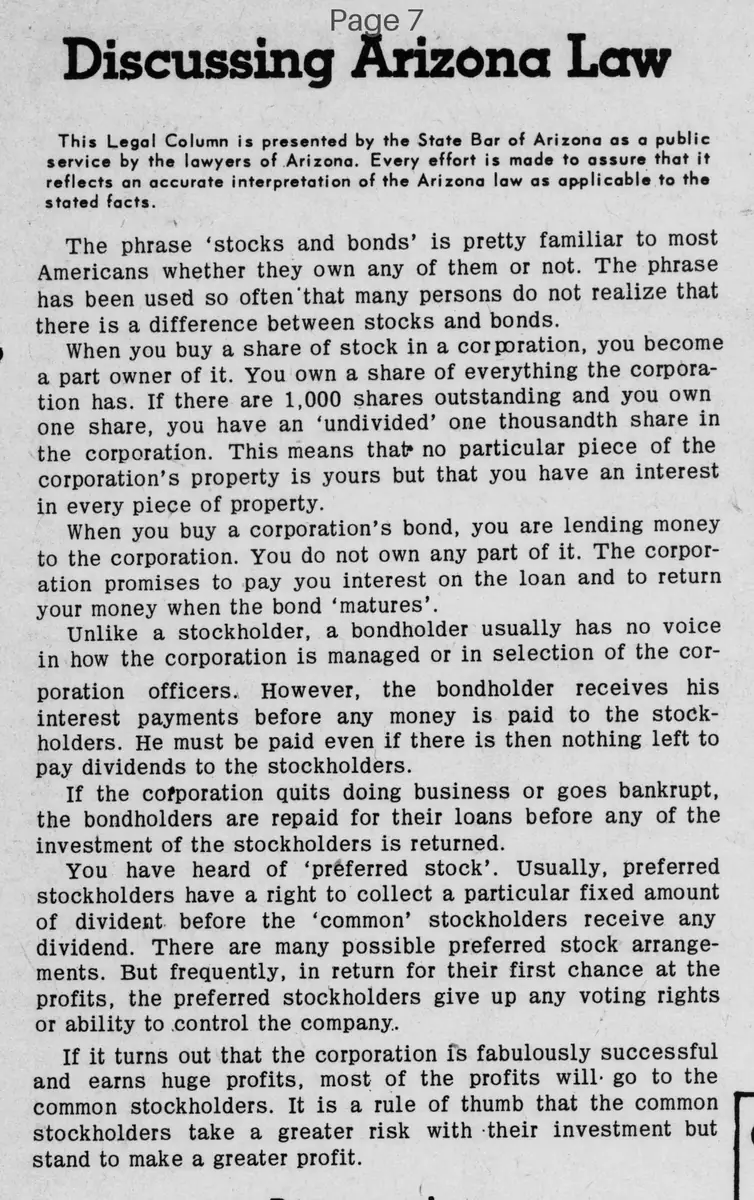
Discussing Arizona Law
This Legal Column is presented by the State Bar of Arizona as a public service by the lawyers of Arizona. Every effort is made to assure that it reflects an accurate interpretation of the Arizona law as applicable to the stated facts.
The phrase 'stocks and bonds' is pretty familiar to most Americans whether they own any of them or not. The phrase has been used so often that many persons do not realize that there is a difference between stocks and bonds.
When you buy a share of stock in a corporation, you become a part owner of it. You own a share of everything the corporation has. If there are 1,000 shares outstanding and you own one share, you have an 'undivided' one thousandth share in the corporation. This means that no particular piece of the corporation's property is yours but that you have an interest in every piece of property.
When you buy a corporation's bond, you are lending money to the corporation. You do not own any part of it. The corporation promises to pay you interest on the loan and to return your money when the bond 'matures'.
Unlike a stockholder, a bondholder usually has no voice in how the corporation is managed or in selection of the corporation officers. However, the bondholder receives his interest payments before any money is paid to the stockholders. He must be paid even if there is then nothing left to pay dividends to the stockholders.
If the corporation quits doing business or goes bankrupt, the bondholders are repaid for their loans before any of the investment of the stockholders is returned.
You have heard of 'preferred stock'. Usually, preferred stockholders have a right to collect a particular fixed amount of dividend before the 'common' stockholders receive any dividend. There are many possible preferred stock arrangements. But frequently, in return for their first chance at the profits, the preferred stockholders give up any voting rights or ability to control the company.
If it turns out that the corporation is fabulously successful and earns huge profits, most of the profits will go to the common stockholders. It is a rule of thumb that the common stockholders take a greater risk with their investment but stand to make a greater profit.
This Legal Column is presented by the State Bar of Arizona as a public service by the lawyers of Arizona. Every effort is made to assure that it reflects an accurate interpretation of the Arizona law as applicable to the stated facts.
The phrase 'stocks and bonds' is pretty familiar to most Americans whether they own any of them or not. The phrase has been used so often that many persons do not realize that there is a difference between stocks and bonds.
When you buy a share of stock in a corporation, you become a part owner of it. You own a share of everything the corporation has. If there are 1,000 shares outstanding and you own one share, you have an 'undivided' one thousandth share in the corporation. This means that no particular piece of the corporation's property is yours but that you have an interest in every piece of property.
When you buy a corporation's bond, you are lending money to the corporation. You do not own any part of it. The corporation promises to pay you interest on the loan and to return your money when the bond 'matures'.
Unlike a stockholder, a bondholder usually has no voice in how the corporation is managed or in selection of the corporation officers. However, the bondholder receives his interest payments before any money is paid to the stockholders. He must be paid even if there is then nothing left to pay dividends to the stockholders.
If the corporation quits doing business or goes bankrupt, the bondholders are repaid for their loans before any of the investment of the stockholders is returned.
You have heard of 'preferred stock'. Usually, preferred stockholders have a right to collect a particular fixed amount of dividend before the 'common' stockholders receive any dividend. There are many possible preferred stock arrangements. But frequently, in return for their first chance at the profits, the preferred stockholders give up any voting rights or ability to control the company.
If it turns out that the corporation is fabulously successful and earns huge profits, most of the profits will go to the common stockholders. It is a rule of thumb that the common stockholders take a greater risk with their investment but stand to make a greater profit.
What sub-type of article is it?
Legal Explanation
Financial Education
What keywords are associated?
Stocks
Bonds
Corporation
Ownership
Dividends
Bankruptcy
Preferred Stock
What entities or persons were involved?
State Bar Of Arizona
Where did it happen?
Arizona
Story Details
Key Persons
State Bar Of Arizona
Location
Arizona
Story Details
The article explains the differences between stocks and bonds: stocks represent partial ownership in a corporation with potential for greater profits but higher risk, while bonds are loans to the corporation with fixed interest and priority repayment in bankruptcy. Preferred stock offers fixed dividends but often no voting rights.