Thank you for visiting SNEWPapers!
Sign up free
Editorial
September 3, 1821
Alexandria Gazette & Daily Advertiser
Alexandria, Virginia
What is this article about?
Editorial critiques the National Gazette's editor for accusing British influence in criticisms of John Quincy Adams's Oration, highlights hypocrisy in his past writings, surveys negative press reactions across U.S. papers, and defends an 'Appeal from the Judgments of Great Britain' against misrepresentations, linking to Anti-Missouri policy shifts.
Clipping
OCR Quality
98%
Excellent
Full Text
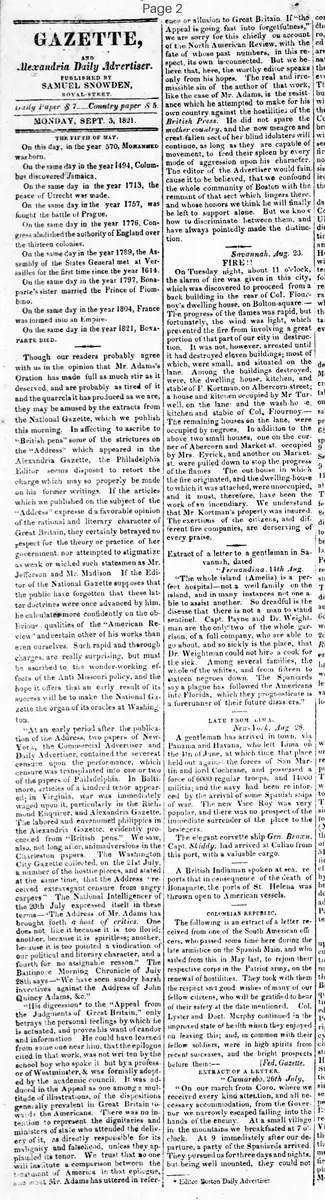
Though our readers probably agree with us in the opinion that Mr. Adams's Oration has made full as much stir as it deserved, and are probably as tired of it and the quarrels it has produced as we are, they may be amused by the extracts from the National Gazette, which we publish this morning. In affecting to ascribe to "British pens" some of the strictures on the "Address" which appeared in the Alexandria Gazette, the Philadelphia Editor seems disposed to retort the charge which may so properly be made on his former writings. If the articles which we published on the subject of the "Address" expressed a favorable opinion of the rational and literary character of Great Britain, they certainly betrayed no respect for the theory or practice of her government, nor attempted to stigmatize as weak or wicked such statesmen as Mr. Jefferson and Mr. Madison. If the Editor of the National Gazette supposes that the public have forgotten that these latter doctrines were once advanced by him, he calculates more confidently on the oblivious qualities of the "American Review" and certain other of his works than even ourselves. Such rapid and thorough charges are really surprising, but must be ascribed to the wonder-working effects of the Anti-Missouri policy, and the hope it offers that an early result of its success will be to make the National Gazette the organ of its oracles at Washington.
"At an early period after the publication of the Address, two papers of New York, the Commercial Advertiser and Daily Advertiser, contained the severest censure upon the performance, which censure was transplanted into one or two of the papers of Philadelphia. In Baltimore, articles of a kindred tenor appeared; in Virginia, war was immediately waged upon it, particularly in the Richmond Enquirer, and Alexandria Gazette. The labored and envenomed philippics in the Alexandria Gazette, evidently proceeded from "British pens." We saw, also, not long after, animadversions in the Charleston papers. The Washington City Gazette collected, on the 21st July, a number of the hostile pieces, and stated at the same time, that the Address received extravagant censure from angry carpers." The National Intelligencer of the 20th July expressed itself in these terms-"The Address of Mr. Adams has brought forth a host of critics. One does not like it because it is too florid: another, because it is spiritless; another, because it is too pointed; a vindication of our political and literary character, and a fourth for no assignable reason." The Baltimore Morning Chronicle of July 28th says-"We have seen sundry harsh invectives against the Address of John Quincy Adams, &c."
His digression to the "Appeal from the Judgments of Great Britain," only betrays the personal feelings by which he is actuated, and proves his want of candor and information. He could have learned from some one near him, that the epilogue cited in that work, was not written by the school boy who spoke it but by a professor of Westminster, & was formally adopted by the academic council. It was adduced in the Appeal as one among a multitude of illustrations, of the dispositions towards the Americans. There was no intention to represent the dignitaries and ministers of state who attended the delivery of it, as directly responsible for its malignity and falsehood, unless they applauded its tenor. We trust that no one will institute a comparison between the treatment of America in that epilogue, and what Mr. Adams has uttered in reference or allusion to Great Britain. If "the Appeal is going fast into forgetfulness, we are sorry for this chiefly on account of the North American Review, with the fate of whose past numbers, in this respect, its own is connected. But we believe that, here, the worthy editor speaks only from his hopes. The real and irremissible sin of the author of that work, like the case of Mr. Adams, is the resistance which he attempted to make for his own country against the hostilities of the British Press. He did not spare the mother country, and the now meagre and crest-fallen sect of her blind idolaters will continue, as long as they are capable of movement, to feed their spleen by every mode of aggression upon his character. The editor of the Advertiser would fain cause it to be believed, that we confound the whole community of Boston with the remnant of that sect which lingers there, and whose honors we think he will finally be left to support alone. But we know how to discriminate between them, and have always pointedly made the distinction.
"At an early period after the publication of the Address, two papers of New York, the Commercial Advertiser and Daily Advertiser, contained the severest censure upon the performance, which censure was transplanted into one or two of the papers of Philadelphia. In Baltimore, articles of a kindred tenor appeared; in Virginia, war was immediately waged upon it, particularly in the Richmond Enquirer, and Alexandria Gazette. The labored and envenomed philippics in the Alexandria Gazette, evidently proceeded from "British pens." We saw, also, not long after, animadversions in the Charleston papers. The Washington City Gazette collected, on the 21st July, a number of the hostile pieces, and stated at the same time, that the Address received extravagant censure from angry carpers." The National Intelligencer of the 20th July expressed itself in these terms-"The Address of Mr. Adams has brought forth a host of critics. One does not like it because it is too florid: another, because it is spiritless; another, because it is too pointed; a vindication of our political and literary character, and a fourth for no assignable reason." The Baltimore Morning Chronicle of July 28th says-"We have seen sundry harsh invectives against the Address of John Quincy Adams, &c."
His digression to the "Appeal from the Judgments of Great Britain," only betrays the personal feelings by which he is actuated, and proves his want of candor and information. He could have learned from some one near him, that the epilogue cited in that work, was not written by the school boy who spoke it but by a professor of Westminster, & was formally adopted by the academic council. It was adduced in the Appeal as one among a multitude of illustrations, of the dispositions towards the Americans. There was no intention to represent the dignitaries and ministers of state who attended the delivery of it, as directly responsible for its malignity and falsehood, unless they applauded its tenor. We trust that no one will institute a comparison between the treatment of America in that epilogue, and what Mr. Adams has uttered in reference or allusion to Great Britain. If "the Appeal is going fast into forgetfulness, we are sorry for this chiefly on account of the North American Review, with the fate of whose past numbers, in this respect, its own is connected. But we believe that, here, the worthy editor speaks only from his hopes. The real and irremissible sin of the author of that work, like the case of Mr. Adams, is the resistance which he attempted to make for his own country against the hostilities of the British Press. He did not spare the mother country, and the now meagre and crest-fallen sect of her blind idolaters will continue, as long as they are capable of movement, to feed their spleen by every mode of aggression upon his character. The editor of the Advertiser would fain cause it to be believed, that we confound the whole community of Boston with the remnant of that sect which lingers there, and whose honors we think he will finally be left to support alone. But we know how to discriminate between them, and have always pointedly made the distinction.
What sub-type of article is it?
Partisan Politics
Foreign Affairs
Press Freedom
What keywords are associated?
Adams Oration
National Gazette
British Pens
Anti Missouri Policy
Press Criticisms
Appeal Judgments
Jefferson Madison
What entities or persons were involved?
Mr. Adams
National Gazette Editor
Mr. Jefferson
Mr. Madison
Alexandria Gazette
Richmond Enquirer
British Pens
Editorial Details
Primary Topic
Criticism Of National Gazette's Response To Adams's Oration And Defense Of Related Works
Stance / Tone
Defensive Critique Of Rival Editor And British Influences
Key Figures
Mr. Adams
National Gazette Editor
Mr. Jefferson
Mr. Madison
Alexandria Gazette
Richmond Enquirer
British Pens
Key Arguments
Criticisms Of Adams's Oration Not From British Pens But Widespread U.S. Press
National Gazette Editor's Hypocrisy In Past Writings Against Jefferson And Madison
Anti Missouri Policy Influencing Editor's Shifts
Misrepresentation Of 'Appeal From The Judgments Of Great Britain' Epilogue Authorship And Intent
Author's Resistance To British Press Hostilities Defended