Thank you for visiting SNEWPapers!
Sign up free
Editorial
December 23, 1914
The Hartford Herald
Hartford, Ohio County, Kentucky
What is this article about?
Herbert N. Carson, from London, questions why U.S. businesses aren't capitalizing on Europe's WWI disruptions by boosting production, advertising, and preparing for post-war immigration and trade boom, urging Americans to appreciate their peace and prosperity.
Clipping
OCR Quality
98%
Excellent
Full Text
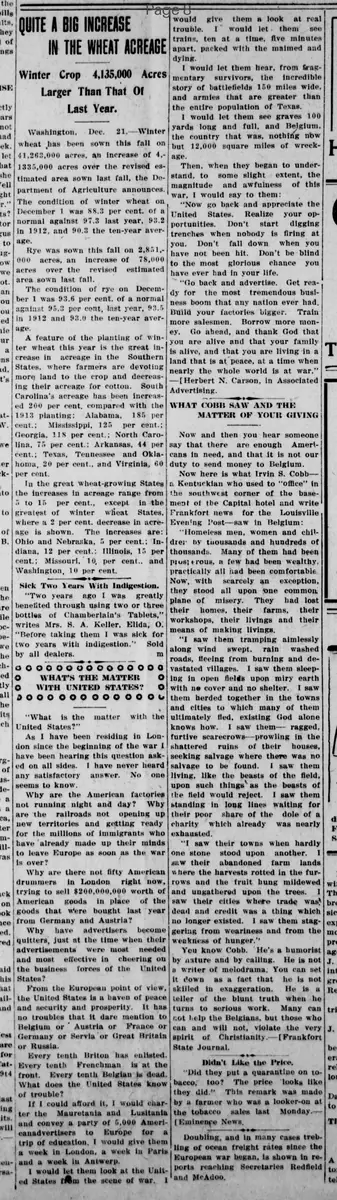
"What is the matter with the United States?"
As I have been residing in London since the beginning of the war I have been hearing this question asked on all sides. I have never heard any satisfactory answer. No one seems to know. Why are the American factories not running night and day? Why are the railroads not opening up new territories and getting ready for the millions of immigrants who have already made up their minds to leave Europe as soon as the war is over? Why are there not fifty American drummers in London right now, trying to sell $200,000,000 worth of American goods in place of the goods that were bought last year from Germany and Austria? Why have advertisers become quitters, just at the time when their advertisements were most needed and most effective in cheering on the business forces of the United States?
From the European point of view, the United States is a haven of peace and security and prosperity. It has no troubles that it dare mention to Belgium or Austria or France or Germany or Servia or Great Britain or Russia. Every tenth Briton has enlisted. Every tenth Frenchman is at the front. Every tenth Belgian is dead. What does the United States know of trouble?
If I could afford it, I would charter the Mauretania and Lusitania and convey a party of 5,000 American advertisers to Europe for a trip of education. I would give them a week in London, a week in Paris and a week in Antwerp. I would let them look at the United States from the scene of war. I would give them a look at real trouble. I would let them see trains, ten at a time, five minutes apart, packed with the maimed and dying. I would let them hear, from fragmentary survivors, the incredible story of battlefields 150 miles wide, and armies that are greater than the entire population of Texas. I would let them see graves 100 yards long and full, and Belgium, the country that was, nothing now but 12,000 square miles of wreckage.
Then, when they began to understand, to some slight extent, the magnitude and awfulness of this war, I would say to them: "Now go back and appreciate the United States. Realize your opportunities. Don't start digging trenches when nobody is firing at you. Don't fall down when you have not been hit. Don't be blind to the most glorious chance you have ever had in your life. "Go back and advertise. Get ready for the most tremendous business boom that any nation ever had. Build your factories bigger. Train more salesmen. Borrow more money. Go ahead, and thank God that you are alive and that your family is alive, and that you are living in a land that is at peace, at a time when nearly the whole world is at war."
[Herbert N. Carson, in Associated Advertising.
As I have been residing in London since the beginning of the war I have been hearing this question asked on all sides. I have never heard any satisfactory answer. No one seems to know. Why are the American factories not running night and day? Why are the railroads not opening up new territories and getting ready for the millions of immigrants who have already made up their minds to leave Europe as soon as the war is over? Why are there not fifty American drummers in London right now, trying to sell $200,000,000 worth of American goods in place of the goods that were bought last year from Germany and Austria? Why have advertisers become quitters, just at the time when their advertisements were most needed and most effective in cheering on the business forces of the United States?
From the European point of view, the United States is a haven of peace and security and prosperity. It has no troubles that it dare mention to Belgium or Austria or France or Germany or Servia or Great Britain or Russia. Every tenth Briton has enlisted. Every tenth Frenchman is at the front. Every tenth Belgian is dead. What does the United States know of trouble?
If I could afford it, I would charter the Mauretania and Lusitania and convey a party of 5,000 American advertisers to Europe for a trip of education. I would give them a week in London, a week in Paris and a week in Antwerp. I would let them look at the United States from the scene of war. I would give them a look at real trouble. I would let them see trains, ten at a time, five minutes apart, packed with the maimed and dying. I would let them hear, from fragmentary survivors, the incredible story of battlefields 150 miles wide, and armies that are greater than the entire population of Texas. I would let them see graves 100 yards long and full, and Belgium, the country that was, nothing now but 12,000 square miles of wreckage.
Then, when they began to understand, to some slight extent, the magnitude and awfulness of this war, I would say to them: "Now go back and appreciate the United States. Realize your opportunities. Don't start digging trenches when nobody is firing at you. Don't fall down when you have not been hit. Don't be blind to the most glorious chance you have ever had in your life. "Go back and advertise. Get ready for the most tremendous business boom that any nation ever had. Build your factories bigger. Train more salesmen. Borrow more money. Go ahead, and thank God that you are alive and that your family is alive, and that you are living in a land that is at peace, at a time when nearly the whole world is at war."
[Herbert N. Carson, in Associated Advertising.
What sub-type of article is it?
Economic Policy
Trade Or Commerce
War Or Peace
What keywords are associated?
World War
American Business
Advertising
Post War Boom
European War
U.S. Prosperity
Immigration
Trade Opportunities
What entities or persons were involved?
United States
American Advertisers
Europe
Belgium
Great Britain
France
Germany
Austria
Russia
Servia
Herbert N. Carson
Editorial Details
Primary Topic
Urging U.S. Businesses To Exploit Wartime Opportunities In Europe
Stance / Tone
Exhortative And Patriotic
Key Figures
United States
American Advertisers
Europe
Belgium
Great Britain
France
Germany
Austria
Russia
Servia
Herbert N. Carson
Key Arguments
American Factories Should Run Night And Day
Railroads Should Prepare For Post War Immigrants
U.S. Salesmen Should Sell Goods In Europe Replacing German And Austrian Imports
Advertisers Should Not Quit But Promote Business During War
U.S. Is A Haven Of Peace Compared To War Torn Europe
Appreciate Opportunities And Prepare For Post War Boom
Build Factories, Train Salesmen, Borrow Money