Thank you for visiting SNEWPapers!
Sign up free
Editorial
May 16, 1855
Star Of The Kanawha Valley
Buffalo, Putnam County, West Virginia
What is this article about?
Editorial from 'The Star' defends its actions in a dispute with 'Independent Republican' over publishing personal political communications between Col. Harvey and Mr. Hall, accuses rivals of inconsistency, and includes letters from Hall clarifying positions.
Clipping
OCR Quality
95%
Excellent
Full Text
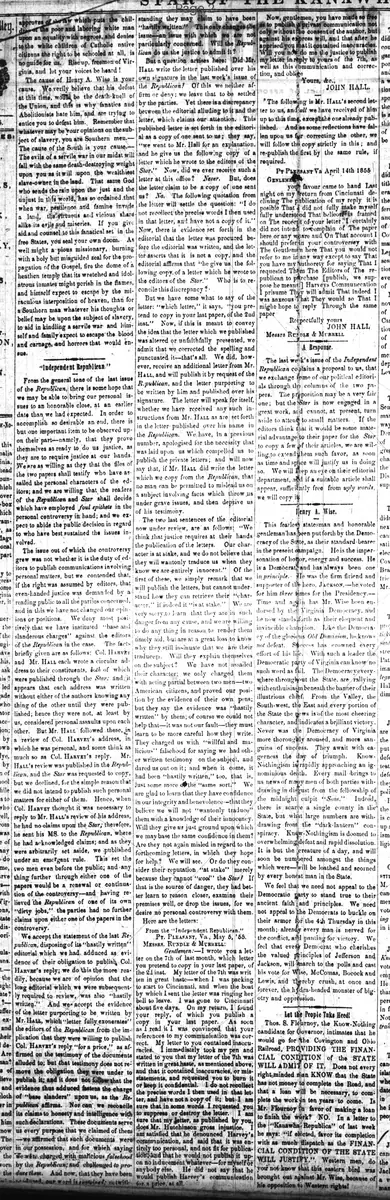
"Independent Republican."
From the general tone of the last issue of the Republican, there is some hope that we may be able to bring our personal issues to an honorable close, at an earlier date than we had expected. In order to accomplish so desirable an end, there is but one important item to be observed upon their part--namely, that they prove themselves as ready to do us justice, as they are to require justice at our hands. We are as willing as they that the files of the two papers shall testify who have assailed the personal characters of the editors; and we are willing that the readers of the Republican and Star shall decide which have employed foul epithets in the personal controversy in hand; and we expect to abide the public decision in regard to who have best sustained the issues involved.
The issue out of which the controversy grew was not whether it is the duty of editors to publish communications involving personal matters, but we contended that, if the right was assumed by editors, that even-handed justice was demanded by a reading public to all the parties concerned, and in this we have not changed our opinions or positions. We deny most positively that we have instituted base and slanderous charges against the editors of the Republican in the case. The facts briefly given are as follows: Col. Harvey and Mr. Hall each wrote a circular address to their constituents, both of which were published through the Star: and it appears that each address was written without either of the authors knowing anything of the other until they were published; hence they were not, at least by us, considered personal assaults upon each other. But Mr. Hall followed these, in a review of Col. Harvey's address, in which he was personal, and some think as much so as Col. Harvey's reply. Mr. Hall's review was published in the Republican, and the Star was requested to copy, but we declined, for the simple reason that we did not intend to publish such personal matters for either of them. Hence, when Col. Harvey thought it was necessary to reply to Mr. Hall's review of his address he had no claims upon the Star; therefore, he sent his MS. to the Republican, where he had acknowledged claims; and as they were arbitrarily set aside, we published under an emergent rule. This set the two men even before the public; and anything further through either one of the papers would be a renewal or continuation of the controversy--and having relieved the Republican of one of its own "dirty jobs," the parties had no further claims upon either one of the papers in the controversy.
We accept the statement of the last Republican, disposing of its "hastily written" editorial which we had adduced as evidence of their obligation to publish Col. Harvey's reply; we do this the more readily, because we are of opinion that the long editorial which we were subsequently required to review, was also "hastily written." And we accept the evidence of the letter purporting to be written by Mr. Hall, which letter fully exonerates the editors of the Republican from the implication that they were willing to publish Col. Harvey's reply "for a price," as affirmed on the testimony of the documents alluded to; but that testimony does not remove the obligation they were under to publish it; and it does not follow that the evidence thus adduced fastens the charge of "base slanders" upon us, as the Republican affirms. Nor can we reconcile its claims to honesty and intelligence with such declarations. These documents serve us every purpose that we claimed of them--we affirmed that such documents were in our possession, and for which saying we were charged with malicious falsehood by the Republican; and challenged to produce them. And now, that they have been produced, our word is vindicated: notwithstanding they may claim to have been "hastily written." This only changes the issue an issue with which we are no particularly concerned. Will the Republican do us the justice to admit it?
But a question arises here: Did Mr. Hall write the letter published over his own signature in the last week's issue of the Republican? Of this we neither affirm or deny; we leave that to be settled by the parties. Yet there is a discrepancy between the editorial alluding to it and the letter, which claims our attention. This published letter is set forth in the editorial as a copy of one sent to us; they say, "we went to Mr. Hall for an explanation, and he give us the following copy of a letter which he wrote to the editors of the Star." Now, did we ever receive such a letter at this office? Never. But, does the letter claim to be a copy of one sent us? No. The following quotation from the letter will settle the question: "I do not recollect the precise words I then used in that letter, and have not a copy of it."
Now, there is evidence set forth in the editorial that the letter was procured before the editorial was written, and the letter asserts that it is not a copy. And the editorial affirms that "he give us the following copy, of a letter which he wrote to the editors of the Star." Who is to reconcile this discrepancy?
But we have something to say of the letter: "which letter," it says, "you pretend to copy in your last paper, of the 2nd inst." Now, if this is meant to convey the idea that the letter which we published was altered or unfaithfully presented, we admit that we corrected the spelling and punctuated it--that's all. We did, however, receive an additional letter from Mr. Hall, and will publish it by request of the Republican, and the letter purporting to be written by him and published over his signature. The letter will speak for itself, whether we have received any such instructions from Mr. Hall as are set forth in the letter published over his name in the Republican. We have, in a previous number, apologised for the necessity that was laid upon us which compelled us to publish the private letters; and will now say that, if Mr. Hall did write the letter which we copy from the Republican, that no man can be permitted to mislead us on a subject involving facts which throw us under grave issues, and then deprive us of his testimony.
- The two last sentences of the editorial now under review, are as follows: "We think that justice requires at their hands the publication of the letters. Our character is at stake, and we do not believe that they will wantonly traduce us when they know we are entirely innocent."
Of the first of these, we simply remark that we will publish the letters, but cannot understand how they can retrieve their "character," if indeed it "is at stake." We are very sorry to learn that they are in such danger from any cause, and we are willing to do anything in reason to render them timely aid, but are at a great loss to know why they still insinuate that we are their traducers. Will they explain themselves on the subject? We have not assailed their character: we only charged them with acting partial between two men--two American citizens, and proved our position by the evidence of their own pens; but they say the evidence was "hastily written" by them; of course we could not help that--it was not our fault--they must learn to be more careful how they write. They charged us with "willful and malicious" falsehood for saying we had other written testimony on the subject, and dared us out on it: and when it came, it had been "hastily written," too, that is, just some more of the "same sort. We are glad to learn that they have confidence in our integrity and benevolence--that they believe we will not "wantonly traduce" them with a knowledge of their innocence. Will they give us just ground upon which we may base the same confidence in them? Are they not again misled in regard to the forthcoming letters, in which they hope for help? We will see. Or do they consider their reputation "at stake" merely because they cannot "wool" the Star? If that is the source of danger, they had better learn to reason closer, examine their premises well, or drop the issues, for we desire no personal controversy with them.
Here are the letters:
From the "Independent Republican."
PT. Pleasant, Va., May 5, '55.
Messrs. Rundle & Murrell:
Gentlemen:--I wrote you a letter on the 7th of last month, which letter you pretend to copy in your last paper, of the 2d inst. My letter of the 7th was written in great haste--when I was packing to start to Cincinnati, and when the boat by which I sent the letter was ringing her bell to leave. I was gone to Cincinnati about five days. On my return, I found your reply, of which you publish a copy in your last paper. As soon as I read it I was convinced that your references to my communication was correct. My letter to you contained inaccuracies, I immediately took my pen and stated to you that my letter of the 7th was written in great haste, as mentioned above, and that it contained inaccuracies, or misstatements, and requested you to burn it or keep it confidential. I do not recollect the precise words I then used in that letter, and have not a copy of it; but I am sure that in some words I requested you to suppress or destroy the letter. I am sure that my letter, as published by you, does Mr. Hutchinson gross injustice, am satisfied that he denounced Harvey's communication, and said that it was entirely too personal, and not fit for publication, and that he would not publish it upon no inducement whatever--for myself or anybody else. He did not say that he would publish Harvey's communication for a price, at all.
Now, gentlemen, you have made so free as to publish private communication not only without the consent of the author, but against his express will, and that after he apprised you that it contained inaccuracies. Will you now do me the justice to publish my letter in reply to yours of the 7th, as well as this communication and correction, and oblige
Yours, &c.,
JOHN HALL
The following is Mr. Hall's second letter to us, and all we have received of him up to this time, except the one already published. And as some reflections have fallen upon us for correcting the other, we will follow the copy strictly in this; and re-publish the first by the same rule, if required.
Pt. Pleasant Va April 14th 1855
Gentlemen
your favour came to hand Last night on my return from Cincinnati declining The publication of my reply it is posible That I did not fully make myself understod That belicve is fraied on The receept of your letter. I certainly did not intenc tocomplain of The paper here or any whare and On That account I should preferin your controversey with The Gentlemen here That you would not refer to me inan way except to sav That you have my duthorety for saying That I requested Thim The Editors of The republican to purchase publish, wo suppose he means Harveys Communication I prisume Thyy will admit That indeed I was anxeous That They would so That I might hope to reply Through the same paper
Respectfully yours
JOHN HALL
Messrs Rundle & Murrell
A Response.
The last week's issue of the Independent Republican contains a proposal to us, that we exchange some of our political editorials through the columns of the two papers. The proposition may be a very fair one: but the Star is now engaged in a great work, and cannot, at present, turn aside to attend to small matters. If the editors think that it would be some material advantage to their paper for the Star to copy a few of their articles, we are willing to extend them such favor, as soon as time and space will justify us in doing so. We will keep an eye on their editorial department, and if a suitable article shall appear, sufficiently free from ugly words, we will copy
From the general tone of the last issue of the Republican, there is some hope that we may be able to bring our personal issues to an honorable close, at an earlier date than we had expected. In order to accomplish so desirable an end, there is but one important item to be observed upon their part--namely, that they prove themselves as ready to do us justice, as they are to require justice at our hands. We are as willing as they that the files of the two papers shall testify who have assailed the personal characters of the editors; and we are willing that the readers of the Republican and Star shall decide which have employed foul epithets in the personal controversy in hand; and we expect to abide the public decision in regard to who have best sustained the issues involved.
The issue out of which the controversy grew was not whether it is the duty of editors to publish communications involving personal matters, but we contended that, if the right was assumed by editors, that even-handed justice was demanded by a reading public to all the parties concerned, and in this we have not changed our opinions or positions. We deny most positively that we have instituted base and slanderous charges against the editors of the Republican in the case. The facts briefly given are as follows: Col. Harvey and Mr. Hall each wrote a circular address to their constituents, both of which were published through the Star: and it appears that each address was written without either of the authors knowing anything of the other until they were published; hence they were not, at least by us, considered personal assaults upon each other. But Mr. Hall followed these, in a review of Col. Harvey's address, in which he was personal, and some think as much so as Col. Harvey's reply. Mr. Hall's review was published in the Republican, and the Star was requested to copy, but we declined, for the simple reason that we did not intend to publish such personal matters for either of them. Hence, when Col. Harvey thought it was necessary to reply to Mr. Hall's review of his address he had no claims upon the Star; therefore, he sent his MS. to the Republican, where he had acknowledged claims; and as they were arbitrarily set aside, we published under an emergent rule. This set the two men even before the public; and anything further through either one of the papers would be a renewal or continuation of the controversy--and having relieved the Republican of one of its own "dirty jobs," the parties had no further claims upon either one of the papers in the controversy.
We accept the statement of the last Republican, disposing of its "hastily written" editorial which we had adduced as evidence of their obligation to publish Col. Harvey's reply; we do this the more readily, because we are of opinion that the long editorial which we were subsequently required to review, was also "hastily written." And we accept the evidence of the letter purporting to be written by Mr. Hall, which letter fully exonerates the editors of the Republican from the implication that they were willing to publish Col. Harvey's reply "for a price," as affirmed on the testimony of the documents alluded to; but that testimony does not remove the obligation they were under to publish it; and it does not follow that the evidence thus adduced fastens the charge of "base slanders" upon us, as the Republican affirms. Nor can we reconcile its claims to honesty and intelligence with such declarations. These documents serve us every purpose that we claimed of them--we affirmed that such documents were in our possession, and for which saying we were charged with malicious falsehood by the Republican; and challenged to produce them. And now, that they have been produced, our word is vindicated: notwithstanding they may claim to have been "hastily written." This only changes the issue an issue with which we are no particularly concerned. Will the Republican do us the justice to admit it?
But a question arises here: Did Mr. Hall write the letter published over his own signature in the last week's issue of the Republican? Of this we neither affirm or deny; we leave that to be settled by the parties. Yet there is a discrepancy between the editorial alluding to it and the letter, which claims our attention. This published letter is set forth in the editorial as a copy of one sent to us; they say, "we went to Mr. Hall for an explanation, and he give us the following copy of a letter which he wrote to the editors of the Star." Now, did we ever receive such a letter at this office? Never. But, does the letter claim to be a copy of one sent us? No. The following quotation from the letter will settle the question: "I do not recollect the precise words I then used in that letter, and have not a copy of it."
Now, there is evidence set forth in the editorial that the letter was procured before the editorial was written, and the letter asserts that it is not a copy. And the editorial affirms that "he give us the following copy, of a letter which he wrote to the editors of the Star." Who is to reconcile this discrepancy?
But we have something to say of the letter: "which letter," it says, "you pretend to copy in your last paper, of the 2nd inst." Now, if this is meant to convey the idea that the letter which we published was altered or unfaithfully presented, we admit that we corrected the spelling and punctuated it--that's all. We did, however, receive an additional letter from Mr. Hall, and will publish it by request of the Republican, and the letter purporting to be written by him and published over his signature. The letter will speak for itself, whether we have received any such instructions from Mr. Hall as are set forth in the letter published over his name in the Republican. We have, in a previous number, apologised for the necessity that was laid upon us which compelled us to publish the private letters; and will now say that, if Mr. Hall did write the letter which we copy from the Republican, that no man can be permitted to mislead us on a subject involving facts which throw us under grave issues, and then deprive us of his testimony.
- The two last sentences of the editorial now under review, are as follows: "We think that justice requires at their hands the publication of the letters. Our character is at stake, and we do not believe that they will wantonly traduce us when they know we are entirely innocent."
Of the first of these, we simply remark that we will publish the letters, but cannot understand how they can retrieve their "character," if indeed it "is at stake." We are very sorry to learn that they are in such danger from any cause, and we are willing to do anything in reason to render them timely aid, but are at a great loss to know why they still insinuate that we are their traducers. Will they explain themselves on the subject? We have not assailed their character: we only charged them with acting partial between two men--two American citizens, and proved our position by the evidence of their own pens; but they say the evidence was "hastily written" by them; of course we could not help that--it was not our fault--they must learn to be more careful how they write. They charged us with "willful and malicious" falsehood for saying we had other written testimony on the subject, and dared us out on it: and when it came, it had been "hastily written," too, that is, just some more of the "same sort. We are glad to learn that they have confidence in our integrity and benevolence--that they believe we will not "wantonly traduce" them with a knowledge of their innocence. Will they give us just ground upon which we may base the same confidence in them? Are they not again misled in regard to the forthcoming letters, in which they hope for help? We will see. Or do they consider their reputation "at stake" merely because they cannot "wool" the Star? If that is the source of danger, they had better learn to reason closer, examine their premises well, or drop the issues, for we desire no personal controversy with them.
Here are the letters:
From the "Independent Republican."
PT. Pleasant, Va., May 5, '55.
Messrs. Rundle & Murrell:
Gentlemen:--I wrote you a letter on the 7th of last month, which letter you pretend to copy in your last paper, of the 2d inst. My letter of the 7th was written in great haste--when I was packing to start to Cincinnati, and when the boat by which I sent the letter was ringing her bell to leave. I was gone to Cincinnati about five days. On my return, I found your reply, of which you publish a copy in your last paper. As soon as I read it I was convinced that your references to my communication was correct. My letter to you contained inaccuracies, I immediately took my pen and stated to you that my letter of the 7th was written in great haste, as mentioned above, and that it contained inaccuracies, or misstatements, and requested you to burn it or keep it confidential. I do not recollect the precise words I then used in that letter, and have not a copy of it; but I am sure that in some words I requested you to suppress or destroy the letter. I am sure that my letter, as published by you, does Mr. Hutchinson gross injustice, am satisfied that he denounced Harvey's communication, and said that it was entirely too personal, and not fit for publication, and that he would not publish it upon no inducement whatever--for myself or anybody else. He did not say that he would publish Harvey's communication for a price, at all.
Now, gentlemen, you have made so free as to publish private communication not only without the consent of the author, but against his express will, and that after he apprised you that it contained inaccuracies. Will you now do me the justice to publish my letter in reply to yours of the 7th, as well as this communication and correction, and oblige
Yours, &c.,
JOHN HALL
The following is Mr. Hall's second letter to us, and all we have received of him up to this time, except the one already published. And as some reflections have fallen upon us for correcting the other, we will follow the copy strictly in this; and re-publish the first by the same rule, if required.
Pt. Pleasant Va April 14th 1855
Gentlemen
your favour came to hand Last night on my return from Cincinnati declining The publication of my reply it is posible That I did not fully make myself understod That belicve is fraied on The receept of your letter. I certainly did not intenc tocomplain of The paper here or any whare and On That account I should preferin your controversey with The Gentlemen here That you would not refer to me inan way except to sav That you have my duthorety for saying That I requested Thim The Editors of The republican to purchase publish, wo suppose he means Harveys Communication I prisume Thyy will admit That indeed I was anxeous That They would so That I might hope to reply Through the same paper
Respectfully yours
JOHN HALL
Messrs Rundle & Murrell
A Response.
The last week's issue of the Independent Republican contains a proposal to us, that we exchange some of our political editorials through the columns of the two papers. The proposition may be a very fair one: but the Star is now engaged in a great work, and cannot, at present, turn aside to attend to small matters. If the editors think that it would be some material advantage to their paper for the Star to copy a few of their articles, we are willing to extend them such favor, as soon as time and space will justify us in doing so. We will keep an eye on their editorial department, and if a suitable article shall appear, sufficiently free from ugly words, we will copy
What sub-type of article is it?
Press Freedom
Partisan Politics
What keywords are associated?
Newspaper Controversy
Publishing Obligations
Personal Attacks
Editorial Dispute
Political Communications
What entities or persons were involved?
Independent Republican Editors
Star Editors Rundle & Murrell
Col. Harvey
Mr. Hall
Mr. Hutchinson
Editorial Details
Primary Topic
Dispute Over Editorial Obligations To Publish Personal Political Communications
Stance / Tone
Defensive Justification Against Accusations Of Slander And Partiality
Key Figures
Independent Republican Editors
Star Editors Rundle & Murrell
Col. Harvey
Mr. Hall
Mr. Hutchinson
Key Arguments
Editors Must Provide Even Handed Justice In Publishing Personal Matters If They Choose To Publish Them
Star Did Not Initiate Slanderous Charges But Acted To Balance Publication
Republican Inconsistently Refused To Publish Harvey's Reply Despite Obligations
Discrepancies In Hall's Letters Question Republican's Honesty
Star Apologizes For Publishing Private Letters But Justifies Necessity