Thank you for visiting SNEWPapers!
Sign up free
Daily National Intelligencer
Washington, District Of Columbia
What is this article about?
In the U.S. House of Representatives on March 27, Mr. H. Nelson of Virginia opposes Mr. Clay's proposition to appropriate funds for sending a Minister to Buenos Ayres, arguing it interferes with Executive powers, risks war with Spain, and divides the Republican party, while affirming support for South American independence.
Clipping
OCR Quality
Full Text
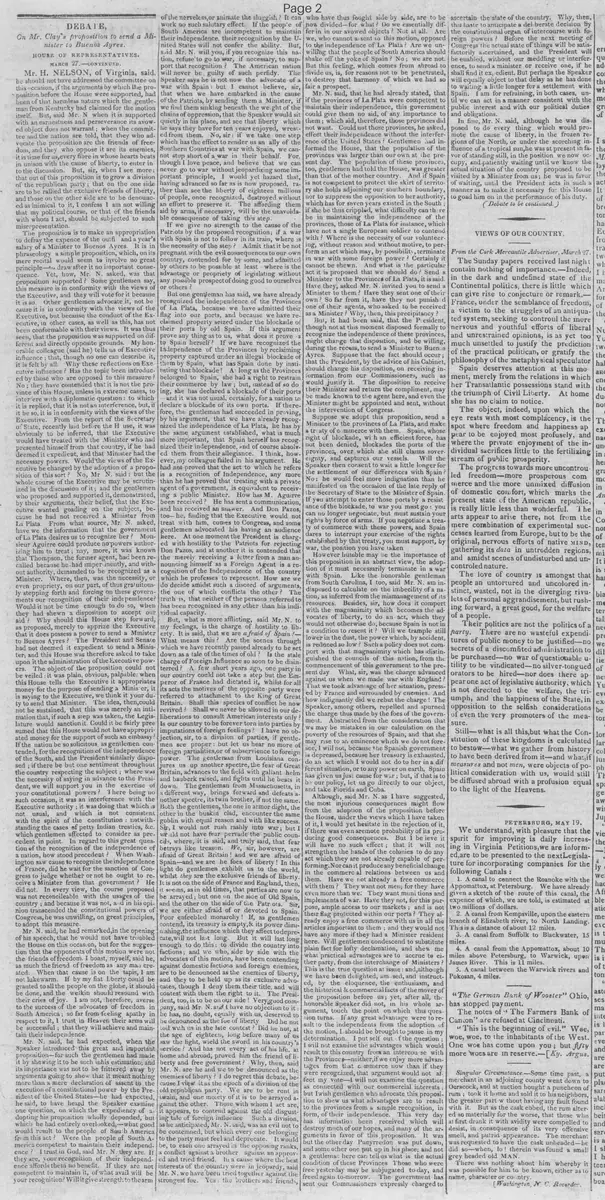
On Mr. Clay's proposition to send a Minister to Buenos Ayres.
HOUSE OF REPRESENTATIVES.
MARCH 27.
—CONTINUED.
Mr. H. NELSON, of Virginia, said he should not have addressed the committee on this occasion, if the arguments by which the proposition before the House were supported, had been of that harmless nature which the gentleman from Kentucky had claimed for the motion itself. But, said Mr. N. when it is supported with an earnestness and perseverance its avowed object does not warrant; when the committee and the nation are told, that they who advocate the proposition are the friends of freedom, and they who oppose it are its enemies, it is time for us, every fibre in whose hearts beats in unison with the cause of liberty, to enter into the discussion. But, sir, when I see more; that out of this proposition is to grow a division of the republican party; that on the one side are to be rallied the exclusive friends of liberty, and those on the other side are to be denounced as inimical to it, I confess I am not willing that my political course, or that of the friends with whom I act, should be subjected to such misrepresentation.
The proposition is to make an appropriation to defray the expense of the outfit and a year's salary of a Minister to Buenos Ayres. It is in phraseology a simple proposition, which, on its mere recital would seem to involve no great principle—to draw after it no important consequence. Yet, how, Mr. N. asked, was that proposition supported? Some gentlemen say, this measure is in conformity with the views of the Executive, and they will vote for it because it is so. Other gentlemen advocate it, not because it is in conformity with the views of the Executive, but because the conduct of the Executive, in other cases, as well as this, has not been conformable with their views. It was thus seen, that the proposition was supported on different and directly opposite grounds. My honorable colleague (said he) tells us of Executive influence; that, though no one can describe it, it is felt by all. Why these reflections on Executive influence? Has the topic been introduced by those who are opposed to this measure? No; they have contended that it is not the province of this House, unless in extreme cases, to interfere with a diplomatic question: to which it is replied, that it is not an interference, but, if it be so, it is in conformity with the views of the Executive. From the report of the Secretary of State, recently laid before the House, it was obviously to be inferred, that the Executive would have treated with the Minister who had presented himself from that country, if he had deemed it expedient, and that Minister had the necessary powers. Would the views of the Executive be changed by the adoption of a proposition of this sort? No, Mr N. said: but the whole course of the Executive may be scrutinized in the discussion of it; and the gentlemen who proposed and supported it, demonstrated, by their arguments, their belief, that the Executive wanted goading on the subject, because he had not received a Minister from La Plata From what source, Mr. N. asked. have we the information that the government of La Plata desires us to recognize her? Monsieur Aguirre could produce no powers authorizing him to treat; nay, more, it was known that Thompson, the former agent, had been recalled because he had impertinently, and without authority, demanded to be recognized as a Minister. Where, then, was the necessity, or even propriety, on our part, of thus gratuitously stepping forth and forcing on these governments our recognition of their independence? Would it not be time enough to do so, when they had shewn a disposition to accept our aid? Why should this House step forward, as proposed, merely to apprize the Executive that it does possess a power to send a Minister to Buenos Ayres? The President and Senate had not deemed it expedient to send a Minister; and this House was therefore asked to take upon it the administration of the Executive powers. The object of the proposition could not be veiled: it was plain, obvious, palpable: when this House tells the Executive it appropriates money for the purpose of sending a Minister, it is saying to the Executive, we think it your duty to send that Minister. The idea, then, could not be sustained, that this was merely an intimation that, if such a step was taken, the Legislature would sanction it. Could it be fairly presumed that this House would not have appropriated money for the support of such an embassy? If the nation be so solicitous, as gentlemen contended, for the recognition of the independence of the South, and the President similarly disposed: if there be but one sentiment throughout the country respecting the subject; where was the necessity of saying in advance to the President, we will support you in the exercise of your constitutional powers? There being no such occasion, it was an interference with the Executive authority: it was doing that which is not usual, and which is not consistent with the spirit of the constitution: notwithstanding the cases of petty Indian treaties, &c. which gentlemen affected to consider as precedent in point. In regard to this great question of the recognition of the independence of a nation, how stood precedent? When Washington saw cause to recognize the independence of France, did he wait for the sanction of Congress to judge whether or not he ought to receive a Minister from that government? He did not. In every view, the course proposed was not reconcileable with the usages of the country; and because it was not, and in his opinion transcended the constitutional powers of Congress, he was unwilling, on great principles. to adopt this measure.
Mr. N. said, he had remarked, in the opening of his speech, that he would not have troubled the House on this occasion, but for the suggestion that the opponents of this motion were not the friends of freedom. I boast, myself, said he, as much the friend of freedom as any man created. When that cause is on the tapis, I am not lukewarm. If by my fiat liberty could be granted to all the people on the globe, it should be done, and the welkin should resound with their cries of joy. I am not, therefore, averse to the success of the advocates of freedom in South America; so far from feeling apathy in respect to it, I trust in Heaven their arms will be successful; that they will achieve and maintain their independence.
Mr. N. said, he had expected, when the Speaker introduced this great and important proposition—for such the gentlemen had made it by shewing it to be such in his estimation; and its importance was not to be frittered away by arguments going to shew that it meant nothing more than a mere declaration of assent to the execution of a constitutional power by the President of the United States—he had expected, he said, to have heard the Speaker examine one question, on which the expediency of adopting his proposition wholly depended, but which he had entirely overlooked, what good would result to the people of South America from this act? Were the people of South America competent to maintain their independence? I trust in God, said Mr. N. they are. If they are, your recognition of their independence affords them no benefit. If they are not competent to maintain it, of what avail will be your recognition? Will it give strength to the arm of the nerveless, or animate the sluggish? It can work no such salutary effect. If the people of South America are incompetent to maintain their independence, their recognition by the United States will not confer the ability. But, said Mr. N. will you, if you recognize this nation, refuse to go to war, if necessary, to support that recognition? The American nation will never be guilty of such perfidy. The Speaker says he is not now the advocate of a war with Spain: but I cannot believe, sir. that when we have embarked in the cause of the Patriots, by sending them a Minister, if we find them sinking beneath the weight of the chains of oppression, that the Speaker would sit quietly in his place, and see that liberty which he says they have for ten years enjoyed, wrested from them. No, sir: if we take one step which has the effect to render us an ally of the Southern Countries at war with Spain, we cannot stop short of a war in their behalf. For, though I love peace, and believe that we can never go to war without jeopardizing some important principle, I would yet hazard that, having advanced so far as is now proposed, rather than see the liberty of eighteen millions of people, once recognized, destroyed without an effort to preserve it. The affording them aid by arms, if necessary, will be the unavoidable consequence of taking this step.
If we give no strength to the cause of the Patriots by the proposed recognition; if a war with Spain is not to follow in its train, where is the necessity of the step? Admit that it be not pregnant with the evil consequences to our own country, contended for by some, and admitted by others to be possible at least—where is the advantage or propriety of legislating without any possible prospect of doing good to ourselves or others?
But one gentleman has said, we have already recognized the independence of the Provinces of La Plata, because we have admitted their flag into our ports, and because we have reclaimed property seized under the blockade of their ports by old Spain. If this argument prove any thing as to us, what does it prove as to Spain herself? If we have recognized the Independence of the Provinces by reclaiming property captured under an illegal blockade of them by Spain, what has Spain done by instituting that blockade! As long as the Provinces belonged to Spain, she had a right to restrain their commerce by law; but, instead of so doing, she has declared a blockade of their ports; and it was not usual, certainly, for a nation to declare a blockade of its own ports. If, therefore, the gentleman had succeeded in proving, by his argument, that we have already recognized the independence of La Plata, he has by the same argument established, what is much more important, that Spain herself has recognized their independence, and of course absolved them from their allegiance. I think, however, my colleague failed in his argument. He had not proved that the act to which he refers is a recognition of Independence, any more than he has proved that treating with a private agent of a government, is equivalent to receiving a public Minister. How has M. Aguirre been received? He has sent a communication, and has received an answer. And Don Pazos too—he, finding that the Executive would not treat with him, comes to Congress, and some gentlemen advocated his having an audience here. At one moment the President is charged with hostility to the Patriots for rejecting Don Pazos, and at another it is contended that the merely receiving a letter from a man announcing himself as a Foreign Agent is a recognition of the Independence of the country which he professes to represent. How are we to decide amidst such a discord of arguments, the one of which conflicts the other? The truth is, that neither of the persons referred to has been recognized in any other than his individual capacity.
But, what is more afflicting, said Mr. N. to my feelings, is the charge of hostility to liberty. It is said, that we are afraid of Spain! What means this? Are the scenes through which we have recently passed already to be set down as a tale of the times of old? Is the stale charge of Foreign Influence so soon to be disinterred? A few short years ago, one party in our country could not take a step but the Emperor of France had dictated it, whilst for all its acts the motives of the opposite party were referred to attachment to the King of Great Britain. Shall this species of conflict be now revived? Shall we never be allowed in our deliberations to consult American interests only? Is our country to be forever torn into parties by imputations of foreign feelings? I have no objection, sir, to a division of parties, if gentlemen see proper: but let us hear no more of foreign partialities, or of subservience to foreign power. The gentleman from Louisiana conjures us up another spectre, the fear of Great Britain, advances to the field with gallant helm and hauberk raised, and fights until he beats it down. The gentleman from Massachusetts, in a different way, brings forward and defeats another spectre, its twin brother, if not the same. Both the gentlemen, the one in armor dight, the other in the buskin clad, encounter the same goblin with equal reason and with like success. Sir, I would not rush rashly into war; but I would not have fear pervade the public councils, where, it is said, and truly said, that fear betrays like treason. We, sir, however, are afraid of Great Britain! and we are afraid of Spain—and we are the foes of liberty! In this light do gentlemen exhibit us to the world, whilst they are the exclusive friends of liberty. It is not on the side of France and England, then, it seems, as in old times, that parties are now to be arrayed; but one on the side of Old Spain, and the other on the side of the Patriots. Sir, we are either afraid of or devoted to Spain. Poor enfeebled monarchy! If, as gentlemen contend, its treasury is empty, & its power diminishing, the influence which they affect to deprecate, will not last long. But it will last long enough to do this: to divide the country into factions; and we who, side by side with the advocates of this motion, have been contending against domestic factions and foreign enemies, are to be denounced as the enemies of liberty, and they to be held up as its exclusive advocates, though I deny them their title, and will contest with them the right to it. The President, too, is to be on our side! Very good company, said Mr. N. and I have no objection to it: he has, no doubt, equally with us, deserved to be denounced as the foe of liberty Did he not toil with us in the late contest? Did he not, at the age of eighteen, long before many of us saw the light, wield the sword in his country's service? And has not every act of his life, at home and abroad, proved him the friend of liberty and free government? Why, then, said Mr. N. are he and we to be denounced as the enemies of liberty? I do regret this debate, because I view it as the epoch of a division of the old republican party. We are to be rent in twain, and one moiety of it is to be arrayed against the other. Those with whom I act are, it appears, to contend against the old disgusting tale of foreign influence Such a division, as he anticipated, Mr. N. said, was an evil not to be contemned, but which every one belonging to the party must feel and deprecate. It would be, to each one arrayed in the opposing ranks, a conflict against a brother against an approved and tried friend. In a cause where the best interests of the country were in jeopardy, said Mr. N. we have been tried together against the strongest foe. Yes: the brothers and friends, who have thus fought side by side, are to be now divided—for what? Do we essentially differ in our avowed objects? Not at all. Are we, who cannot assent to this motion, opposed to the independence of La Plata? Are we unwilling that the people of South America should shake off the yoke of Spain? No; we are not. But this feeling, which comes from abroad to divide us, is, for reasons not to be penetrated, to destroy that harmony of which we had so fair a prospect.
Mr. N. said, that he had already stated, that if the provinces of La Plata were competent to maintain their independence, this government could give them no aid, of any importance to them; which aid, therefore, those provinces did not want. Could not those provinces, he asked. effect their independence without the interference of the United States? Gentlemen had informed the House, that the population of the provinces was larger than our own at the present day. The population of these provinces, too, gentlemen had told the House, was greater than that of the mother country. And if Spain is not competent to protect the skirt of territory she holds adjoining our southern boundary, nor to suppress the opposition to her authority, which has for seven years existed in the South; if she be thus crippled, what difficulty can there be in maintaining the independence of the provinces, those of La Plata for instance, which have not a single European soldier to contend with? Where is the necessity of our volunteering, without reason and without motive, to perform an act which may, by possibility, terminate in war with some foreign power? Certainly it cannot be shewn. And what is the particular act it is proposed that we should do? Send a Minister to the Provinces of La Plata, it is said. Have they, asked Mr. N. invited you to send a Minister to them? Have they sent one of their own? So far from it, have they not punished one of their agents, who asked to be received as a Minister? Why, then, this precipitancy? But, it had been said, that the President, though not at this moment disposed formally to recognize the independence of these provinces, might change that disposition, and be willing, during the recess, to send a Minister to Buenos Ayres. Suppose that the fact should occur; that the President, by the advice of his Cabinet. should change his disposition, on receiving information from our Commissioners, such as would justify it. The disposition to receive their Minister and return the compliment, may be made known to the agent here, and even the Minister might be appointed and sent, without the intervention of Congress.
Suppose we adopt this proposition, send a Minister to the provinces of La Plata, and make a treaty of commerce with them. Spain, whose right of blockade, with an efficient force, has not been denied, blockades the ports of the provinces, over which she still claims sovereignty, and captures our vessels. Will the Speaker then consent to wait a little longer for the settlement of our differences with Spain? No: he would feel more indignation than he manifested on the occasion of the late reply of the Secretary of State to the Minister of Spain. If you attempt to enter those ports by a resistance of the blockade, to war you must go: you can no longer negotiate, but must sustain your rights by force of arms. If you negotiate a treaty of commerce with these powers, and Spain dares to interrupt your exercise of the rights established by that treaty, you must support, by war, the position you have taken However humble may be the importance of this proposition in an abstract view, the adoption of it must necessarily terminate in a war with Spain. Like the honorable gentleman from South Carolina, I too, said Mr. N. am indisposed to calculate on the imbecility of a nation, as inferred from the mismanagement of its resources. Besides, sir, how does it comport with the magnanimity which becomes the advocates of liberty, to do an act, which they would not otherwise do, because Spain is not in a condition to resent it? Will we trample still lower in the dust, the power which, by accident, is reduced so low? Such a policy does not comport with that magnanimity which has distinguished the councils of this nation, from the commencement of this government to the present day What, sir, was the charge advanced against us when we made war with England? That we took advantage of her situation, pressed by France and surrounded by enemies. And how indignantly did we rebut the charge! The Speaker, among others, repelled and spurned the charge thus made by the foes of the government. Abstracted from the consideration that we may be mistaken in our calculation on the poverty of the resources of Spain, and that she may rise to an eminence which we do not foresee, I will not, because the Spanish government is depressed, because her treasury is exhausted. do an act which I would not do to her in a different situation, or to any power on earth. Spain has given us just cause for war; but, if that is to be our policy, let us go directly to our object, and take Florida and Cuba.
Although, said Mr. N. as I have suggested the most injurious consequences might flow from the adoption of the proposition before the House, under the views which I have taken of it, I would yet hesitate in the rejection of it. if there was even a remote probability of its producing good consequences. But I believe it will have no such effect; that it will not strengthen the hands of the colonies to do any act which they are not already capable of performing. Nor can it produce any beneficial change in the commercial relations between us and them. Have we not already a free commerce with them? They want not men; for they have even more than we: They want munitions and implements of war. Have they not, for this purpose, ample access to our markets; and is not their flag protected within our ports? They already enjoy a free commerce with us in all the articles important to them; and they would not have any more if they had a Minister resident here. Will gentlemen condescend to substitute plain fact for lofty declamation, and shew me what practical advantages are to accrue to either party, from the interchange of Ministers? This is the true question at issue: and, although we have been delighted, amused, and instructed, by the eloquence, the enthusiasm, and the historical & commercial facts of the mover of the proposition before us; yet, after all, the honorable Speaker did not, in his whole argument, touch the point on which this question turns. If any great advantage were to result to the independents from the adoption of the motion, I should be brought to pause in my determination. I put self out of the question; I will not examine the advantages which would result to this country from an intercourse with the Provinces—neither, if we enjoy more advantages from that commerce now than if they were recognized, that argument would not affect my vote—I will not examine the question as connected with our commercial interests; but I wish gentlemen who advocate this proposition to shew us what advantages are to result to the provinces from a simple recognition, in form. of their independence. This very day has information been received which will destroy much of our hopes, and many of the arguments in favor of this, proposition. It was but the other day Pueyrredon was put down, and some other one put up in his place; and not a gentleman here can tell us what is the actual condition of these Provinces Those who were free yesterday may be subjugated to-day, and freed again to-morrow. The government has sent our Commissioners expressly charged to ascertain the state of the country. Why, then, this haste to anticipate a deliberate decision by the constitutional organ of intercourse with foreign powers? Before the next meeting of Congress the actual state of things will be satisfactorily ascertained, and the President will be enabled, without our meddling or interference, to send a minister or receive one, if he shall find it expedient. But perhaps the Speaker will equally object to that delay as he has done to waiting a little longer for a settlement with Spain. I am for refraining, in both cases, until we can act in a manner consistent with the public interest and with our political duties and obligations.
In fine, Mr. N. said, although he was disposed to do every thing which would promote the cause of liberty, in the frozen regions of the North, or under the scorching influence of a tropical sun, he was at present in favor of standing still, in the position we now occupy, and patiently waiting until we know the actual situation of the country proposed to be visited by a Minister from us: he was in favor of waiting, until the President acts in such a manner as to make it necessary for this House to goad him on in the performance of his duty.
(Debate to be continued.)
What sub-type of article is it?
What keywords are associated?
What entities or persons were involved?
Domestic News Details
Event Date
March 27
Key Persons
Outcome
debate continued; no resolution mentioned.
Event Details
Mr. H. Nelson of Virginia delivers a speech opposing Mr. Clay's proposition to appropriate funds for sending a Minister to Buenos Ayres, arguing it interferes with Executive authority, risks war with Spain, offers no benefit to South American independence, and threatens to divide the Republican party.