Thank you for visiting SNEWPapers!
Sign up free
Editorial
October 23, 1839
The Madisonian
Washington, District Of Columbia
What is this article about?
This editorial vehemently criticizes laws that deprive married women of property rights, deeming them barbarous and contrary to justice and Christian principles. It refutes arguments based on female inferiority and unity of interest, illustrating harms through a scenario of family destitution after a husband's bankruptcy.
Clipping
OCR Quality
98%
Excellent
Full Text
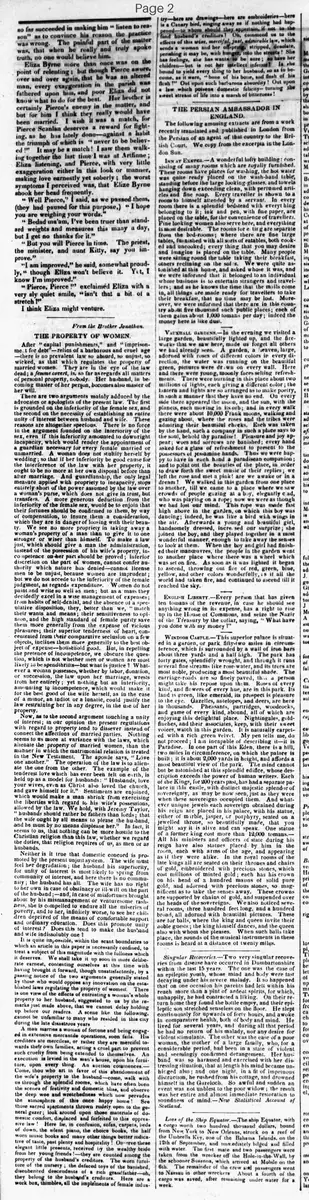
THE PROPERTY OF WOMEN.
After "capital punishments," and "imprisonment for debt" -relics of a barbarous and cruel age -there is no prevalent law so absurd, so unjust, so wicked, as that which regulates the property of married women. They are in the eye of the law dead; a feme covert, is, so far as regards all matters of personal property, nobody. Her husband, in becoming master of her person, becomes also master of her will. There are two arguments mainly adduced by the advocates or apologists of the present law. The first is grounded on the inferiority of the female sex, and the second on the necessity of establishing an entire unity of interest between husband and wife. These reasons are altogether specious. There is no force in the argument founded on the inferiority of the sex, even if this inferiority amounted to downright incapacity, which would render the appointment of a guardian necessary for every female married or unmarried. A woman does not stultify herself by wedding; so that if her inferiority be good cause for the interference of the law with her property, it ought to be no more at her own disposal before than after marriage. And guardianship, the only legal measure applied with propriety to incapacity, stops entirely short of the power assumed by the law over a woman's purse, which does not give in trust, but transfers. A more generous deduction from the inferiority of the female sex, would be to enjoin that their fortunes should be confirmed to them, by way of compensation, to insure them a consideration, which they are in danger of losing with their beauty. We see no more propriety in taking away a woman's property of a man than to give it to one stronger or wiser than himself. To make a law just, which should give a man the administration, instead of the possession of his wife's property, incompetence on her part should be proved; inferior discretion on the part of women, cannot confer authority which nature has denied cannot license men to be unjust, because women are imprudent; but we do not accede to the inferiority of the female judgment, as regards expenditure. Women do not paint and write so well as men; but as a mass they decidedly excel in a wise management of expenses; from habits of self-denial, and the absence of a speculative disposition, they, better than we, "match their wants and means; their sensitiveness to opinion, and the high standard of female purity save them more generally from the expense of vicious pleasures; their superior tenderness of heart, concentrated from their comparative seclusion on a few objects, inclines them more generally to the best object of expense--household good. But, in repelling the pretence of incompetence, we obscure the question, which is not whether men or women are most likely to be spendthrifts-but what is justice? Whatever a woman possesses, whether by labor, donation, or succession, the law upon her marriage, wrests from her entirely; yet nothing but an inferiority amounting to incompetence, which would make it for the best good of the wife herself, as in the case of a minor, an idiot or a lunatic, could justify the law restraining her in any degree, in the use of her property.
Now, as to the second argument touching a unity of interest; in our opinion the present regulations with regard to property tend to dissever instead of connect the affections of married parties. Nothing seems to us more at variance with the laws, which alienate the property of married women, than the manner in which the matrimonial relation is treated in the New Testament. The apostle says, "Love one another." The operation of the law is to alienate the one from the other. The example of the tenderest love which has ever been felt on earth, is held up as a model for husbands: "Husbands, love your wives, even as Christ also loved the church, and gave himself for it." Sentiments are enjoined which would make a man shrink from exercising the liberties with regard to his wife's possessions, allowed by the law. We hold, with Jeremy Taylor, "husbands should rather be fathers than lords; that the wife ought by all means to please the husband, and he must by no means displease her." In fact, it seems to us, that nothing can be more hostile to the Christian religion than this law, whether we regard the duties, that religion requires of us, as men or as husbands. Neither is it true that domestic concord is promoted by the present unjust system. The wife must feel her degradation; the husband his superiority, for unity of interest is most likely to spring from community of interest, and here there is no community; the husband has all. The wife has no right to her own in case of obstinacy or ill-will on the part of the husband;-and, in case of misfortunes brought about by his mismanagement or venturesome rashness, she is compelled to endure all the miseries of poverty, and to her, infinitely worse, to see her children deprived of the means of comfortable support and ordinary education. Does this promote unity of interest? Does this tend to make the husband and wife indissolubly one?
It is quite impossible, within the scant boundaries to which an article in this paper is necessarily confined, to treat a subject of this magnitude with the fullness which it deserves. We shall take it up soon in more deliberate earnest, contenting ourselves at this time with having brought it forward, though unsatisfactorily, by a passing notice of the two arguments generally stated by those who would oppose any innovation on the established laws regulating the property of women. There is one view of the effects of entrusting a woman's whole property to her husband, suggested to us by the remarks just made above, that we cannot delay holding up before our readers. A scene like the following, cannot be unfamiliar to many who resided in this city during the late disastrous years.
A man marries a woman of fortune and being engaged in extensive mercantile operations, soon fails. His creditors are merciless, or rather they are merciful towards their own families, acting a cruel part to prevent such cruelty from being extended to themselves. An execution is levied in the man's house, upon his furniture, upon every thing. An auction commences.—Come, thou who art in favor of this abandonment of the wife's property to the husband—come, walk with us through the splendid rooms, which have often been the scenes of festivity and domestic bliss, and observe the deep woe and wretchedness which now pervades the atmosphere of this once happy home! See those sacred apartments thrown rudely open to the general gazer; look around upon those materials of domestic comfort, displaced and forfeited to this oppressive law! Here lie, in confusion, sofas, carpets, beds of down, the silent piano, the choice books, the half worn music books and many other things better indicative of taste, past plenty and hospitality! Observe these elegant little presents, received by the wealthy bride from her young friends!-they are counted among the property of the husband's creditors. The worn furniture of the nursery; the defaced toys of the banished, disinherited descendants of a rich grandfather—oh, they belong to the husband's creditors. Here are sewing implements, work box, thimbles, all the implements of female industry—here are drawings—here are embroideries—here are opened letters—to whom should they appertain, if not to the innocent Canary bird, singing away as if nothing had happened——to the fond husband's creditors! Oh, commend us to the effects of this wise, merciful, just, admirable law, which sends a woman and her offspring, stripped, desolate, perishing it may be, with hunger, into the streets! She has feelings. she has wants to be sure; so have her children—but is not her intellect inferior? Is she not, come, on it were, "bone of his bone, and flesh of his flesh!" Out upon such barbarous absurdity! Out upon law which poisons domestic felicity-- turning the sweet stream of life into a marsh of bitterness!
After "capital punishments," and "imprisonment for debt" -relics of a barbarous and cruel age -there is no prevalent law so absurd, so unjust, so wicked, as that which regulates the property of married women. They are in the eye of the law dead; a feme covert, is, so far as regards all matters of personal property, nobody. Her husband, in becoming master of her person, becomes also master of her will. There are two arguments mainly adduced by the advocates or apologists of the present law. The first is grounded on the inferiority of the female sex, and the second on the necessity of establishing an entire unity of interest between husband and wife. These reasons are altogether specious. There is no force in the argument founded on the inferiority of the sex, even if this inferiority amounted to downright incapacity, which would render the appointment of a guardian necessary for every female married or unmarried. A woman does not stultify herself by wedding; so that if her inferiority be good cause for the interference of the law with her property, it ought to be no more at her own disposal before than after marriage. And guardianship, the only legal measure applied with propriety to incapacity, stops entirely short of the power assumed by the law over a woman's purse, which does not give in trust, but transfers. A more generous deduction from the inferiority of the female sex, would be to enjoin that their fortunes should be confirmed to them, by way of compensation, to insure them a consideration, which they are in danger of losing with their beauty. We see no more propriety in taking away a woman's property of a man than to give it to one stronger or wiser than himself. To make a law just, which should give a man the administration, instead of the possession of his wife's property, incompetence on her part should be proved; inferior discretion on the part of women, cannot confer authority which nature has denied cannot license men to be unjust, because women are imprudent; but we do not accede to the inferiority of the female judgment, as regards expenditure. Women do not paint and write so well as men; but as a mass they decidedly excel in a wise management of expenses; from habits of self-denial, and the absence of a speculative disposition, they, better than we, "match their wants and means; their sensitiveness to opinion, and the high standard of female purity save them more generally from the expense of vicious pleasures; their superior tenderness of heart, concentrated from their comparative seclusion on a few objects, inclines them more generally to the best object of expense--household good. But, in repelling the pretence of incompetence, we obscure the question, which is not whether men or women are most likely to be spendthrifts-but what is justice? Whatever a woman possesses, whether by labor, donation, or succession, the law upon her marriage, wrests from her entirely; yet nothing but an inferiority amounting to incompetence, which would make it for the best good of the wife herself, as in the case of a minor, an idiot or a lunatic, could justify the law restraining her in any degree, in the use of her property.
Now, as to the second argument touching a unity of interest; in our opinion the present regulations with regard to property tend to dissever instead of connect the affections of married parties. Nothing seems to us more at variance with the laws, which alienate the property of married women, than the manner in which the matrimonial relation is treated in the New Testament. The apostle says, "Love one another." The operation of the law is to alienate the one from the other. The example of the tenderest love which has ever been felt on earth, is held up as a model for husbands: "Husbands, love your wives, even as Christ also loved the church, and gave himself for it." Sentiments are enjoined which would make a man shrink from exercising the liberties with regard to his wife's possessions, allowed by the law. We hold, with Jeremy Taylor, "husbands should rather be fathers than lords; that the wife ought by all means to please the husband, and he must by no means displease her." In fact, it seems to us, that nothing can be more hostile to the Christian religion than this law, whether we regard the duties, that religion requires of us, as men or as husbands. Neither is it true that domestic concord is promoted by the present unjust system. The wife must feel her degradation; the husband his superiority, for unity of interest is most likely to spring from community of interest, and here there is no community; the husband has all. The wife has no right to her own in case of obstinacy or ill-will on the part of the husband;-and, in case of misfortunes brought about by his mismanagement or venturesome rashness, she is compelled to endure all the miseries of poverty, and to her, infinitely worse, to see her children deprived of the means of comfortable support and ordinary education. Does this promote unity of interest? Does this tend to make the husband and wife indissolubly one?
It is quite impossible, within the scant boundaries to which an article in this paper is necessarily confined, to treat a subject of this magnitude with the fullness which it deserves. We shall take it up soon in more deliberate earnest, contenting ourselves at this time with having brought it forward, though unsatisfactorily, by a passing notice of the two arguments generally stated by those who would oppose any innovation on the established laws regulating the property of women. There is one view of the effects of entrusting a woman's whole property to her husband, suggested to us by the remarks just made above, that we cannot delay holding up before our readers. A scene like the following, cannot be unfamiliar to many who resided in this city during the late disastrous years.
A man marries a woman of fortune and being engaged in extensive mercantile operations, soon fails. His creditors are merciless, or rather they are merciful towards their own families, acting a cruel part to prevent such cruelty from being extended to themselves. An execution is levied in the man's house, upon his furniture, upon every thing. An auction commences.—Come, thou who art in favor of this abandonment of the wife's property to the husband—come, walk with us through the splendid rooms, which have often been the scenes of festivity and domestic bliss, and observe the deep woe and wretchedness which now pervades the atmosphere of this once happy home! See those sacred apartments thrown rudely open to the general gazer; look around upon those materials of domestic comfort, displaced and forfeited to this oppressive law! Here lie, in confusion, sofas, carpets, beds of down, the silent piano, the choice books, the half worn music books and many other things better indicative of taste, past plenty and hospitality! Observe these elegant little presents, received by the wealthy bride from her young friends!-they are counted among the property of the husband's creditors. The worn furniture of the nursery; the defaced toys of the banished, disinherited descendants of a rich grandfather—oh, they belong to the husband's creditors. Here are sewing implements, work box, thimbles, all the implements of female industry—here are drawings—here are embroideries—here are opened letters—to whom should they appertain, if not to the innocent Canary bird, singing away as if nothing had happened——to the fond husband's creditors! Oh, commend us to the effects of this wise, merciful, just, admirable law, which sends a woman and her offspring, stripped, desolate, perishing it may be, with hunger, into the streets! She has feelings. she has wants to be sure; so have her children—but is not her intellect inferior? Is she not, come, on it were, "bone of his bone, and flesh of his flesh!" Out upon such barbarous absurdity! Out upon law which poisons domestic felicity-- turning the sweet stream of life into a marsh of bitterness!
What sub-type of article is it?
Feminism
Legal Reform
Moral Or Religious
What keywords are associated?
Married Women Property
Women's Rights
Legal Injustice
Female Inferiority
Unity Of Interest
Christian Marriage
Domestic Concord
What entities or persons were involved?
Husbands
Wives
Jeremy Taylor
New Testament
Christ
The Apostle
Editorial Details
Primary Topic
Opposition To Laws Regulating Married Women's Property
Stance / Tone
Strongly Critical Of Unjust Laws Denying Women Property Rights, Advocating Reform With Moral And Religious Arguments
Key Figures
Husbands
Wives
Jeremy Taylor
New Testament
Christ
The Apostle
Key Arguments
Laws Treating Married Women As Legally Dead Regarding Property Are Absurd And Unjust
Argument Of Female Inferiority Does Not Justify Transferring Property To Husbands Without Proof Of Incompetence
Women Often Manage Expenses Wisely Due To Self Denial And Moral Habits
Unity Of Interest Argument Fails As Laws Alienate Spouses Rather Than Unite Them
Current Laws Contradict Christian Teachings On Love And Mutual Respect In Marriage
Laws Promote Discord By Degrading Wives And Exposing Families To Poverty From Husband's Mismanagement
Vivid Example Of Family Ruin Through Auction Of Possessions After Husband's Failure