Thank you for visiting SNEWPapers!
Sign up free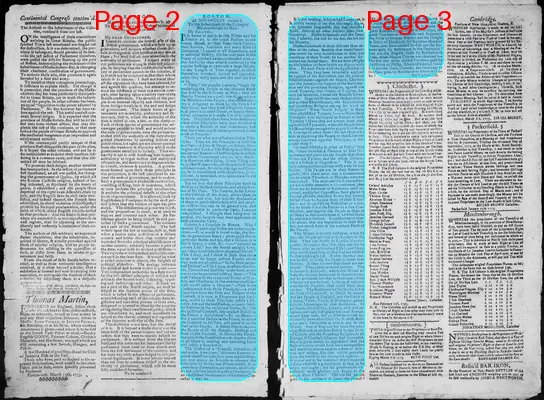
The New Hampshire Gazette And Historical Chronicle
Portsmouth, Greenland, Rockingham County, New Hampshire
What is this article about?
Novanglus defends revolution principles of natural equality, popular sovereignty, and right to resist oppression, critiquing Massachusettensis and others for opposing them. Argues these principles support historical gains in liberty against tyrants like Charles I, and underpin the current government.
Merged-components note: Continuation of the Novanglus editorial series; text flows directly from the end of the first to the start of the second. Relabeled from 'letter_to_editor' to 'editorial' as it fits the definition of opinion pieces in a partisan debate.
Clippings
1 of 2
OCR Quality
Full Text
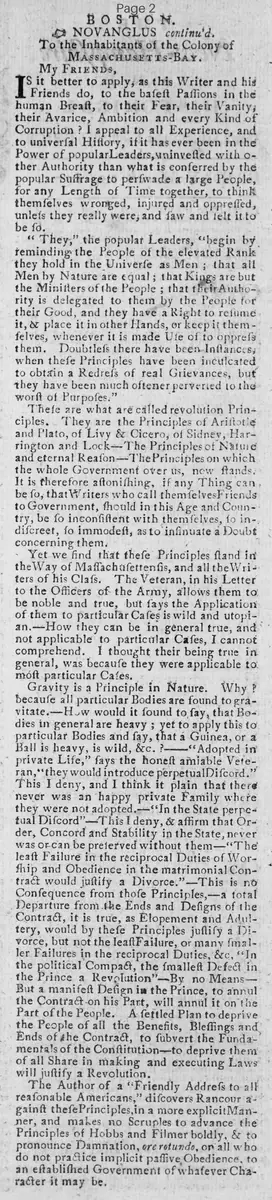
NOVANGLUS continu'd.
To the Inhabitants of the Colony of MASSACHUSETTS-BAY.
My FRIENDS,
Is it better to apply, as this Writer and his Friends do, to the basest Passions in the human Breast, to their Fear, their Vanity; their Avarice, Ambition and every Kind of Corruption? I appeal to all Experience, and to universal History, if it has ever been in the Power of popular Leaders, uninvested with O- Ther Authority than what is conferred by the popular Suffrage to persuade a large People, for any Length of Time together, to think themselves wronged, injured and oppressed, unless they really were, and saw and felt it to be so.
"They," the popular Leaders, "begin by reminding the People of the elevated Rank they hold in the Universe as Men; that all Men by Nature are equal; that Kings are but the Ministers of the People: that their Authority is delegated to them by the People for their Good, and they have a Right to resume it, & place it in other Hands, or keep it them- selves, whenever it is made Use of to oppress them. Doubtless there have been Instances; when these Principles have been inculcated to obtain a Redress of real Grievances, but they have been much oftener perverted to the worst of Purposes."
These are what are called revolution Prin- ciples. They are the Principles of Aristotle and Plato, of Livy & Cicero, of Sidney, Har- rington and Lock--The Principles of Nature and eternal Reason--The Principles on which the whole Government over us, now stands. It is therefore astonishing, if any Thing can be so, that Writers who call themselves Friends to Government, should in this Age and Coun- try, be so inconsistent with themselves, so in- discreet, so immodest, as to insinuate a Doubt concerning them.
Yet we find that these Principles stand in the Way of Massachusettensis, and all the Wri- ters of his Class. The Veteran, in his Letter to the Officers of the Army, allows them to be noble and true, but says the Application of them to particular Cases is wild and utopi- an.--How they can be in general true, and not applicable to particular Cases, I cannot comprehend. I thought their being true in general, was because they were applicable to most particular Cases.
Gravity is a Principle in Nature. Why? because all particular Bodies are found to gra- vitate.--How would it sound to say, that Bo- dies in general are heavy; yet to apply this to particular Bodies and say, that a Guinea, or a Ball is heavy, is wild, &c.?--"Adopted in private Life," says the honest amiable Vete- ran, "they would introduce perpetual Discord." This I deny, and I think it plain that there never was a happy private Family where they were not adopted.--In the State perpe- tual Discord. This I deny, & affirm that Or- der, Concord and Stability in the State, never was or can be preserved without them--"The least Failure in the reciprocal Duties of Wor- ship and Obedience in the matrimonial Con- Tract would justify a Divorce."--This is no Consequence from those Principles,--a total Departure from the Ends and Designs of the Contract, it is true, as Elopement and Adul- tery, would by these Principles justify a Di- vorce, but not the least Failure, or many small- er Failures in the reciprocal Duties, &c. "In the political Compact, the smallest Defect in the Prince a Revolution" By no Means-- But a manifest Design in the Prince, to annul the Contract--on his Part, will annul it on the Part of the People. A settled Plan to deprive the People of all the Benefits, Blessings and Ends of the Contract, to subvert the Funda- mentals of the Constitution--to deprive them of all Share in making and executing Laws will justify a Revolution.
The Author of a "Friendly Address to all reasonable Americans," discovers Rancour a- gainst these Principles, in a more explicit Man- ner, and makes no Scruples to advance the Principles of Hobbes and Filmer boldly, & to pronounce Damnation, ore rotundo, on all who do not practice implicit passive Obedience, to an established Government of whatever Cha- racter it may be.
It is not reviling, it is not bad Language, it is strictly decent to say that this angry Bigot, this ignorant Dogmatist, this foul-mouthed Scold, deserves no other Answer than silent Contempt. Massachusetts and the Veteran, I admire, the first for his Art, the last for his Honesty.
Massachusetts is more discreet than either of the others. Sensible that these Principles would be very troublesome to him, yet conscious of their Truth, he has neither admitted nor denied them: But we have a Right to his Opinion of them before we dispute with him. He finds Fault with the Application of them. They have been invariably applied in support of the Revolution and the present Establishment—against the Stuarts, Charles's and the James's—in Support of the Reformation and the protestant Religion, against the worst Tyranny, that Genius of Toryism, has ever yet invented, I mean the Romish Superstition. Does this Writer rank the Revolution and present Establishment: the Reformation and protestant Religion among his worst of Purposes? What "worse Purpose" is there than established Tyranny?—Were these Principles ever inculcated in Favour of such Tyranny? Have they not always been used against such Tyrannies, when the People have had Knowledge enough to be appriz'd of them; & Courage to assert them? Do not those who aim at depriving the People of their Liberties always inculcate opposite Principles, or discredit these?
"A small Mistake in point of Policy" says he, "often furnishes a Pretence to libel Government and persuade the People that their Rulers are Tyrants, and the whole Government a System of Oppression." This is not only untrue, but inconsistent with what he said before. The People are in their Nature so gentle, that there never was a Government yet in which Thousands of Mistakes were not overlooked. The most sensible & jealous People are so little attentive to Government, that there are no Instances of Resistance until repeated, multiplied Oppressions have placed it beyond a Doubt, that their Rulers had formed settled Plans to deprive them of their Liberties; not to oppress an Individual or a few, but to break down the Fences of a free Constitution, and deprive the People at large of all Share in the Government & all the Checks by which it is limited: Even Machiavel himself allows, that not Ingratitude to their Rulers, but much Love is the constant Fault of the People.
This Writer is equally mistaken, when he says, the People are sure to be Losers in the End. They can hardly be Losers if unsuccessful: because if they live, they can but be Slaves, after an unfortunate Effort, and Slaves they would have been if they had not resisted. So that nothing is lost. If they die they cannot be said to loose, for Death is better than Slavery. If they succeed their Gains are immense. They preserve their Liberties. The Instances in Antiquity, which this Writer alludes to, are not mentioned. & therefore cannot be answered, but that in the Country from whence we are derived, is the most unfortunate for his Purpose: that could have been chosen. The Resistance to Charles the first & the Case of Cromwell, no Doubt he means. But the People of England, and the Cause of Liberty, Truth, Virtue, & Humanity, gained infinite Advantages by that Resistance. In all human Probability, Liberty, civil and religious, not only in England but in all Europe, would have been lost.— Charles would undoubtedly have established the Romish Religion and a Despotism as wild as any in the World. And as England has been the principal Bulwark from that Period to this of civil Liberty and the Protestant Religion in all Europe, if Charles's schemes had succeeded, there is great reason to apprehend that the light of science would have been extinguished and mankind drawn back to a state of darkness and misery, like that which prevailed from the fourth to the fourteenth century.—
It is true and to be lamented that Cromwell did not establish a government as free, as he might and ought; but his government was infinitely more glorious and happy to the people than Charles's. Did not the people gain by the resistance to James the second?
Did not the Romans gain by resistance to Tarquin? Without that Resistance and the Liberty that was restored by it, would the great Roman Orators, Poets & Historians, the great Teachers of Humanity and Politeness; the Pride of Human Nature, and the Delight & Glory of Mankind, for seventeen Hundred Years, ever have existed?—Did not the Romans gain by Resistance to the Decemvirs? Did not the English Gain by Resistance to John, when Magna Charta was obtained?— Did not the seven united Provinces gain by Resistance to Philip, Alva and Granville?— Did not the Swiss Cantons, the Genevans & Grisons; gain by Resistance to Albert & Griffler?
NOVANGLUS:
What sub-type of article is it?
What keywords are associated?
What entities or persons were involved?
Editorial Details
Primary Topic
Defense Of Revolution Principles And Right To Resist Tyranny
Stance / Tone
Strongly Supportive Of Popular Sovereignty And Anti Tyranny
Key Figures
Key Arguments