Thank you for visiting SNEWPapers!
Sign up free
The New Hampshire Gazette
Portsmouth, Rockingham County, New Hampshire
What is this article about?
A writer signing as 'A Republican' defends a Portsmouth citizen's account of a town meeting disapproving Jay's Treaty against criticisms by 'Bradshaw.' He refutes claims on the treaty's publication, meeting legality, address timing, and motives, attributing delays to uncertainty over the President's decision and possible personal malice.
Merged-components note: This is a single long letter responding to 'Bradshaw', split across components.
Clippings
1 of 2
OCR Quality
Full Text
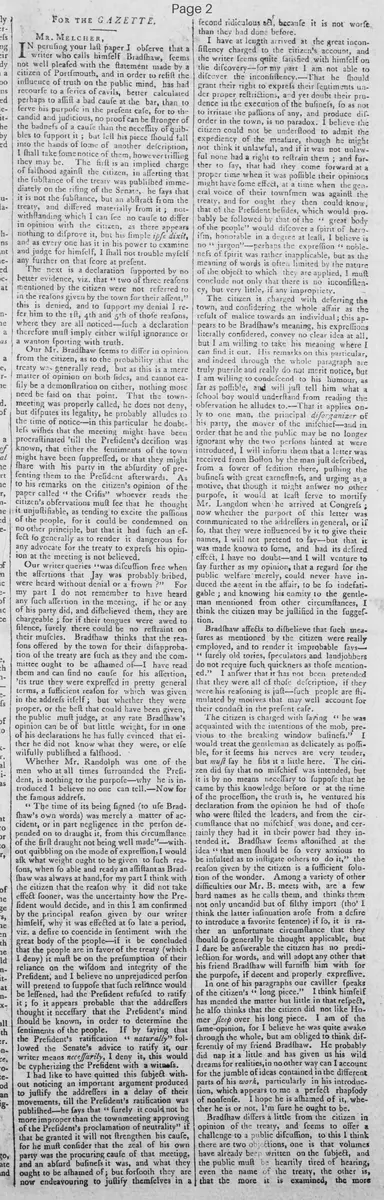
MR. MELCHER,
IN perusing your last paper I observe that a writer who calls himself Bradshaw, seems not well pleased with the statement made by a citizen of Portsmouth, and in order to resist the influence of truth on the public mind, has had recourse to a series of cavils, better calculated perhaps to assist a bad cause at the bar, than to serve his purpose in the present case, for to the candid and judicious, no proof can be stronger of the badness of a cause than the necessity of quibbles to support it; but lest his piece should fall into the hands of some of another description, I shall take some notice of them, however trifling they may be. The first is an implied charge of falsehood against the citizen, in asserting that the substance of the treaty was published immediately on the rising of the Senate, he says that it is not the substance, but an abstract from the treaty, and differed materially from it; notwithstanding which I can see no cause to differ in opinion with the citizen, as there appears nothing to disprove it, but his simple ipse dixit, and as every one has it in his power to examine and judge for himself, I shall not trouble myself any further on that score at present.
The next is a declaration supported by no better evidence, viz. that 'two of three reasons mentioned by the citizen were not referred to in the reasons given by the town for their assent,' this is denied, and to support my denial I refer him to the 1st, 4th and 5th of those reasons, where they are all noticed—such a declaration therefore must imply either wilful ignorance or a wanton sporting with truth.
Our Mr. Bradshaw seems to differ in opinion from the citizen, as to the probability that the treaty was generally read, but as this is a mere matter of opinion on both sides, and cannot easily be a demonstration on either, nothing more need be said on that point. That the town-meeting was properly called, he does not deny, but disputes its legality, he probably alludes to the time of notice—in this particular he doubtless wishes that the meeting might have been procrastinated 'till the President's decision was known, that either the sentiments of the town might have been suppressed, or that they might share with his party in the absurdity of presenting them to the President afterwards. As to his remarks on the citizen's opinion of the paper called 'the Crisis' whoever reads the citizen's observations must see that he thought it unjustifiable, as tending to excite the passions of the people, for it could be condemned on no other principle. but that it had such an effect so generally as to render it dangerous for any advocate for the treaty to express his opinion at the meeting is not believed.
Our writer queries 'was discussion free when the assertions that Jay was probably bribed, were heard without denial or a frown?' For my part I do not remember to have heard any such assertion in the meeting, if he or any of his party did, and disbelieved them, they are chargeable; for if their tongues were awed to silence, surely there could be no restraint on their muscles. Bradshaw thinks that the reasons offered by the town for their disapprobation of the treaty are such as they and the committee ought to be ashamed of—I have read them and can find no cause for his assertion, 'tis true they were expressed in pretty general terms, a sufficient reason for which was given in the address itself; but whether they were proper, or the best that could have been given, the public must judge, at any rate Bradshaw's opinion can be of but little weight, for in one of his declarations he has fully evinced that either he did not know what they were, or else wilfully published a falsehood.
Whether Mr. Randolph was one of the men who at all times surrounded the President, is nothing to the purpose—why he is introduced I believe no one can tell. Now for the famous address.
'The time of its being signed (to use Bradshaw's own words) was merely a matter of accident, or in part negligence in the person depended on to draught it, from this circumstance of the first draught not being well made'—without quibbling on the mode of expression, I would ask what weight ought to be given to such reasons, when so able and ready an assistant as Bradshaw was always at hand, for my part I think with the citizen that the reason why it did not take effect sooner, was the uncertainty how the President would decide, and in this I am confirmed by the principal reason given by our writer himself, why it was effected at so late a period, viz. a desire to coincide in sentiment with the great body of the people—if it be concluded that the people are in favor of the treaty (which I deny) it must be on the presumption of their reliance on the wisdom and integrity of the President, and I believe no unprejudiced person will pretend to suppose that such reliance would be lessened, had the President refused to ratify it; so it appears probable that the addressers thought it necessary that the President's mind should be known, in order to determine the sentiments of the people. If by saying that the President's ratification 'naturally' followed the Senate's advice to ratify it, our writer means necessarily, I deny it, this would be cipherizing the President with a witness.
I had like to have quitted this subject without noticing an important argument produced to justify the addressers in a delay of their movements, till the President's ratification was published—he says that 'surely it could not be more improper than the townmeeting approving of the President's proclamation of neutrality' if that be granted it will not strengthen his cause, for he must consider that the zeal of his own party was the procuring cause of that meeting, and an absurd business it was, and what they ought to be ashamed of; but forsooth they are now endeavouring to justify themselves in a second ridiculous act, because it is not worse than they had done before.
I have at length arrived at the great inconsistency charged to the citizen's account, and the writer seems quite satisfied with himself on the discovery—for my part I am not able to discover the inconsistency.—That he should grant their right to express their sentiments under proper restrictions, and yet doubt their prudence in the execution of the business, so as not to irritate the passions of any, and produce disorder in the town, is no paradox. I believe the citizen could not be understood to admit the expediency of the measure, though he might not think it unlawful, and if it was not unlawful none had a right to restrain them; and further to say, that had they come forward at a proper time when it was possible their opinions might have some effect, at a time when the general voice of their townsmen was against the treaty, and for ought they then could know, that of the President besides, which would probably be followed by that of the 'great body of the people' would discover a spirit of heroism, honorable in a degree at least, I believe is no 'jargon'—perhaps the expression 'nobleness of spirit was rather inapplicable, but as the meaning of words is often limited by the nature of the object to which they are applied, I must conclude not only that there is no inconsistency, but very little, if any impropriety.
The citizen is charged with deserting the town, and considering the whole affair as the result of malice towards an individual; this appears to be Bradshaw's meaning, his expressions literally considered, convey no clear idea at all, but I am willing to take his meaning where I can find it out. His remarks on this particular, and indeed through the whole paragraph are truly puerile and really do not merit notice, but I am willing to condescend to his humour, as far as possible, and will just tell him what a school boy would understand from reading the observation he alludes to.—That it applies only to one man, the principal disorganizer of his party, the mover of the mischief—and in order that he and the public may be no longer ignorant why the two persons hinted at were introduced, I will inform them that a letter was received from Boston by the man just described, from a sower of sedition there, pushing the business with great earnestness, and urging as a motive, that though it might answer no other purpose, it would at least serve to mortify Mr. Langdon when he arrived at Congress; now whether the purport of this letter was communicated to the addressers in general, or if so, that they were influenced by it to give their names, I will not pretend to say—but that it was made known to some. and had its desired effect, I have no doubt—and I will venture to say further as my opinion, that a regard for the public welfare merely, could never have induced the agent in the affair, to be so indefatigable; and knowing his enmity to the gentleman mentioned from other circumstances, I think the citizen may be justified in the suggestion.
Bradshaw affects to disbelieve that such measures as mentioned by the citizen were really employed, and to render it improbable says—'surely old tories, speculators and landjobbers do not require such quickness as those mentioned.' I answer that it has not been pretended that they were all of those description, if they were his reasoning is just—such people are stimulated by motives that may well account for their conduct in the present case.
The citizen is charged with saying 'he was acquainted with the intentions of the mob, previous to the breaking window business.' I would treat the gentleman as delicately as possible, for it seems his nerves are very tender, but must say he fibs it a little here. The citizen did say that no mischief was intended, but it is by no means necessary to suppose that he came by this knowledge before or at the time of the procession, the truth is, he ventured his declaration from the opinion he had of those who were styled the leaders, and from the circumstance that no mischief was done, and certainly they had it in their power had they intended it. Bradshaw seems astonished at the idea 'that men should be so very anxious to be insulted as to instigate others to do it,' the reason given by the citizen is a sufficient solution of the wonder. Among a variety of other difficulties our Mr. B. meets with, are a few hard names as he calls them, and thinks them not only uncandid but of filthy import (tho' I think the latter insinuation arose from a desire to introduce a favorite sentence) if so, it is rather an unfortunate circumstance that they should so generally be thought applicable, but I dare be answerable the citizen has no predilection for words, and will adopt any other that his friend Bradshaw will furnish him with for the purpose, if decent and properly expressive.
In one of his paragraphs our caviller speaks of the citizen's 'long piece.' I think himself has mended the matter but little in that respect, he also thinks that the citizen did not like Homer sleep over his long piece. I am of the same opinion, for I believe he was quite awake through the whole, but am obliged to think differently of my friend Bradshaw. He probably did nap it a little and has given us his wild dreams for realities, in no other way can I account for the jumble of ideas contained in the different parts of his work, particularly in his introduction, which appears to me a perfect rhapsody of nonsense. I hope he is ashamed of it, whether he is or not, I'm sure he ought to be.
Bradshaw differs a little from the citizen in opinion of the treaty, and seems to offer a challenge to a public discussion, to this I think there are two objections, one is that volumes have already been written on the subject, and the public must be heartily tired of hearing, even the name of the treaty, the other is that the more it is examined, the more
the cloven foot will appear, and if it must become the law of the land, it is best the people should think as favorably of it as possible. But if Mr. B. is very desirous of displaying his talents on the occasion, and will convince me that the public good can be promoted by it, I'll engage he shall be answered, provided that instead of reasoning, he will not impose on the public any more of his quibbles. I observe a note at foot of Bradshaw's performance that seems to look a little like a threat to those who differ from him in sentiment, I am one of them, and am not an advocate for abuse, but shall take the liberty to speak what I think to be truth, when necessary, fearless of consequences. Thus have I followed Bradshaw to the end of a very laborious, indigested and truly farcical performance, but before I quit, will just observe that, is he a friend to good government, so am I: is he a friend to the constitution of the United States, and determined to support it, so am I: and would therefore guard equally against the insidious machinations of the ambitious aristocrat on the one hand, and the violence of the licentious democrat on the other.
A REPUBLICAN.
What sub-type of article is it?
What themes does it cover?
What keywords are associated?
What entities or persons were involved?
Letter to Editor Details
Author
A Republican
Recipient
Mr. Melcher
Main Argument
the letter refutes bradshaw's criticisms of a portsmouth citizen's account regarding the town's disapproval of jay's treaty, defending the meeting's legality, the address's timing due to uncertainty over the president's decision, and suggesting motives of personal malice rather than public welfare.
Notable Details