Thank you for visiting SNEWPapers!
Sign up free
Gazette Of The United States And Daily Evening Advertiser
Philadelphia, Philadelphia County, Pennsylvania
What is this article about?
Final proceedings of the U.S. House of Representatives: debate and passage of bill authorizing President to acquire Georgia lands (41-24); agreements on appropriations, mint act, and other bills; Mr. Dexter's resolution on revising severe criminal punishments; adjournment sine die with unanimous thanks to Speaker Muhlenberg.
Clipping
OCR Quality
Full Text
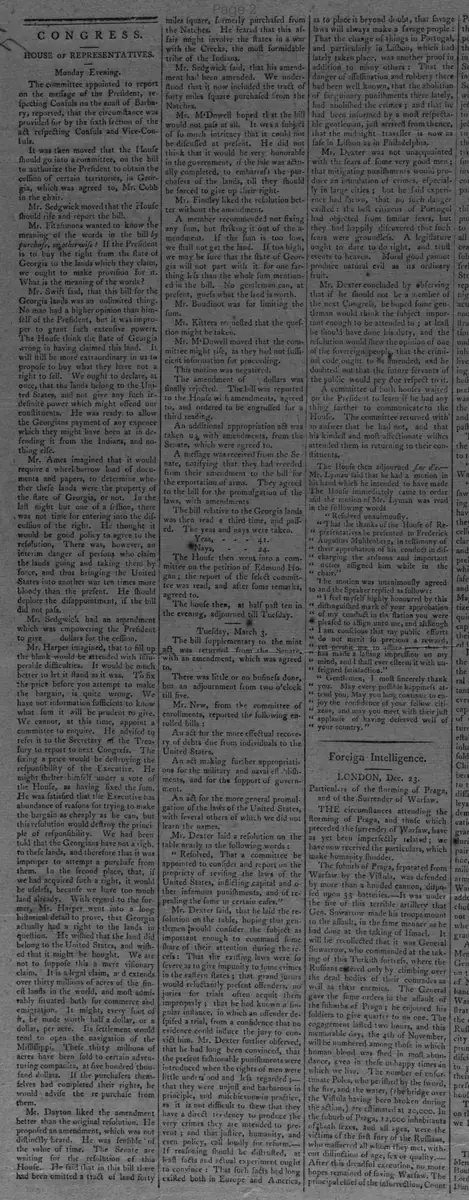
HOUSE OF REPRESENTATIVES.
Monday Evening.
The committee appointed to report on the message of the President, respecting Consuls on the coast of Barbary, reported, that the circumstance was provided for by the sixth section of the act respecting Consuls and Vice-Consuls.
It was then moved that the House should go into a committee, on the bill to authorize the President to obtain the cession of certain territories, in Georgia, which was agreed to, Mr. Cobb in the chair.
Mr. Sedgwick moved that the House should rise and report the bill.
Mr. Fitzsimons wanted to know the meaning of the words in the bill by purchase, or otherwise. If the President is to buy the right from the state of Georgia to the lands which they claim, we ought to make provision for it. What is the meaning of the words?
Mr. Swift said, that this bill for the Georgia lands was an unlimited thing. No man had a higher opinion than himself of the President, but it was improper to grant such extensive powers. The House think the state of Georgia wrong in having claimed this land. It will still be more extraordinary in us to propose to buy what they have not a right to sell. We ought to declare, at once, that the lands belong to the United States, and not give any such indefinite power which might offend our constituents. He was ready to allow the Georgians payment of any expense which they might have been at in defending it from the Indians, and nothing else.
Mr. Ames imagined that it would require a wheel-barrow load of documents and papers, to determine whether these lands were the property of the state of Georgia, or not. In the last night but one of a session, there was not time for entering into the discussion of the right. He thought it would be good policy to agree to the resolution. There was, however, an imminent danger of persons who claim the lands going and taking them by force, and thus bringing the United States into another war ten times more bloody than the present. He should deplore the disappointment, if the bill did not pass.
Mr. Sedgwick had an amendment which was empowering the President to give dollars for the cession.
Mr. Harper imagined, that to fill up the blank would be attended with insuperable difficulties. It would be much better to let it stand as it was. To fix the price before you attempt to make the bargain, is quite wrong. We have not information sufficient to know what sum it will be prudent to give. We cannot, at this time, appoint a committee to enquire. He advised to refer it to the Secretary of the Treasury to report to next Congress. The fixing a price would be destroying the responsibility of the Executive. He might shelter himself under a vote of the House, as having fixed the sum. He was satisfied that this Executive has abundance of reasons for trying to make the bargain as cheaply as he can, but this resolution would destroy the principle of responsibility. We had been told that the Georgians have not a right to these lands, and therefore that it was improper to attempt a purchase from them. In the second place, that, if we had acquired such a right, it would be useless, because we have too much land already. With regard to the former, Mr. Harper went into a long historical detail to prove, that Georgia actually had a right to the lands in question. He wished that the land did belong to the United States, and wished that it might be bought. We are not to suppose this a mere visionary claim. It is a legal claim, and extends over thirty millions of acres of the finest lands in the world, and most admirably situated both for commerce and emigration. It might, every foot of it, be made worth half a dollar, or a dollar, per acre. Its settlement would tend to open the navigation of the Mississippi. These thirty millions of acres have been sold to certain adventuring companies, at five hundred thousand dollars. If the purchasers themselves had completed their rights, he would advise the re-purchase from them.
Mr. Dayton liked the amendment better than the original resolution. He proposed an amendment, which was not distinctly heard. He was sensible of the value of time. The Senate are waiting for the resolution of this House. He said that in this bill there had been omitted a tract of land forty miles square, formerly purchased from the Natchez. He feared that this affair might involve the states in a war with the Creeks, the most formidable tribe of the Indians.
Mr. Sedgwick said, that his amendment had been amended. We understood that it now included the tract of forty miles square purchased from the Natchez.
Mr. McDowell hoped that the bill would not pass at all. It was a subject of so much intricacy that it could not be discussed at present. He did not think that it would be very honorable in the government, if the sale was actually completed, to embarrass the purchasers of the lands, till they should be forced to give up their right.
Mr. Findley liked the resolution better without the amendment.
A member recommended not fixing any sum, but striking it out of the amendment. If the sum is too low, we shall not get the land. If too high, we may be sure that the state of Georgia will not part with it for one farthing less than the whole sum mentioned in the bill. No gentleman can, at present, guess what the land is worth.
Mr. Boudinot was for limiting the sum.
Mr. Kittera requested that the question might be taken.
Mr. McDowell moved that the committee might rise, as they had not sufficient information for proceeding.
This motion was negatived.
The amendment of dollars was finally rejected. The bill was reported to the House with amendments, agreed to, and ordered to be engrossed for a third reading.
An additional appropriation act was taken up with amendments, from the Senate, which were agreed to.
A message was received from the Senate, notifying that they had receded from their amendment to the bill for the exportation of arms. They agreed to the bill for the promulgation of the laws, with amendments.
The bill relative to the Georgia lands was then read a third time, and passed. The yeas and nays were taken.
Yeas, 41.
Nays, 24.
The House then went into a committee on the petition of Edmund Hogan; the report of the select committee was read, and after some remarks, agreed to.
The House then, at half past ten in the evening, adjourned till Tuesday.
Tuesday, March 3.
The bill supplementary to the mint act was returned from the Senate with an amendment, which was agreed to.
There was little or no business done, but an adjournment from two o'clock till five.
Mr. New, from the committee of enrollments, reported the following enrolled bills:
An act for the more effectual recovery of debts due from individuals to the United States.
An act making further appropriations for the military and naval establishments, and for the support of government.
An act for the more general promulgation of the laws of the United States, with several others of which we did not learn the names.
Mr. Dexter laid a resolution on the table nearly in the following words:
"Resolved, That a committee be appointed to consider and report on the propriety of revising the laws of the United States, inflicting capital and other infamous punishments, and of repealing the same in certain cases."
Mr. Dexter said, that he laid the resolution on the table, hoping that gentlemen would consider the subject as important enough to command some share of their attention during the recess: That the existing laws were so severe as to give impunity to some crimes in the eastern states; that grand jurors would reluctantly present offenders, no juries for trials often acquit them improperly; that he had known a singular instance, in which an offender despised a trial, from a confidence that no evidence could induce the jury to convict him. Mr. Dexter further observed, that he had long been convinced, that the present fashionable punishments were introduced when the rights of men were little understood and less regarded; that they were unjust and barbarous in principle, and mischievous in practice, as it is not difficult to show that they have a direct tendency to produce the very crimes they are intended to prevent; and that justice, humanity, and even policy, call loudly for reform.—If reasoning should be distrusted, at least facts and actual experiment ought to convince: That such facts had long existed both in Europe and America, as to place it beyond doubt, that savage laws will always make a savage people: That the change of things in Portugal, and particularly in Lisbon, which had lately taken place, was another proof in addition to many others: That the danger of assassination and robbery there had been well known, that the abolition of sanguinary punishments there lately, had abolished the crimes; and that he had been informed by a most respectable gentleman, just arrived from thence, that the midnight traveller is now as safe in Lisbon as in Philadelphia.
Mr. Dexter was not unacquainted with the fears of some very good men; that mitigating punishments would produce an inundation of crimes, especially in large cities; but he said experience had shown, that no such danger existed: the best citizens of Portugal had objected from similar fears, but they had happily discovered that such fears were groundless. A legislature ought to dare to do right, and trust events to heaven. Moral good cannot produce natural evil as its ordinary fruit.
Mr. Dexter concluded by observing that if he should not be a member of the next Congress, he hoped some gentleman would think the subject important enough to be attended to; at least he should have done his duty, and the resolution would show the opinion of one of the sovereign people, that the criminal code ought to be amended, and he doubted not that the future servants of the public would pay due respect to it.
A committee of both houses waited on the President to learn if he had any thing farther to communicate to the House. The committee returned with an answer that he had not, and that his kindest and most affectionate wishes attended them in returning to their constituents.
The House then adjourned sine die.
Mr. Lyman said that he had a motion in his hand which he intended to have made 'The House immediately came to order and the motion of Mr. Lyman was read in the following words
"Resolved unanimously,
"That the thanks of the House of Representatives be presented to Frederick Augustus Muhlenberg, in testimony of
"their approbation of his conduct in discharging the arduous and important
"duties assigned him while in the
"chair."
The motion was unanimously agreed to and the Speaker replied as follows:
"I feel myself highly honoured by this
"distinguished mark of your approbation
"of my conduct in the station you were
"pleased to assign unto me, and although
". I am conscious that my public efforts
"do not merit so precious a reward,
"yet permit me to assure
"has made a lasting impression on my
"mind, and I shall ever esteem it with un-
"feigned satisfaction."
"Gentlemen, I most sincerely thank
"you. May every possible happiness at-
"tend you, May you long continue to en-
"joy the confidence of your fellow citi-
"zens, and may you meet with their just
"applause of having deserved well of
"your country."
What sub-type of article is it?
What keywords are associated?
What entities or persons were involved?
Domestic News Details
Event Date
Monday Evening And Tuesday, March 3
Key Persons
Outcome
georgia lands bill passed (yeas 41, nays 24); additional appropriation act agreed; bill for exportation of arms and promulgation of laws passed; supplementary mint act agreed; enrolled bills reported; dexter's resolution on revising criminal punishments laid on table; house adjourned sine die; unanimous thanks to speaker muhlenberg.
Event Details
House committee reports on President's message regarding Barbary consuls; debate in committee on bill to authorize President to obtain Georgia territories by purchase or otherwise, with amendments discussed and rejected; bill reported, engrossed, read third time, and passed; Senate messages on various bills agreed; petition of Edmund Hogan considered; on Tuesday, mint act amendment agreed; enrolled bills reported; Dexter proposes resolution to revise capital punishments, citing severity leading to impunity and examples from Portugal; joint committee to President; adjournment; Lyman's motion for thanks to Speaker unanimously agreed.