Thank you for visiting SNEWPapers!
Sign up free
Juniata Sentinel And Republican
Mifflintown, Juniata County, Pennsylvania
What is this article about?
A fire broke out in Chicago on Tuesday, the 14th inst., around 4:30 p.m., in a frame building storing rags near an oil factory on Taylor street between Fourth avenue and Clarke street. It destroyed nearly twenty blocks, including churches, hotels, postoffice, and residences, with total losses estimated at $4,025,000 and net loss after insurance at $2,244,970. The flames were stopped before reaching major business blocks.
Clipping
OCR Quality
Full Text
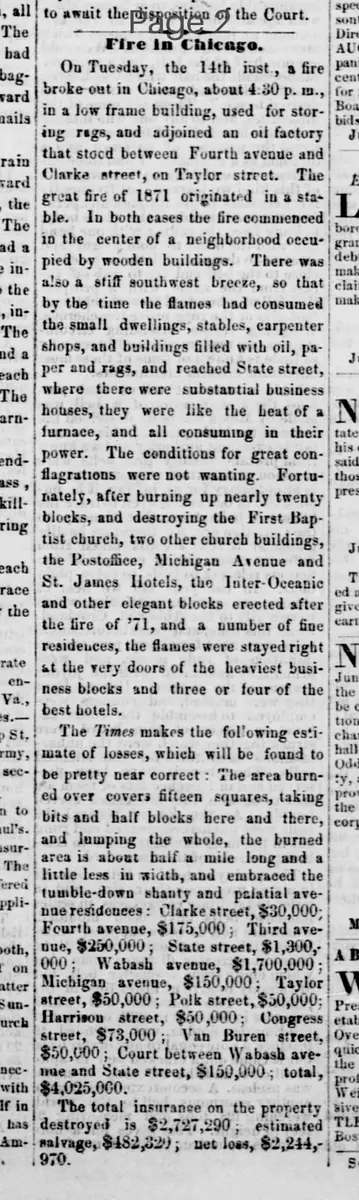
On Tuesday, the 14th inst, a fire broke out in Chicago, about 4:30 p. m., in a low frame building, used for storing rags, and adjoined an oil factory that stood between Fourth avenue and Clarke street, on Taylor street. The great fire of 1871 originated in a stable. In both cases the fire commenced in the center of a neighborhood occupied by wooden buildings. There was also a stiff southwest breeze, so that by the time the flames had consumed the small dwellings, stables, carpenter shops, and buildings filled with oil, paper and rags, and reached State street, where there were substantial business houses, they were like the heat of a furnace, and all consuming in their power. The conditions for great conflagrations were not wanting. Fortunately, after burning up nearly twenty blocks, and destroying the First Baptist church, two other church buildings, the Postoffice, Michigan Avenue and St. James Hotels, the Inter-Oceanic and other elegant blocks erected after the fire of '71, and a number of fine residences, the flames were stayed right at the very doors of the heaviest business blocks and three or four of the best hotels. The Times makes the following estimate of losses, which will be found to be pretty near correct: The area burned over covers fifteen squares, taking bits and half blocks here and there, and lumping the whole, the burned area is about half a mile long and a little less in width, and embraced the tumble-down shanty and palatial avenue residences: Clarke street, $30,000; Fourth avenue, $175,000; Third avenue, $250,000; State street, $1,300,000; Wabash avenue, $1,700,000; Michigan avenue, $150,000; Taylor street, $50,000; Polk street, $50,000; Harrison street, $50,000; Congress street, $73,000; Van Buren street, $50,000; Court between Wabash avenue and State street, $150,000; total, $4,025,000. The total insurance on the property destroyed is $2,727,290; estimated salvage, $482,320; net loss, $2,244,970.
What sub-type of article is it?
What keywords are associated?
Where did it happen?
Domestic News Details
Primary Location
Chicago
Event Date
Tuesday, The 14th Inst
Outcome
no casualties mentioned; destroyed nearly twenty blocks including first baptist church, two other churches, postoffice, michigan avenue and st. james hotels, inter-oceanic and other blocks, fine residences; total loss $4,025,000; insurance $2,727,290; salvage $482,320; net loss $2,244,970; flames stayed at business blocks and hotels.
Event Details
Fire started in a low frame building storing rags adjoining an oil factory between Fourth avenue and Clarke street on Taylor street around 4:30 p.m.; spread due to wooden buildings and southwest breeze; consumed dwellings, stables, shops, oil/paper/rag buildings; reached State street with intense heat; burned fifteen squares, half mile long area including shanties and residences on various streets.