Thank you for visiting SNEWPapers!
Sign up free
Staunton Spectator
Staunton, Virginia
What is this article about?
Speech by Hon. Daniel W. Voorhees of Indiana at Cooper Institute, New York, on October 31, criticizing Radical Congressional reconstruction of the South as betrayal of Union promises, military tyranny, and imposition of negro supremacy, urging Northern voters to reject it for national prosperity and liberty.
Clipping
OCR Quality
Full Text
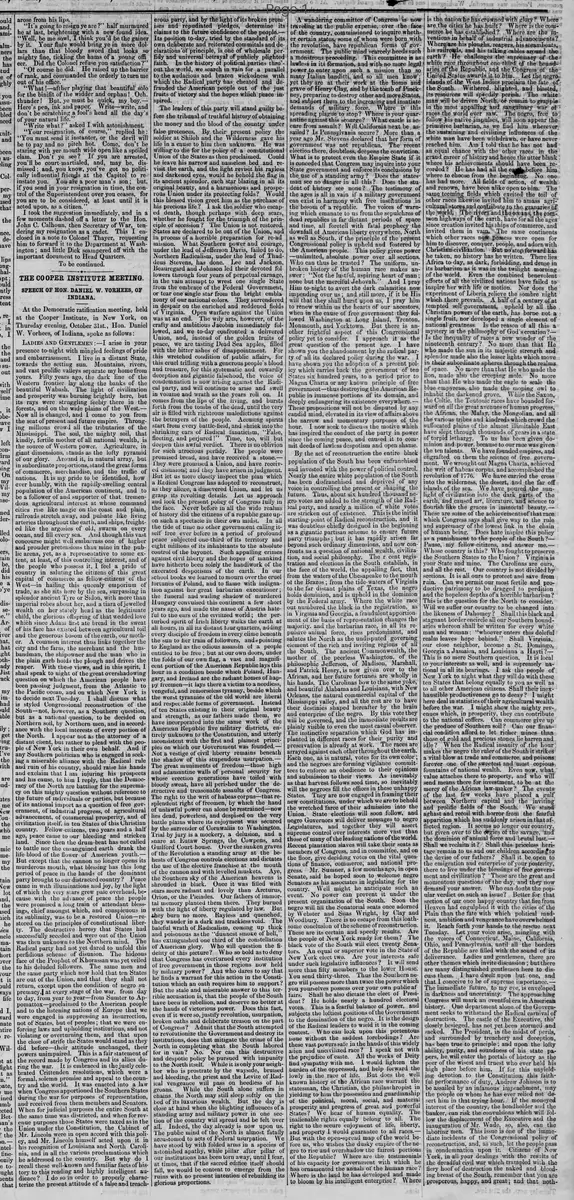
SPEECH OF HON. DANIEL W. VORHEES, OF
INDIANA.
At the Democratic ratification meeting, held
at the Cooper Institute, in New York, on
Thursday evening, October 31st., Hon. Daniel
W. Vorhees, of Indiana, spoke as follows:
LADIES AND GENTLEMEN:—I arise in your
presence to-night with mingled feelings of pride
and embarrassment. I live in a distant State,
towards the setting sun. Mountains, rivers,
and vast prolific valleys separate my home from
yours. Fifty years ago, the dark line of the
Western frontier lay along the banks of the
beautiful Wabash. The light of civilization
and prosperity was burning brightly here, but
its rays were struggling feebly there in the
forests, and on the wide plains of the West.
Now all is changed, and I come to you from
the seat of present and future empire. Thronging
millions crowd all the tributaries of the
Mississippi. The soil, the mighty soil, that
kindly, fertile mother of all national wealth, is
the source of Western power. Agriculture, in
giant dimensions, stands as the lofty pyramid
of our glory. Around it, in natural array, but
in subordinate proportions, stand the great forms
of commerce, merchandise, and the traffic of
nations. It is my pride to be identified, however
humbly, with the rapidly-swelling central population
of the American continent, and to be a follower
of and supporter of that tremendous agricultural
interest at whose command cities rise like magic
on the coast and plain, railroads stretch away,
and pulsate like living arteries throughout the
earth, and ships, freighted like the argosies of
old, swarm on every ocean, and fill every sea.
And though this vast concourse might well embarrass
one of higher and prouder pretensions than
mine in the public arena, yet, as a representative
to some extent, at least, of this controlling interest,
and of the people who possess it, I feel a pride of
country in saluting the citizens of this great capital
of commerce as fellow-citizens of the West—in
hailing this queenly emporium of trade, as she sits
here by the sea, surpassing in splendor ancient Tyre
or Sidon, with more than imperial robes about her,
and a tiara of jewelled wealth on her stately head
as the legitimate child, the glorious offspring of
that wedded love which since Adam first ate bread
in the sweat of his face has existed between agricultural
toil and the generous bosom of the earth, our mother.
A common interest thus links together the city and
the farm, the merchant and the husbandman, the
shipowner and the man who in the plain garb holds
the plough and drives the reaper. With these views,
and in this spirit, I shall speak to night of the great
overshadowing question on which the American people
have been passing judgment, from the Atlantic to
the Pacific ocean, and on which New York is to decide
next Tuesday. I shall discuss what is styled Congressional
reconstruction of the South—not, however, as a
Southern question, but as a national question, to be
decided on Northern soil, by Northern men, and in
accordance with the local interests of every portion of
the North. I appear not as the attorney of a distant
client, but rather to plead with the people of New
York in their own behalf. And if any Southern
politician who is engaged in seeking a miserable alliance
with the Radical rule and ruin of his country, should
raise his hands and exclaim that I am injuring his
prospects and his cause, to him I reply, that the Democracy
of the North are battling for the supremacy on
this mighty question without reference to the future
of individuals or parties, but because of its national
import as a question of free government, of industrial
progress, of agricultural advancement, of commercial
prosperity, and of civilization itself, in ten States of
this Christian country. Fellow-citizens, two years and
a half ago, peace came to our bleeding and stricken
land. Since then the drum-beat has not called to
battle nor the ensanguined earth drank the life-blood
of the flower of American youth. But except that
the cannon no longer opens its murderous mouth,
what blessing has this long period of peace in the
hands of the dominant party brought to our distracted
country? Peace came in with illuminations and joy,
by the light of which the very stars grew pale overhead,
because with the advance of peace the people were
promised a long train of attendant blessings, chief
amongst which, and conspicuous in its sublimity, was
to be a restored Union—restored on the principles of
constitutional liberty. The destructive heresy that
States had successfully seceded and were out of the
Union was then unknown to the Northern mind. The
Radical party had not yet dared to unfold this perfidious
scheme of disunion. The hideous face of the Prophet
of Khorassan was yet veiled to his deluded followers.
The same men and the same party which now hold
that ten States are out of the Union, and that they
shall not return, except upon the condition of negro supremacy,
at every stage of the war, from day to day,
from year to year—from Sumter to Appomattox—proclaimed
to the American people and to the listening
nations of Europe that we were engaged in suppressing
an insurrection, not of States, but of peoples; that
we were enforcing laws and upholding institutions,
and not violating or overturning them, and that upon
the close of strife the States would stand as they did
before—their attitude unchanged, their powers unimpaired.
This is a fair statement of the record made by
Congress and its allies during the war. It is embraced
in the justly celebrated Crittenden resolutions, which
were a formal, solemn promise and appeal to the country
and the world. It was enacted into a law when
Congress apportioned the Southern States during the
war for purposes of representation, and received from
them members and Senators. When for judicial purposes
the entire South at the same time was districted,
and when for revenue purposes those States were
taxed as in the Union under the Constitution, the
Cabinet of Mr. Lincoln were in open accord with this policy,
and Mr. Lincoln himself acted upon it in his
recognition of Louisiana and North Carolina, and in
all the various proclamations which he addressed to
the country. But why do I recall these well-known
and familiar facts of history to this reading and highly
intelligent audience? I do so in order to properly characterize
the present attitude of a false and treacherous
party, and by the light of its broken promises and
repudiated pledges, determine its claims to the future
confidence of the people. Its position to-day, tried
by the standard of its own deliberate and reiterated
commitals and declarations of principle, is one of
wholesale perfidy and universal betrayal of publicly
plighted faith. In the history of political parties throughout
the world, we search in vain for a parallel to
the audacious and brazen wickedness with which the
Radical party has cheated and defrauded the American
people out of the just fruits of victory and the hopes
which peace inspired. The leaders of this party will
stand guilty before the tribunal of truthful history of
obtaining the money and the blood of the country under
false pretences. By their present policy the soldier
at Shiloh and the Wilderness gave his life in a cause
to him then unknown. He was willing to die for the
policy of a constitutional Union of the States as then
proclaimed. Could he leave his narrow and nameless
bed and revisit the earth, and the light revisit his
rayless and darkened eyes, would he behold the flag in
its ancient splendor, each star blazing in all its original
beauty, and a harmonious and prosperous Union under
its protecting folds? Would this blessed vision greet
him as the purchase of his precious life? I ask the
soldier who escaped death, though perhaps with deep
scars, whether he fought for the triumph of the principle
of secession? The Union is not restored. States
are declared to be out of the Union, and in process
of a horrible preparation for re-admission. What
Southern power and courage, under the lead of Jefferson
Davis, failed to do, Northern Radicalism, under the
lead of Thaddeus Stevens, has done. Lee and Jackson,
Beauregard and Johnston led their devoted followers
through four years of perpetual carnage, in the vain
attempt to wrest one single State from the embrace of
the Federal Government, or tear one single star from
the bright emblazonry of our national colors. They
surrendered in despair on the enriched and reddened
fields of Virginia. Open warfare against the Union
was at an end. The wily arts, however, of the crafty
and ambitious Jacobin immediately followed, and we
to-day confront a dissevered Union, and, instead of
the golden fruits of peace, we are tasting Dead Sea
apples, filled with the bitter ashes of disappointment.
For this wretched condition of public affairs, for this
cruel trifling with a generous people's blood and
treasure, for this systematic and cowardly deception
and gigantic falsehood, the voice of condemnation is
now arising against the Radical party, and will continue
to arise and swell in volume and wrath as the years
roll on. It comes from the lips of the living, and bursts
forth from the tombs of the dead, until the very air
is filled with righteous maledictions against the betrayers
of the people. Accusing spirits start from every
battle-field, and shriek into the shrinking ears of Radical
fanaticism, "False, fleeting, and perjured!" Time,
too, will but deepen this awful verdict. There is no
oblivion for such atrocious perfidy. The people were
promised bread, and have received a stone. They
were promised a Union, and have received disunion;
and they have arisen in judgment. But let us more
closely inspect the plan which a Radical Congress has
adopted to reconstruct, as they allege, a dissevered
Union, and let us grasp its revolting details. Let us
approach and look the present policy of Congress fully
in the face. Never before in all the wide realms of
history did the citizens of a republic gaze upon such
a spectacle in their own midst. In all the tide of time
no other government calling itself free ever before in
a period of profound peace subjected one-third of its
territory and eight millions of its inhabitants to the
absolute control of the bayonet. Such appalling crimes
against civil liberty and the hopes of mankind have
hitherto been solely the handiwork of the execrated
despotisms of the earth. In our school books we
learned to mourn over the cruel fortunes of Poland,
and to flame with indignation against her great barbarian
executioner; the funeral and wailing shadow of murdered
Hungary convulsed this continent a few short years
ago, and made the name of Austria hateful to the ears
of the civilized world; the perturbed spirit of Irish
liberty walks the earth at all hours, in all its distant
four quarters, adding every disciple of freedom in
every clime beneath the sun to her train of followers,
and pointing to England as the odious assassin of a
people entitled to be free; but at our own doors, under
the folds of our own flag, a vast and magnificent portion
of the American Republic lays this hour in a condition
beside which Poland, Hungary, and Ireland are the
radiant homes of happy freemen—it lays there a victim
to a needless, vengeful, and remorseless tyranny,
beside which the worst tyrannies of the old world are
liberal and respectable forms of government. Instead
of ten States existing in their original beauty and
strength, as our fathers made them, we have incorporated
into the same work of the American Republic five
military districts, entirely unknown to the Constitution,
and utterly inconsistent with the first and plainest principles
on which our Government was founded. Not a
vestige of civil liberty remains beneath the shadow of
this stupendous usurpation. The great muniments of
freedom—those high and adamantine walls of personal
security for whose erection generations have toiled
with bloody sweat, have all perished under the destructive
and treasonable assaults of Congress. The right
to the writ of habeas corpus—that resplendent right
of freemen, by which the hand of unlawful power can
alone be restrained—now lies dead, powerless, and
despised on the very battle plains where its enjoyment
was secured by the surrender of Cornwallis to Washington.
Trial by jury is a mockery, a delusion, and a snare
at Eutaw Springs, the Cowpens, and Guilford Court
House. Over the sunken graves of the Revolution a
standing army at the behests of Congress controls
elections and dictates the use of the elective franchise
at the mouth of the cannon and with levelled muskets.
Aye, the Southern sky of the American heavens is
shrouded in black. Once it was filled with stars more
radiant and lovely than Arcturus, Orion, or the Pleiades.
Our fathers of immortal memory planted them there.
They burned with the light of liberty regulated by
law. But they burn no more. Rayless and quenched,
they wander in a dark and trackless void. The baleful
wrath of Radicalism, coming up thick and poisonous
as the "dunnest smoke of hell," has extinguished one
third of the constellation of American glory. Who
will question the fidelity of this picture? Who so bold
as to deny that Congress has overturned every institution
of free government in those regions now held by
military power? And who dares to say that he finds
a warrant for this action in the Constitution which an
oath requires him to support? But the stale and miserable
answer to this terrible accusation is, that the
people of the South have been in rebellion, and deserve
no better at the hands of victorious power. Does this
fact, even if it were so, justify revolution, usurpation,
broken oaths and deliberate treason on the part of
Congress? Admit that the South attempted to revolutionize
the Government and destroy its institutions,
does that mitigate the crime of the North in completing
what the South labored for in vain? No. Nor can
this destructive and despotic policy be pursued with
impunity to the North itself. While it is only your neighbor
who is prostrate by the wayside, bruised and
bleeding, the priest and the Levite of Radical vengeance
will pass on heedless of his groans. While the South
alone suffers in chains, the North may still sleep softly
on the bed of its luxurious wealth. But the day is
close at hand when the blighting influences of a standing
army and military power in one section of the country
will spread and be felt over all. Indeed, the day already
is now upon us. The public mind of the North is
almost fatally accustomed to acts of Federal usurpation.
We have stood by with folded arms in a species of
astonished apathy, while pillar after pillar of our institutions
has been torn away, until I fear, at times, that
if the sacred edifice itself should fall, we would be content
to emerge from the ruins with no present intention
of rebuilding its glorious proportions. A wandering
committee of Congress is now traveling at the public
expense, over the face of the country, commissioned
to inquire whether certain states, some of whom were
born with the revolution, have republican forms of government.
The public mind scarcely heeds such a monstrous
proceeding. This committee is as lawless in its
formation, and with no more legal power to enter upon
such a mission than so many Italian banditti, and so
all men know yet they are at their work at the home
and grave of Henry Clay, and by the tomb of Pinckney,
preparing to destroy other and more States, and subject
them to the increasing and insatiate demands of military
force. Where is this spreading plague to stop? Where
is your quarantine against this scourge? What castle
is secure from assault? Will California next be assailed?
Is Pennsylvania secure? More than a year ago Mr.
Stevens declared that her form of government was not
republican. The recent election there, doubtless,
deepens the conviction. What is to protect even the
Empire State if it is conceded that Congress may inquire
into your State government and enforce its conclusions
by the use of a standing army? Does the statesman
see no danger in all this? Does the student of history
see none? The testimony of the ages is all in vain if
a military government can exist in harmony with free
institutions in the bosom of a republic. The voices of warning
which emanate to us from the sepulchres of dead
republics in far distant periods of space and time, all
foretell with fatal prophecy the downfall of American
liberty everywhere, North as well as South, if the principle
of the present Congressional policy is upheld and
fostered by the American people. This policy gives
power—unlimited, absolute power over all sections.
Who can thus be trusted? The uniform, unbroken
history of the human race makes answer: "Not the
lustful, aspiring heart of man; none but the merciful
Jehovah." And I pray Him to-night to avert the dark
calamities now impending over us; and still more, if it
be His will that they shall burst upon us, I pray him to
renew within us the hearts of our ancestors, when in
the cause of free government they followed Washington
at Long Island, Trenton, Monmouth, and Yorktown.
But there is another frightful aspect of this Congressional
policy yet to consider. I approach it as the great
question of the present age. I have shown you the
abandonment by the radical party of all its declared
policy during the war. I have shown you the adoption
of a present policy which carries back the government
of ten States six hundred years, to a period prior to
Magna Charta or any known principle of free government—thus
destroying the American Republic in immense
portions of its domain, and deeply endangering its existence
everywhere. These propositions will not be disputed
by any candid mind, elevated in its view of affairs above
the narrow and momentary purposes of the hour. I
now seek to discuss the motive which has inspired the
conduct of the party in power since the coming peace,
and caused it to commit deeds of lawless despotism
and open shame. By the act of reconstruction the entire
black population of the South has been enfranchised
and invested with the power of political control. Nearly
the entire white population of the South has been disfranchised
and deprived of any voice in controlling the
present or shaping the future. Thus, about six hundred
thousand negro votes are added to the strength of the Radical
party, and nearly a million of white votes are stricken
out of existence. This is the initial starting-point of
Radical reconstruction, and it was doubtless chiefly designed
in the beginning as a gigantic partisan scheme to
ensure future party triumphs; but it has rapidly arisen
far beyond such ordinary dimensions, and now confronts
us a question of national wealth, civilization, and social
philosophy. The recent registration and elections in
the South establish, in the face of the world, the appalling
fact, that from the waters of the Chesapeake to the
mouth of the Brazos; from the tide-waters of Virginia
to the far distant plains of Texas, the negro holds
dominion, and is upheld in the dominion by the Federal
army. Where the white race outnumbered the black—in
the registration, as in Virginia and Georgia, a fraudulent
apportionment of the basis of representation changes
the majority, and the barbarian race, in all its repulsive
animal force, rises predominant, and salutes the North
as the undisputed governing element of the rich and
inviting regions of all the South. The ancient Commonwealth,
the mother of the peerless Washington, of the philosophic
Jefferson, of Madison, Marshall, and Patrick
Henry, is now given over to the African, and her future
fortunes are wholly in his hands. The Carolinas bow
to the same yoke, and beautiful Alabama and Louisiana,
with New Orleans, the natural commercial capital of
the Mississippi valley, and all the rest are to have their
destinies shaped hereafter by the brain and enterprise
of the negro. By this vote they will be governed, and
the immediate results are plainly visible to even the
most casual observer. The instinctive separation which
God has implanted in different races for their purity and
preservation is already at work. The races are arrayed
against each other throughout the earth. Each one,
as is natural, votes for its own color; and the negroes
are forming vigilance committees to enforce an obedience
to their opinions and submission to their views. As
inevitably as that harvest follows seed time, so inevitably
will the negroes fill the offices in these unhappy States.
They are now engaged in framing their new constitutions,
under which we are to behold the wretched farce
of their admission into the Union. State elections will
soon follow, and negro Governors will deliver messages
to negro Legislatures, and together they will assert
supreme control over interests more vast than those of
many of the leading nations of the world. Recent
plantation slaves will take their seats as members of
Congress, and in committee, and on the floor, give deciding
votes on the vital questions of finance, commerce,
and national progress. Mr. Sumner, a few months ago,
in open Senate, said he hoped soon to welcome negro
Senators as his associates in legislating for the country.
Well might he anticipate such an event. No power
can prevent it under the present organization of the
South. Soon the negro will fill the Senatorial seats
once adorned by Webster and Silas Wright, by Clay and
Woodbury. There is no escape from this loathsome
conclusion of the scheme of reconstruction. These
are its certain and speedy results. Are the people of
New York ready for them? The black vote of the
South will elect twenty Senators. An equal or superior
vote in the State of New York elect two. Are your
interests safe under such legislative influences? It will
send more than fifty members to the lower House. You
send thirty-three. Thus the Southern negro will possess
more than twice the power which you yourselves possess
over your own public affairs. Shall he also dictate
the elect of President? He holds nearly a hundred
electoral votes. This is a fearful balance of power,
and subjects the loftiest positions of the Government to
the domination of the negro. It is the design of the
Radical leaders to wield it in the coming contest. Who
can look upon this portentous issue without the saddest
forebodings? Are these vast powers safe in the hands
of this widely alien and uncivilized race? I speak not
with the prejudice of caste. All the works of Deity find
sympathy with me. I would lighten the burden of the
oppressed, and help forward the lowly in the race of
life. But does the well known history of the African
race warrant the statesman, the Christian, the philanthropist
in yielding to him the possession and guardianship
of the political, moral, social, and material prosperity
and progress of great and powerful States? We hear
of human equality. The inalienable rights equally
belong to all. The right to the secure enjoyment of
life, liberty, and property I would guarantee to all
races. But with the open-spread map of the world before
us, who wishes the dusky empire of the negro to rise
and overshadow the fairest portions of the Republic?
Where are the testimonials of his capacity for government
with which he has ornamented the annals of the
human race? Where is the land he has developed and
made to bloom by his intelligent enterprise? Where
are the cities he has built? Where is the commerce he
has established? Where are the inventions in behalf
of industrial advancements? Where are his ploughs,
reapers, his steamboats, his railroads, and his talking
wires around the earth? He challenges the supremacy
of the white race throughout one-third of the boundaries
of the Republic, and the Congress of the United
States awards it to him. Let the negro islands of the
West Indies proclaim the fate of the South. Withered,
blighted, and blasted, its resources will speedily perish.
The white man will be driven North, or remain to
grapple in the most appalling and sanguinary war of
races the world ever saw. The negro, freed to follow
his native impulses, will soon appear the primitive
barbarian, as we find him wherever the sustaining and
civilizing influences of the white man have been withdrawn,
or have never reached him. Am I told that he
has not had an equal chance with the other races in the
grand career of history and hence the utter blank where
his achievements should have been recorded? He has
had all the earth before him where to choose from the
beginning. No one has had more. All fields of action,
of wealth and renown, have been alike open to him. The
same teeming fields which excited the toil of other races
likewise invited him to amass agricultural stores and
contribute to the granaries of the world. The rivers
and the oceans, the common highways of the earth,
have for all the ages since creation invited his ships of
commerce, and invited them in vain. The same continents
which other races now possess were open for him
to discover, conquer, people, and adorn with Christian
civilization. But no step forward has he taken, no
history has he written. There lies Africa to-day, as
dark, forbidding, and dense in its barbarism as it was
in the twilight morning of the world. Even the combined
benevolent efforts of all the civilized nations have
failed to inspire her with life or motion. Nor does the
experiment of Liberia relieve the sombre night which
there prevails. A half of a century of attempted self-government,
upheld by all the Christian powers of the
earth, has borne not a single fruit, nor developed a
single element of national greatness. Is the reason of
all this a mystery in the philosophy of God's creation?
Is the inequality of races a new wonder of the nineteenth
century? No more than that He who made the sun
in its majestic strength and splendor made also the
lesser lights which move in their subordinate spheres
through the realms of space. No more than that He
who made the lion, made also the creeping mole. No
more than that He who made the eagle to scale the blue
empyrean, also made the moping owl to inhabit the
darkened grove. While the Saxon, the Celtic, the
Teutonic races have bounded forward on all the great
avenues of human progress, the African, the Malay,
the Mongolian, and all the various tribes and kindreds
which crowd the suffocated plains of the almost illimitable
East have slept through thousands of years in a
state of torpid lethargy. To us has been given dominion
and power, because to our race was given the ten
talents. We have founded empires, and engrafted on
them the science of free government. We wrought out
Magna Charta, achieved the writ of habeas corpus, and
accomplished the revolution of 1776. We have carried
the cross into the wilderness, the desert, and the far off
islands of the sea. We have poured the sunlight of
civilization into the dark parts of the earth, and caused
art, literature, and science to flourish like the graces
in immortal beauty. These are some of the achievements
of that race which Congress says shall give way to
the rule and supremacy of the lowest link in the chain
of human being. Does hate inspire this policy as a
punishment to the people of the South? Pause, my
fellow-citizens, and answer me. Whose country is
this? Who fought to preserve the Southern States to
the Union? Virginia is your State and mine. The
Carolinas are ours, and all the rest. Our country is
not divided by sections. It is all ours to protect and
save from ruin. Can we permit our most fertile and productive
patrimony to be dragged to perdition and the
hopeless depths of a horrible barbarism? This is the
question for the North to consider. Will we suffer our
country to be changed into the likeness of Dahomey?
Shall this black and stagnant border encircle all our
Southern boundaries whereon shall be written for
every white man and woman: "whoever enters this
doleful realm leaves hope behind." Shall Virginia, our
close neighbor, become a St. Domingo, Georgia a Jamaica,
and Louisiana a Hayti? This is no mere Southern
question. It is local to your interests as well, and is
supremely national in all its bearings. I ask the people
of New York to night what they will do with these ten
States that belong equally to you as well as to all other
American citizens. Shall their inexhaustible productiveness
go to decay? I might here deal in statistics of
their agricultural wealth before the war. I might show
the mighty revenues which, in prosperity, they can contribute
to the national coffers. Can commerce give up the
produce of Southern soil? Can our financial condition
afford to let richer mines than those of gold and precious
stones lie barren and idle? When the Radical insanity
of the hour makes the negro the ruler of the South it
strikes a vital blow at trade and commerce, and poisons
forever one of the sweetest and most copious fountains
of national wealth. Even now, what value attaches
there to property, and who will send means there for
investment, to be at the mercy of the African law-maker?
The events of the last few weeks have placed a
gulf between Northern capital and the inviting and
prolific fields of the South. We stand aghast and recoil
with horror from the fearful apparition which has suddenly
arisen in that afflicted region. It seems no longer
our country, but given over to the orgies of the savage,
and the dominion of animal force and brutal lust. Shall
we reclaim it? Shall this priceless heritage remain to
us and our children according to the devise of our
fathers? Shall it be open to the emigration and enterprise
of your posterity, there to live under the blessings
of free government and civilization? These are the
great and momentous questions of the day, and they
now demand your answer. Who can doubt the popular
verdict on such an issue? Better for that section of
our once happy country that fire from Heaven had
engulphed it with the cities of the Plain than the fate
with which political madness, ambition and vengeance
have overwhelmed it. Reach forth your hands to the
rescue next Tuesday. Let your voice arise, mingling
with the voices of Connecticut, Maine, California, Ohio,
and Pennsylvania, until all the borders of the Republic
are filled with the sound of its deliverance. Ladies
and gentlemen, there are other themes which invite
discussion; but there are many distinguished gentlemen
here to discuss them. I have dwelt upon but one, and
that I conceive to be of supreme importance. The immediate
future, to my eye, is enveloped in darkness and
uncertainty. The approaching Congress will mark an
eventful era in American history. One department
alone of the Government seeks to withstand the Radical
carnival of destruction. The castle of the Executive,
tho' closely besieged, has not yet been stormed and
sacked. The President, in the midst of perils, and
surrounded by treachery and deception, has been true
to principle; and upon the lofty ability, purity, and
soundness of his state papers, he will enter the portals
of history as the peer of the wisest and truest who ever
held his high place before him. If for this unyielding
devotion to the Constitution, this faithful performance
of duty, Andrew Johnson is to be assailed by an infamous
impeachment, may the people on whom he has ever
relied not desert him in that trying hour. If the moneyed
interest of the country, the bondholder and the banker,
can risk the convulsions which will follow the
displacement of the Executive and the inauguration of
Mr. Wade, so, also, can the laboring men. This issue
is one of the immediate incidents of the Congressional
policy of reconstruction, and, as such, let the people
pass in condemnation upon it. Citizens of New York,
in all your dealings with the results of the dreadful
civil war which trampled with the fiery hoof of destruction
the naked and bleeding breast of the South,
remember that you are prosperous, happy, and growing,
and was, nothing.
What sub-type of article is it?
What themes does it cover?
What keywords are associated?
What entities or persons were involved?
Where did it happen?
Story Details
Key Persons
Location
Cooper Institute, New York
Event Date
October 31st
Story Details
Daniel W. Vorhees delivers a Democratic speech decrying Radical reconstruction as perfidy against war promises, military despotism over the South, and elevation of negroes to political power at whites' expense, warning of national ruin and urging New York voters to oppose it for Union restoration and prosperity.