Thank you for visiting SNEWPapers!
Sign up free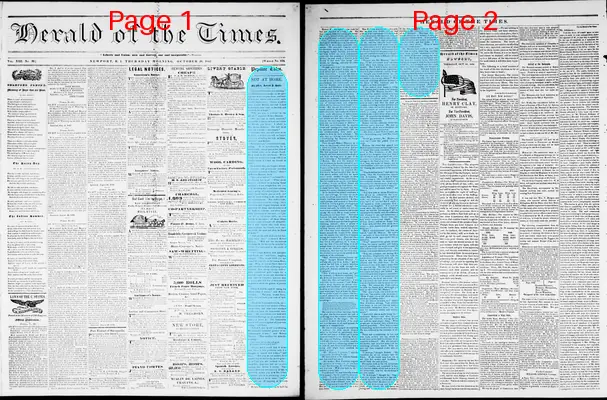
Literary
October 20, 1842
Herald Of The Times
Newport, Newport County, Rhode Island
What is this article about?
In this short story, fashionable Miss Lucy Cummings mocks the idea of wives being at home, contrasting with Robert Hanson's encounter with devoted Annie Carleton, who cares for her ill mother and family, restoring his faith in marriage and leading him to woo her over three years.
Merged-components note: This is a continuation of the serialized literary story 'Not at Home' by Mrs. Sarah J. Hale, split across pages.
Clippings

1 of 2
OCR Quality
98%
Excellent
Full Text
Popular Tales.
From the Philadelphia Saturday Courier.
NOT AT HOME.
By Mrs. Sarah J. Hale.
"I have a call to make this morning," said Miss Lucy Cummings, as she gave a glance at her elegant dress, and turned from the mirror with a sweet smile of self-complacency ; "I have a call to make, cousin Robert, and fear I shall be detained some time, as the lady will positively be at home."
"Why are you so certain ? Is the lady ill ?" inquired Robert Hanson.
"Oh! no--she is lately married," and a bride is always at home to receive her friends, you know. I allude to Mrs. James Johnson. She will be at home for a week or two longer,"
"And after that, she will cease to be the bride, and then you will no longer be certain of finding the wife at home, will you ?" said Robert.
"To be sure not," returned his cousin, smiling. "It is unfashionable for a married lady, except just at the time of her bridal visits, to be always found, like a snail, in her own house. When I make my round of morning calls, I am always vexed if I find my friends at home."
"You think they are happier abroad. I presume, and generously sacrifice your own enjoyment to theirs," observed Robert Hanson, dryly.
"Enjoyment indeed !" exclaimed Lucy, tossing her head. "What great pleasure can there be in saying 'Good morning'-'I am delighted to see you --'A charming day'—and then running over a string of common-places that a parrot might repeat just as well, and with as much feeling as do one half of my acquaintances. But with a bride, the call is much more interesting ; there is the new and elegant furniture to admire, and the dress and decorations of the bride to criticise, and often some pretty inventions of her taste, or bijouterie are on the centre table, or rare flowers in the vases; all these things serve to make a formal call delightful. But a wife cannot take such weary pains to please her friends, so to save her credit, she must not often be found at home."
"And yet the wife must see her husband every day," remarked Robert Hanson. "Will not the decorations which are fit for his eye be suitable for friends less interested in the credit of his wife ?"
"Oh! cousin Robert, how unsophisticated you are," said Lucy, laughing outright. "One would think you had passed all your life on the Green Mountains. Why, do you not know that it is quite obsolete to think of pleasing one's husband: It is, among our city fashionables. considered quite vulgar for a married couple to pay any attention to each other in company, and you may be pretty sure that few of them trouble themselves about the graces in private life."
"Then I shall be ranked among the vulgar when I marry," said Robert, seriously. " But pray, cousin Lucy, where did you learn your code of fashion."
"From the fashionable novels, sir.-- They exhibit the Court models of Paris and London. and what better standard would you have for fashionable manners? Oh. never shake your head with that Lord Burleigh air of superior wisdom ; it won't do The fashionable novels will carry it against all your reasoning," said Lucy.
"I think I once heard you admiring Wordsworth's beautiful picture of unsophisticated woman," said Robert Hanson. "You recollect the lines de scribing-
" A creature not too bright or good For human nature's daily food."
"(Oh yes, and I could find it in my own heart to love goodness, only it is thought so insipid now-a-days." said Lucy. "But pray do not answer, for I cannot stay to discuss the matter gravely, as I see you are inclined to do.- Good-bye, dear coz; and put on your smiling face before I return. Such gravity does not become you at all: it positively makes you look like a married man. who is in perplexity because his wife will not be at home," and the gay girl ran off' laughing at her own pleasantries.
Robert Hanson sighed as he took his hat and departed on a long walk. He was a highly educated young gentleman of very retired habits, and had never been fond of what is styled "fashionable society," still he had travelled and seen much of the world, and was, whenever he chose to be so, a most agreeable companion. He was very fond, as men of his character usually are, of refined and intelligent female society, and having, not long before my story commences, come into the possession of a handsome fortune, he was really in earnest in his search to find some "fair being" who would, by sharing, enhance the value of his property.
"I must give it up," he murmured to himself, as he walked hastily on. "I shall never find a young lady whom I shall dare marry. I could not love an ignorant, awkward girl, and the manner in which admiration is now conducted though it may confer intelligence and gracefulness, yet fosters such an ambition for display, such a taste for the fashions and frivolities of the European great world, that our young ladies are, it seems to me, rendered the most heartless and artificial beings in creation. A lady born to a title has her dignity of station to maintain; she is therefore natural, even in the assumption of those airs of exclusiveness and cliqueism, which she has always been taught to observe. But for our Republican ladies, whose ambition should be to maintain a noble simplicity and frankness of deportment, such affectation of subserviency to fashion is a folly and a sin. Cannot our people see that they are not dependent on the vain pageantry of a Court birth-day for their patent of fashion?--Will they never learn that by superior virtue and intelligence, their rank must be measured and graduated? Oh, my fair countrywomen, how much good might be done by their influence! But alas, they are bowing down to vain idols--worshipping the shadows of foreign rank and fashion."
Thus thought Robert Hanson, as he went on his errand, which was to carry a letter to a lady who lived in that part of Roxbury known as Jamaica Plain. He had promised to deliver the letter himself, and had anticipated much pleasure from the long walk in one of the most charming of the beautiful environs of Boston. But now the scenery had lost its charm, he hardly noticed it, as he strolled on, soliloquizing, like melancholy Jaques, on the faults of mankind, or rather womankind. Before he reached Mrs. Carleton's he had decided that the sex was utterly selfish, and that he would never waste another thought on those chimeras, love and "home, sweet home."
No, he would never marry, even though "maiden, lovely as Mary Stuart and good and intelligent as Jane Grey, were to stand before him, he would not even inquire her name--his mind was made up. As he finished his mental anathema of love and marriage, he came out on the pretty woodland scene where Mrs. Carleton's dwelling was situated. It was a small cottage, and seemed to have been nestled in among a grove of evergreens, without disturbing a single shrub. The narrow foot-path, by which only the cottage was accessible, wound in and around among the trees, like a trunk turned in the gambols of a fairy frolic. Now it led beneath tall, dark evergreens, standing so closely, that the hand was involuntarily put forth to part the low boughs ere venturing onward; then a gleam of bright sunshine would break through the opening leaves, and rest on the violets and roses that were clustered in their beauty around the trunks of the acacia and the stately elm, which were mingled among the sombre firs. Here and there a small circular patch of green sward was left in the pathway, as it were, to stay the foot of any evil thing, or to admonish those who were eager to press onward in the brilliant career of worldly distinction, that this was not their way--the verdure never grows so quietly in the pathway of the ambitious.
"Mrs. Carleton does not keep a carriage," thought Robert Hanson, "so perhaps she may be at home;" and he pulled the bell with a quick, impatient jerk--for even his walk through that quiet path had not calmed the vexation of his spirit.
"Mrs. Carleton is at home, sir," said the domestic, to Robert's inquiries, "but she is ill and does not see company."
"Give her this card and letter: I will wait here for her answer;" and Robert turned away towards an arbour overgrown with woodbine and honeysuckle thinking in heart that it was well women were sometimes kept at home by illness.
He heard the sound of a piano--the keys seemed touched by one whose soul was harmonious, and a soft, clear voice was breathing--
"Birds, joyous birds of the wandering wing,
Whence is it ye come with the flowers of spring?
We come from the shores of the green old Nile
From the land where the roses of Sharon smile.
From the palms that wave through the Indian sky.
From the myrrh trees of glowing Araby."
He could not forbear listening; but he felt glad that he was spared the task of proffering even the common compliments of admiration to the singer. He was resolved to steel his heart, if he could not close his ears, to all such syrens--he would be a woman-hater.
He was deeply engaged in examining a scabiosa; the little purple blossom spoke to his heart of unfortunate love, and the sad history of Paul and Virginia seemed stamped on the morning flower. He was just thinking whether such devoted affection were, in real life, possible, when a light step advancing caused him to look up, and there stood before him a being who might have resolved his scruples at once.
"Mr. Hanson, I presume," said the young lady, blushing deeply.
I bowed low as Sir Charles Grandison, but could not speak.
"My mother, Mrs. Carleton, requests the pleasure of seeing you; if you have no dislike nursing, she will be happy to see you now. Will you walk in, sir?" said the young lady.
Poor Robert! he was naturally reserved in manner, but he could converse eloquently. Now he felt his voice as well as his tongue and ears had forsaken him; and it was in the most awkward style that he signified his assent to see Mrs. Carleton. But he had just determined to be a woman-hater.
Mrs. Carleton was reclining on a sofa. She seemed very feeble, yet she had nothing of that querulous listless look, which often marks the incipient or impatient invalid. She had become accustomed to confinement, and reconciled to her lot, and the cheerful smile which illumined her pale face as she extended her hand with a warm welcome to Robert Hanson, appeared to him expressive of that real heartfelt happiness which he had just concluded could not be found in the world, among the selfish race of civilized man.
"Excuse me, Mr. Hanson," she began; "I did not consult your entertainment when thus asking you to visit an invalid. But I wish to hear personally about my friends, and to see a gentleman they so highly commend--and my daughter thought you would excuse me; she believes every body is happy to oblige her mother; do you not, Annie?" What smiles of confiding affection beamed on the faces of Mrs. Carleton and her daughter, as their eyes met!
"I am, indeed, most happy to oblige you, Madam, and to make your acquaintance," said Mr. Hanson, warmly. He addressed the mother, but his eyes wandered to Annie as he spoke. She was arranging the pillow under the head of her mother, so that she might converse more at ease; and then the kind girl brought a reviving cordial and bent over the sofa, while her mother drank it, with that expression of elevated tenderness which a young mother wears when watching the cradle sleep of her sick infant. It was a lovely example of those domestic charities which constitute the real bliss of human life.
Robert felt the influence of this filial affection enter his soul. He had announced the whole sex as heartless--he never repeated the accusation.
"Ah, there is dear Willy's voice, Annie--he is calling you," said Mrs. Carleton.
"I will go, mother; Mr. Hanson excuse me"--and she glided from the room.
Perhaps the cloud that passed over Robert's countenance as that bright vision of female loveliness vanished, was not noticed by Mrs. Carleton; or she might speak of her daughter from that fullness of soul which must pour itself out, either in praises to a human ear, or in thanksgivings to the God of mercies. Be that as it may, she spoke of Annie, and the tear trembled in her eye, as she dwelt on the blessing she possessed in her daughter.
"You doubtless know," said she to her guest, "that Mr. Carleton was unfortunate in business. He is now in India, endeavouring to obtain sufficient to pay his creditors--fortune for ourselves we do not expect--we are poor--I am almost helpless, and yet how much I enjoy!"
"You have a pleasant home," said Robert.
"And firm faith in divine Providence that all will be ordered for the best," added Mrs. Carleton. "Hope and love make our happiness. I said we were poor, but I do not feel that I ought to call myself so while possessing such a treasure as my daughter. It is now two years since her father was obliged to leave us, and she has managed all the concerns of the family, with the additional care of nurse to me, and instructress to her young brothers. Never were children better trained and taught. They all love Annie, and are so happy to be at home with her that they apply themselves to their studies with the greatest diligence."
"Did I not understand you that one was ill," said Mr. Hanson. He wished to ascertain if there was any likelihood that Annie would again make her appearance.
"Yes," answered the gentle invalid, folding her hands together and looking upward, as though she would commit the little sufferer to the care of heaven. She felt her own helplessness to aid her child. "Yes, our youngest, our darling Willy has been dangerously sick with the scarlet fever: we feared the result; but God is merciful. He has heard our prayers and the child lives. To the unwearied care of his sister, under God, he owes his life. For the last fortnight she has scarcely slept; and yet you saw how bright and happy she looked. She never seems to feel fatigue or impatience; her smiles as well as her assistance are always ready for those she loves. Just as you called, she had stolen a moment from her brother's side to cheer me with a song. But excuse me, I am running on with my family story as though you were an old friend, Mr. Hanson."
"Oh! how I wish you would so consider me," he replied, with earnestness "How I wish you would allow me the privilege of calling often."
"I am always at home, sir," replied Mrs. Carleton, smiling, "and shall be very happy to see you; but we have no fashionable attractions here; we live only for domestic duties and employments."
"And what else is worth living for!" exclaimed Robert--and then stopped abruptly and coloured, fearing he had not said the most proper thing. When people are in earnest, they seldom compliment gracefully. They feel too much is depending on their words to be at ease.
He was relieved by the entrance of Annie.
There was a tenderness in her mild blue eyes, as they met his, which he would have given half his fortune to appropriate to himself. But she turned to her mother, and in a low voice told her something pleasant, which Willy had said, and then inquired if she was not fatigued.
"I must go," thought Robert. "She considers me as an intruder into her Eden. If she would only love me as she does her mother and brothers, I should think she was perfect."
During his walk to the city he became more reasonable, and could not help reflecting to himself that she charm which had won on his admiration, was her devotedness to her own family.
"It is strange," thought he, "that lover can dream he has won the attractions of his lady love, unless she shows in her girlhood that she has a heart! If she has not been loving and kind as a child, sister, friend, she will never be loving and tender as a wife and mother. If she has not loved the home of her childhood, she will never love the home of her husband. Marriage does not create affections or virtues, it only perfects and enlarges them. I am glad that Annie does love her mother and brothers thus devotedly, and her home. I will see her often there. What a sweet wife she would make!"
Mr. Hanson was really in love, and his own scruples respecting marriage were soon as little remembered as are the snows of January among the roses of July. But Anne was not lightly won. She was not waiting for an offer--she had never imagined what her bridal dress would be, nor arranged who she would invite for bride's maids, nor thought of the wedding party. She was happy as a daughter and sister; oh how happy in conferring benefits in her own family, and having them daily bless her care and kindness! It was months after she first saw Robert Hanson, before she believed there were dearer relations in life than those she had so cherished. Robert had to wait three years, till Mr. Carleton had returned, and Mrs. Carleton, in a good measure recovered her health, before he could win Annie to be his wife. But he says she was worth waiting for.
From the Philadelphia Saturday Courier.
NOT AT HOME.
By Mrs. Sarah J. Hale.
"I have a call to make this morning," said Miss Lucy Cummings, as she gave a glance at her elegant dress, and turned from the mirror with a sweet smile of self-complacency ; "I have a call to make, cousin Robert, and fear I shall be detained some time, as the lady will positively be at home."
"Why are you so certain ? Is the lady ill ?" inquired Robert Hanson.
"Oh! no--she is lately married," and a bride is always at home to receive her friends, you know. I allude to Mrs. James Johnson. She will be at home for a week or two longer,"
"And after that, she will cease to be the bride, and then you will no longer be certain of finding the wife at home, will you ?" said Robert.
"To be sure not," returned his cousin, smiling. "It is unfashionable for a married lady, except just at the time of her bridal visits, to be always found, like a snail, in her own house. When I make my round of morning calls, I am always vexed if I find my friends at home."
"You think they are happier abroad. I presume, and generously sacrifice your own enjoyment to theirs," observed Robert Hanson, dryly.
"Enjoyment indeed !" exclaimed Lucy, tossing her head. "What great pleasure can there be in saying 'Good morning'-'I am delighted to see you --'A charming day'—and then running over a string of common-places that a parrot might repeat just as well, and with as much feeling as do one half of my acquaintances. But with a bride, the call is much more interesting ; there is the new and elegant furniture to admire, and the dress and decorations of the bride to criticise, and often some pretty inventions of her taste, or bijouterie are on the centre table, or rare flowers in the vases; all these things serve to make a formal call delightful. But a wife cannot take such weary pains to please her friends, so to save her credit, she must not often be found at home."
"And yet the wife must see her husband every day," remarked Robert Hanson. "Will not the decorations which are fit for his eye be suitable for friends less interested in the credit of his wife ?"
"Oh! cousin Robert, how unsophisticated you are," said Lucy, laughing outright. "One would think you had passed all your life on the Green Mountains. Why, do you not know that it is quite obsolete to think of pleasing one's husband: It is, among our city fashionables. considered quite vulgar for a married couple to pay any attention to each other in company, and you may be pretty sure that few of them trouble themselves about the graces in private life."
"Then I shall be ranked among the vulgar when I marry," said Robert, seriously. " But pray, cousin Lucy, where did you learn your code of fashion."
"From the fashionable novels, sir.-- They exhibit the Court models of Paris and London. and what better standard would you have for fashionable manners? Oh. never shake your head with that Lord Burleigh air of superior wisdom ; it won't do The fashionable novels will carry it against all your reasoning," said Lucy.
"I think I once heard you admiring Wordsworth's beautiful picture of unsophisticated woman," said Robert Hanson. "You recollect the lines de scribing-
" A creature not too bright or good For human nature's daily food."
"(Oh yes, and I could find it in my own heart to love goodness, only it is thought so insipid now-a-days." said Lucy. "But pray do not answer, for I cannot stay to discuss the matter gravely, as I see you are inclined to do.- Good-bye, dear coz; and put on your smiling face before I return. Such gravity does not become you at all: it positively makes you look like a married man. who is in perplexity because his wife will not be at home," and the gay girl ran off' laughing at her own pleasantries.
Robert Hanson sighed as he took his hat and departed on a long walk. He was a highly educated young gentleman of very retired habits, and had never been fond of what is styled "fashionable society," still he had travelled and seen much of the world, and was, whenever he chose to be so, a most agreeable companion. He was very fond, as men of his character usually are, of refined and intelligent female society, and having, not long before my story commences, come into the possession of a handsome fortune, he was really in earnest in his search to find some "fair being" who would, by sharing, enhance the value of his property.
"I must give it up," he murmured to himself, as he walked hastily on. "I shall never find a young lady whom I shall dare marry. I could not love an ignorant, awkward girl, and the manner in which admiration is now conducted though it may confer intelligence and gracefulness, yet fosters such an ambition for display, such a taste for the fashions and frivolities of the European great world, that our young ladies are, it seems to me, rendered the most heartless and artificial beings in creation. A lady born to a title has her dignity of station to maintain; she is therefore natural, even in the assumption of those airs of exclusiveness and cliqueism, which she has always been taught to observe. But for our Republican ladies, whose ambition should be to maintain a noble simplicity and frankness of deportment, such affectation of subserviency to fashion is a folly and a sin. Cannot our people see that they are not dependent on the vain pageantry of a Court birth-day for their patent of fashion?--Will they never learn that by superior virtue and intelligence, their rank must be measured and graduated? Oh, my fair countrywomen, how much good might be done by their influence! But alas, they are bowing down to vain idols--worshipping the shadows of foreign rank and fashion."
Thus thought Robert Hanson, as he went on his errand, which was to carry a letter to a lady who lived in that part of Roxbury known as Jamaica Plain. He had promised to deliver the letter himself, and had anticipated much pleasure from the long walk in one of the most charming of the beautiful environs of Boston. But now the scenery had lost its charm, he hardly noticed it, as he strolled on, soliloquizing, like melancholy Jaques, on the faults of mankind, or rather womankind. Before he reached Mrs. Carleton's he had decided that the sex was utterly selfish, and that he would never waste another thought on those chimeras, love and "home, sweet home."
No, he would never marry, even though "maiden, lovely as Mary Stuart and good and intelligent as Jane Grey, were to stand before him, he would not even inquire her name--his mind was made up. As he finished his mental anathema of love and marriage, he came out on the pretty woodland scene where Mrs. Carleton's dwelling was situated. It was a small cottage, and seemed to have been nestled in among a grove of evergreens, without disturbing a single shrub. The narrow foot-path, by which only the cottage was accessible, wound in and around among the trees, like a trunk turned in the gambols of a fairy frolic. Now it led beneath tall, dark evergreens, standing so closely, that the hand was involuntarily put forth to part the low boughs ere venturing onward; then a gleam of bright sunshine would break through the opening leaves, and rest on the violets and roses that were clustered in their beauty around the trunks of the acacia and the stately elm, which were mingled among the sombre firs. Here and there a small circular patch of green sward was left in the pathway, as it were, to stay the foot of any evil thing, or to admonish those who were eager to press onward in the brilliant career of worldly distinction, that this was not their way--the verdure never grows so quietly in the pathway of the ambitious.
"Mrs. Carleton does not keep a carriage," thought Robert Hanson, "so perhaps she may be at home;" and he pulled the bell with a quick, impatient jerk--for even his walk through that quiet path had not calmed the vexation of his spirit.
"Mrs. Carleton is at home, sir," said the domestic, to Robert's inquiries, "but she is ill and does not see company."
"Give her this card and letter: I will wait here for her answer;" and Robert turned away towards an arbour overgrown with woodbine and honeysuckle thinking in heart that it was well women were sometimes kept at home by illness.
He heard the sound of a piano--the keys seemed touched by one whose soul was harmonious, and a soft, clear voice was breathing--
"Birds, joyous birds of the wandering wing,
Whence is it ye come with the flowers of spring?
We come from the shores of the green old Nile
From the land where the roses of Sharon smile.
From the palms that wave through the Indian sky.
From the myrrh trees of glowing Araby."
He could not forbear listening; but he felt glad that he was spared the task of proffering even the common compliments of admiration to the singer. He was resolved to steel his heart, if he could not close his ears, to all such syrens--he would be a woman-hater.
He was deeply engaged in examining a scabiosa; the little purple blossom spoke to his heart of unfortunate love, and the sad history of Paul and Virginia seemed stamped on the morning flower. He was just thinking whether such devoted affection were, in real life, possible, when a light step advancing caused him to look up, and there stood before him a being who might have resolved his scruples at once.
"Mr. Hanson, I presume," said the young lady, blushing deeply.
I bowed low as Sir Charles Grandison, but could not speak.
"My mother, Mrs. Carleton, requests the pleasure of seeing you; if you have no dislike nursing, she will be happy to see you now. Will you walk in, sir?" said the young lady.
Poor Robert! he was naturally reserved in manner, but he could converse eloquently. Now he felt his voice as well as his tongue and ears had forsaken him; and it was in the most awkward style that he signified his assent to see Mrs. Carleton. But he had just determined to be a woman-hater.
Mrs. Carleton was reclining on a sofa. She seemed very feeble, yet she had nothing of that querulous listless look, which often marks the incipient or impatient invalid. She had become accustomed to confinement, and reconciled to her lot, and the cheerful smile which illumined her pale face as she extended her hand with a warm welcome to Robert Hanson, appeared to him expressive of that real heartfelt happiness which he had just concluded could not be found in the world, among the selfish race of civilized man.
"Excuse me, Mr. Hanson," she began; "I did not consult your entertainment when thus asking you to visit an invalid. But I wish to hear personally about my friends, and to see a gentleman they so highly commend--and my daughter thought you would excuse me; she believes every body is happy to oblige her mother; do you not, Annie?" What smiles of confiding affection beamed on the faces of Mrs. Carleton and her daughter, as their eyes met!
"I am, indeed, most happy to oblige you, Madam, and to make your acquaintance," said Mr. Hanson, warmly. He addressed the mother, but his eyes wandered to Annie as he spoke. She was arranging the pillow under the head of her mother, so that she might converse more at ease; and then the kind girl brought a reviving cordial and bent over the sofa, while her mother drank it, with that expression of elevated tenderness which a young mother wears when watching the cradle sleep of her sick infant. It was a lovely example of those domestic charities which constitute the real bliss of human life.
Robert felt the influence of this filial affection enter his soul. He had announced the whole sex as heartless--he never repeated the accusation.
"Ah, there is dear Willy's voice, Annie--he is calling you," said Mrs. Carleton.
"I will go, mother; Mr. Hanson excuse me"--and she glided from the room.
Perhaps the cloud that passed over Robert's countenance as that bright vision of female loveliness vanished, was not noticed by Mrs. Carleton; or she might speak of her daughter from that fullness of soul which must pour itself out, either in praises to a human ear, or in thanksgivings to the God of mercies. Be that as it may, she spoke of Annie, and the tear trembled in her eye, as she dwelt on the blessing she possessed in her daughter.
"You doubtless know," said she to her guest, "that Mr. Carleton was unfortunate in business. He is now in India, endeavouring to obtain sufficient to pay his creditors--fortune for ourselves we do not expect--we are poor--I am almost helpless, and yet how much I enjoy!"
"You have a pleasant home," said Robert.
"And firm faith in divine Providence that all will be ordered for the best," added Mrs. Carleton. "Hope and love make our happiness. I said we were poor, but I do not feel that I ought to call myself so while possessing such a treasure as my daughter. It is now two years since her father was obliged to leave us, and she has managed all the concerns of the family, with the additional care of nurse to me, and instructress to her young brothers. Never were children better trained and taught. They all love Annie, and are so happy to be at home with her that they apply themselves to their studies with the greatest diligence."
"Did I not understand you that one was ill," said Mr. Hanson. He wished to ascertain if there was any likelihood that Annie would again make her appearance.
"Yes," answered the gentle invalid, folding her hands together and looking upward, as though she would commit the little sufferer to the care of heaven. She felt her own helplessness to aid her child. "Yes, our youngest, our darling Willy has been dangerously sick with the scarlet fever: we feared the result; but God is merciful. He has heard our prayers and the child lives. To the unwearied care of his sister, under God, he owes his life. For the last fortnight she has scarcely slept; and yet you saw how bright and happy she looked. She never seems to feel fatigue or impatience; her smiles as well as her assistance are always ready for those she loves. Just as you called, she had stolen a moment from her brother's side to cheer me with a song. But excuse me, I am running on with my family story as though you were an old friend, Mr. Hanson."
"Oh! how I wish you would so consider me," he replied, with earnestness "How I wish you would allow me the privilege of calling often."
"I am always at home, sir," replied Mrs. Carleton, smiling, "and shall be very happy to see you; but we have no fashionable attractions here; we live only for domestic duties and employments."
"And what else is worth living for!" exclaimed Robert--and then stopped abruptly and coloured, fearing he had not said the most proper thing. When people are in earnest, they seldom compliment gracefully. They feel too much is depending on their words to be at ease.
He was relieved by the entrance of Annie.
There was a tenderness in her mild blue eyes, as they met his, which he would have given half his fortune to appropriate to himself. But she turned to her mother, and in a low voice told her something pleasant, which Willy had said, and then inquired if she was not fatigued.
"I must go," thought Robert. "She considers me as an intruder into her Eden. If she would only love me as she does her mother and brothers, I should think she was perfect."
During his walk to the city he became more reasonable, and could not help reflecting to himself that she charm which had won on his admiration, was her devotedness to her own family.
"It is strange," thought he, "that lover can dream he has won the attractions of his lady love, unless she shows in her girlhood that she has a heart! If she has not been loving and kind as a child, sister, friend, she will never be loving and tender as a wife and mother. If she has not loved the home of her childhood, she will never love the home of her husband. Marriage does not create affections or virtues, it only perfects and enlarges them. I am glad that Annie does love her mother and brothers thus devotedly, and her home. I will see her often there. What a sweet wife she would make!"
Mr. Hanson was really in love, and his own scruples respecting marriage were soon as little remembered as are the snows of January among the roses of July. But Anne was not lightly won. She was not waiting for an offer--she had never imagined what her bridal dress would be, nor arranged who she would invite for bride's maids, nor thought of the wedding party. She was happy as a daughter and sister; oh how happy in conferring benefits in her own family, and having them daily bless her care and kindness! It was months after she first saw Robert Hanson, before she believed there were dearer relations in life than those she had so cherished. Robert had to wait three years, till Mr. Carleton had returned, and Mrs. Carleton, in a good measure recovered her health, before he could win Annie to be his wife. But he says she was worth waiting for.
What sub-type of article is it?
Prose Fiction
Satire
What themes does it cover?
Social Manners
Moral Virtue
Love Romance
What keywords are associated?
Fashionable Society
Domestic Virtues
Marriage
Bride
Home
Satire
Family Devotion
What entities or persons were involved?
By Mrs. Sarah J. Hale.
Literary Details
Title
Not At Home.
Author
By Mrs. Sarah J. Hale.
Key Lines
"It Is Unfashionable For A Married Lady, Except Just At The Time Of Her Bridal Visits, To Be Always Found, Like A Snail, In Her Own House."
"One Would Think You Had Passed All Your Life On The Green Mountains. Why, Do You Not Know That It Is Quite Obsolete To Think Of Pleasing One's Husband"
"A Creature Not Too Bright Or Good For Human Nature's Daily Food."
"Hope And Love Make Our Happiness."
"Marriage Does Not Create Affections Or Virtues, It Only Perfects And Enlarges Them."