Thank you for visiting SNEWPapers!

Sign up free

Page thumbnail for Indiana State Sentinel
Domestic News February 14, 1846

Indiana State Sentinel

Indianapolis, Marion County, Indiana

What is this article about?

U.S. House Standing Committee on the Militia reports bill to reorganize inefficient national militia, detailing peace/war enrollments (1M/2.7M men aged 18-45), 12-month service terms, $40 annual clothing allowance, legalized substitutions, and volunteer corps retention. Notes constitutional authority and past 1840 Whig criticisms of similar proposal as 'standing army.'

Clipping
OCR Quality

98% Excellent

Full Text

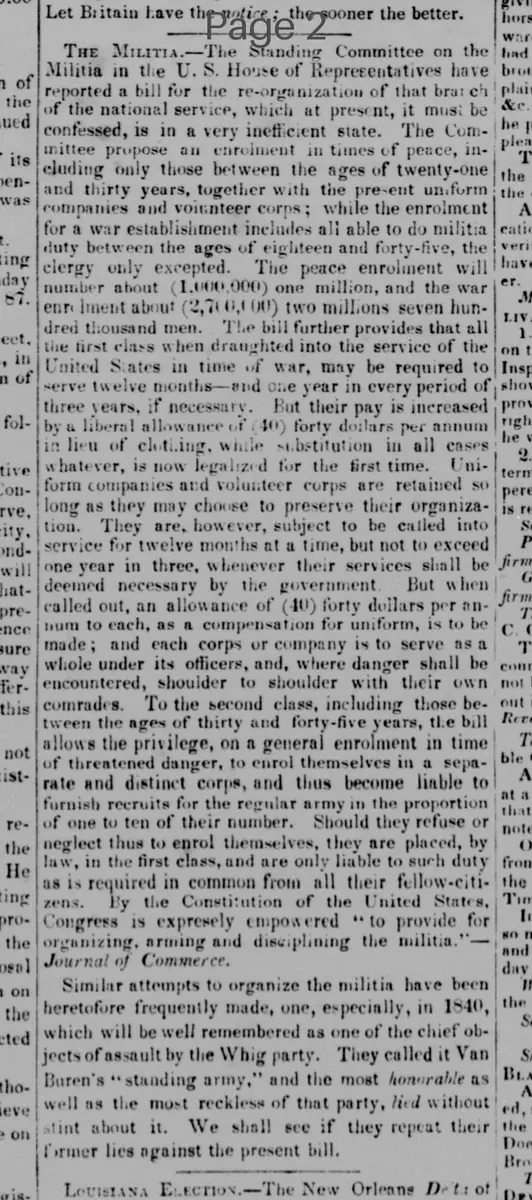
The Militia.—The Standing Committee on the Militia in the U. S. House of Representatives have reported a bill for the re-organization of that branch of the national service, which at present, it must be confessed, is in a very inefficient state. The Committee propose an enrolment in times of peace, including only those between the ages of twenty-one and thirty years, together with the present uniform companies and volunteer corps: while the enrolment for a war establishment includes all able to do militia duty between the ages of eighteen and forty-five, the clergy only excepted. The peace enrolment will number about (1,000,000) one million, and the war enrolment about (2,700,000) two millions seven hundred thousand men. The bill further provides that all the first class when draughted into the service of the United States in time of war, may be required to serve twelve months—and one year in every period of three years, if necessary. But their pay is increased by a liberal allowance of $40 forty dollars per annum in lieu of clothing, while substitution in all cases whatever, is now legalized for the first time. Uniform companies and volunteer corps are retained so long as they may choose to preserve their organization. They are, however, subject to be called into service for twelve months at a time, but not to exceed one year in three, whenever their services shall be deemed necessary by the government. But when called out, an allowance of $40 forty dollars per annum to each, as a compensation for uniform, is to be made; and each corps or company is to serve as a whole under its officers, and, where danger shall be encountered, shoulder to shoulder with their own comrades. To the second class, including those between the ages of thirty and forty-five years, the bill allows the privilege, on a general enrolment in time of threatened danger, to enrol themselves in a separate and distinct corps, and thus become liable to furnish recruits for the regular army in the proportion of one to ten of their number. Should they refuse or neglect thus to enrol themselves, they are placed, by law, in the first class, and are only liable to such duty as is required in common from all their fellow-citizens. By the Constitution of the United States Congress is expressly empowered 'to provide for organizing, arming and disciplining the militia.'—Journal of Commerce

Similar attempts to organize the militia have been heretofore frequently made, one, especially, in 1840, which will be well remembered as one of the chief objects of assault by the Whig party. They called it Van Buren's 'standing army,' and the most honorable as well as the most reckless of that party, lied without stint about it. We shall see if they repeat their former lies against the present bill.

What sub-type of article is it?

Politics Military

What keywords are associated?

Militia Reorganization Congressional Bill National Service Volunteer Corps Whig Party Criticism

Where did it happen?

United States

Domestic News Details

Primary Location

United States

Outcome

bill reported for reorganization; provisions include enrollments of 1,000,000 for peace and 2,700,000 for war, 12-month service, $40 annual allowance, legalized substitutions; volunteer corps retained with similar terms; second class option to form separate corps or join first class.

Event Details

Standing Committee on the Militia in U.S. House reports bill to reorganize inefficient militia: peace enrollment for ages 21-30 plus volunteers; war enrollment for ages 18-45 excluding clergy; first class draftable for 12 months (up to 1 year every 3); pay increase with $40 clothing allowance; substitutions legalized; volunteers callable for 12 months (up to 1 year every 3) with $40 uniform allowance, serving as units; second class (30-45) may form separate corps to supply recruits (1:10) or join first class; constitutional empowerment noted. Commentary on past 1840 attempts criticized by Whigs as Van Buren's 'standing army.'

Are you sure?