Thank you for visiting SNEWPapers!
Sign up free
Editorial
March 9, 1791
Gazette Of The United States
New York, New York County, New York
What is this article about?
The editorial regrets the absence of comprehensive, philosophical travel accounts of the United States, critiques superficial or biased traveler memoirs that mislead readers and perpetuate prejudice, and advocates for candid travel writing to foster international understanding and dispel ignorance.
Clipping
OCR Quality
98%
Excellent
Full Text
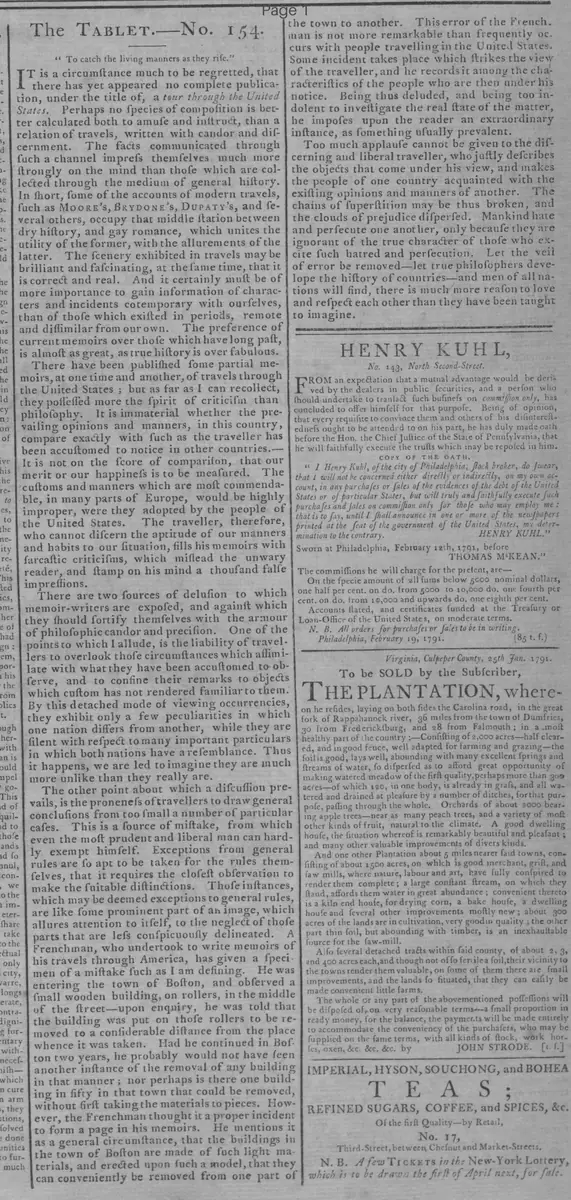
The TABLET. No. 154.
"To catch the living manners as they rise."
It is a circumstance much to be regretted, that there has yet appeared no complete publication, under the title of, a tour through the United States. Perhaps no species of composition is better calculated both to amuse and instruct, than a relation of travels, written with candor and discernment. The facts communicated through such a channel impress themselves much more strongly on the mind than those which are collected through the medium of general history.
In short, some of the accounts of modern travels, such as Moore's, Brydone's, Dupaty's, and several others, occupy that middle station between dry history, and gay romance, which unites the utility of the former, with the allurements of the latter. The scenery exhibited in travels may be brilliant and fascinating, at the same time, that it is correct and real. And it certainly must be of more importance to gain information of characters and incidents cotemporary with ourselves, than of those which existed in periods, remote and dissimilar from our own. The preference of current memoirs over those which have long past, is almost as great, as true history is over fabulous.
There have been published some partial memoirs, at one time and another, of travels through the United States; but as far as I can recollect, they possessed more the spirit of criticism than philosophy. It is immaterial whether the prevailing opinions and manners, in this country, compare exactly with such as the traveller has been accustomed to notice in other countries.—It is not on the score of comparison, that our merit or our happiness is to be measured. The customs and manners which are most commendable, in many parts of Europe, would be highly improper, were they adopted by the people of the United States.
The traveller, therefore, who cannot discern the aptitude of our manners and habits to our situation, fills his memoirs with sarcastic criticisms, which mislead the unwary reader, and stamp on his mind a thousand false impressions.
There are two sources of delusion to which memoir-writers are exposed, and against which they should fortify themselves with the armour of philosophic candor and precision. One of the points to which I allude, is the liability of travellers to overlook those circumstances which assimilate with what they have been accustomed to observe, and to confine their remarks to objects which custom has not rendered familiar to them.
By this detached mode of viewing occurrences, they exhibit only a few peculiarities in which one nation differs from another, while they are silent with respect to many important particulars in which both nations have a resemblance. Thus it happens, we are led to imagine they are much more unlike than they really are.
The other point about which a discussion prevails, is the proneness of travellers to draw general conclusions from too small a number of particular cases. This is a source of mistake, from which even the most prudent and liberal man can hardly exempt himself.
Exceptions from general rules are so apt to be taken for the rules themselves, that it requires the closest observation to make the suitable distinctions. Those instances, which may be deemed exceptions to general rules, are like some prominent part of an image, which allures attention to itself, to the neglect of those parts that are less conspicuously delineated.
A Frenchman, who undertook to write memoirs of his travels through America, has given a specimen of a mistake such as I am defining. He was entering the town of Boston, and observed a small wooden building, on rollers, in the middle of the street—upon enquiry, he was told that the building was put on those rollers to be removed to a considerable distance from the place whence it was taken. Had he continued in Boston two years, he probably would not have seen another instance of the removal of any building in that manner; nor perhaps is there one building in fifty in that town that could be removed, without first taking the materials to pieces. However, the Frenchman thought it a proper incident to form a page in his memoirs.
He mentions it as a general circumstance, that the buildings in the town of Boston are made of such light materials, and erected upon such a model, that they can conveniently be removed from one part of the town to another. This error of the Frenchman is not more remarkable than frequently occurs with people travelling in the United States.
Some incident takes place which strikes the view of the traveller, and he records it among the characteristics of the people who are then under his notice. Being thus deluded, and being too indolent to investigate the real state of the matter, he imposes upon the reader an extraordinary instance, as something usually prevalent.
Too much applause cannot be given to the discerning and liberal traveller, who justly describes the objects that come under his view, and makes the people of one country acquainted with the existing opinions and manners of another. The chains of superstition may be thus broken, and the clouds of prejudice dispersed. Mankind hate and persecute one another, only because they are ignorant of the true character of those who excite such hatred and persecution. Let the veil of error be removed—let true philosophers develop the history of countries—and men of all nations will find, there is much more reason to love and respect each other than they have been taught to imagine.
"To catch the living manners as they rise."
It is a circumstance much to be regretted, that there has yet appeared no complete publication, under the title of, a tour through the United States. Perhaps no species of composition is better calculated both to amuse and instruct, than a relation of travels, written with candor and discernment. The facts communicated through such a channel impress themselves much more strongly on the mind than those which are collected through the medium of general history.
In short, some of the accounts of modern travels, such as Moore's, Brydone's, Dupaty's, and several others, occupy that middle station between dry history, and gay romance, which unites the utility of the former, with the allurements of the latter. The scenery exhibited in travels may be brilliant and fascinating, at the same time, that it is correct and real. And it certainly must be of more importance to gain information of characters and incidents cotemporary with ourselves, than of those which existed in periods, remote and dissimilar from our own. The preference of current memoirs over those which have long past, is almost as great, as true history is over fabulous.
There have been published some partial memoirs, at one time and another, of travels through the United States; but as far as I can recollect, they possessed more the spirit of criticism than philosophy. It is immaterial whether the prevailing opinions and manners, in this country, compare exactly with such as the traveller has been accustomed to notice in other countries.—It is not on the score of comparison, that our merit or our happiness is to be measured. The customs and manners which are most commendable, in many parts of Europe, would be highly improper, were they adopted by the people of the United States.
The traveller, therefore, who cannot discern the aptitude of our manners and habits to our situation, fills his memoirs with sarcastic criticisms, which mislead the unwary reader, and stamp on his mind a thousand false impressions.
There are two sources of delusion to which memoir-writers are exposed, and against which they should fortify themselves with the armour of philosophic candor and precision. One of the points to which I allude, is the liability of travellers to overlook those circumstances which assimilate with what they have been accustomed to observe, and to confine their remarks to objects which custom has not rendered familiar to them.
By this detached mode of viewing occurrences, they exhibit only a few peculiarities in which one nation differs from another, while they are silent with respect to many important particulars in which both nations have a resemblance. Thus it happens, we are led to imagine they are much more unlike than they really are.
The other point about which a discussion prevails, is the proneness of travellers to draw general conclusions from too small a number of particular cases. This is a source of mistake, from which even the most prudent and liberal man can hardly exempt himself.
Exceptions from general rules are so apt to be taken for the rules themselves, that it requires the closest observation to make the suitable distinctions. Those instances, which may be deemed exceptions to general rules, are like some prominent part of an image, which allures attention to itself, to the neglect of those parts that are less conspicuously delineated.
A Frenchman, who undertook to write memoirs of his travels through America, has given a specimen of a mistake such as I am defining. He was entering the town of Boston, and observed a small wooden building, on rollers, in the middle of the street—upon enquiry, he was told that the building was put on those rollers to be removed to a considerable distance from the place whence it was taken. Had he continued in Boston two years, he probably would not have seen another instance of the removal of any building in that manner; nor perhaps is there one building in fifty in that town that could be removed, without first taking the materials to pieces. However, the Frenchman thought it a proper incident to form a page in his memoirs.
He mentions it as a general circumstance, that the buildings in the town of Boston are made of such light materials, and erected upon such a model, that they can conveniently be removed from one part of the town to another. This error of the Frenchman is not more remarkable than frequently occurs with people travelling in the United States.
Some incident takes place which strikes the view of the traveller, and he records it among the characteristics of the people who are then under his notice. Being thus deluded, and being too indolent to investigate the real state of the matter, he imposes upon the reader an extraordinary instance, as something usually prevalent.
Too much applause cannot be given to the discerning and liberal traveller, who justly describes the objects that come under his view, and makes the people of one country acquainted with the existing opinions and manners of another. The chains of superstition may be thus broken, and the clouds of prejudice dispersed. Mankind hate and persecute one another, only because they are ignorant of the true character of those who excite such hatred and persecution. Let the veil of error be removed—let true philosophers develop the history of countries—and men of all nations will find, there is much more reason to love and respect each other than they have been taught to imagine.
What sub-type of article is it?
Social Reform
Moral Or Religious
What keywords are associated?
Travel Memoirs
United States
Cultural Prejudice
Philosophic Candor
Traveler Biases
Boston Buildings
National Manners
What entities or persons were involved?
Moore
Brydone
Dupaty
Frenchman Traveler
Boston
Editorial Details
Primary Topic
Philosophical Travel Memoirs Of The United States
Stance / Tone
Advocacy For Candid And Discerning Travel Writing To Reduce Prejudice
Key Figures
Moore
Brydone
Dupaty
Frenchman Traveler
Boston
Key Arguments
Travel Memoirs Amuse And Instruct More Effectively Than General History.
Existing Us Travel Accounts Are Overly Critical Rather Than Philosophical.
Travelers Should Assess Manners In Context, Not Just Compare To Their Own.
Travelers Overlook Similarities And Focus On Differences, Exaggerating Dissimilarities.
Generalizing From Isolated Incidents Leads To False Impressions.
Discerning Travel Writing Breaks Superstition And Prejudice, Promoting Mutual Respect.