Thank you for visiting SNEWPapers!
Sign up free
The National Intelligencer And Washington Advertiser
Washington, District Of Columbia
What is this article about?
This editorial from the Aurora, signed by Columbus, defends the Louisiana Purchase as a strategic and economic boon for the US. It highlights relief for American merchants' claims against France, the bargain price despite Federalist exaggerations, prevention of British or European control over the Mississippi region, benefits to lumber and provision trades, and criticism of pro-British opponents.
Merged-components note: Continuation across pages of the opinionated essay 'The advantages of the purchase of Louisiana' by COLUMBUS from the Aurora, critical of federalists and supportive of the purchase; relabeled to editorial as it is an argumentative piece.
Clippings
1 of 2
OCR Quality
Full Text
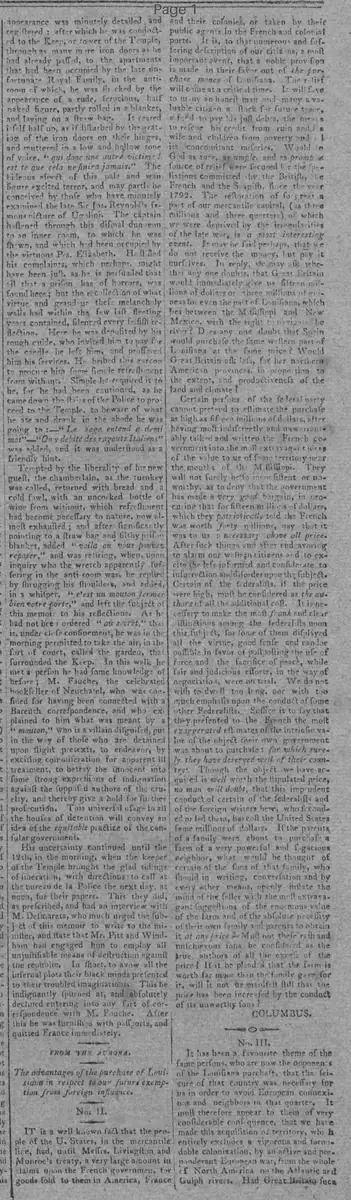
The advantages of the purchase of Louisiana in respect to our future exemption from foreign influence.
No. II.
IT is a well known fact that the people of the U. States, in the mercantile line, had, until Messrs. Livingston and Munroe's treaty, a very large amount in claims upon the French government, for goods sold to them in America, France and their colonies. or taken by their public agents in the French and colonial ports. It is, to that numerous and suffering description of our citizens, a most important event that a noble provision is made in their favor out of the purchase money of Louisiana. The relief will come at a critical time. It will serve to many an honest man and many a valuable citizen a stock for future trade, a fund to pay his just debts, the means to retrieve his credit from ruin and his wife and children from poverty and its concomitant miseries. Would to God as sure, as ample. and as prompt a source of relief were secured for the depredations committed by the British, the French and the Spanish, since the year 1792. The restoration of so great a part of our mercantile capital, (as three millions and three quarters) of which we were deprived by the irregularities of the late war, is a most interesting event. It may be said perhaps, that we do not receive the money, but pay it ourselves. In reply, we may ask whether any one doubts. that Great Britain would immediately give us fifteen millions of dollars or three millions of guineas for even the part of Louisiana, which lies between the Mississippi and New Mexico, with the right to navigate the river? Does any one doubt that Spain would purchase the same western part of Louisiana at the same price? Would Great Britain ask less, for her northern American provinces. in proportion to the extent, and productiveness of the land and climate?
Certain persons of the several parties cannot pretend to estimate the purchase as high as fifteen millions of dollars, after having most indiscreetly and unwarrantably talked and written the French government into the most extravagant ideas of the value to us of our territory near the mouths of the Mississippi. They will not surely be so inconsistent or unworthy, as to deny that the government has made a very good bargain, in procuring that for fifteen millions of dollars. which they patriotically told the French was worth forty millions, nay that it was to us a necessary above all price.
After such things and after endeavoring to alarm our western citizens as to excite the less informed and considerate to insurrection and disorder upon the subject. Certain of the federalists. if the price were high, must be considered as the authors of all the additional cost. It is necessary to make the most frank and clear distinctions among the federalists upon this subject, or some of them displayed all the virtue. good sense and candor possible in favor of postponing the use of force and the sacrifice of peace, while fair and judicious efforts, in the way of negotiation, were on trial. We do not wish to dwell too long. Nor with too much emphasis upon the conduct of some other Federalists. Suffice it to say that they presented to the French the most exaggerated estimates of the intrinsic value of the object their own government was about to purchase: for which surely they have deserved well of their country Though the object we have acquired is well worth the stipulated price, no man will doubt, that this impudent conduct of certain of the federalists and of the foreign writers here. who seconded or led them, has cost the United States some millions of dollars. If the parents of a family were about to purchase a farm of a very powerful and sagacious neighbor, what would be thought of certain of the sons of that family, who should in writing, conversation and by every other means, openly insinuate the mind of the seller with the most extravagant suggestions of the enormous value of the farm and of the absolute necessity of their own family and parents to obtain it at any price ? Must not these rash and mischievous sons be considered as the true. authors of all the excess of the price ? If it be pleaded that the farm is worth far more than the family gave for it, will it not be manifest still that the price has been increased by the conduct of its unworthy sons?
COLUMBUS.
No. III.
It has been a favourite theme of the same persons, who are now the opponents of the Louisiana purchase. that the seizure of that country was necessary for us in order to avoid European connections and neighbors in that quarter. It must therefore appear to them of very considerable consequence, that we have made this acquisition of territory, which entirely excludes a vigorous and formidable colonization, by an active and preponderant European power, from the whole North America on the Atlantic and Gulf rivers. Had Great Britain succeeded—while the governor of Canada, the British minister, their generals in St. Domingo, and governor Blount co-operated to secure the Spanish gulf provinces to England, we at least might have been liable to a continuation of all that excitement, influence and intrigue, which occasioned the British designs upon our treaty limits, Indian wars, the defeats of Harmar and St. Clair, the corruption of Blount, and the establishment of their known and secret Porcupinian gazettes, as avowed "Censors" of our legislative and executive governments, et multa alia ejus modi. It is no unworthy passion, that gives rise to these remarks. They are absolutely necessary to the just defence of the calm and prudent firmness of our government, lately urged with insults to war, and reviled with bitterness for preserving peace, by the successors of Porcupine and by the other friends, foreign and native, of exclusive British politics in the United States. If Great Britain had acquired the Mississippi provinces of Spain and France, would she not treat us as to that noble and all important river, as she treats our natural right to the St. Lawrence, which is shut to us with the utmost severity?--Would she not withhold the right of deposit at New-Orleans as she withheld Point au Fer, Oswego, Niagara, and Detroit? Would she not pay no regard to a right secured by Spain, in a form dangerously loose, what she did of parts of Pennsylvania, New York, &c. secured by the eleven precise treaty of 1783. "that we could not have them" that we could not have the country on the western side of Erie. Niagara, Ontario and St. Lawrence? Would it be more agreeable to the opponents of the treaty to have the French, whom they so much dislike, settled in Louisiana? Let them revise their own recent statements of the vast evils with which colonization in Louisiana was said to threaten us, and let them candidly say what an immense sum it is worth to avoid the long Catalogue of ills, which they so clamorously detailed. We acquire Louisiana without the effusion of one drop of human blood --one pang, one sigh, for distressed humanity. Glorious victory of firm pacific councils! Bloodless acquisition of a country so intrinsically valuable, so intimately connected with our prosperity, our union, and our peace! Every Louisianian rejoices, that he is become the citizen of a country, which protects his religion, secures his person and property, affords him the benefit of a cheap supply of every necessary, and opens the doors of a free commerce, sheltered by public functionaries of his own choice All are benefited. But the friends of war and conquest repine amidst the precious securities of our peace, liberty and safety, which result from the acquisition of Louisiana.
It is asserted, on various authorities, that the British government had lately attempted to purchase Louisiana from France. It is also well understood that the British government meditated an expedition against that province in May last, when they commenced hostilities against France. The danger of their depriving us of the country at the mouth of the Mississippi, has therefore been very lately renewed and repeated. If the world had continued in peace or war, we see in Canada, Halifax, Bermuda, and the Bahamas, the purposes of rivalry, depopulation and spoliation, to which the territory and the gulph ports might have been applied by Great Britain. If it be alleged, that France has influenced, intrigued in, pillaged the trade of, and menaced the United States. Great Britain has done the same, and even attempted partition. Both should have been resisted. The conduct of England in Canada, Halifax, Bermuda, and the Bahamas have taught us that she does not very greatly bless us by her near neighbourhood. Upon the present occasion, we most earnestly wished not to notice such facts, but the department of the foreign and American partizans of Great Britain in this Country, is so ungenerously, so indecently and so bitterly opposed to all our republican men, institutions and measures, that a defensive war against that hostile corps seems likely to be once more rendered necessary. They wished to beguile or drive us into a seizure of Louisiana to produce war between us and France. The insults of Porcupine to Mr. Adams were reiterated to president Jefferson, by the Charleston Gazette. Traduced as a coward, he intrepidly pursued the treaty under all these foreign attacks. Those men being likely to sustain a disappointment by the unexpected purchase of Louisiana, daily pour forth their abuse on the conduct of the president in this happy affair, and now labour to defeat the treaty in order to effect a rupture between him and the first Consul Bonaparte. Were that to take place, and Louisiana to return to France, the British with their present navy could make a successful expedition, and secure it to themselves. Services. With these pernicious and criminal views they will endeavour to effect discontent against the treaty in order to its rejection by the senate,-Every patriot in our public councils, of whatever state or party, if convinced of the reality of such a design, will exert his powers to render it abortive.
The Ship building, cooperage and lumber business of the United States, or the manufacture & export trade in wood, in various forms, is an object of considerable importance to every port, county and state on the Atlantic rivers or on the Mississippi : to some of them it is of the utmost consequence. Had the province of Louisiana remained in the hands of France or been purchased or seized by Great Britain, the most injurious interference with the American lumber trade and manufactures of wood must sooner or later, have certainly arisen. Those nations could have increased the impediments to the purchase of our ships by their citizens or subjects and they could have prohibited our staves and heading, hoops, boards, cantling shingles and knocked-down casks in all their colonies and ports. The evils, which the English mercantile writers foretold, (happily without verification) that we should sustain from the northern British colonies with regard to the lumber trade, would indeed have been fulfilled. if England had accomplished her original design to seize Louisiana by corrupting our public and private men, or if she had succeeded in her late attempt to purchase that province. or if she had carried into successful execution the expedition to take it which was formed in London in April or May. The states of New-Jersey and Delaware, the Maine district of Massachusetts. and most of the states would have deeply felt this evil. The vast carrying trade, which the Eastern states and our ports in general enjoy in transporting every year one hundred and sixty millions of boards, cantling, staves, hoops and shingles to foreign countries, would have been most seriously affected. The lumber of the Mississippi would have been carried in British ships only to British colonies and ports, The pine, oak, and cedar of New- Jersey. the cedar and other woods of Delaware, the pine and other woods of Maine, particularly, must have rotted on their hands. It is a deep error to suppose that the states have not each a great and real interest in this and other respects, in keeping Louisiana out of the hands of any great and active power of Europe.
The effects of the purchase of Louisiana upon the prices of grain, cattle, and fish, raised or caught by the people of the eastern and middle states will be very great and very favorable. The Americans are about five millions and one half. So many of them were employed in fishing, lumber cutting and raising grain and cattle, that the prices of fish wood, bread-stuff and meat were likely to fall, when the cultivation of cotton was suddenly extended to 30 millions of pounds. Those who were formerly employed in raising provisions and getting lumber, were taken off in great numbers from those employments, and engaged in raising cotton. The soil and climate of the southern part of Louisiana being capable of producing sugar, coffee, cocoa, pimento and ginger, it is manifest that many of our people, who have raised provisions or got lumber and would have reduced the prices of those articles, will be engaged in raising sugar. coffee, cocoa, pimento, &c. so as not only to prevent the reduction on the prices of lumber, provision, and cattle, but even to raise those prices. It is a certain truth, in farming and planting, that the greater the variety of the good consumable articles we bring to market the higher each will be. If all the Americans raised Indian corn and nothing else, we could not sell it. But, if they also catch fish and raise sugar, coffee, cocoa, rice, indigo, cotton, tobacco, wheat and other small grain, horses, sheep, horned cattle and wine, and make iron, lumber, and various manufactures, it is plain, that the Indian corn they raise will not only be kept from falling in price, but will actually be advanced in their markets.- Seven years ago we raised no cotton, we now raise thirty millions of pounds weight. The people who raise this immense quantity of cotton are kept from fishing, getting lumber, raising cattle and grain. So the Louisiana sugar, coffee, and cocoa planters will not employ themselves in raising cattle and provisions, getting lumber or catching fish, but will often buy those provisions from the more northern and eastern states.
COLUMBUS.
What sub-type of article is it?
What keywords are associated?
What entities or persons were involved?
Editorial Details
Primary Topic
Advantages Of The Louisiana Purchase For Exemption From Foreign Influence And Economic Benefits
Stance / Tone
Strongly Supportive Of The Purchase, Critical Of Federalists And British Sympathizers
Key Figures
Key Arguments