Thank you for visiting SNEWPapers!
Sign up free
The Mississippi Creole
Canton, Madison County, Mississippi
What is this article about?
Editorial reveals Senator Haywood's secret confidential talks with President Polk on opposing the new Tariff and adjusting Oregon stance to 49 degrees, kept hidden from party leaders like Cass, Allen, Benton, and the Union paper, critiquing the resulting political confusion and Polk's strategic secrecy to avert war and treasury bankruptcy.
Merged-components note: Sequential reading order and text continuity (cut-off and resumption) indicate continuation of editorial on President Polk's political secrecy and party dynamics.
Clipping
OCR Quality
Full Text
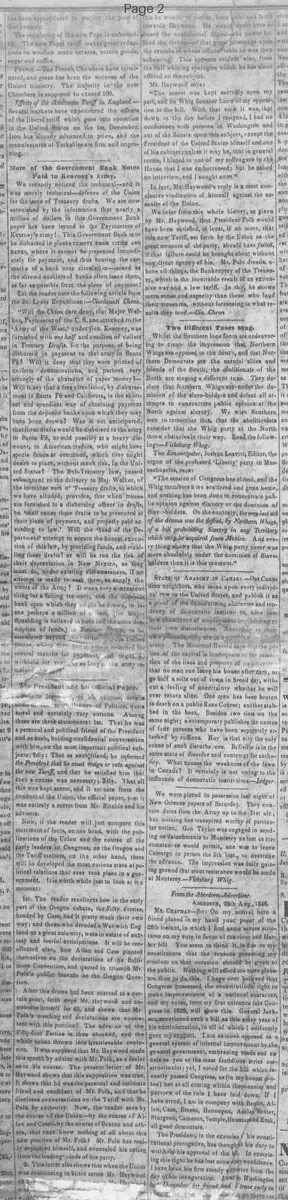
Senator Haywood, in his address, details some of the secret history of Politics, quite novel and certainly very curious. Among these are three statements: 1st. That he was a personal and political friend of the President and as such, holding confidential conversation with him, on the most important political subjects; 2dly: That as such friend, he informed the President that he must resign or vote against the new Tariff, and that he satisfied him that such a course was necessary; 3dly. That all this was kept secret, and it appears from the conduct of the Union, the official paper, that it was entirely a secret from Mr. Ritchie and his advisers.
Now, if the reader will just compare this statement of facts, on one hand, with the publications of the Union and the course of the party leaders in Congress, on the Oregon and the Tariff matters, on the other hand, there will be developed the most curious state of political relations that ever took place in a government. It is worth while just to look at it a moment:
1st. The reader recollects how in the early part of the Oregon debate, the Fifty Forties, headed by Cass, had it pretty much their own way; and those who dreaded a War with England as a great calamity, were in a state of anxiety and fearful anticipations. It will be recollected also, how Allen and Cass planted themselves on the declarations of the Baltimore Convention, and quoted in triumph Mr. Polk's public bravado on the Oregon Question.
After this drama had been enacted to a certain point, forth steps Mr. Haywood and announces himself for 49, and shows that Mr. Polk's meaning and declarations are consistent with this position! The advance of the Fifty-four Forties is thus checked, and the whole nation thrown into irretrievable confusion. It was supposed that Mr. Haywood made this speech by advice with Mr. Polk, as a feeler as to his course. The present letter of Mr. Haywood shows that this supposition was true. It shows that he was the personal and intimate friend and confidant of Mr. Polk, and that he discloses conversations on the Tariff with Mr. Polk by authority. Now, the reader sees by the course of the Union—by the course of Allen and Cass by the course of Benton and others, that they knew nothing at all about this new position of Mr. Polk! Mr. Polk has really separated himself, and concealed his action from the leading minds of his party.
This letter also shows that when the Union was denouncing in bitter terms Mr. Haywood ... My Hammond
...this he would, of course, have been meek as a lamb towards Haywood. He would never have abused the confidential friend—the power behind the throne—of that great personage upon the crumbs of whose official table he was then subsisting. This appears evident also, from the half whining apologies which he has since offered on the subject.
Mr. Haywood says:
"The Secret was kept sacredly upon my part, and no Whig Senator knew of my opposition to the bill. With that view it was, that down to the day before I resigned, I had no conference with persons in Washington and out of the Senate upon this subject, except the President of the United States himself and one of his cabinet; unless it may be, that in general terms, I hinted to one of my colleagues in the House that I was embarrassed; but he asked no interview, and I sought none."
In fact, Mr. Haywood's reply is a most conclusive vindication of himself against the assaults of the Union.
We infer from this whole history, as given by Mr. Haywood, that President Polk would have been satisfied, at least, if no more, that this new Tariff, set forth by the Union as the great measure of the party, should have failed, if that failure could be brought about without any direct agency of his. Mr. Polk dreads, above all things, the Bankruptcy of the Treasury, which is the inevitable result of an expensive war and a low tariff. In this, he shows more sense and sagacity than those who laud their measures, without foreseeing to what results they tend. Cin. Chron.
What sub-type of article is it?
What keywords are associated?
What entities or persons were involved?
Editorial Details
Primary Topic
Secret Conversations Between Senator Haywood And President Polk On Tariff And Oregon
Stance / Tone
Critical Of Political Secrecy And Party Divisions, Vindicating Haywood
Key Figures
Key Arguments