Thank you for visiting SNEWPapers!
Sign up free
Foreign News
July 8, 1816
Daily National Intelligencer
Washington, District Of Columbia
What is this article about?
An essay from the Paris Spectator on the history and persistence of dueling in France, from ancient origins to modern times, culminating in the fatal duel of young Alfred in early May 1813 near Boulogne woods.
Clipping
OCR Quality
95%
Excellent
Full Text
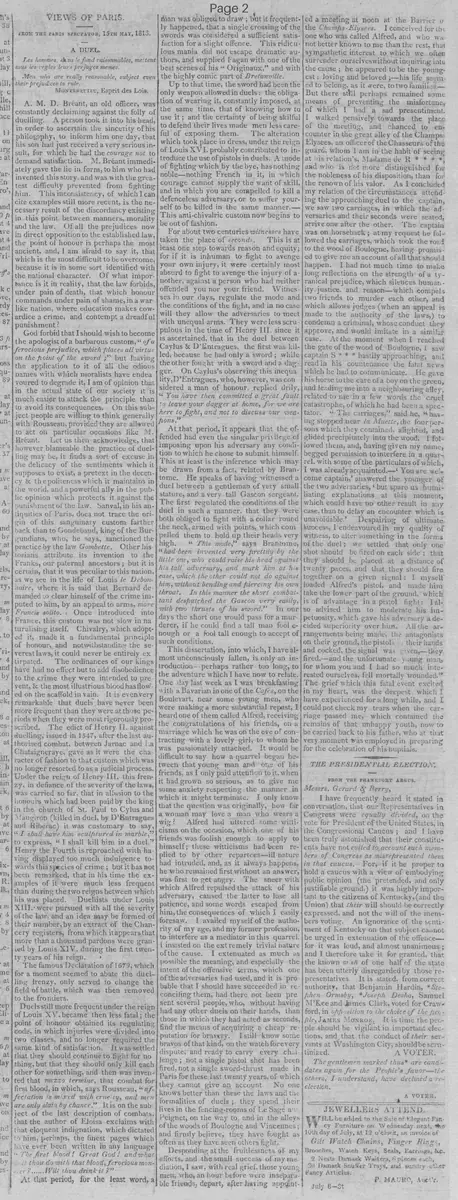
VIEWS OF PARIS.
FROM THE PARIS SPECTATOR, 15TH MAY, 1813
A DUEL.
Les hommes, dans le fond raisonnables, mettent sous les regles leurs prejuges memes.
Men who are really reasonable, subject even their prejudices to rule.
Montesquieu, Esprit des Lois.
A. M. D. Bréant, an old officer, was constantly declaiming against the folly of duelling. A person took it into his head, in order to ascertain the sincerity of his philosophy, to inform him one day, that his son had just received a very serious insult, for which he had the courage not to demand satisfaction. M. Bréant immediately gave the lie in form, to him who had invented this story, and was with the greatest difficulty prevented from fighting him. This inconsistency, of which I can cite examples still more recent, is the necessary result of the discordancy existing in this point between manners, morality and the law. Of all the prejudices now in direct opposition to the established law, the point of honour is perhaps the most ancient, and, I am afraid to say it, that which is the most difficult to be overcome, because it is in some sort identified with the national character. Of what importance is it in reality, that the law forbids, under pain of death, that which honour commands under pain of shame, in a warlike nation, where education makes cowardice a crime, and contempt a dreadful punishment?
God forbid that I should wish to become the apologist of a barbarous custom, of a ferocious prejudice, which places all virtue on the point of the sword; but leaving the application to it of all the odious names with which moralists have endeavoured to degrade it, I am of opinion that in the actual state of our society it is much easier to attack the principle than to avoid its consequences. On this subject people are willing to think generally with Rousseau, provided they are allowed to act on particular occasions like M. Bréant. Let us then acknowledge, that however blameable the practice of duelling may be, it finds a sort of excuse in the delicacy of the sentiments which it supposes to exist, a pretext in the decency & the politeness which it maintains in the world, and a powerful ally in the public opinion which protects it against the punishment of the law. Sanval, in his antiquities of Paris, does not trace the origin of this sanguinary custom farther back than to Gondebaud, king of the Burgundians, who, he says, sanctioned the practice by the law Gombette. Other historians attribute its invention to the Franks, our paternal ancestors; but it is certain, that it was peculiar to this nation, as we see in the life of Louis le Debonnaire, where it is said that Bernard demanded to clear himself of the crime imputed to him, by an appeal to arms, more Francico solito. Once introduced into France, this custom was not slow in naturalising itself. Chivalry, which adopted it, made it a fundamental principle of honour, and notwithstanding the severest laws, it could never be entirely extirpated. The ordinances of our kings have had no effect but to add disobedience to the crime they were intended to prevent, & the most illustrious blood has flowed on the scaffold in vain. It is even very remarkable that duels have never been more frequent than they were at those periods when they were most rigorously proscribed. The edict of Henry II. against duelling, issued in 1547, after the last authorised combat, between Jarnac and La Chataigneraye, gave as it were the character of fashion to that custom which was no longer resorted to as a judicial process. Under the reign of Henry III. this frenzy, in defiance of the severity of the laws, was carried so far, that in allusion to the honours which had been paid by the king in the church of St. Paul to Cylus and Vaugiron (killed in duel, by D'Entragues and Riberac) it was customary to say, "I shall have him sculptured in marble," to express, "I shall kill him in a duel."
Henry the Fourth is reproached with having displayed too much indulgence towards this species of crime; but it has not been remarked, that in his time the examples of it were much less frequent than during the two reigns between which his was placed. Duellists under Louis XIII. were pursued with all the severity of the law, and an idea may be formed of their number, by an extract of the Chancery registers, from which it appears that more than a thousand pardons were granted by Louis XIV. during the first twenty years of his reign.
The famous Declaration of 1679, which for a moment seemed to abate the duelling frenzy, only served to change the field of battle, which was then removed to the frontiers.
Duels still more frequent under the reign of Louis XV. became then less fatal; the point of honour obtained its regulating code, in which injuries were divided into two classes, and no longer required the same kind of satisfaction. It was settled that they should continue to fight for nothing, but that they should only kill each other for something, and then was invented that mezzo termine, that combat for first blood, in which, says Rousseau, "affectation is mixed with cruelty and men are only slain by chance." It is on the subject of the last description of combats that the author of Eloisa exclaims with that eloquent indignation, which dictated to him, perhaps, the finest pages which have ever been written in any language. The first blood! Great God! and what thou do with that blood, ferocious monster?......Wilt thou drink it?
At that period, for the least word, a man was obliged to draw; but it frequently happened, that a single crossing of the swords was considered a sufficient satisfaction for a slight offence. This ridiculous mania did not escape dramatic authors, and supplied Fagan with one of the best scenes of his "Originaux," and with the highly comic part of Bretanville.
Up to that time, the sword had been the only weapon allowed in duels: the obligation of wearing it, constantly imposed, at the same time, that of knowing how to use it; and the certainty of being skilful to defend their lives made men less careful of exposing them. The alteration which took place in dress, under the reign of Louis XVI. probably contributed to introduce the use of pistols in duels. A mode of fighting which by the bye, has nothing noble--nothing French in it, in which courage cannot supply the want of skill, and in which you are compelled to kill a defenceless adversary, or to suffer yourself to be killed in the same manner. This anti-chivalric custom now begins to be out of fashion.
For about two centuries witnesses have taken the place of seconds. This is at least one step towards reason and equity; for if it is inhuman to fight to avenge your own injury, it were certainly most absurd to fight to avenge the injury of another, against a person who had neither offended you nor your friend. Witnesses in our days, regulate the mode and the conditions of the fight, and in no case will they allow the adversaries to meet with unequal arms. They were less scrupulous in the time of Henry III. since it is ascertained, that in the duel between Caylus & D'Entragues, the first was killed, because he had only a sword; while the other fought with a sword and a dagger. On Caylus's observing this inequality, D'Entragues, who, however, was considered a man of honour, replied drily, "You have then committed a great fault to leave your dagger at home, for we are here to fight, and not to discuss our weapons."
At that period, it appears that the offended had even the singular privilege of imposing upon his adversary any condition to which he chose to submit himself. This at least is the inference which may be drawn from a fact, related by Brantome. He speaks of having witnessed a duel between a gentleman of very small stature, and a very tall Gascon sergeant. The first regulated the conditions of the duel in such a manner, that they were both obliged to fight with a collar round the neck, armed with points, which compelled them to hold up their heads very high. "This mode," says Brantome, "had been invented very prettily by the little one, who could raise his head against his tall adversary, and mark him at his ease, which the other could not do against him, without bending and piercing his own throat. In this manner the short combatant despatched the Gascon very easily, with two thrusts of his sword." In our days the short one would pass for a murderer, if he could find a tall man fool enough or a fool tall enough to accept of such conditions.
This dissertation, into which I have almost unconsciously fallen, is only an introduction--perhaps rather too long, to the adventure which I have now to relate.
One day last week as I was breakfasting with a Bavarian in one of the Cafes, on the Boulevart, near some young men, who were making a more substantial repast, I heard one of them called Alfred, receiving the congratulations of his friends, on a marriage which he was on the eve of contracting with a lovely girl, to whom he was passionately attached. It would be difficult to say how a quarrel began between that young man and one of his friends, as I only paid attention to it, when it had grown so serious, as to give me some anxiety respecting the manner in which it might terminate. I only know that the question was originally, how far a woman may love a man who wears a wig? Alfred had uttered some witticisms on the occasion, which one of his friends was foolish enough to apply to himself; these witticisms had been replied to by other repartees--ill nature had intruded, and, as it always happens, he who remained first without an answer, was first to get angry. The sneer with which Alfred repulsed the attack of his adversary, caused the latter to lose all patience, and some words escaped from him, the consequences of which I easily foresaw. I availed myself of the authority of my age, and my former profession, to interfere as a mediator in this quarrel. I insisted on the extremely trivial nature of the cause. I extenuated as much as possible the meaning, and especially the intent of the offensive terms, which one of the adversaries had used, and it is probable that I should have succeeded in reconciling them, had there not been present several people, who, without having had any other duels on their hands, than those in which they had acted as seconds, find the means of acquiring a cheap reputation for bravery. I still know some bravos of that kind, on the watch for every dispute, and ready to carry every challenge; not a single pistol shot has been fired, not a single sword-thrust made in Paris for these last twenty years, of which they cannot give an account. No one knows better than these the laws and the formalities of duels; they spend their lives in the fencing-rooms of Le Sage and Peignet, on the way to, and in the alleys of the woods of Boulogne and Vincennes; and firmly believe, they have fought as often as they have seen others fight.
Desponding at the fruitlessness of my efforts, and the small success of my mediation, I saw, with real grief, those young men, who, an hour before were inseparable friends, depart, after having appointed a meeting at noon at the Barrier of the Champs-Elysees. I conceived for the one who was called Alfred, and who was not better known to me than the rest, that sympathetic interest to which we often surrender ourselves without inquiring into the cause; he appeared to be the youngest; loving and beloved;--his life seemed to belong, as it were, to two families.— But there still perhaps remained some means of preventing the misfortune of which I had a sad presentiment.
I walked pensively towards the place of the meeting, and chanced to encounter in the great alley of the Champs Elysees, an officer of the Chasseurs of the guard, whom I am in the habit of seeing at his relation's, Madame de R * * *, and who is not more distinguished for the nobleness of his disposition, than for the renown of his valor. As I concluded my relation of the circumstances attending the approaching duel to the captain, we saw two carriages, in which the adversaries and their seconds were seated, arrive one after the other. The captain was on horseback; at my request he followed the carriages, which took the road to the wood of Boulogne, having promised to give me an account of all that should happen. I had not much time to make long reflections on the strength of a tyrannical prejudice, which silences humanity, justice, and reason--which compels two friends to murder each other, and which allows judges (when an appeal is made to the authority of the laws,) to condemn a criminal, whose conduct they approve, and would imitate in a similar case. At the moment when I reached the gate of the wood of Boulogne, I saw captain S * * * hastily approaching, and read in his countenance the fatal news which he had to communicate. He gave his horse to the care of a boy on the green, and leading me into a neighbouring alley, related to me in a few words the cruel catastrophe, of which he had been a spectator. "The carriages," said he, "having stopped near la Muette, the four persons which they contained, alighted, and glided precipitately into the wood. I followed them, and, having given my name, begged permission to interfere in a quarrel, with some of the particulars of which, I was already acquainted.--' You are welcome captain,' answered the younger of the two adversaries, 'but spare us humiliating explanations at this moment, which could have no other result in any case, than to delay an encounter which is unavoidable.' Despairing of ultimate success, I endeavoured in my quality of witness, to alter something in the forms of the duel; we settled that only one shot should be fired on each side; that they should be placed at a distance of twenty paces, and that they should fire together on a given signal: I myself loaded Alfred's pistol, and made him take the lower part of the ground, which is of advantage in a pistol fight: I also advised him to moderate his impetuosity, which gave his adversary a decided superiority over him. All the arrangements being made, the antagonists on their ground, the pistols in their hands and cocked, the signal was given,--they fired,--and the unfortunate young man, for whom you and I had so much interested ourselves, fell mortally wounded."
The grief which this fatal event excited in my heart, was the deepest which I have experienced for a long while, and I could not check my tears when the carriage passed me, which contained the remains of that unhappy youth, now to be carried back to his father, who at that very moment was employed in preparing for the celebration of his nuptials.
FROM THE PARIS SPECTATOR, 15TH MAY, 1813
A DUEL.
Les hommes, dans le fond raisonnables, mettent sous les regles leurs prejuges memes.
Men who are really reasonable, subject even their prejudices to rule.
Montesquieu, Esprit des Lois.
A. M. D. Bréant, an old officer, was constantly declaiming against the folly of duelling. A person took it into his head, in order to ascertain the sincerity of his philosophy, to inform him one day, that his son had just received a very serious insult, for which he had the courage not to demand satisfaction. M. Bréant immediately gave the lie in form, to him who had invented this story, and was with the greatest difficulty prevented from fighting him. This inconsistency, of which I can cite examples still more recent, is the necessary result of the discordancy existing in this point between manners, morality and the law. Of all the prejudices now in direct opposition to the established law, the point of honour is perhaps the most ancient, and, I am afraid to say it, that which is the most difficult to be overcome, because it is in some sort identified with the national character. Of what importance is it in reality, that the law forbids, under pain of death, that which honour commands under pain of shame, in a warlike nation, where education makes cowardice a crime, and contempt a dreadful punishment?
God forbid that I should wish to become the apologist of a barbarous custom, of a ferocious prejudice, which places all virtue on the point of the sword; but leaving the application to it of all the odious names with which moralists have endeavoured to degrade it, I am of opinion that in the actual state of our society it is much easier to attack the principle than to avoid its consequences. On this subject people are willing to think generally with Rousseau, provided they are allowed to act on particular occasions like M. Bréant. Let us then acknowledge, that however blameable the practice of duelling may be, it finds a sort of excuse in the delicacy of the sentiments which it supposes to exist, a pretext in the decency & the politeness which it maintains in the world, and a powerful ally in the public opinion which protects it against the punishment of the law. Sanval, in his antiquities of Paris, does not trace the origin of this sanguinary custom farther back than to Gondebaud, king of the Burgundians, who, he says, sanctioned the practice by the law Gombette. Other historians attribute its invention to the Franks, our paternal ancestors; but it is certain, that it was peculiar to this nation, as we see in the life of Louis le Debonnaire, where it is said that Bernard demanded to clear himself of the crime imputed to him, by an appeal to arms, more Francico solito. Once introduced into France, this custom was not slow in naturalising itself. Chivalry, which adopted it, made it a fundamental principle of honour, and notwithstanding the severest laws, it could never be entirely extirpated. The ordinances of our kings have had no effect but to add disobedience to the crime they were intended to prevent, & the most illustrious blood has flowed on the scaffold in vain. It is even very remarkable that duels have never been more frequent than they were at those periods when they were most rigorously proscribed. The edict of Henry II. against duelling, issued in 1547, after the last authorised combat, between Jarnac and La Chataigneraye, gave as it were the character of fashion to that custom which was no longer resorted to as a judicial process. Under the reign of Henry III. this frenzy, in defiance of the severity of the laws, was carried so far, that in allusion to the honours which had been paid by the king in the church of St. Paul to Cylus and Vaugiron (killed in duel, by D'Entragues and Riberac) it was customary to say, "I shall have him sculptured in marble," to express, "I shall kill him in a duel."
Henry the Fourth is reproached with having displayed too much indulgence towards this species of crime; but it has not been remarked, that in his time the examples of it were much less frequent than during the two reigns between which his was placed. Duellists under Louis XIII. were pursued with all the severity of the law, and an idea may be formed of their number, by an extract of the Chancery registers, from which it appears that more than a thousand pardons were granted by Louis XIV. during the first twenty years of his reign.
The famous Declaration of 1679, which for a moment seemed to abate the duelling frenzy, only served to change the field of battle, which was then removed to the frontiers.
Duels still more frequent under the reign of Louis XV. became then less fatal; the point of honour obtained its regulating code, in which injuries were divided into two classes, and no longer required the same kind of satisfaction. It was settled that they should continue to fight for nothing, but that they should only kill each other for something, and then was invented that mezzo termine, that combat for first blood, in which, says Rousseau, "affectation is mixed with cruelty and men are only slain by chance." It is on the subject of the last description of combats that the author of Eloisa exclaims with that eloquent indignation, which dictated to him, perhaps, the finest pages which have ever been written in any language. The first blood! Great God! and what thou do with that blood, ferocious monster?......Wilt thou drink it?
At that period, for the least word, a man was obliged to draw; but it frequently happened, that a single crossing of the swords was considered a sufficient satisfaction for a slight offence. This ridiculous mania did not escape dramatic authors, and supplied Fagan with one of the best scenes of his "Originaux," and with the highly comic part of Bretanville.
Up to that time, the sword had been the only weapon allowed in duels: the obligation of wearing it, constantly imposed, at the same time, that of knowing how to use it; and the certainty of being skilful to defend their lives made men less careful of exposing them. The alteration which took place in dress, under the reign of Louis XVI. probably contributed to introduce the use of pistols in duels. A mode of fighting which by the bye, has nothing noble--nothing French in it, in which courage cannot supply the want of skill, and in which you are compelled to kill a defenceless adversary, or to suffer yourself to be killed in the same manner. This anti-chivalric custom now begins to be out of fashion.
For about two centuries witnesses have taken the place of seconds. This is at least one step towards reason and equity; for if it is inhuman to fight to avenge your own injury, it were certainly most absurd to fight to avenge the injury of another, against a person who had neither offended you nor your friend. Witnesses in our days, regulate the mode and the conditions of the fight, and in no case will they allow the adversaries to meet with unequal arms. They were less scrupulous in the time of Henry III. since it is ascertained, that in the duel between Caylus & D'Entragues, the first was killed, because he had only a sword; while the other fought with a sword and a dagger. On Caylus's observing this inequality, D'Entragues, who, however, was considered a man of honour, replied drily, "You have then committed a great fault to leave your dagger at home, for we are here to fight, and not to discuss our weapons."
At that period, it appears that the offended had even the singular privilege of imposing upon his adversary any condition to which he chose to submit himself. This at least is the inference which may be drawn from a fact, related by Brantome. He speaks of having witnessed a duel between a gentleman of very small stature, and a very tall Gascon sergeant. The first regulated the conditions of the duel in such a manner, that they were both obliged to fight with a collar round the neck, armed with points, which compelled them to hold up their heads very high. "This mode," says Brantome, "had been invented very prettily by the little one, who could raise his head against his tall adversary, and mark him at his ease, which the other could not do against him, without bending and piercing his own throat. In this manner the short combatant despatched the Gascon very easily, with two thrusts of his sword." In our days the short one would pass for a murderer, if he could find a tall man fool enough or a fool tall enough to accept of such conditions.
This dissertation, into which I have almost unconsciously fallen, is only an introduction--perhaps rather too long, to the adventure which I have now to relate.
One day last week as I was breakfasting with a Bavarian in one of the Cafes, on the Boulevart, near some young men, who were making a more substantial repast, I heard one of them called Alfred, receiving the congratulations of his friends, on a marriage which he was on the eve of contracting with a lovely girl, to whom he was passionately attached. It would be difficult to say how a quarrel began between that young man and one of his friends, as I only paid attention to it, when it had grown so serious, as to give me some anxiety respecting the manner in which it might terminate. I only know that the question was originally, how far a woman may love a man who wears a wig? Alfred had uttered some witticisms on the occasion, which one of his friends was foolish enough to apply to himself; these witticisms had been replied to by other repartees--ill nature had intruded, and, as it always happens, he who remained first without an answer, was first to get angry. The sneer with which Alfred repulsed the attack of his adversary, caused the latter to lose all patience, and some words escaped from him, the consequences of which I easily foresaw. I availed myself of the authority of my age, and my former profession, to interfere as a mediator in this quarrel. I insisted on the extremely trivial nature of the cause. I extenuated as much as possible the meaning, and especially the intent of the offensive terms, which one of the adversaries had used, and it is probable that I should have succeeded in reconciling them, had there not been present several people, who, without having had any other duels on their hands, than those in which they had acted as seconds, find the means of acquiring a cheap reputation for bravery. I still know some bravos of that kind, on the watch for every dispute, and ready to carry every challenge; not a single pistol shot has been fired, not a single sword-thrust made in Paris for these last twenty years, of which they cannot give an account. No one knows better than these the laws and the formalities of duels; they spend their lives in the fencing-rooms of Le Sage and Peignet, on the way to, and in the alleys of the woods of Boulogne and Vincennes; and firmly believe, they have fought as often as they have seen others fight.
Desponding at the fruitlessness of my efforts, and the small success of my mediation, I saw, with real grief, those young men, who, an hour before were inseparable friends, depart, after having appointed a meeting at noon at the Barrier of the Champs-Elysees. I conceived for the one who was called Alfred, and who was not better known to me than the rest, that sympathetic interest to which we often surrender ourselves without inquiring into the cause; he appeared to be the youngest; loving and beloved;--his life seemed to belong, as it were, to two families.— But there still perhaps remained some means of preventing the misfortune of which I had a sad presentiment.
I walked pensively towards the place of the meeting, and chanced to encounter in the great alley of the Champs Elysees, an officer of the Chasseurs of the guard, whom I am in the habit of seeing at his relation's, Madame de R * * *, and who is not more distinguished for the nobleness of his disposition, than for the renown of his valor. As I concluded my relation of the circumstances attending the approaching duel to the captain, we saw two carriages, in which the adversaries and their seconds were seated, arrive one after the other. The captain was on horseback; at my request he followed the carriages, which took the road to the wood of Boulogne, having promised to give me an account of all that should happen. I had not much time to make long reflections on the strength of a tyrannical prejudice, which silences humanity, justice, and reason--which compels two friends to murder each other, and which allows judges (when an appeal is made to the authority of the laws,) to condemn a criminal, whose conduct they approve, and would imitate in a similar case. At the moment when I reached the gate of the wood of Boulogne, I saw captain S * * * hastily approaching, and read in his countenance the fatal news which he had to communicate. He gave his horse to the care of a boy on the green, and leading me into a neighbouring alley, related to me in a few words the cruel catastrophe, of which he had been a spectator. "The carriages," said he, "having stopped near la Muette, the four persons which they contained, alighted, and glided precipitately into the wood. I followed them, and, having given my name, begged permission to interfere in a quarrel, with some of the particulars of which, I was already acquainted.--' You are welcome captain,' answered the younger of the two adversaries, 'but spare us humiliating explanations at this moment, which could have no other result in any case, than to delay an encounter which is unavoidable.' Despairing of ultimate success, I endeavoured in my quality of witness, to alter something in the forms of the duel; we settled that only one shot should be fired on each side; that they should be placed at a distance of twenty paces, and that they should fire together on a given signal: I myself loaded Alfred's pistol, and made him take the lower part of the ground, which is of advantage in a pistol fight: I also advised him to moderate his impetuosity, which gave his adversary a decided superiority over him. All the arrangements being made, the antagonists on their ground, the pistols in their hands and cocked, the signal was given,--they fired,--and the unfortunate young man, for whom you and I had so much interested ourselves, fell mortally wounded."
The grief which this fatal event excited in my heart, was the deepest which I have experienced for a long while, and I could not check my tears when the carriage passed me, which contained the remains of that unhappy youth, now to be carried back to his father, who at that very moment was employed in preparing for the celebration of his nuptials.
What sub-type of article is it?
Duelling Custom
Fatal Duel
What keywords are associated?
Duelling History
French Customs
Paris Duel
Fatal Shooting
Point Of Honour
Alfred Death
What entities or persons were involved?
M. D. Bréant
Alfred
Captain S * * *
Where did it happen?
Paris
Foreign News Details
Primary Location
Paris
Event Date
One Day Last Week, As Of 15 May 1813
Key Persons
M. D. Bréant
Alfred
Captain S * * *
Outcome
alfred mortally wounded and killed in pistol duel
Event Details
Essay on history of dueling in France from ancient times through reigns of kings, critiquing the custom; recent incident where young Alfred quarreled over trivial matter in cafe, dueled with pistols in wood of Boulogne, and was fatally shot despite mediation attempts.