Thank you for visiting SNEWPapers!
Sign up free
Editorial
August 11, 1846
The New Hampshire Gazette
Portsmouth, Rockingham County, New Hampshire
What is this article about?
An editorial defends John C. Calhoun's Senate report on the Memphis Convention's memorial, arguing for constitutional federal supervision of Mississippi River navigation as an inland sea, while opposing broader internal improvements. It clarifies misconceptions and reprints supportive commentary from the Charleston Mercury, emphasizing strict constructionism.
Clipping
OCR Quality
98%
Excellent
Full Text
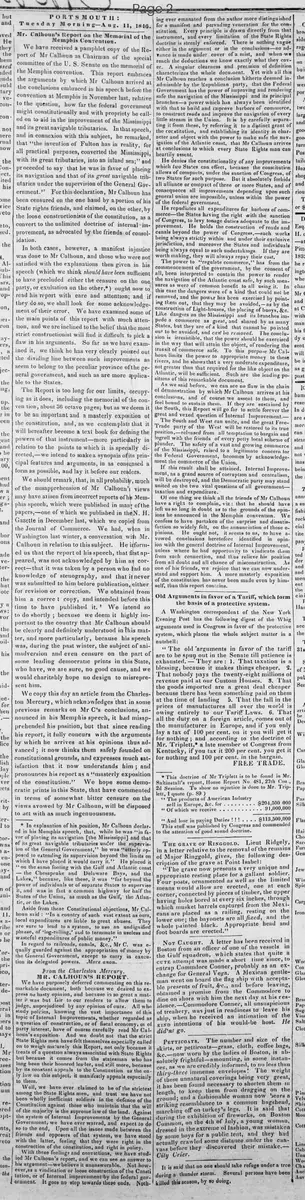
PORTSMOUTH: Tuesday Morning—Aug. 11, 1846.
Mr. Calhoun's Report on the Memorial of the Memphis Convention.
We have received a pamphlet copy of the Report of Mr Calhoun as Chairman of the special committee of the U. S. Senate on the memorial of the Memphis convention. This report embraces the arguments by which Mr Calhoun arrived at the conclusions embraced in his speech before the convention at Memphis in November last, relative to the question, how far the federal government might constitutionally and with propriety be called on to aid in the improvement of the Mississippi and its great navigable tributaries. In that speech, and in connexion with this subject, he remarked, that "the invention of Fulton has in reality, for all practical purposes, converted the Mississippi, with its great tributaries, into an inland sea;" and proceeded to say that he was in favor of placing its navigation and that of its great navigable tributaries under the supervision of the General Government." For this declaration, Mr Calhoun has been censured on the one hand by a portion of his State rights friends, and claimed, on the other, by the loose constructionists of the constitution, as a convert to the unlimited doctrine of internal improvement, as advocated by the friends of consolidation.
In both cases, however, a manifest injustice was done to Mr Calhoun, and those who were not satisfied with the explanations then given in his speech (which we think should have been sufficient to have precluded either the censure on the one party, or exultation on the other, *) ought now to read his report with care and attention; and if they do so, we shall look for some acknowledgment of their error. We have examined some of the main points of this report with much attention, and we are inclined to the belief that the most strict constructionist will find it difficult to pick a flaw in his arguments. So far as we have examined it, we think he has very clearly pointed out the dividing line between such improvements as seem to belong to the peculiar province of the general government, and such as are more applicable to the States.
The Report is too long for our limits, occupying as it does, including the memorial of the convention, about 36 octavo pages; but as we deem it to be an important and a masterly exposition of the constitution, and, as we contemplate that it will hereafter become a text book for defining the powers of that instrument—more particularly in relation to the points to which it is specially directed,—we intend to make a synopsis of its principal features and arguments, in as concensed a form as possible, and lay it before our readers.
We should remark, that, in all probability, much of the misapprehension of Mr Calhoun's views may have arisen from incorrect reports of his Memphis speech, which were published in many of the papers,—one of which we published in the N. H. Gazette in December last, which we copied from the Journal of Commerce. We had, when in Washington last winter, a conversation with Mr. Calhoun in relation to this subject. He informed us that the report of his speech, that first appeared, was not acknowledged by him as correct—that it was taken by a person who had no knowledge of stenography, and that it never was submitted to him before publication, either for revision or correction. We obtained from him a correct copy, and intended before this time to have published it. We intend so to do shortly; because we deem it highly important to the country that Mr Calhoun should be clearly and definitely understood in this matter, and more particularly, because his speech was, during the past winter, the subject of animadversion and even censure on the part of some leading democratic prints in this State, who have, we are sure, no good cause, and we would charitably hope no design to misrepresent him.
We copy this day an article from the Charleston Mercury, which acknowledges that in some previous remarks on Mr C's conclusions, announced in his Memphis speech, it had misapprehended his position, but that since reading his report, it fully concurs with the arguments by which he arrives at his opinions thus advanced; it now thinks them safely founded on constitutional grounds, and expresses much satisfaction that it now understands him; and pronounces his report as a "masterly exposition of the constitution." We hope some democratic prints in this State, that have commented in terms of somewhat bitter censure on the views avowed by Mr Calhoun, will be disposed to act with as much ingenuousness.
* In explanation of his position, Mr Calhoun declared in his Memphis speech, that, while he was "in favor of placing its navigation [the Mississippi] and that of its great navigable tributaries under the supervision of the General Government," he was "utterly opposed to extending its supervision beyond the limits on which I have placed it would carry it." He placed it "on the same footing with the Gulf and Atlantic coast—the Chesapeake and Delaware Bays, and the Lakes," because, like these, it was "far beyond the power of individuals or of separate States to supervise it, and was in fact a common highway for half the States of the Union, as much as the Gulf, the Atlantic, or the Lakes."
Aside from these Constitutional objections, Mr Calhoun said : "In a country of such vast extent as ours, local expenditures are liable to great abuses. They are sure to lead to a system, to use an undignified phrase, of 'log-rolling,' and to terminate in useless and wasteful expenditures of public money."
In regard to railroads, canals, &c., Mr C. was equally guarded against the appropriation of money by the General Government, except to carry in execution its delegated powers. More anon.
From the Charleston Mercury.
MR. CALHOUN'S REPORT.
We have purposely deferred commenting on this remarkable document, both because we desired to express no hasty opinion, and because in so great a matter it was but fair to our readers to allow them to judge, unprejudiced by any opinion of ours. All who study politics, knowing the vast importance of this topic of Internal Improvements, whether regarded as a question of construction, or of fiscal economy, or of party interest, have of course carefully read Mr Calhoun's exposition. And we doubt not that the strict State Rights men have felt themselves especially called on to weigh maturely this Report, not only because it treats of a question always associated with State Rights but because it comes from the statesman who has long been their honored leader, and still more, because by its constant appeals to the Constitution as the only law on this subject, it manifestly appeals especially to them.
Well, we have ever claimed to be of the strictest among the State Rights men, and trust we have not been wholly inefficient soldiers in the defence of the Constitution against those who maintain that the will of the majority is the supreme law of the land. Against the system of Internal Improvements by the General Government, we have ever warred, and expect to do so to the end, Upon all the issues made between the friends and opposers of that system, we have stood with the latter, feeling that they were right in the construction of the constitution, and right in policy.
With these feelings and convictions, we have studied Mr Calhoun's report, and we can see no answer to his argument—we believe it unanswerable. Not however, as a vindication or loose construction of the Constitution, or of Internal improvement by the federal government. It goes no step towards these ends, Nothing ever emanated from the author more distinguished for a manifest and pervading veneration for the constitution. Every principle is drawn directly from that instrument, and every limitation of the State Rights doctrine is sternly enforced. There is nothing vague either in the argument or in the conclusions—no advance is made under cover of a mist, and when we reach the deductions we know exactly what they cover. A singular clearness and precision of definition characterizes the whole document. Yet with all this Mr Calhoun reaches a conclusion hitherto deemed inadmissible by the Republican party, that the Federal Government has the power of improving and rendering safe the navigation of the Mississippi and its principal branches—a power which has always been identified with that to build and improve harbors of commerce, to construct roads and improve the navigation of every little stream in the Union. It is by carefully separating it from these, by referring it to a distinct grant of the constitution, and establishing its identity in character and object with the power to make safe the navigation of the Atlantic coast, that Mr Calhoun arrives at conclusions to which every State Rights man can heartily assent.
He denies the constitutionality of any improvements which two States can effect, because the constitution allows of compacts, under the sanction of Congress, of two States for such purpose. But it absolutely forbids all alliance or compact of three or more States, and of consequence all improvements depending upon such general union are impossible, unless within the power of the federal government.
He repudiates all expenditures for harbors of commerce—the States having the right with the sanction of Congress, to levy tonnage duties adequate to the improvement. He holds the construction of roads and canals beyond the power of Congress,—such works being always strictly within and under their exclusive jurisdiction, and moreover the States and individuals being always equal to such undertakings. If they are worth making, they will always repay their cost.
The power to "regulate commerce," has from the commencement of the government, by the consent of all, been interpreted to contain the power to render the navigation of the Atlantic coast safe, by such measures as were of common benefit to all using it. In this case the dangers were of a kind that could not be removed, and the power has been exercised by pointing them out, that they may be avoided,—as by the construction of Light-houses, the placing of buoys, &c. Like dangers on the Mississippi and its branches impede a commerce as great, and shared by as many States, but they are of a kind that cannot be pointed out to be avoided, and can be removed. The conclusion is irresistible, that the power should be exercised in the way that will attain the object, of rendering the transit of commerce safe. To this purpose Mr Calhoun limits the power to appropriate money to these rivers, and he shows that a very moderate expenditure, not greater than that required for the like object on the Atlantic, will be sufficient. Such are the leading positions of this remarkable document.
As we said before, we can see no flaw in the chain of demonstration by which Mr Calhoun arrives at his conclusions, and of course we assent to them, and feel bound to sustain them. If they are sustained by the South, this Report will go far to settle forever the great and vexed question of Internal Improvement.—The South and West can unite, and the great Free Trade party of the West will be restored to its true position,—released from all temptation to bargain and logroll with the friends of every petty local scheme of plunder. The safety of a vast and growing commerce of the Mississippi, raised to a legitimate concern for the Federal Government, becomes by acknowledgment the commerce of the Union.
If this result shall be attained. Internal Improvement, as a grand source of corruption and centralism, will be destroyed, and the Democratic party may stand united on the two vital questions of all government—taxation and expenditure.
Of one thing we think all the friends of Mr Calhoun have a right to complain, viz: that he should have left us so long in doubt as to the grounds of the opinions he announced in the Memphis convention. We confess to have partaken of the surprise and dissatisfaction so widely felt, on the annunciation of those opinions. He ought not, it seems to us, to have avowed conclusions heretofore identified in opinion with the general doctrine of Internal Improvement, unless where he had opportunity to vindicate them from such connection, and thus relieve his position from all doubt and all chance of misconstruction. As one of his friends, we rejoice that we can now understand and support him. A more masterly exposition of the constitution has never been made even by himself, than this report contains.
Mr. Calhoun's Report on the Memorial of the Memphis Convention.
We have received a pamphlet copy of the Report of Mr Calhoun as Chairman of the special committee of the U. S. Senate on the memorial of the Memphis convention. This report embraces the arguments by which Mr Calhoun arrived at the conclusions embraced in his speech before the convention at Memphis in November last, relative to the question, how far the federal government might constitutionally and with propriety be called on to aid in the improvement of the Mississippi and its great navigable tributaries. In that speech, and in connexion with this subject, he remarked, that "the invention of Fulton has in reality, for all practical purposes, converted the Mississippi, with its great tributaries, into an inland sea;" and proceeded to say that he was in favor of placing its navigation and that of its great navigable tributaries under the supervision of the General Government." For this declaration, Mr Calhoun has been censured on the one hand by a portion of his State rights friends, and claimed, on the other, by the loose constructionists of the constitution, as a convert to the unlimited doctrine of internal improvement, as advocated by the friends of consolidation.
In both cases, however, a manifest injustice was done to Mr Calhoun, and those who were not satisfied with the explanations then given in his speech (which we think should have been sufficient to have precluded either the censure on the one party, or exultation on the other, *) ought now to read his report with care and attention; and if they do so, we shall look for some acknowledgment of their error. We have examined some of the main points of this report with much attention, and we are inclined to the belief that the most strict constructionist will find it difficult to pick a flaw in his arguments. So far as we have examined it, we think he has very clearly pointed out the dividing line between such improvements as seem to belong to the peculiar province of the general government, and such as are more applicable to the States.
The Report is too long for our limits, occupying as it does, including the memorial of the convention, about 36 octavo pages; but as we deem it to be an important and a masterly exposition of the constitution, and, as we contemplate that it will hereafter become a text book for defining the powers of that instrument—more particularly in relation to the points to which it is specially directed,—we intend to make a synopsis of its principal features and arguments, in as concensed a form as possible, and lay it before our readers.
We should remark, that, in all probability, much of the misapprehension of Mr Calhoun's views may have arisen from incorrect reports of his Memphis speech, which were published in many of the papers,—one of which we published in the N. H. Gazette in December last, which we copied from the Journal of Commerce. We had, when in Washington last winter, a conversation with Mr. Calhoun in relation to this subject. He informed us that the report of his speech, that first appeared, was not acknowledged by him as correct—that it was taken by a person who had no knowledge of stenography, and that it never was submitted to him before publication, either for revision or correction. We obtained from him a correct copy, and intended before this time to have published it. We intend so to do shortly; because we deem it highly important to the country that Mr Calhoun should be clearly and definitely understood in this matter, and more particularly, because his speech was, during the past winter, the subject of animadversion and even censure on the part of some leading democratic prints in this State, who have, we are sure, no good cause, and we would charitably hope no design to misrepresent him.
We copy this day an article from the Charleston Mercury, which acknowledges that in some previous remarks on Mr C's conclusions, announced in his Memphis speech, it had misapprehended his position, but that since reading his report, it fully concurs with the arguments by which he arrives at his opinions thus advanced; it now thinks them safely founded on constitutional grounds, and expresses much satisfaction that it now understands him; and pronounces his report as a "masterly exposition of the constitution." We hope some democratic prints in this State, that have commented in terms of somewhat bitter censure on the views avowed by Mr Calhoun, will be disposed to act with as much ingenuousness.
* In explanation of his position, Mr Calhoun declared in his Memphis speech, that, while he was "in favor of placing its navigation [the Mississippi] and that of its great navigable tributaries under the supervision of the General Government," he was "utterly opposed to extending its supervision beyond the limits on which I have placed it would carry it." He placed it "on the same footing with the Gulf and Atlantic coast—the Chesapeake and Delaware Bays, and the Lakes," because, like these, it was "far beyond the power of individuals or of separate States to supervise it, and was in fact a common highway for half the States of the Union, as much as the Gulf, the Atlantic, or the Lakes."
Aside from these Constitutional objections, Mr Calhoun said : "In a country of such vast extent as ours, local expenditures are liable to great abuses. They are sure to lead to a system, to use an undignified phrase, of 'log-rolling,' and to terminate in useless and wasteful expenditures of public money."
In regard to railroads, canals, &c., Mr C. was equally guarded against the appropriation of money by the General Government, except to carry in execution its delegated powers. More anon.
From the Charleston Mercury.
MR. CALHOUN'S REPORT.
We have purposely deferred commenting on this remarkable document, both because we desired to express no hasty opinion, and because in so great a matter it was but fair to our readers to allow them to judge, unprejudiced by any opinion of ours. All who study politics, knowing the vast importance of this topic of Internal Improvements, whether regarded as a question of construction, or of fiscal economy, or of party interest, have of course carefully read Mr Calhoun's exposition. And we doubt not that the strict State Rights men have felt themselves especially called on to weigh maturely this Report, not only because it treats of a question always associated with State Rights but because it comes from the statesman who has long been their honored leader, and still more, because by its constant appeals to the Constitution as the only law on this subject, it manifestly appeals especially to them.
Well, we have ever claimed to be of the strictest among the State Rights men, and trust we have not been wholly inefficient soldiers in the defence of the Constitution against those who maintain that the will of the majority is the supreme law of the land. Against the system of Internal Improvements by the General Government, we have ever warred, and expect to do so to the end, Upon all the issues made between the friends and opposers of that system, we have stood with the latter, feeling that they were right in the construction of the constitution, and right in policy.
With these feelings and convictions, we have studied Mr Calhoun's report, and we can see no answer to his argument—we believe it unanswerable. Not however, as a vindication or loose construction of the Constitution, or of Internal improvement by the federal government. It goes no step towards these ends, Nothing ever emanated from the author more distinguished for a manifest and pervading veneration for the constitution. Every principle is drawn directly from that instrument, and every limitation of the State Rights doctrine is sternly enforced. There is nothing vague either in the argument or in the conclusions—no advance is made under cover of a mist, and when we reach the deductions we know exactly what they cover. A singular clearness and precision of definition characterizes the whole document. Yet with all this Mr Calhoun reaches a conclusion hitherto deemed inadmissible by the Republican party, that the Federal Government has the power of improving and rendering safe the navigation of the Mississippi and its principal branches—a power which has always been identified with that to build and improve harbors of commerce, to construct roads and improve the navigation of every little stream in the Union. It is by carefully separating it from these, by referring it to a distinct grant of the constitution, and establishing its identity in character and object with the power to make safe the navigation of the Atlantic coast, that Mr Calhoun arrives at conclusions to which every State Rights man can heartily assent.
He denies the constitutionality of any improvements which two States can effect, because the constitution allows of compacts, under the sanction of Congress, of two States for such purpose. But it absolutely forbids all alliance or compact of three or more States, and of consequence all improvements depending upon such general union are impossible, unless within the power of the federal government.
He repudiates all expenditures for harbors of commerce—the States having the right with the sanction of Congress, to levy tonnage duties adequate to the improvement. He holds the construction of roads and canals beyond the power of Congress,—such works being always strictly within and under their exclusive jurisdiction, and moreover the States and individuals being always equal to such undertakings. If they are worth making, they will always repay their cost.
The power to "regulate commerce," has from the commencement of the government, by the consent of all, been interpreted to contain the power to render the navigation of the Atlantic coast safe, by such measures as were of common benefit to all using it. In this case the dangers were of a kind that could not be removed, and the power has been exercised by pointing them out, that they may be avoided,—as by the construction of Light-houses, the placing of buoys, &c. Like dangers on the Mississippi and its branches impede a commerce as great, and shared by as many States, but they are of a kind that cannot be pointed out to be avoided, and can be removed. The conclusion is irresistible, that the power should be exercised in the way that will attain the object, of rendering the transit of commerce safe. To this purpose Mr Calhoun limits the power to appropriate money to these rivers, and he shows that a very moderate expenditure, not greater than that required for the like object on the Atlantic, will be sufficient. Such are the leading positions of this remarkable document.
As we said before, we can see no flaw in the chain of demonstration by which Mr Calhoun arrives at his conclusions, and of course we assent to them, and feel bound to sustain them. If they are sustained by the South, this Report will go far to settle forever the great and vexed question of Internal Improvement.—The South and West can unite, and the great Free Trade party of the West will be restored to its true position,—released from all temptation to bargain and logroll with the friends of every petty local scheme of plunder. The safety of a vast and growing commerce of the Mississippi, raised to a legitimate concern for the Federal Government, becomes by acknowledgment the commerce of the Union.
If this result shall be attained. Internal Improvement, as a grand source of corruption and centralism, will be destroyed, and the Democratic party may stand united on the two vital questions of all government—taxation and expenditure.
Of one thing we think all the friends of Mr Calhoun have a right to complain, viz: that he should have left us so long in doubt as to the grounds of the opinions he announced in the Memphis convention. We confess to have partaken of the surprise and dissatisfaction so widely felt, on the annunciation of those opinions. He ought not, it seems to us, to have avowed conclusions heretofore identified in opinion with the general doctrine of Internal Improvement, unless where he had opportunity to vindicate them from such connection, and thus relieve his position from all doubt and all chance of misconstruction. As one of his friends, we rejoice that we can now understand and support him. A more masterly exposition of the constitution has never been made even by himself, than this report contains.
What sub-type of article is it?
Constitutional
Infrastructure
Partisan Politics
What keywords are associated?
Calhoun Report
Mississippi Navigation
Internal Improvements
Constitutional Powers
State Rights
Memphis Convention
Commerce Regulation
What entities or persons were involved?
Mr. Calhoun
Memphis Convention
U.S. Senate
Charleston Mercury
State Rights Friends
Loose Constructionists
Democratic Prints
Editorial Details
Primary Topic
Calhoun's Report On Federal Supervision Of Mississippi River Navigation
Stance / Tone
Defensive And Supportive Of Calhoun's Strict Constitutional Interpretation
Key Figures
Mr. Calhoun
Memphis Convention
U.S. Senate
Charleston Mercury
State Rights Friends
Loose Constructionists
Democratic Prints
Key Arguments
Federal Supervision Of Mississippi Navigation Is Constitutional As It Functions Like An Inland Sea Shared By Multiple States.
Opposed To Federal Funding For Roads, Canals, And Local Improvements To Avoid Log Rolling And Waste.
Mississippi Improvements Akin To Atlantic Coast Navigation Aids, Under Commerce Regulation Power.
States Can Handle Improvements Feasible For One Or Two States Via Compacts.
Report Clarifies Misconceptions From Inaccurate Speech Reports.
Supports Limited Federal Role To Prevent Broader Internal Improvement Abuses.