Thank you for visiting SNEWPapers!
Sign up free
Kentucky Gazette
Lexington, Fayette County, Kentucky
What is this article about?
Queen Caroline addresses King George IV in a letter protesting the persecution, secret tribunal, and impending parliamentary bill for her divorce, demanding a fair trial and highlighting injustices to her honor and the nation. Dated August 7, 1820, from Brandenburgh House.
Clipping
OCR Quality
Full Text
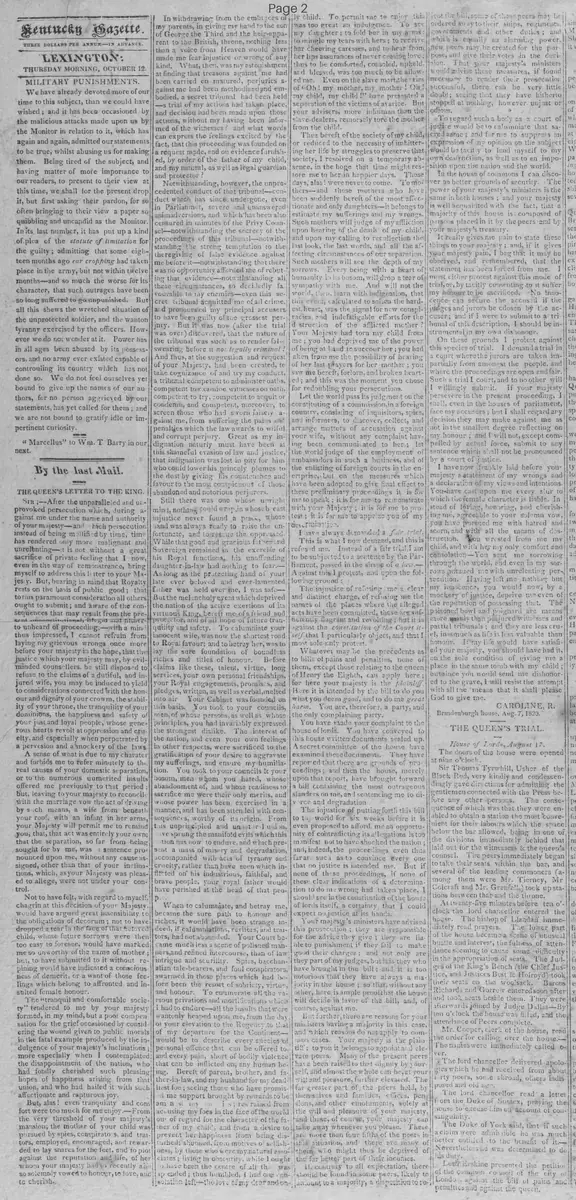
THE QUEEN'S LETTER TO THE KING.
Sir;--After the unparalleled and unprovoked persecution which, during a--gainst me under the name and authority of your majesty--and which persecution instead of being mollified by time, time has rendered only more malignant and unrelenting--it is not without a great sacrifice of private feeling that I now, even in the way of remonstrance, bring myself to address this letter to your Majesty. But, bearing in mind that Royalty rests on the basis of public good; that to this paramount consideration all others ought to submit; and aware of the consequences that may result from the present unconstitutional, illegal and unheard of proceeding;--with a mind thus impressed, I cannot refrain from laying my grievous wrongs once more before your majesty in the hope, that the justice which your majesty may, by evil-minded counsellors, be still disposed to refuse to the claims of a dutiful, and injured wife, you may be induced to yield to considerations connected with the honour and dignity of your crown, the stability of your throne, the tranquility of your dominions, the happiness and safety of your just and loyal people, whose generous hearts revolt at oppression and cruelty, and especially when perpetrated by a perversion and a mockery of the laws.
A sense of what is due to my character forbids me to refer minutely to the real causes of your domestic separation, or to the numerous unmerited insults offered me previously to that period; but, leaving to your majesty to reconcile with the marriage vow the act of driving by such means, a wife from beneath your roof, with an infant in her arms, your Majesty will permit me to remind you, that, that act was entirely your own; that the separation, so far from being sought for by me, was a sentence pronounced upon me, without any cause assigned, other than that of your inclinations, which, as your Majesty was pleased to allege, were not under your control.
Not to have felt, with regard to myself, chagrin at this decision of your Majesty, would have argued great insensibility to the obligations of decorum; not to have dropped a tear in the face of that beloved child, whose future sorrows were then too easy to foresee, would have marked me so unworthy of the name of mother; but, to have submitted to it without repining would have indicated a consciousness of demerit, or a want of those feelings which belong to affronted and insulted female honour.
The "tranquil and comfortable society" tendered to me by your majesty formed, in my mind, but a poor compensation for the grief occasioned by considering the wound given to public morals in the fatal example produced by the indulgence of your majesty's inclinations; more especially when I contemplated the disappointment of the nation, who had fondly cherished such pleasing hopes of happiness arising from that union, and who had hailed it with such affectionate and rapturous joy.
But, alas! even tranquility and comfort were too much for me to enjoy.--From the very threshold of your majesty's mansion; the mother of your child was pursued by spies, conspirators, and traitors, employed, encouraged, and rewarded to lay snares for the feet, and to plot against the reputation and life, of her whom your majesty had so recently and so solemnly vowed to honour, to love, and to cherish.
In withdrawing from the embraces of my parents, in giving my hand to the son of George the Third and the heir-apparent to the British, throne, nothing less than a voice from Heaven would have made me fear injustice or wrong of any kind. What, then, was my astonishment at finding that treasons against me had been carried on matured, perjuries against me had been methodized and embodied, a secret tribunal had been held --a trial of my actions had taken place, and decision had been made upon those actions, without my having been informed of the witnesses? and what words can express the feelings excited by the fact, that this proceeding was founded on a request made, and on evidence furnished, by order of the father of my child, and my natural, as well as legal guardian and protector?
Notwithstanding, however, the unprecedented conduct of that tribunal--conduct which has since undergone, even in Parliament, severe and unanswered animadversions, and which has been also censured in minutes of the Privy Council--notwithstanding the secrecy of the proceedings of this tribunal--notwithstanding the strong temptation to the giving of false evidence against me before it--notwithstanding that there was no opportunity afforded me of rebutting that evidence--notwithstanding all these circumstances, so decidedly favourable to my enemies--even this secret tribunal acquitted me of all crime, and pronounced my principal accusers to have been guilty of the grossest perjury. But it was now (after the trial was over) discovered, that the nature of the tribunal was such as to render false-swearing before it not legally criminal! And thus, at the suggestion and request of your Majesty, had been created, to take cognizance of and try my conduct, a tribunal competent to administer oaths, competent to examine witnesses on oath, competent to try, competent to acquit or condemn, and competent, moreover, to screen those who had sworn falsely against me, from suffering the pains and penalties which the law awards to wilful and corrupt perjury. Great as my indignation naturally must have been at this shameful evasion of law and justice, that indignation was lost in pity for him who could lower his princely plumes to the dust by giving his countenance and favour to the most conspicuous of those abandoned and notorious perjurers.
Still there was one whose upright mind, nothing could warp, in whose breast injustice never found a place, whose hand was always ready to raise the unfortunate, and to rescue the oppressed. While that good and gracious father and Sovereign remained in the exercise of his Royal functions, his unoffending daughter-in-law had nothing to fear.-- As long as the protecting hand of your late ever beloved and ever-lamented father was held over me, I was safe-- But the melancholy event which deprived the nation of the active exertions of its virtuous King, bereft me of a friend and protector, and of all hope of future tranquility and safety. To calumniate your innocent wife, was now the shortest road to Royal favour; and to betray her, was to lay the sure foundation of boundless riches and titles of honour. Before claims like these, talent, virtue, long services, your own personal friendships, your Royal engagements, promises, and pledges, written, as well as verbal, melted into air Your Cabinet was founded on this basis. You took to your councils, men, of whose persons, as well as whose principles, you had invariably expressed the strongest dislike. The interest of the nation, and even your own feelings in other respects, were sacrificed to the gratification of your desire to aggravate my sufferings, and ensure my humiliation. You took to your councils & your bosom, men whom you hated, whose abandonment of, and whose readiness to sacrifice me were their only merits, and whose power has been exercised in a manner, and has been attended with consequences, worthy of its origin. From this unprincipled and unnatural union, have sprung the manifold evils which this nation has now to endure, and which present a mass of misery and degradation, accompanied with acts of tyranny and cruelty, rather than have seen which inflicted on his industrious, faithful, and brave people, your royal father would have perished at the head of that people
When to calumniate, and betray me, became the sure path to honour and riches, it would have been strange indeed, if calumniators, revilers, and traitors, had not abounded. Your Court became much less a scene of polished manners, and refined intercourse, than of low intrigue and scurrility. Spies, bacchanalian tale-bearers, and foul conspirators, swarmed in those places which had before been the resort of sobriety, virtue and honour. To enumerate all the various privations and mortifications which I had to endure--all the insults that were wantonly heaped upon me, from the day of your elevation to the Regency, to that of my departure for the Continent-- would be to describe every species of personal offence that can be offered to, and every pain, short of bodily violence that can be inflicted on, any human being. Bereft of parent, brother, and father-in-law, and my husband for my deadliest foe; seeing those who have promised me support brought by rewards to be my enemies; restrained from accusing my foes in the face of the world out of regard for the character of the father of my child, and from a desire to prevent her happiness from being disturbed: shunned, from motives of selfishness, by those who were my natural associates; living in obscurity, while I ought to have been the centre of all that was splendid; thus humbled, I had one consolation left--the love of my dear and only child.
Thus bereft of the society of my child, or reduced to the necessity of imbittering her life by struggles to preserve that society, I resolved on a temporary absence, in the hope that time might restore me to her in happier days. Those days, alas! were never to come. To mothers--and these mothers who have been suddenly bereft of the most affectionate and only daughters--it belongs to estimate my sufferings and my wrongs. Such mothers will judge of my affliction upon hearing of the death of my child, and upon my calling to recollection the last look, the last words, and all the affecting circumstances--of our separation. Such mothers will see the depth of my sorrows. Every being with a heart of humanity in its bosom, will drop a tear of sympathy with me. And will not the world, then, learn with indignation, that this event, calculated to soften the hardest, heart, was the signal for new conspiracies, and indefatigable efforts for the destruction of the afflicted mother?
Your Majesty had torn my child from me; you had deprived me of the power of being at hand to succour her; you had taken from me the possibility of hearing of her last prayers for her mother; you saw me bereft, forlorn, and broken hearted; and this was the moment you chose for redoubling your persecutions.
Let the world pass its judgment on the constituting of a commission, in a foreign country, consisting of inquisitors, spies, and informers, to discover, collect, and arrange matters of accusation against your wife, without any complaint having been communicated to her; let the world judge of the employment of embassadors in such a business, and of the enlisting of foreign courts in the enterprise, But on the measures which have been adopted to give final effect to these preliminary proceedings it is for me to speak; it is for me to remonstrance with your Majesty; it is for me to protest; it is for me to apprise you of my determination.
I have always demanded a fair trial. This is what I now demand, and this is refused me. Instead of a fair trial, I am to be subjected to a sentence by the Parliament, passed in the shape of a law.-- Against this I protest, and upon the following ground:
The injustice of refusing me a clear and distinct charge, of refusing me the names of the places where the alleged acts have been committed, these are sufficiently flagrant and revolting: but it is against the constitution of the Court itself that I particularly object, and that I most solemnly protest.
Whatever may be the precedents as to bills of pains and penalties, none of them, except those relating to the queen of Henry the Eighth, can apply here; for here your majesty is the plaintiff Here it is intended by the bill to do you what you deem good, and to do me great harm. You are, therefore, a party, and the only complaining party.
You have made your complaint to the house of lords. You have conveyed to this house written documents sealed up. A secret committee of the house have examined these documents. They have reported that there are grounds of proceeding; and then the house, merely upon that report, have brought forward a bill containing the most outrageous slanders on me, and sentencing me to divorce and degradation
The injustice of putting forth this bill to the world for six weeks before it is even proposed to afford me an opportunity of contradicting its allegations is too manifest not to have shocked the nation; and, indeed, the proceedings even thus far are such as to convince every one that no justice is intended me. But if none of these proceedings, if none of these clear indications of a determination to do me wrong had taken place, I should see in the constitution of the house of lords itself, a certainty that I could expect no justice at its hands.
Your majesty's ministers have advised this prosecution; they are responsible for the advice they give; they are liable to punishment if they fail to make good their charges; and not only are they part of my judges, but it is they who have brought in the bill; and it is too notorious that they have always a majority in the house; so that, without any other, here is ample proof that the house will decide in favor of the bill, and, of course, against me.
But further, there are reasons for your ministers having a majority in this case, and which reasons do not apply to common cases. Your majesty is the plaintiff; to you it belongs to appoint and elevate peers. Many of the present peers have been raised to that dignity by yourself, and almost the whole can be, at your will and pleasure, further elevated. The far greater part of the peers hold, by themselves and families, offices, pensions, and other emoluments, solely at the will and pleasure of your majesty, and these, of course, your majesty can take away whenever you please. There are more than four fifths of the peers in this situation, and there are many of them who might thus be deprived of the far better part of their incomes.
If, contrary to all expectation, there should be found in some peers, likely to amount to a majority, a disposition to reject the bill, some of these peers may be ordered away to their ships, regiments, governments and other duties; and which is equally an alarming power, new peers may be created for the purpose, and give their votes in the decision. That your majesty's ministers would advise these measures, if found necessary to render their prosecution successful, there can be very little doubt; seeing that they have hitherto stopped at nothing, however unjust or odious.
To regard such a body as a court of justice would be to calumniate that sacred name; and for me to suppress an expression of my opinion on the subject would be tacitly to lend myself to my own destruction, as well as to an imposition upon the nation and the world.
In the house of commons I can discover no better grounds of security. The power of your majesty's ministers is the same in both houses; and your majesty is well acquainted with the fact, that a majority of this house is composed of persons placed in it by the peers and by your majesty's treasury.
It really gives me pain to state these things to your majesty; and, if it gives your majesty pain, I beg that it may be observed, and remembered, that the statement has been forced from me. I must either protest against this mode of trial, or, by tacitly consenting to it suffer my honour to be sacrificed. No innocence can secure the accused if the judges and jurors be chosen by the accuser: and if I were to submit to a tribunal of this description, I should be instrumental in my own dishonour.
On these grounds I protest against this species of trial. I demand a trial in a court where the jurors are taken impartially from amongst the people, and where the proceedings are open and fair. Such a trial I court, and to no other will I willingly submit. If your majesty persevere in the present proceeding, I shall, even in the houses of parliament, face my accusers; but I shall regard any decision they may make against me as not in the smallest degree reflecting on my honour; and I will not, except compelled by actual force, submit to any sentence which shall not be pronounced by a court of justice.
I have now frankly laid before your majesty a statement of my wrongs and a declaration of my views and intentions. You have cast upon me every slur to which the female character is liable. In stead of loving, honoring, and cherishing me, agreeable to your solemn vow, you have pursued me with hatred and scorn, and with all the means of destruction. You wrested from me my child, and with her my only comfort and consolation You sent me sorrowing through the world, and even in my sorrows pursued me with unrelenting persecution. Having left me nothing but my innocence, you would now, by a mockery of justice, deprive me even of the reputation of possessing that. The poisoned bowl and poignard are means more manly than perjured witnesses and partial tribunals; and they are less cruel, inasmuch as life is less valuable than honour. If my life would have satisfied your majesty, you should have had it on the sole condition of giving me a place in the same tomb with my child; but since you would send me dishonoured to the grave, I will resist the attempt with all the means that it shall please God to give me.
CAROLINE, R.
Brandenburgh house, Aug. 7, 1820.
What sub-type of article is it?
What keywords are associated?
What entities or persons were involved?
Where did it happen?
Foreign News Details
Primary Location
Brandenburgh House
Event Date
1820 08 07
Key Persons
Outcome
queen caroline protests the proposed parliamentary bill for her divorce, demands a fair trial, and refuses to submit to the house of lords proceedings, asserting they are biased and unconstitutional.
Event Details
Queen Caroline writes a detailed letter to King George IV outlining her grievances over their separation, the secret tribunal that acquitted her but shielded perjurers, the loss of her child, ongoing persecutions including a foreign commission, and the current parliamentary bill sentencing her to divorce without a fair trial. She protests the bias in the House of Lords and demands an impartial court.