Thank you for visiting SNEWPapers!
Sign up free
Virginia Argus
Richmond, Virginia
What is this article about?
US House committee report by Mr. Bacon details British atrocities in the War of 1812, including mistreatment of American prisoners, forced service of seamen, violations of truce flags, ransom from Indian allies, pillage in Chesapeake Bay, massacres at River Raisin, and outrages including rape and murder at Hampton, Virginia.
Clipping
OCR Quality
Full Text
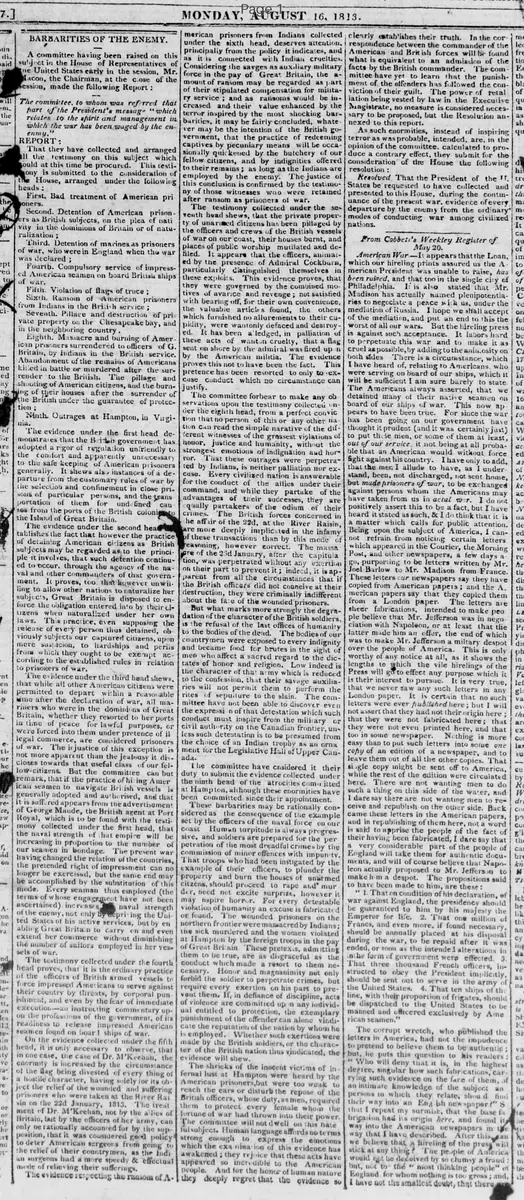
A committee having been raised on this subject in the House of Representatives of the United States early in the session, Mr. Bacon, the Chairman, at the close of the session, made the following Report:
The committee, to whom was referred that part of the President's message--"which relates to the spirit and management in which the war has been waged by the enemy,"
REPORT:
That they have collected and arranged all the testimony on this subject which could at this time be procured. This testimony is submitted to the Consideration of the House, arranged under the following heads:
First. Bad treatment of American prisoners.
Second. Detention of American prisoners as British subjects, on the plea of nativity in the dominions of Britain or of naturalization;
Third. Detention of marines as prisoners of war, who were in England when the war was declared;
Fourth. Compulsory service of impressed American seamen on board British ships of war.
Fifth. Violation of flags of truce;
Sixth. Ransom of American prisoners from Indians in the British service;
Seventh. Pillage and destruction of private property on the Chesapeake bay, and in the neighboring country.
Eighth. Massacre and burning of American prisoners surrendered to officers of G. Britain, by Indians in the British service.
Abandonment of the remains of Americans killed in battle or murdered after the surrender to the British. The pillage and shooting of American citizens, and the burning of their houses after the surrender of the British under the guarantee of protection;
Ninth. Outrages at Hampton, in Virginia.
The evidence under the first head demonstrates that the British government has adopted a rigor of regulation unfriendly to the comfort and apparently unnecessary to the safe keeping of American prisoners generally. It shews also instances of a departure from the customary rules of war by the selection and confinement in close prisons of particular persons, and the transportation of them for undefined causes from the ports of the British colonies to the Island of Great Britain.
The evidence under the second head establishes the fact that however the practice of detaining American citizens as British subjects may be regarded as, to the principle it involves, that such detention continued to occur, through the agency of the naval and other commanders of that government. It proves, too, that however unwilling to allow other nations to naturalize her subjects, Great Britain is disposed to enforce the obligation entered into by their citizens when naturalized under her own laws. This practice, even supposing the release of every person thus detained, obviously subjects our captured citizens, upon mere suspicion, to hardships and perils from which they ought to be exempt according to the established rules in relation to prisoners of war.
The evidence under the third head shews, that while all other American citizens were permitted to depart within a reasonable time after the declaration of war, all marines who were in the dominions of Great Britain, whether they resorted to her ports in time of peace for lawful purposes, or were forced into them under pretence of illegal commerce, are considered prisoners of war. The injustice of this exception is not more apparent than the jealousy it discloses towards that useful class of our fellow-citizens. But the committee cannot but remark, that if the practice of hiring American seamen to navigate British vessels is generally adopted and authorised, and that it is suffered appears from the advertisement of George Maude, the British agent at Port Royal, which is to be found with the testimony collected under the first head, that the naval strength of that empire will be increasing in proportion to the number of our seamen in bondage. The present war having changed the relation of the countries, the pretended right of impressment can no longer be exercised, but the same end may be accomplished by the substitution of this mode. Every seaman thus employed (the terms of whose engagement have not been ascertained) increases the naval strength of the enemy, not only by depriving the United States of his active services, but by enabling Great Britain to carry on and even extend her commerce without diminishing the number of sailors employed in her vessels of war.
The testimony collected under the fourth head proves, that it is the ordinary practice of the officers of British armed vessels to force impressed Americans to serve against their country by threats, by corporal punishment, and even by the fear of immediate execution--an instructive commentary upon the professions of the government, of its readiness to release impressed American seamen found on board ships of war.
On the evidence collected under the fifth head, it is only necessary to observe, that in one case, the case of Dr. M'Keehan, the enormity is increased by the circumstance of the flag being divested of every thing of a hostile character, having solely for its object the relief of the wounded and suffering prisoners who were taken at the River Raisin on the 22d January, 1813. The treatment of Dr. M'Keehan, not by the allies of Britain, but by the officers of her army, can only be rationally accounted for by the supposition, that it was considered good policy to deter American surgeons from going to the relief of their countrymen, as the Indian surgeons had a more speedy & effectual mode of relieving their sufferings.
The evidence respecting the ransom of American prisoners from Indians collected under the sixth head, deserves attention, principally from the policy it indicates, and as it is connected with Indian cruelties. Considering the savages as auxiliary military force in the pay of Great Britain, the amount of ransom may be regarded as part of their stipulated compensation for military service; and as ransoms would be increased and their value enhanced by the terror inspired by the most shocking barbarities, it may be fairly concluded, whatever may be the intention of the British government, that the practice of redeeming captives by pecuniary means will be occasionally quickened by the butchery of our fellow citizens, and by indignities offered to their remains; as long as the Indians are employed by the enemy. The justice of this conclusion is confirmed by the testimony of those witnesses who were retained after ransom as prisoners of war.
The testimony collected under the seventh head shews, that the private property of unarmed citizens has been pillaged by the officers and crews of the British vessels of war on our coast, their houses burnt, and places of public worship mutilated and defiled. It appears that the officers, animated by the presence of Admiral Cockburn, particularly distinguished themselves in these exploits. This evidence proves, that they were governed by the combined motives of avarice and revenge; not satisfied with bearing off, for their own convenience, the valuable articles found, the others which furnished no allurements to their cupidity, were wantonly defaced and destroyed. It has been alleged, in palliation of these acts of wanton cruelty, that a flag sent on shore by the admiral was fired upon by the American militia. The evidence proves this not to have been the fact. This pretence has been resorted to only to excuse conduct which no circumstance can justify.
The committee forbear to make any observations upon the testimony collected under the eighth head, from a perfect conviction that no person of this or any other nation can read the simple narrative of the different witnesses of the grossest violations of honor, justice and humanity, without the strongest emotions of indignation and horror. That these outrages were perpetrated by Indians, is neither palliation nor excuse. Every civilized nation is answerable for the conduct of the allies under their command, and while they partake of the advantages of their successes, they are equally partakers of the odium of their crimes. The British forces concerned in the affair of the 22d, at the River Raisin, are more deeply implicated in the infamy of these transactions than by this mode of reasoning, however correct. The massacre of the 22d January, after the capitulation, was perpetrated without any exertion on their part to prevent it; indeed, it is apparent from all the circumstances that if the British officers did not connive at their destruction, they were criminally indifferent about the fate of the wounded prisoners. But what marks more strongly the degradation of the character of the British soldiers, is the refusal of the last offices of humanity to the bodies of the dead. The bodies of our countrymen were exposed to every indignity and became food for brutes in the sight of men who affect a sacred regard to the dictates of honor and religion. Low indeed is the character of that army which is reduced to the confession, that their savage auxiliaries will not permit them to perform the rites of sepulture to the slain. The committee have not been able to discover even the expression of that detestation which such conduct must inspire from the military or civil authority on the Canadian frontier, unless such detestation is to be presumed from the choice of an Indian trophy as an ornament for the Legislative Hall of Upper Canada.
The committee have considered it their duty to submit the evidence collected under the ninth head of the atrocities committed at Hampton, although these enormities have been committed since their appointment. These barbarities may be rationally considered as the consequence of the example set by the officers of the naval force on our coast. Human turpitude is always progressive, and soldiers are prepared for the perpetration of the most dreadful crimes by the commission of minor offences with impunity. That troops who had been instigated by the example of their officers, to plunder the property and burn the houses of unarmed citizens, should proceed to rape and murder, need not excite surprise, however it may inspire horror. For every detestable violation of humanity an excuse is fabricated or found. The wounded prisoners on the northern frontier were massacred by Indians; the sick murdered and the women violated at Hampton by the foreign troops in the pay of Great Britain. These pretexts, admitting them to be true, are as disgraceful as the conduct which made a resort to them necessary. Honor and magnanimity not only forbid the soldier to perpetrate crimes, but require every exertion on his part to prevent them. If, in defiance of discipline, acts of violence are committed upon any individual entitled to protection, the exemplary punishment of the offender can alone vindicate the reputation of the nation by whom he is employed. Whether such exertions were made by the British soldiers, or the character of the British nation thus vindicated, the evidence will shew.
The shrieks of the innocent victims of infernal lust at Hampton were heard by the American prisoners, but were too weak to reach the ears or disturb the repose of the British officers, whose duty, as men, required them to protect every female whom the fortune of war had thrown into their power. The committee will not dwell on this hateful subject. Human language affords no terms strong enough to express the emotions which the examination of this evidence has awakened; they rejoice that these acts have appeared so incredible to the American people. And for the honor of human nature they deeply regret that the evidence so clearly establishes their truth. In the correspondence between the commander of the American and British forces will be found what is equivalent to an admission of the facts by the British commander. The committee have yet to learn that the punishment of the offenders has followed the conviction of their guilt. The power of retaliation being vested by law in the Executive Magistrate, no measure is considered necessary to be proposed, but the Resolution annexed to this report.
As such enormities, instead of inspiring terror as was probably intended, are, in the opinion of the committee, calculated to produce a contrary effect, they submit for the consideration of the House the following resolution:
Resolved That the President of the United States be requested to have collected and presented to this House, during the continuance of the present war, evidence of every departure by the enemy from the ordinary modes of conducting war among civilized nations.
What sub-type of article is it?
What keywords are associated?
What entities or persons were involved?
Where did it happen?
Foreign News Details
Primary Location
Chesapeake Bay And Hampton, Virginia
Event Date
1813
Key Persons
Outcome
massacres of prisoners at river raisin on january 22, 1813; outrages including rape and murder at hampton; pillage and destruction of property; resolution requesting ongoing evidence collection
Event Details
US House committee report compiles evidence of British war atrocities against Americans, covering mistreatment and detention of prisoners, forced service of seamen, violation of truce flags, ransom from Indian allies, pillage in Chesapeake Bay, massacres and abandonment of bodies by British and Indian forces, and rapes and murders at Hampton, Virginia.