Thank you for visiting SNEWPapers!
Sign up free
Editorial
October 30, 1908
The Black Hills Union And Western Stock Review
Rapid City, Pennington County, South Dakota
What is this article about?
The editorial criticizes the Democratic party's platform plank favoring tax exemption for homes and improvements up to $2,500, arguing it would exempt most urban residences while shifting the tax burden to farmers' land in cities and towns like Vermillion.
Clipping
OCR Quality
98%
Excellent
Full Text
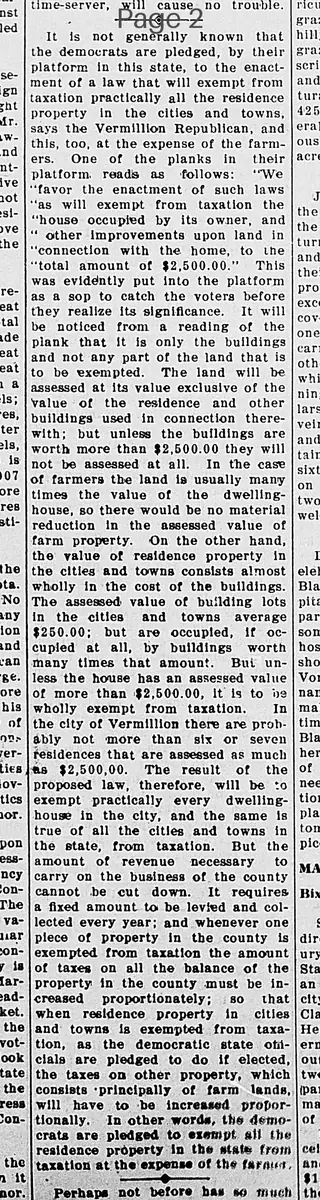
It is not generally known that the democrats are pledged, by their platform in this state, to the enactment of a law that will exempt from taxation practically all the residence property in the cities and towns, says the Vermillion Republican, and this, too, at the expense of the farmers. One of the planks in their platform reads as follows:
"We favor the enactment of such laws as will exempt from taxation the house occupied by its owner, and other improvements upon land in connection with the home, to the total amount of $2,500.00."
This was evidently put into the platform as a sop to catch the voters before they realize its significance. It will be noticed from a reading of the plank that it is only the buildings and not any part of the land that is to be exempted. The land will be assessed at its value exclusive of the value of the residence and other buildings used in connection therewith; but unless the buildings are worth more than $2,500.00 they will not be assessed at all. In the case of farmers the land is usually many times the value of the dwelling house, so there would be no material reduction in the assessed value of farm property. On the other hand, the value of residence property in the cities and towns consists almost wholly in the cost of the buildings. The assessed value of building lots in the cities and towns average $250.00; but are occupied, if occupied at all, by buildings worth many times that amount. But unless the house has an assessed value of more than $2,500.00, it is to be wholly exempt from taxation.
In the city of Vermillion there are probably not more than six or seven residences that are assessed as much as $2,500.00. The result of the proposed law, therefore, will be to exempt practically every dwelling-house in the city, and the same is true of all the cities and towns in the state, from taxation. But the amount of revenue necessary to carry on the business of the county cannot be cut down. It requires a fixed amount to be levied and collected every year; and whenever one piece of property in the county is exempted from taxation the amount of taxes on all the balance of the property in the county must be increased proportionately; so that when residence property in cities and towns is exempted from taxation, as the democratic state officials are pledged to do if elected the taxes on other property, which consists principally of farm lands, will have to be increased proportionately. In other words, the democrats are pledged to exempt all the residence property in the state from taxation at the expense of the farmers.
"We favor the enactment of such laws as will exempt from taxation the house occupied by its owner, and other improvements upon land in connection with the home, to the total amount of $2,500.00."
This was evidently put into the platform as a sop to catch the voters before they realize its significance. It will be noticed from a reading of the plank that it is only the buildings and not any part of the land that is to be exempted. The land will be assessed at its value exclusive of the value of the residence and other buildings used in connection therewith; but unless the buildings are worth more than $2,500.00 they will not be assessed at all. In the case of farmers the land is usually many times the value of the dwelling house, so there would be no material reduction in the assessed value of farm property. On the other hand, the value of residence property in the cities and towns consists almost wholly in the cost of the buildings. The assessed value of building lots in the cities and towns average $250.00; but are occupied, if occupied at all, by buildings worth many times that amount. But unless the house has an assessed value of more than $2,500.00, it is to be wholly exempt from taxation.
In the city of Vermillion there are probably not more than six or seven residences that are assessed as much as $2,500.00. The result of the proposed law, therefore, will be to exempt practically every dwelling-house in the city, and the same is true of all the cities and towns in the state, from taxation. But the amount of revenue necessary to carry on the business of the county cannot be cut down. It requires a fixed amount to be levied and collected every year; and whenever one piece of property in the county is exempted from taxation the amount of taxes on all the balance of the property in the county must be increased proportionately; so that when residence property in cities and towns is exempted from taxation, as the democratic state officials are pledged to do if elected the taxes on other property, which consists principally of farm lands, will have to be increased proportionately. In other words, the democrats are pledged to exempt all the residence property in the state from taxation at the expense of the farmers.
What sub-type of article is it?
Taxation
Partisan Politics
Economic Policy
What keywords are associated?
Tax Exemption
Democratic Platform
Residence Property
Farmers Burden
Urban Taxation
Vermillion
What entities or persons were involved?
Democrats
Vermillion Republican
Farmers
Editorial Details
Primary Topic
Democratic Platform On Property Tax Exemption For Residences
Stance / Tone
Critical Of Democratic Proposal, Protective Of Farmers
Key Figures
Democrats
Vermillion Republican
Farmers
Key Arguments
Democratic Platform Pledges Exemption Of Homes And Improvements Up To $2,500 From Taxation
Exemption Applies Only To Buildings, Not Land, Benefiting Urban Residences More Than Farms
Most City Homes In Vermillion And State Towns Valued Under $2,500 Would Be Fully Exempt
Fixed County Revenue Needs Would Increase Taxes On Remaining Property, Mainly Farms
Proposal Seen As A Voter Lure Without Realizing Its Burden On Farmers