Thank you for visiting SNEWPapers!
Sign up free
Literary
June 16, 1790
Gazette Of The United States
New York, New York County, New York
What is this article about?
This essay argues that the spread of literature and civilization must precede the universal acceptance of religion, as savages cannot grasp Christianity without prior intellectual development. It refutes objections by comparing national progress to human life stages and notes religion thrives in knowledgeable, moderate societies.
Clipping
OCR Quality
95%
Excellent
Full Text
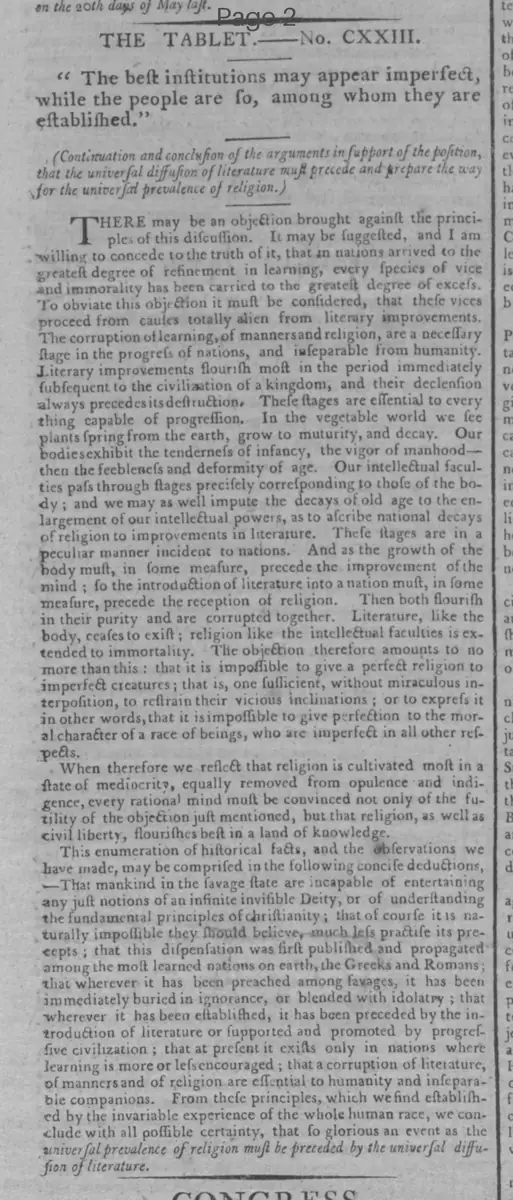
THE TABLET. NO. CXXIII.
"The best institutions may appear imperfect, while the people are so, among whom they are established."
(Continuation and conclusion of the arguments in support of the position, that the universal diffusion of literature must precede and prepare the way for the universal prevalence of religion.)
There may be an objection brought against these principles of this discussion. It may be suggested, and I am willing to concede to the truth of it, that in nations arrived to the greatest degree of refinement in learning, every species of vice and immorality has been carried to the greatest degree of excess.
To obviate this objection it must be considered, that these vices proceed from causes totally alien from literary improvements. The corruption of learning, of manners and religion, are a necessary stage in the progress of nations, and inseparable from humanity. Literary improvements flourish most in the period immediately subsequent to the civilization of a kingdom, and their declension always precedes its destruction. These stages are essential to every thing capable of progression. In the vegetable world we see plants spring from the earth, grow to maturity, and decay. Our bodies exhibit the tenderness of infancy, the vigor of manhood—then the feebleness and deformity of age. Our intellectual faculties pass through stages precisely corresponding to those of the body; and we may as well impute the decays of old age to the enlargement of our intellectual powers, as to ascribe national decays of religion to improvements in literature. These stages are in a peculiar manner incident to nations. And as the growth of the body must, in some measure, precede the improvement of the mind; so the introduction of literature into a nation must, in some measure, precede the reception of religion. Then both flourish in their purity and are corrupted together. Literature, like the body, ceases to exist; religion like the intellectual faculties is extended to immortality. The objection therefore amounts to no more than this: that it is impossible to give a perfect religion to imperfect creatures; that is, one sufficient, without miraculous interposition, to restrain their vicious inclinations; or to express it in other words, that it is impossible to give perfection to the moral character of a race of beings, who are imperfect in all other respects.
When therefore we reflect that religion is cultivated most in a state of mediocrity, equally removed from opulence and indigence, every rational mind must be convinced not only of the futility of the objection just mentioned, but that religion, as well as civil liberty, flourishes best in a land of knowledge.
This enumeration of historical facts, and the observations we have made, may be comprised in the following concise deductions,—That mankind in the savage state are incapable of entertaining any just notions of an infinite invisible Deity, or of understanding the fundamental principles of christianity; that of course it is naturally impossible they should believe, much less practice its precepts; that this dispensation was first published and propagated among the most learned nations on earth, the Greeks and Romans; that wherever it has been preached among savages, it has been immediately buried in ignorance, or blended with idolatry; that wherever it has been established, it has been preceded by the introduction of literature or supported and promoted by progressive civilization; that at present it exists only in nations where learning is more or less encouraged; that a corruption of literature, of manners and of religion are essential to humanity and inseparable companions. From these principles, which we find established by the invariable experience of the whole human race, we can conclude with all possible certainty, that so glorious an event as the universal prevalence of religion must be preceded by the universal diffusion of literature.
"The best institutions may appear imperfect, while the people are so, among whom they are established."
(Continuation and conclusion of the arguments in support of the position, that the universal diffusion of literature must precede and prepare the way for the universal prevalence of religion.)
There may be an objection brought against these principles of this discussion. It may be suggested, and I am willing to concede to the truth of it, that in nations arrived to the greatest degree of refinement in learning, every species of vice and immorality has been carried to the greatest degree of excess.
To obviate this objection it must be considered, that these vices proceed from causes totally alien from literary improvements. The corruption of learning, of manners and religion, are a necessary stage in the progress of nations, and inseparable from humanity. Literary improvements flourish most in the period immediately subsequent to the civilization of a kingdom, and their declension always precedes its destruction. These stages are essential to every thing capable of progression. In the vegetable world we see plants spring from the earth, grow to maturity, and decay. Our bodies exhibit the tenderness of infancy, the vigor of manhood—then the feebleness and deformity of age. Our intellectual faculties pass through stages precisely corresponding to those of the body; and we may as well impute the decays of old age to the enlargement of our intellectual powers, as to ascribe national decays of religion to improvements in literature. These stages are in a peculiar manner incident to nations. And as the growth of the body must, in some measure, precede the improvement of the mind; so the introduction of literature into a nation must, in some measure, precede the reception of religion. Then both flourish in their purity and are corrupted together. Literature, like the body, ceases to exist; religion like the intellectual faculties is extended to immortality. The objection therefore amounts to no more than this: that it is impossible to give a perfect religion to imperfect creatures; that is, one sufficient, without miraculous interposition, to restrain their vicious inclinations; or to express it in other words, that it is impossible to give perfection to the moral character of a race of beings, who are imperfect in all other respects.
When therefore we reflect that religion is cultivated most in a state of mediocrity, equally removed from opulence and indigence, every rational mind must be convinced not only of the futility of the objection just mentioned, but that religion, as well as civil liberty, flourishes best in a land of knowledge.
This enumeration of historical facts, and the observations we have made, may be comprised in the following concise deductions,—That mankind in the savage state are incapable of entertaining any just notions of an infinite invisible Deity, or of understanding the fundamental principles of christianity; that of course it is naturally impossible they should believe, much less practice its precepts; that this dispensation was first published and propagated among the most learned nations on earth, the Greeks and Romans; that wherever it has been preached among savages, it has been immediately buried in ignorance, or blended with idolatry; that wherever it has been established, it has been preceded by the introduction of literature or supported and promoted by progressive civilization; that at present it exists only in nations where learning is more or less encouraged; that a corruption of literature, of manners and of religion are essential to humanity and inseparable companions. From these principles, which we find established by the invariable experience of the whole human race, we can conclude with all possible certainty, that so glorious an event as the universal prevalence of religion must be preceded by the universal diffusion of literature.
What sub-type of article is it?
Essay
What themes does it cover?
Religious
Moral Virtue
Liberty Freedom
What keywords are associated?
Literature Diffusion
Religion Prevalence
Civilization Stages
Historical Deductions
Moral Corruption
Literary Details
Subject
Continuation And Conclusion Of The Arguments In Support Of The Position, That The Universal Diffusion Of Literature Must Precede And Prepare The Way For The Universal Prevalence Of Religion.
Key Lines
"The Best Institutions May Appear Imperfect, While The People Are So, Among Whom They Are Established."
Literary Improvements Flourish Most In The Period Immediately Subsequent To The Civilization Of A Kingdom, And Their Declension Always Precedes Its Destruction.
Religion, As Well As Civil Liberty, Flourishes Best In A Land Of Knowledge.
That Mankind In The Savage State Are Incapable Of Entertaining Any Just Notions Of An Infinite Invisible Deity, Or Of Understanding The Fundamental Principles Of Christianity;
That So Glorious An Event As The Universal Prevalence Of Religion Must Be Preceded By The Universal Diffusion Of Literature.