Thank you for visiting SNEWPapers!
Sign up free
Story
November 2, 1843
Port Gibson Herald
Port Gibson, Claiborne County, Mississippi
What is this article about?
Judge Winchester argues in a speech to the Anti-Repudiating Club that Mississippi is legally, morally, and constitutionally obligated to pay the Union Bank Bonds, refuting claims of unconstitutionality and warning of reputational and economic damage from repudiation.
Clipping
OCR Quality
95%
Excellent
Full Text
From the Natchez Courier.
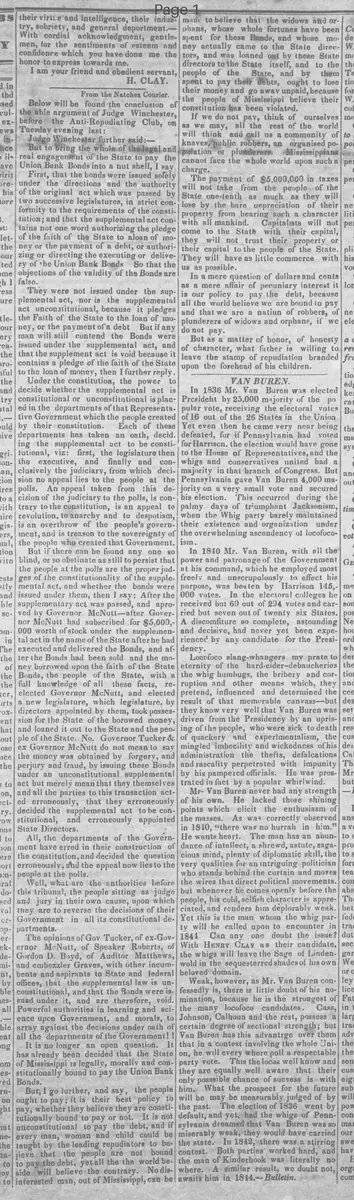
Below will be found the conclusion of the able argument of Judge Winchester, before the Anti-Repudiating Club, on Tuesday evening last:
Judge Winchester further said:--But to bring the whole of the legal and real engagement of the State to pay the Union Bank Bonds into a nut shell, I say First, that the bonds were issued solely under the directions and the authority of the original act which was passed by two successive legislatures, in strict conformity to the requirements of the constitution; and that the supplemental act contains not one word authorizing the pledge of the faith of the State to a loan of money or the payment of a debt, or authorizing or directing the executing or delivery of the Union Bank Bonds So that the objections of the validity of the Bonds are false.
They were not issued under the supplemental act, nor is the supplemental act unconstitutional, because it pledges the Faith of the State to the loan of money, or the payment of a debt But if any man will still contend the Bonds were issued under the supplemental act, and that the supplement act is void because it contains a pledge of the faith of the State to the loan of money, then I further reply.
Under the constitution, the power to decide whether the supplemental act is constitutional or unconstitutional is placed in the departments of that Representative Government which the people created by their constitution. Each of these departments has taken an oath, deciding the supplemental act to be constitutional, viz: first, the legislature then the executive, and finally and conclusively the judiciary, from which decision no appeal lies to the people at the polls. An appeal taken from this decision of the judiciary to the polls, is contrary to the constitution, is an appeal to revolution, to anarchy and to despotism, is an overthrow of the people's government, and is treason to the sovereignty of the people who created that Government.
But if there can be found any one so blind, or so obstinate as still to persist that the people at the polls are the proper judges of the constitutionality of the supplemental act, and whether the bonds were issued under them, then I say: After the supplementary act was passed, and approved by Governor McNutt--after Governor McNutt had subscribed for $5,000,000 worth of stock under the supplemental act in the name of the State after he had executed and delivered the Bonds. and after the Bonds had been sold and the money borrowed upon the faith of the State Bonds. the people of the State. with a full knowledge of all these facts, re-elected Governor McNutt, and elected a new legislature, which legislature, by directors appointed by them, took possession for the State of the borrowed money, and loaned it out to the State and the people of the State. No. Governor Tucker & ex Governor McNutt do not mean to say the money was obtained by forgery, and perjury and fraud, by issuing these Bonds under an unconstitutional supplemental act but merely mean that they themselves and all the parties to this transaction acted erroneously, that they erroneously decided the supplemental act to be constitutional, and erroneously appointed State Directors.
All, the departments of the Government have erred in their construction of the constitution, and decided the question erroneously. and the appeal now lies to the people at the polls.
Well. what are the authorities before this tribunal. the people sitting as judge and jury in their own cause, upon which they are to reverse the decisions of their Government in all its constitutional departments.
'The opinions of Gov Tucker, of ex-Governor McNutt. of Speaker Roberts, of Gordon D. Boyd, of Auditor Matthews, and embezzler Graves, with other incumbents and aspirants to State and federal offices, that the supplemental law is unconstitutional, and that the Bonds were issued under it, and are therefore. void.
Powerful authorities in learning and science upon Government, and morals, to array against the decisions under oath of all the departments of the Government!!
It is no longer an open question. It has already been decided that the State of Mississippi is legally, morally and constitutionally bound to pay the Union Bank Bonds.
But, I go further, and say. the people ought to pay; it is their best policy to pay, whether they believe they are constitutionally bound to pay or not. It is not unconstitutional to pay the debt, and if every man, woman and child could be taught by the leading repudiators to believe that the people are not bound to pay the debt, yet all the the world besides will believe the contrary. No disinterested man, out of Mississippi, can be made to believe that the widows and orphans, whose whole fortunes have been spent for these Bonds, and whose money actually came to the State directors. and was loaned out by these State directory to the State itself. and to the people of the State, and by them spent to pay their debts, ought to lose their money and go away unpaid, because the people of Mississippi believe their constitution has been violated.
If we do not pay, think of ourselves as we may, all the rest of the world will think and call us a community of knaves, public robbers, an organised population of plunderers. Mississippians cannot face the whole world upon such a charge.
The payment of $5,000,000 in taxes will not take from the people of the State one-tenth as much as they will lose by the bare depreciation of their property from bearing such a character with all mankind. Capitalists will not come to the State with their capital, they will not trust their property or their capital to the people of the State. They will have as little commerce with us as possible.
In a mere question of dollars and cents as a mere affair of pecuniary interest it is our policy to pay the debt, because all the world believe we are bound to pay and that we are a nation of robbers, of plunderers of widows and orphans, if we do not pay.
But as a matter of honor, of honesty of character. what father is willing to leave the stamp of repudiation branded upon the forehead of his children.
Below will be found the conclusion of the able argument of Judge Winchester, before the Anti-Repudiating Club, on Tuesday evening last:
Judge Winchester further said:--But to bring the whole of the legal and real engagement of the State to pay the Union Bank Bonds into a nut shell, I say First, that the bonds were issued solely under the directions and the authority of the original act which was passed by two successive legislatures, in strict conformity to the requirements of the constitution; and that the supplemental act contains not one word authorizing the pledge of the faith of the State to a loan of money or the payment of a debt, or authorizing or directing the executing or delivery of the Union Bank Bonds So that the objections of the validity of the Bonds are false.
They were not issued under the supplemental act, nor is the supplemental act unconstitutional, because it pledges the Faith of the State to the loan of money, or the payment of a debt But if any man will still contend the Bonds were issued under the supplemental act, and that the supplement act is void because it contains a pledge of the faith of the State to the loan of money, then I further reply.
Under the constitution, the power to decide whether the supplemental act is constitutional or unconstitutional is placed in the departments of that Representative Government which the people created by their constitution. Each of these departments has taken an oath, deciding the supplemental act to be constitutional, viz: first, the legislature then the executive, and finally and conclusively the judiciary, from which decision no appeal lies to the people at the polls. An appeal taken from this decision of the judiciary to the polls, is contrary to the constitution, is an appeal to revolution, to anarchy and to despotism, is an overthrow of the people's government, and is treason to the sovereignty of the people who created that Government.
But if there can be found any one so blind, or so obstinate as still to persist that the people at the polls are the proper judges of the constitutionality of the supplemental act, and whether the bonds were issued under them, then I say: After the supplementary act was passed, and approved by Governor McNutt--after Governor McNutt had subscribed for $5,000,000 worth of stock under the supplemental act in the name of the State after he had executed and delivered the Bonds. and after the Bonds had been sold and the money borrowed upon the faith of the State Bonds. the people of the State. with a full knowledge of all these facts, re-elected Governor McNutt, and elected a new legislature, which legislature, by directors appointed by them, took possession for the State of the borrowed money, and loaned it out to the State and the people of the State. No. Governor Tucker & ex Governor McNutt do not mean to say the money was obtained by forgery, and perjury and fraud, by issuing these Bonds under an unconstitutional supplemental act but merely mean that they themselves and all the parties to this transaction acted erroneously, that they erroneously decided the supplemental act to be constitutional, and erroneously appointed State Directors.
All, the departments of the Government have erred in their construction of the constitution, and decided the question erroneously. and the appeal now lies to the people at the polls.
Well. what are the authorities before this tribunal. the people sitting as judge and jury in their own cause, upon which they are to reverse the decisions of their Government in all its constitutional departments.
'The opinions of Gov Tucker, of ex-Governor McNutt. of Speaker Roberts, of Gordon D. Boyd, of Auditor Matthews, and embezzler Graves, with other incumbents and aspirants to State and federal offices, that the supplemental law is unconstitutional, and that the Bonds were issued under it, and are therefore. void.
Powerful authorities in learning and science upon Government, and morals, to array against the decisions under oath of all the departments of the Government!!
It is no longer an open question. It has already been decided that the State of Mississippi is legally, morally and constitutionally bound to pay the Union Bank Bonds.
But, I go further, and say. the people ought to pay; it is their best policy to pay, whether they believe they are constitutionally bound to pay or not. It is not unconstitutional to pay the debt, and if every man, woman and child could be taught by the leading repudiators to believe that the people are not bound to pay the debt, yet all the the world besides will believe the contrary. No disinterested man, out of Mississippi, can be made to believe that the widows and orphans, whose whole fortunes have been spent for these Bonds, and whose money actually came to the State directors. and was loaned out by these State directory to the State itself. and to the people of the State, and by them spent to pay their debts, ought to lose their money and go away unpaid, because the people of Mississippi believe their constitution has been violated.
If we do not pay, think of ourselves as we may, all the rest of the world will think and call us a community of knaves, public robbers, an organised population of plunderers. Mississippians cannot face the whole world upon such a charge.
The payment of $5,000,000 in taxes will not take from the people of the State one-tenth as much as they will lose by the bare depreciation of their property from bearing such a character with all mankind. Capitalists will not come to the State with their capital, they will not trust their property or their capital to the people of the State. They will have as little commerce with us as possible.
In a mere question of dollars and cents as a mere affair of pecuniary interest it is our policy to pay the debt, because all the world believe we are bound to pay and that we are a nation of robbers, of plunderers of widows and orphans, if we do not pay.
But as a matter of honor, of honesty of character. what father is willing to leave the stamp of repudiation branded upon the forehead of his children.
What sub-type of article is it?
Historical Event
What themes does it cover?
Moral Virtue
Justice
What keywords are associated?
Union Bank Bonds
Mississippi Repudiation
Judge Winchester
Constitutional Argument
Moral Obligation
State Debt
Anti Repudiating Club
What entities or persons were involved?
Judge Winchester
Governor Mcnutt
Governor Tucker
Speaker Roberts
Gordon D. Boyd
Auditor Matthews
Graves
Where did it happen?
Mississippi
Story Details
Key Persons
Judge Winchester
Governor Mcnutt
Governor Tucker
Speaker Roberts
Gordon D. Boyd
Auditor Matthews
Graves
Location
Mississippi
Event Date
Tuesday Evening Last
Story Details
Judge Winchester delivers a legal and moral argument asserting Mississippi's obligation to pay the Union Bank Bonds, defending their constitutionality against repudiation claims and emphasizing the consequences of non-payment on the state's honor and economy.