Thank you for visiting SNEWPapers!
Sign up free
Daily National Intelligencer
Washington, District Of Columbia
What is this article about?
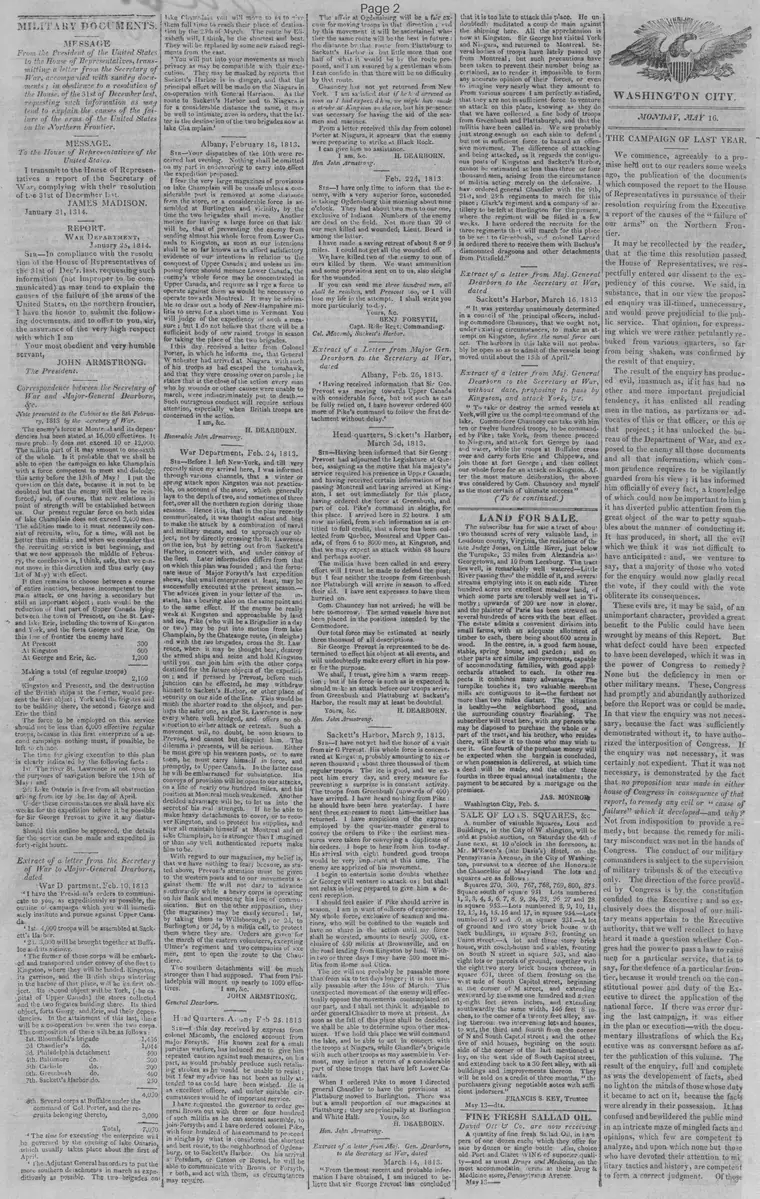
Publication of official War Department documents transmitted by President Madison explaining U.S. military setbacks on the northern frontier in 1813, including plans to attack Upper Canada and correspondence between Secretary Armstrong and General Dearborn. Editorial critiques the House resolution prompting the report as unnecessary, prejudicial, and unproductive.
Merged-components note: Continuation of the editorial commentary on the military report and campaign analysis from page 2 (originally labeled 'story') to page 3 (originally labeled 'editorial'). The merged content fits 'editorial' as it includes opinionated analysis alongside official documents.
Clippings
1 of 2
OCR Quality
Full Text
- MESSAGE
From the President of the United States to the House of Representatives, transmitting a letter from the Secretary of War, accompanied with sundry documents; in obedience to a resolution of the House of the 31st of December last, requesting such information as may tend to explain the causes of the failure of the arms of the United States on the Northern Frontier.
MESSAGE.
To the House of Representatives of the United States.
I transmit to the House of Representatives a report of the Secretary of War, complying with their resolution of the 31st of December last.
JAMES MADISON
January 31, 1814.
REPORT.
WAR DEPARTMENT,
January 25, 1814.
SIR—In compliance with the resolution of the House of Representatives of the 31st of Dec'r. last, requesting such information (not improper to be communicated) as may tend to explain the causes of the failure of the arms of the United States, on the northern frontier I have the honor to submit the following documents, and to offer to you, sir, the assurance of the very high respect with which I am
Your most obedient and very humble servant,
JOHN ARMSTRONG.
The President.
Correspondence between the Secretary of War and Major-General Dearborn, &c.
Note presented to the Cabinet on the 5th February, 1813 by the Secretary of War.
The enemy's force at Montreal and its dependencies has been stated at 16,000 effectives. It more probably does not exceed 10 or 12,000. The militia part of it may amount to one-sixth of the whole. Is it probable that we shall be able to open the campaign on lake Champlain with a force competent to meet and dislodge this army before the 15th of May? I put the question on this date, because it is not to be doubted but that the enemy will then be reinforced, and, of course, that new relations in point of strength will be established between us. Our present regular force on both sides of lake Champlain does not exceed 2,400 men. The addition made to it must necessarily consist of recruits, who, for a time, will not be better than militia; and when we consider that the recruiting service is but beginning, and that we now approach the middle of February, the conclusion is, I think, safe, that we cannot move in this direction and thus early (say 1st of May) with effect.
It then remains to choose between a course of entire inaction, because incompetent to the main attack, or one having a secondary but still an important object; such would be the reduction of that part of Upper Canada lying between the town of Prescott, on the St. Lawrence and lake Erie, including the towns of Kingston and York, and the forts George and Erie. On this line of frontier the enemy have
At Prescott 300
At Kingston 600
At George and Erie, &c. 1,200
Making a total (of regular troops) of 2,100
Kingston and Prescott, and the destruction of the British ships at the former, would present the first object; York and the frigates said to be building there, the second; George and Erie the third
The force to be employed on this service should not be less than 6,000 effective regular troops, because in this first enterprize of a second campaign nothing must, if possible, be left to chance.
The time for giving execution to this plan is clearly indicated by the following facts :
1st. The river St. Lawrence is not open to the purposes of navigation before the 15th of May: and
2d. Lake Ontario is free from all obstruction arising from ice by the 1st day of April.
Under these circumstances we shall have six weeks for the expedition before it be possible for Sir George Prevost to give it any disturbance.
Should this outline be approved, the details for the service can be made and expedited in forty-eight hours.
Extract of a letter from the Secretary of War to Major-General Dearborn,
dated
War Department, Feb. 10, 1813
I have the President's orders to communicate to you, as expeditiously as possible, the outline of campaign which you will immediately institute and pursue against Upper Canada.
1st. 4,000 troops will be assembled at Sackett's Harbor.
2d. 3,000 will be brought together at Buffalo and its vicinity.
The former of these corps will be embarked and transported under convoy of the fleet to Kingston, where they will be landed. Kingston, its garrison, and the British ships wintering in the harbor of that place, will be its first object. Its second object will be York, (the capital of Upper Canada) the stores collected and the two frigates building there. Its third object, forts George and Erie, and their dependencies. In the attainment of this last, there will be a co-operation between the two corps.
The composition of these will be as follows:
1st. Bloomfield's brigade 1,436
2d Chandler's do. 1,044
3d. Philadelphia detachment 400
4th. Baltimore do. 300
5th. Carlisle do. 200
6th. Greenbush do. 400
7th. Sackett's Harbor do. 250
4,030
5th Several corps at Buffalo under the command of Col. Porter, and the recruits belonging thereto, 3,000
Total, 7,030
The time for executing the enterprize will be governed by the opening of lake Ontario, which usually takes place about the first of April.
The Adjutant General has orders to put the more southern detachments in march as expeditiously as possible. The two brigades on lake Champlain you will move so as to give them full time to reach their place of destination by the 25th of March. The route by Elizabeth will, I think, be the shortest and best. They will be replaced by some new raised regiments from the east.
You will put into your movements as much privacy as may be compatible with their execution. They may be masked by reports that Sackett's Harbor is in danger, and that the principal effort will be made on the Niagara in co-operation with General Harrison. As the route to Sackett's Harbor and to Niagara is for a considerable distance the same, it may be well to intimate, even in orders, that the latter is the destination of the two brigades now at lake Champlain.
Albany, February 18, 1813.
SIR—Your dispatches of the 10th were received last evening. Nothing shall be omitted on my part in endeavoring to carry into effect the expedition proposed.
I fear the very large magazines of provisions on lake Champlain will be unsafe unless a considerable part is removed at some distance from the store, or a considerable force is assembled at Burlington and vicinity, by the time the two brigades shall move. Another motive for having a large force on that lake will be, that of preventing the enemy from sending almost his whole force from Lower Canada to Kingston, as soon as our intentions shall be so far known as to afford satisfactory evidence of our intentions in relation to the conquest of Upper Canada; and unless an imposing force should menace Lower Canada, the enemy's whole force may be concentrated in Upper Canada, and require as large a force to operate against them as would be necessary to operate towards Montreal. It may be advisable to draw out a body of New-Hampshire militia to serve for a short time in Vermont. You will judge of the expediency of such a measure; but I do not believe that there will be a sufficient body of new raised troops in season for taking the place of the two brigades.
I this day received a letter from Colonel Porter, in which he informs me, that General Winchester had arrived at Niagara with such of his troops as had escaped the tomahawk, and that they were crossing over on parole ; he states that at the close of the action every man who by wounds or other causes were unable to march, were indiscriminately put to death.-- Such outrageous conduct will require serious attention, especially when British troops are concerned in the action.
I am, &c.
H. DEARBORN.
Honorable John Armstrong
War Department, Feb. 24, 1813.
SIR—Before I left New-York, and till very recently since my arrival here, I was informed through various channels, that a winter or spring attack upon Kingston was not practicable, on account of the snow, which generally lays to the depth of two, and sometimes of three feet, over all the northern region during those seasons. Hence it is, that in the plan recently communicated, it was thought safest and best to make the attack by a combination of naval and military means, and to approach our object, not by directly crossing the St. Lawrence on the ice, but by setting out from Sackett's Harbor, in concert with, and under convoy of the fleet. Later information differs from that on which this plan was founded ; and the fortunate issue of Major Forsyth's last expedition shews, that small enterprises at least, may be successfully executed at the present season.— The advices given in your letter of the instant, has a bearing also on the same point and to the same effect. If the enemy be really weak at Kingston and approachable by land and ice, Pike (who will be a Brigadier in a day or two) may be put into motion from lake Champlain, by the Chateaugay route, (in sleighs) and with the two brigades, cross the St. Lawrence, where it may be thought best, destroy the armed ships and seize and hold Kingston until you can join him with the other corps destined for the future objects of the expedition ; and if pressed by Prevost, before such junction can be effected, he may withdraw himself to Sackett's Harbor, or other place of security on our side of the line. This would be much the shorter road to the object, and perhaps the safer one, as the St. Lawrence is now every where well bridged, and offers no obstruction to either attack or retreat. Such a movement will, no doubt, be soon known to Prevost, and cannot but disquiet him. The dilemma it presents, will be serious. Either he must give up his western posts, or to save them, he must carry himself in force, and promptly, to Upper Canada. In the latter case he will be embarrassed for subsistence. His convoys of provision will be open to our attacks, on a line of nearly one hundred miles, and his position at Montreal much weakened. Another decided advantage will be, to let us into the secret of his real strength. If he be able to make heavy detachments to cover, or to recover Kingston, and to protect his supplies, and after all maintain himself at Montreal and on lake Champlain, he is stronger than I imagined or than any well authenticated reports make him to be.
With regard to our magazines, my belief is, that we have nothing to fear; because, as stated above, Prevost's attention must be given to the western posts and to our movements against them. He will not dare to advance Southwardly while a heavy corps is operating on his flank and menacing his line of communication. But on the other supposition, they (the magazines) may be easily secured; 1st, by taking them to Willsborough; or 2d, to Burlington; or 3d, by a militia call, to protect them where they are. Orders are given for the march of the eastern volunteers, excepting Ulmer's regiment and two companies of axe men, sent to open the route to the Chateaugay.
The southern detachments will be much stronger than I had supposed. That from Philadelphia will mount up nearly to 1000 effectives.
I am, &c.
JOHN ARMSTRONG,
General Dearborn.
Head Quarters. Albany Feb 25. 1813
SIR— this day received by express from colonel Macomb, the enclosed account from major Forsyth. His known zeal for a small parizan warfare, has induced me to give him repeated caution against such measures, on his part, as would probably produce such retaliating strokes as he would be unable to resist ; but I fear my advice has not been as fully attended to as could have been wished. He is an excellent officer, and under suitable circumstances would be of important service.
I have requested the governor to order general Brown out with three or four hundred of such militia as he can soonest assemble, to join Forsyth; and I have ordered colonel Pike, with four hundred of his command to proceed in sleighs by what is considered the shortest and best route, to the neighborhood of Ogdensburg, or to Sackett's Harbor. On his arrival a Potsdam, or Canton or Russel, he will be able to communicate with Brown or Forsyth, or both, and act with them, as circumstances may require.
The affair at Ogdensburg will be a fair excuse for moving troops in that direction ; and by this movement it will be ascertained whether the same route will be the best in future : the distance by that route from Plattsburg to Sackett's Harbor is but little more than one half of what it would be by the route proposed, and I am assured by a gentleman whom I can confide in that there will be no difficulty by that route.
Chauncey has not yet returned from New York. I am satisfied that if he had arrived as soon as I had expected him, we might have made a stroke at Kingston on the ice, but his presence was necessary for having the aid of the seamen and marines.
From a letter received this day from colonel Porter at Niagara, it appears that the enemy were preparing to strike at Black Rock. I can give him no assistance.
I am, &c.
H. DEARBORN.
Hon. John Armstrong
Feb. 22d, 1813.
SIR—I have only time to inform that the enemy, with a very superior force, succeeded in taking Ogdensburg this morning about nine o'clock. They had about two men to our one, exclusive of Indians. Numbers of the enemy are dead on the field. Not more than 20 of our men killed and wounded; Lieut. Beard is among the latter.
I have made a saving retreat of about 8 or 9 miles. I could not get all the wounded off.
We have killed two of the enemy to one of ours killed by them. We want ammunition and some provisions sent on to us; also sleighs for the wounded
If you can send me three hundred men, all shall be retaken, and Prescott too, or I will lose my life in the attempt. I shall write you more particularly to-day.
Yours, &c.
BENJ FORSYTH,
Capt. Rifle Regt. Commanding.
Col. Macomb. Sackett's Harbor.
Extract of a Letter from Major Gen. Dearborn to the Secretary at War,
dated
Albany, Feb. 26, 1813.
Having received information that Sir Geo. Prevost was moving towards Upper Canada with considerable force, but not such as can be fully relied on, I have however ordered 400 more of Pike's command to follow the first detachment without delay.
Head-quarters, Sackett's Harbor,
March 3d, 1813.
SIR—Having been informed that Sir George Prevost had adjourned the Legislature at Quebec, assigning as the motive that his majesty's service required his presence in Upper Canada; and having received certain information of his passing Montreal and having arrived at Kingston, I set out immediately for this place. having ordered the force at Greenbush, and part of col. Pike's command in sleighs. for this place. I arrived here in 52 hours. I am now satisfied, from such information as is entitled to full credit, that a force has been collected from Quebec, Montreal and Upper Canada, of from 6 to 8000 men, at Kingston. and that we may expect an attack within 48 hours and perhaps sooner.
The militia have been called in and every effort will I trust be made to defend the post; but I fear neither the troops from Greenbush nor Plattsburgh will arrive in season to afford their aid. I have sent expresses to have them hurried on.
Com. Chauncey has not arrived; he will be here to-morrow. The armed vessels have not been placed in the positions intended by the Commodore.
Our total force may be estimated at nearly three thousand of all descriptions.
Sir George Prevost is represented to be determined to effect his object at all events, and will undoubtedly make every effort in his power for the purpose.
We shall, I trust, give him a warm reception : but if his force is such as is expected & should make an attack before our troops arrive from Greenbush and Plattsburg at Sackett's Harbor, the result may at least be doubtful.
Yours, &c.
H. DEARBORN.
Hon. John Armstrong
Sackett's Harbor, March 9, 1813.
SIR—I have not yet had the honor of a visit from sir G. Prevost. His whole force is concentrated at Kingston, probably amounting to six or seven thousand; about three thousand of them regular troops. The ice is good, and we expect him every day, and every measure for preventing a surprize is in constant activity
The troops from Greenbush (upwards of 400) have arrived. I have heard nothing from Pike : he should have been here yesterday. I have sent three expresses to meet him—neither has returned. I have suspicions of the express employed by the quarter-master general to convey the orders to Pike : the earliest measures were taken for conveying a duplicate of his orders. I hope to hear from him to-day
His arrival with eight hundred good troops would be very important at this time. The enemy are apprized of his movement.
I begin to entertain some doubts whether sir George will venture to attack us; but shall not relax in being prepared to give him a decent reception.
I should feel easier if Pike should arrive in season. I am in want of officers of experience.
My whole force, exclusive of seamen and marines, who will be confined to the vessels and have no share in the action until my force shall be worsted, amounts to nearly 3000, exclusive of 450 militia at Brownsville. and on the road leading from Kingston by land. Within two or three days I may have 500 more militia from Rome and Utica.
The ice will not probably be passable more than from six to ten days longer; it is not usually passable after the 15th of March. This unexpected movement of the enemy will effectually oppose the movements contemplated on our part, and I shall not think it advisable to order general Chandler to move at present. As soon as the fate of this place shall be decided, we shall be able to determine upon other measures. If we hold this place we will command the lake, and be able to act in concert with the troops at Niagara, while Chandler's brigade with such other troops as may assemble in Vermont, may induce a return of a considerable part of those troops that have left Lower Canada.
When I ordered Pike to move I directed general Chandler to have the provisions at Plattsburg moved to Burlington. There was but a small proportion of our magazines at Plattsburg; they are principally at Burlington and White Hall.
Yours, &c
H. DEARBORN.
Hon. John Armstrong.
Extract of a letter from Maj. Gen. Dearborn, to the Secretary at War, dated
March 14, 1813.
From the most recent and probable information I have obtained, I am induced to believe that sir George Prevost has concluded
that it is too late to attack this place. He undoubtedly meditated a coup de main against the shipping here. All the apprehension is now at Kingston. Sir George has visited York and Niagara, and returned to Montreal. Several bodies of troops have lately passed up from Montreal: but such precautions have been taken to prevent their number being ascertained, as to render it impossible to form any accurate opinion of their forces, or even to imagine very nearly what they amount to
From various sources I am perfectly satisfied, that they are not in sufficient force to venture an attack on this place, knowing as they do that we have collected a fine body of troops from Greenbush and Plattsburgh, and that the militia have been called in. We are probably just strong enough on each side to defend; but not in sufficient force to hazard an offensive movement. The difference of attacking and being attacked, as it regards the contiguous posts of Kingston and Sackett's Harbor, cannot be estimated at less than three or four thousand men, arising from the circumstance of militia acting merely on the defensive. I have ordered general Chandler with the 9th, 21st, and 25th regiments to march for this place; Clark's regiment and a company of artillery to be left at Burlington for the present, where the regiment will be filled in a few weeks. I have ordered the recruits for the three regiments that will march for this place to be sent to Greenbush. and colonel Larned is ordered there to receive them with Backus's dismounted dragoons and other detachments from Pittsfield.
Extract of a letter from Maj. General Dearborn to the Secretary at War,
dated
Sackett's Harbor. March 16. 1813
It was yesterday unanimously determined in a council of the principal officers, including commodore Chauncey, that we ought not, under existing circumstances, to make an attempt on Kingston, before the naval force can act. The harbors in this lake will not probably be open so as to admit of the vessels being moved until about the 15th of April.
Extract of a letter from Maj. General Dearborn to the Secretary at War,
without date, proposing to pass by Kingston, and attack York, &c.
To take or destroy the armed vessels at York, will give us the complete command of the lake, Commodore Chauncey can take with him ten or twelve hundred troops, to be commanded by Pike: take York, from thence proceed to Niagara, and attack fort George by land and water, while the troops at Buffalo cross over and carry forts Erie and Chippewa, and join those at fort George : and then collect our whole force for an attack on Kingston. After the most mature deliberation. the above was considered by Com. Chauncey and myself as the most certain of ultimate success.
(To be continued.)
WASHINGTON CITY.
MONDAY, MAY 16.
THE CAMPAIGN OF LAST YEAR.
We commence, agreeably to a promise held out to our readers some weeks ago, the publication of the documents which composed the report to the House of Representatives in pursuance of their resolution requiring from the Executive a report of the causes of the "failure of our arms" on the Northern Frontier.
It may be recollected by the reader, that at the time this resolution passed the House of Representatives, we respectfully entered our dissent to the expediency of this course. We said, in substance, that in our view the proposed enquiry was ill-timed, unnecessary, and would prove prejudicial to the public service. That opinion, for expressing which we were rather petulantly rebuked from various quarters, so far from being shaken, was confirmed by the result of that enquiry.
The result of the enquiry has produced evil, inasmuch as, if it has had no other and more important prejudicial tendency, it has enlisted all reading men in the nation, as partizans or advocates of this or that officer, or this or that project; it has unlocked the bureau of the Department of War, and exposed to the enemy all those documents and all that information, which common prudence requires to be vigilantly guarded from his view ; it has informed him officially of every fact, a knowledge of which could now be important to him; it has diverted public attention from the great object of the war to petty squabbles about the manner of conducting it.
It has produced, in short, all the evil which we think it was not difficult to have anticipated: and, we venture to say, that a majority of those who voted for the enquiry would now gladly recal the vote, if they could with the vote obliterate its consequences.
These evils are, it may be said, of an unimportant character, provided a great benefit to the Public could have been wrought by means of this Report. But what defect could have been expected to have been developed, which it was in the power of Congress to remedy?
None but the deficiency in men or other military means. These, Congress had promptly and abundantly authorized before the Report was or could be made.
In that view the enquiry was not necessary, because the fact was sufficiently demonstrated without it, to have authorized the interposition of Congress. If the enquiry was not necessary, it was certainly not expedient. That it was not necessary, is demonstrated by the fact that no proposition was made in either house of Congress in consequence of that report, to remedy any evil or "cause of failure" which it developed—and why? Not from indisposition to provide a remedy, but because the remedy for military misconduct was not in the hands of Congress. The conduct of our military commanders is subject to the supervision of military tribunals & of the executive only. The direction of the force provided by Congress is by the constitution confided to the Executive; and so exclusively does the disposal of our military means appertain to the Executive authority, that we well recollect to have heard it made a question whether Congress had the power to pass a law to raise men for a particular service, that is to say, for the defence of a particular frontier, because it would trench on the constitutional power and duty of the Executive to direct the application of the national force. If there was error during the last campaign, it was either in the plan or execution—with the documentary illustrations of which the Executive was as conversant before as after the publication of this volume. The result of the enquiry, full and complete as was the developement of facts, shed no light on the minds of those whose duty it became to act on it, because the facts were already in their possession. It has confused and bewildered the public mind in an intricate maze of mingled facts and opinions, which few are competent to analyze, and upon which none but those who have devoted their attention to military tactics and history, are competent to form a correct judgment. Of those
few we have not the vanity to reckon our selves: and shall therefore be content, in the way of comment, with the remark or two we have made in defence of the opinion we at first expressed on the subject of this enquiry.
The Report having been made, is generally interesting as containing authentic materials, which, being public, are perhaps necessary to the formation of a correct opinion of future operations. Viewing it in this light, as an official document, we have deemed it our duty even at this late hour, having been unable to do it before, to lay it at length before our readers, commending it to a dispassionate perusal.
What sub-type of article is it?
What keywords are associated?
What entities or persons were involved?
Editorial Details
Primary Topic
Causes Of Failure Of U.S. Arms On The Northern Frontier In 1813
Stance / Tone
Critical Of Congressional Inquiry Into Military Failures
Key Figures
Key Arguments