Thank you for visiting SNEWPapers!
Sign up free
The New Hampshire Gazette
Portsmouth, Rockingham County, New Hampshire
What is this article about?
Detailed account of Spanish customs, religious practices like Good Friday processions and autos sacramentales, social norms, royal privileges, geographical extent, political structure under absolute monarchy, colonial possessions, military, economy, and cultural diversions including bullfights.
Clipping
OCR Quality
Full Text
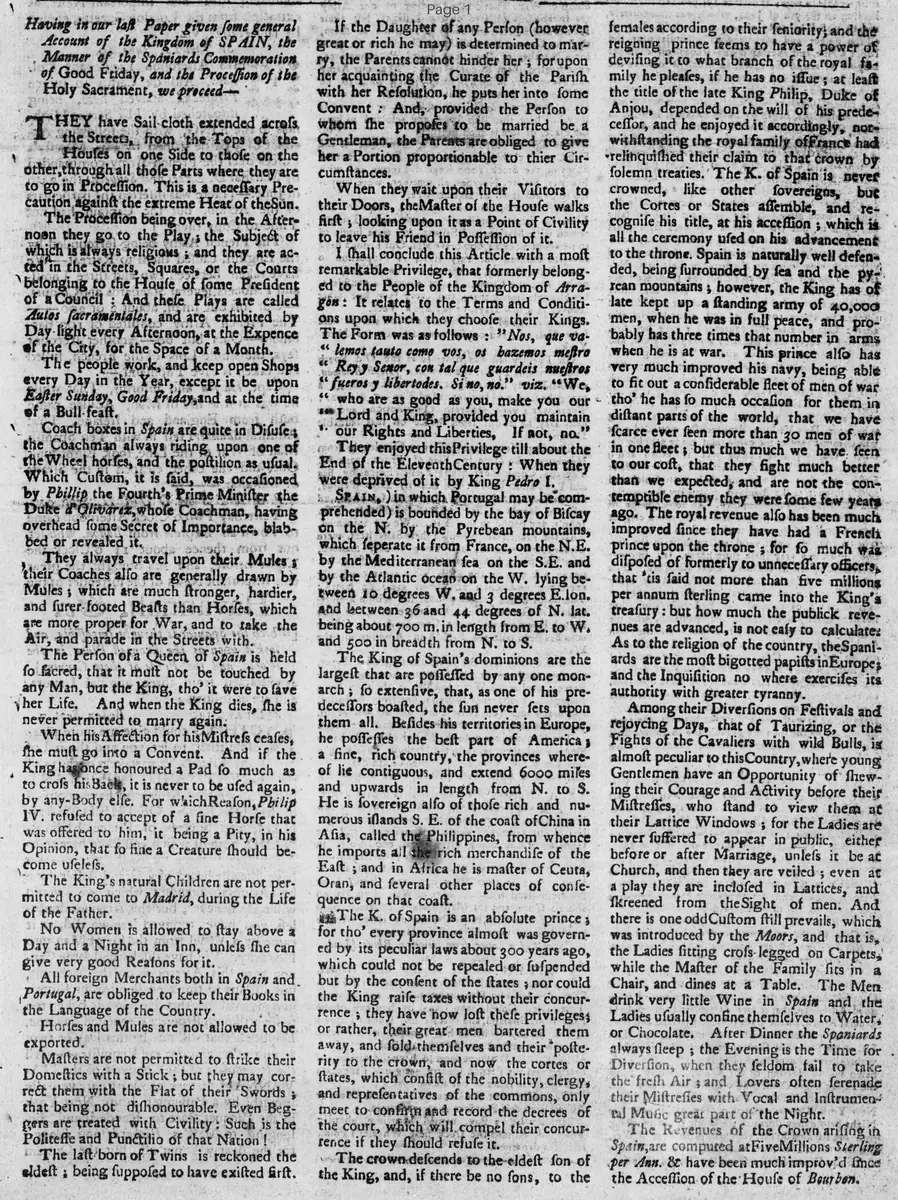
They have Sail cloth extended across the Streets, from the Tops of the Houses on one Side to those on the other, through all those Parts where they are to go in Procession. This is a necessary Precaution against the extreme Heat of the Sun.
The Procession being over, in the Afternoon they go to the Play: the Subject of which is always religious; and they are acted in the Streets, Squares, or the Courts belonging to the House of some President of a Council: And these Plays are called Autos sacramentales, and are exhibited by Day-light every Afternoon, at the Expense of the City, for the Space of a Month.
The people work, and keep open Shops every Day in the Year, except it be upon Easter Sunday, Good Friday, and at the time of a Bull-feast.
Coach boxes in Spain are quite in Disuse; the Coachman always riding upon one of the Wheel horses, and the postilion as usual. Which Custom, it is said, was occasioned by Philip the Fourth's Prime Minister the Duke d'Olivares, whose Coachman, having overheard some Secret of Importance, blabbed or revealed it.
They always travel upon their Mules as their Coaches also are generally drawn by Mules; which are much stronger, hardier, and surer-footed Beasts than Horses, which are more proper for War, and to take the Air, and parade in the Streets with.
The Person of a Queen of Spain is held so sacred, that it must not be touched by any Man, but the King, tho' it were to save her Life. And when the King dies, she is never permitted to marry again: When his Affection for his Mistress ceases, she must go into a Convent. And if the King has once honoured a Pad so much as to cross his Back, it is never to be used again by any Body else. For which Reason, Philip IV. refused to accept of a fine Horse that was offered to him, it being a Pity, in his Opinion, that so fine a Creature should become useless.
The King's natural Children are not permitted to come to Madrid, during the Life of the Father.
No Woman is allowed to stay above a Day and a Night in an Inn, unless she can give very good Reasons for it.
All foreign Merchants both in Spain and Portugal, are obliged to keep their Books in the Language of the Country.
Horses and Mules are not allowed to be exported.
Masters are not permitted to strike their Domestics with a Stick; but they may correct them with the Flat of their Swords: that being not dishonourable. Even Beggars are treated with Civility: Such is the Politeness and Punctilio of that Nation!
The last born of Twins is reckoned the eldest: being supposed to have existed first.
If the Daughter of any Person (however great or rich he may) is determined to marry, the Parents cannot hinder her; for upon her acquainting the Curate of the Parish with her Resolution, he puts her into some Convent: And provided the Person to whom she proposes to be married be a Gentleman, the Parents are obliged to give her a Portion proportionable to their Circumstances.
When they wait upon their Visitors to their Doors, the Master of the House walks first; looking upon it as a Point of Civility to leave his Friend in Possession of it.
I shall conclude this Article with a most remarkable Privilege, that formerly belonged to the People of the Kingdom of Arragon: It relates to the Terms and Conditions upon which they chose their Kings. The Form was as follows: "Nos, que valemos tanto como vos, os hacemos nuestro Maestro e Rey Senor, con tal que guardeis nuestros fueros y libertades; y si no, no." who are as good as you, make you our Lord and King, provided you maintain our Rights and Liberties, If not, no.
They enjoyed this Privilege till about the End of the Eleventh Century: When they were deprived of it by King Pedro I.
Spain, in which Portugal may be comprehended, is bounded by the bay of Biscay on the N. by the Pyrenean mountains, which separate it from France, on the N.E. by the Mediterranean sea on the S.E. and by the Atlantic ocean on the W. lying between 10 degrees W. and 8 degrees E. lon. and between 36 and 44 degrees of N. lat. being about 700 m. in length from E. to W. and 200 in breadth from N. to S.
The King of Spain's dominions are the largest that are possessed by any one Monarch; so extensive, that, as one of his Predecessors boasted, the sun never sets upon them all. Besides his territories in Europe, he possesses the best part of America, a fine, rich country, the provinces whereof lie contiguous, and extend 6000 miles and upwards in length from N. to S.
He is Sovereign also of those rich and numerous Islands S.E. of the Coast of China in Asia, called the Philippines, from whence he imports all the rich merchandize of the East; and in Africa he is master of Ceuta, Oran, and several other places of consequence on that Coast.
The K. of Spain is an absolute prince; for tho' every province almost was governed by its peculiar laws about 300 years ago, which could not be repealed or suspended but by the consent of the States; nor could the King raise taxes without their concurrence; they have now lost these privileges; or rather, their great men bartered them away, and sold themselves and their posterity to the crown, and now the cortes or States, which consist of the nobility, clergy, and representatives of the commons, only meet to confirm and record the decrees of the court, which will compel their concurrence if they should refuse it.
The crown descends to the eldest son of the King, and, if there be no sons, to the females according to their seniority: and the reigning prince seems to have a power of devising it to what branch of the royal family he pleases, if he has no issue; at least the title of the late King Philip, Duke of Anjou, depended on the will of his predecessor, and he enjoyed it accordingly, notwithstanding the royal family of France had relinquished their claim to that crown by solemn treaties. The K. of Spain is never crowned, like other Sovereigns, but the Cortes-or States assemble, and recognize his title, at his accession; which is all the ceremony used on his advancement to the throne. Spain is naturally well defended, being surrounded by sea and the Pyrenean mountains; however, the King has of late kept up a standing army of 40,000 men, when he was in full peace, and probably has three times that number in arms when he is at war. This prince also has very much improved his navy, being able to fit out a considerable fleet of men of war tho' he has so much occasion for them in distant parts of the world, that we have scarce ever seen more than 20 men of war in one fleet; but thus much we have seen to our cost, that they fight much better than we expected, and are not the contemptible enemy they were some few years ago. The royal revenue also has been much improved since they have had a French prince upon the throne; for so much was disposed of formerly to unnecessary officers, that tis said not more than five millions per annum sterling came into the King's treasury: but how much the publick revenues are advanced, is not easy to calculate: As to the religion of the country, the Spaniards are the most bigotted papists in Europe and the Inquisition no where exercises its authority with greater tyranny.
Among their Diversions on Festivals and rejoycing Days, that of Taurizing, or the Fights of the Cavaliers with wild Bulls, is almost peculiar to this Country, where young Gentlemen have an Opportunity of shewing their Courage and Activity before their Mistresses, who stand to view them at their Lattice Windows: for the Ladies are never suffered to appear in public, either before or after Marriage, unless it be at Church, and then they are veiled; even at a play they are enclosed in Lattices, and screened from the Sight of men. And there is one odd Custom still prevails, which was introduced by the Moors, and that is, the Ladies sitting cross-legged on Carpets, while the Master of the Family sits in a Chair, and dines at a Table. The Men drink very little Wine in Spain and the Ladies usually confine themselves to Water, or Chocolate. After Dinner the Spaniards always sleep; the Evening is the Time for Diversion, when they seldom fail to take the fresh Air; and Lovers often serenade their Mistresses with Vocal and Instrumental Music great part of the Night.
The Revenues of the Crown arising in Spain, are computed at Five Millions Sterling per Ann. & have been much improv'd since the Accession of the House of Bourbon.
What sub-type of article is it?
What keywords are associated?
What entities or persons were involved?
Where did it happen?
Foreign News Details
Primary Location
Spain
Key Persons
Event Details
Overview of Spanish customs including Good Friday processions with sail cloth awnings, religious plays called autos sacramentales, work holidays, coach driving practices originating from Duke d'Olivares incident, use of mules for travel, sacred status of the queen, restrictions on royal mistresses and illegitimate children, inn stays for women, merchant book-keeping rules, export bans on horses and mules, disciplinary customs, twin birth reckoning, marriage rights for daughters via convents, visitor etiquette, historical Aragonese privilege revoked by King Pedro I in the 11th century, geographical boundaries and extent, vast dominions in America, Philippines, and Africa, absolute monarchy with lost provincial privileges, succession rules, lack of coronation, military strength with 40,000 standing army and improved navy, revenue improvements under Bourbon house, Catholic bigotry and Inquisition tyranny, cultural diversions like bullfights, women's seclusion, Moorish dining customs, minimal alcohol consumption, siestas, evening outings, and serenades.