Thank you for visiting SNEWPapers!
Sign up free
Story
August 29, 1911
Daily Kennebec Journal
Augusta, Kennebec County, Maine
What is this article about?
Historical article on life insurance data revealing non-drinkers outlive drinkers, with statistics from UK, Canada, Sweden, and Switzerland showing higher death rates among moderate and heavy drinkers, particularly ages 40-60.
Clipping
OCR Quality
98%
Excellent
Full Text
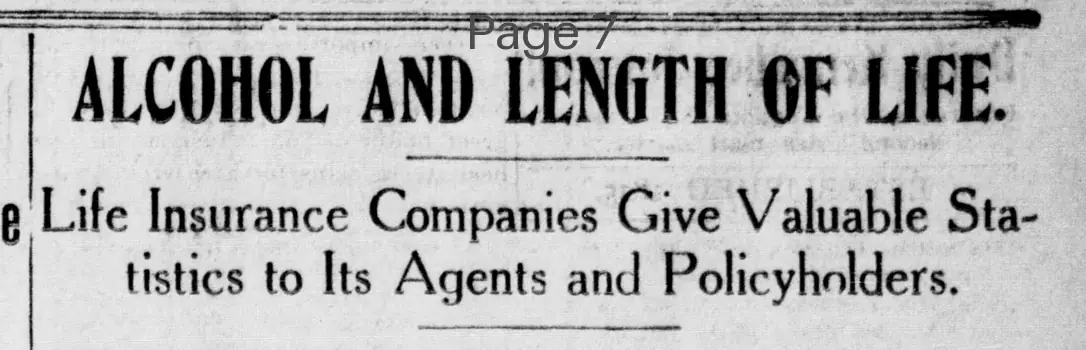
ALCOHOL AND LENGTH OF LIFE.
Life Insurance Companies Give Valuable Statistics to Its Agents and Policyholders.
About 20 years ago a young man in England wished to insure his life. He applied to a London company for a policy. When it was learned he did not drink liquor, he was told that he must pay an extra premium, as it was then believed that a little whiskey or wine was healthful, and that a man who did not drink would not live as long as one who did. The young man did not think the company was right, so he formed a company which insured only persons who did not drink. This was the United Kingdom Temperance and General Provident Institution.
For 10 years this company insured only persons who did not drink. Then it opened a new department which insured those who drank a little. Even these were carefully chosen as to health and the amount they drank. The company was in this way able to watch for more than 60 years and see which of their policy-holders died the earlier—those who drank or those who did not drink. They found that among those who drank there were many more deaths in proportion than there were among those who did not drink. Among the policy-holders in the prime of life, that is, among those between 40 and 50 years of age, the proportionate number of deaths among drinkers was even greater than among those of all ages.
The United Kingdom Temperance and General Provident Institution found that out of every 100 deaths expected among the drinkers, 93 deaths actually occurred, while among those who did not drink, only 70 out of every 100 expected deaths occurred. The experience of another company, the Sceptre Life Insurance Company, shows a better record still for the policy-holders who did not drink as compared with drinkers. The members of that company, however, were all chosen through religious bodies, the company thinking that people who led good and religious lives lived longer, and this proved to be true from the experience of the company.
Similar results have been obtained by other British societies. A Canadian company, which recently established a department for insuring only those who did not drink, found, by five years' experience ending in 1909, that the number of deaths in the new department was only a little over one-half of the number of the older department.
Dr. Ekhrens of the Swedish Life Insurance Company recently furnished evidence which agreed with that of the English companies. He found that drinkers under 43 years of age came 2 per cent. nearer the death rate than non-drinkers at the corresponding ages. For those over 43 he found that the drinkers came 26 per cent. nearer the expected death rate, which again indicates that the heaviest damage done by alcohol occurs during the years of greatest ability—at the age from 40 to 60 years.
An interesting study was made in Chicago in 1909 of all the deaths of men of 60 years and over occurring in the one month of April. The results were what were to be expected from the experience of the insurance companies. Of the 175 deaths of men over 60 years of age information as to their drink habit was obtained in 152 cases: 73 did not drink; 79 were moderate drinkers; four were heavy drinkers. The drinkers on the average had reached the age of 68 years, but those who did not drink passed the three score and 10 mark, reaching over 72 years, or four years more than the drinkers. Figures for the age of 45 and over would probably have shown a larger difference because of the heavier death rate in drinkers between 40 and 60. None of the heavy drinkers had reached the age of 80, but 19 who did not drink and eight moderate drinkers had passed it.
Alcohol on Fatal Diseases.
It is as yet quite impossible, in the United States at least, to tell just how many deaths are brought about, directly or indirectly, by alcohol. Especially is this true in trying to determine the number of cases of deaths from disease promoted by alcohol. In Switzerland provision is made for learning these facts, and the records of that country throw some light on the subject.
Dr. Rudolph Pfister made a study of the records of the city of Basle for the years 1892-1906, finding the percentage of deaths in which alcohol had been reported by the attending physician as one cause of death. He found that 18.1 per cent. of all deaths of men between 40 and 50 years of age were caused, in part at least, by alcohol, and this, at what should be the most active period in a man's life, the time when he is most needed by his family and community. Taking all ages between 20 and 80, he found that alcohol was one cause of death in one man in every 10 who died.
Another study was made by a certain doctor in Sweden, from records of 1082 deaths occurring in his own practice and the local hospital. No case was counted as alcoholic of which there was the slightest doubt. Of deaths of adult men, 18 in every 100 were due, directly or indirectly, to alcoholism. In middle life, between the ages of 40 and 50, 29; and between 50 and 60 years of age, 25.6 out of every 100 deaths had alcohol as one cause, thus agreeing with other statistics we have been quoting.—The Metropolitan.
Life Insurance Companies Give Valuable Statistics to Its Agents and Policyholders.
About 20 years ago a young man in England wished to insure his life. He applied to a London company for a policy. When it was learned he did not drink liquor, he was told that he must pay an extra premium, as it was then believed that a little whiskey or wine was healthful, and that a man who did not drink would not live as long as one who did. The young man did not think the company was right, so he formed a company which insured only persons who did not drink. This was the United Kingdom Temperance and General Provident Institution.
For 10 years this company insured only persons who did not drink. Then it opened a new department which insured those who drank a little. Even these were carefully chosen as to health and the amount they drank. The company was in this way able to watch for more than 60 years and see which of their policy-holders died the earlier—those who drank or those who did not drink. They found that among those who drank there were many more deaths in proportion than there were among those who did not drink. Among the policy-holders in the prime of life, that is, among those between 40 and 50 years of age, the proportionate number of deaths among drinkers was even greater than among those of all ages.
The United Kingdom Temperance and General Provident Institution found that out of every 100 deaths expected among the drinkers, 93 deaths actually occurred, while among those who did not drink, only 70 out of every 100 expected deaths occurred. The experience of another company, the Sceptre Life Insurance Company, shows a better record still for the policy-holders who did not drink as compared with drinkers. The members of that company, however, were all chosen through religious bodies, the company thinking that people who led good and religious lives lived longer, and this proved to be true from the experience of the company.
Similar results have been obtained by other British societies. A Canadian company, which recently established a department for insuring only those who did not drink, found, by five years' experience ending in 1909, that the number of deaths in the new department was only a little over one-half of the number of the older department.
Dr. Ekhrens of the Swedish Life Insurance Company recently furnished evidence which agreed with that of the English companies. He found that drinkers under 43 years of age came 2 per cent. nearer the death rate than non-drinkers at the corresponding ages. For those over 43 he found that the drinkers came 26 per cent. nearer the expected death rate, which again indicates that the heaviest damage done by alcohol occurs during the years of greatest ability—at the age from 40 to 60 years.
An interesting study was made in Chicago in 1909 of all the deaths of men of 60 years and over occurring in the one month of April. The results were what were to be expected from the experience of the insurance companies. Of the 175 deaths of men over 60 years of age information as to their drink habit was obtained in 152 cases: 73 did not drink; 79 were moderate drinkers; four were heavy drinkers. The drinkers on the average had reached the age of 68 years, but those who did not drink passed the three score and 10 mark, reaching over 72 years, or four years more than the drinkers. Figures for the age of 45 and over would probably have shown a larger difference because of the heavier death rate in drinkers between 40 and 60. None of the heavy drinkers had reached the age of 80, but 19 who did not drink and eight moderate drinkers had passed it.
Alcohol on Fatal Diseases.
It is as yet quite impossible, in the United States at least, to tell just how many deaths are brought about, directly or indirectly, by alcohol. Especially is this true in trying to determine the number of cases of deaths from disease promoted by alcohol. In Switzerland provision is made for learning these facts, and the records of that country throw some light on the subject.
Dr. Rudolph Pfister made a study of the records of the city of Basle for the years 1892-1906, finding the percentage of deaths in which alcohol had been reported by the attending physician as one cause of death. He found that 18.1 per cent. of all deaths of men between 40 and 50 years of age were caused, in part at least, by alcohol, and this, at what should be the most active period in a man's life, the time when he is most needed by his family and community. Taking all ages between 20 and 80, he found that alcohol was one cause of death in one man in every 10 who died.
Another study was made by a certain doctor in Sweden, from records of 1082 deaths occurring in his own practice and the local hospital. No case was counted as alcoholic of which there was the slightest doubt. Of deaths of adult men, 18 in every 100 were due, directly or indirectly, to alcoholism. In middle life, between the ages of 40 and 50, 29; and between 50 and 60 years of age, 25.6 out of every 100 deaths had alcohol as one cause, thus agreeing with other statistics we have been quoting.—The Metropolitan.
What sub-type of article is it?
Curiosity
Medical Curiosity
What themes does it cover?
Moral Virtue
Misfortune
What keywords are associated?
Alcohol Mortality
Life Insurance Statistics
Temperance Benefits
Drinking Risks
Age Specific Deaths
What entities or persons were involved?
Dr. Ekhrens
Dr. Rudolph Pfister
Where did it happen?
England, Chicago, Basle, Sweden
Story Details
Key Persons
Dr. Ekhrens
Dr. Rudolph Pfister
Location
England, Chicago, Basle, Sweden
Event Date
1892 1909
Story Details
Life insurance companies and studies show that non-drinkers live longer than drinkers, with higher mortality rates among drinkers especially between 40-60 years, based on data from UK, Canadian, Swedish, and Swiss sources.