Thank you for visiting SNEWPapers!
Sign up free
Story
June 26, 1872
Knoxville Weekly Chronicle
Knoxville, Knox County, Tennessee
What is this article about?
Article by WM. Bacon on muck, a vegetable matter from wet lands used as fertilizer. Discusses its acidic nature, preparation with alkali like lime or ashes, benefits for soil, crops, trees, and gardens, and laments its waste in swamps. From Berkshire Co., Mass.
Clipping
OCR Quality
98%
Excellent
Full Text
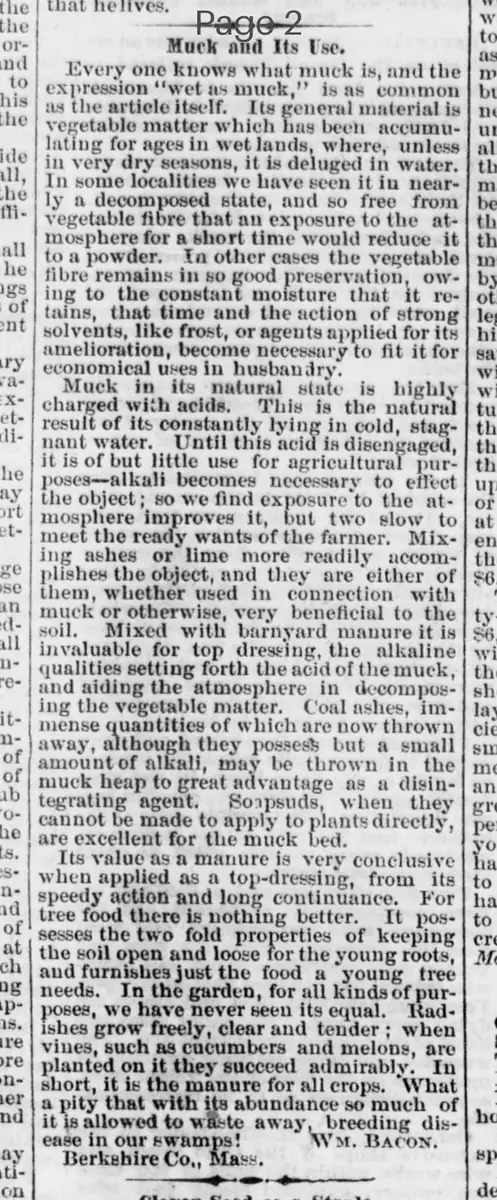
Muck and Its Use.
Every one knows what muck is, and the expression "wet as muck," is as common as the article itself. Its general material is vegetable matter which has been accumulating for ages in wet lands, where, unless in very dry seasons, it is deluged in water. In some localities we have seen it in nearly a decomposed state, and so free from vegetable fibre that an exposure to the atmosphere for a short time would reduce it to a powder. In other cases the vegetable fibre remains in so good preservation, owing to the constant moisture that it retains, that time and the action of strong solvents, like frost, or agents applied for its amelioration, become necessary to fit it for economical uses in husbandry.
Muck in its natural state is highly charged with acids. This is the natural result of its constantly lying in cold, stagnant water. Until this acid is disengaged, it is of but little use for agricultural purposes—alkali becomes necessary to effect the object; so we find exposure to the atmosphere improves it, but too slow to meet the ready wants of the farmer. Mixing ashes or lime more readily accomplishes the object, and they are either of them, whether used in connection with muck or otherwise, very beneficial to the soil. Mixed with barnyard manure it is invaluable for top dressing, the alkaline qualities setting forth the acid of the muck, and aiding the atmosphere in decomposing the vegetable matter. Coal ashes, immense quantities of which are now thrown away, although they possess but a small amount of alkali, may be thrown in the muck heap to great advantage as a disintegrating agent. Soapsuds, when they cannot be made to apply to plants directly, are excellent for the muck bed.
Its value as a manure is very conclusive when applied as a top-dressing, from its speedy action and long continuance. For tree food there is nothing better. It possesses the twofold properties of keeping the soil open and loose for the young roots, and furnishes just the food a young tree needs. In the garden, for all kinds of purposes, we have never seen its equal. Radishes grow freely, clear and tender; when vines, such as cucumbers and melons, are planted on it they succeed admirably. In short, it is the manure for all crops. What a pity that with its abundance so much of it is allowed to waste away, breeding disease in our swamps!
WM. BACON.
Berkshire Co., Mass.
Every one knows what muck is, and the expression "wet as muck," is as common as the article itself. Its general material is vegetable matter which has been accumulating for ages in wet lands, where, unless in very dry seasons, it is deluged in water. In some localities we have seen it in nearly a decomposed state, and so free from vegetable fibre that an exposure to the atmosphere for a short time would reduce it to a powder. In other cases the vegetable fibre remains in so good preservation, owing to the constant moisture that it retains, that time and the action of strong solvents, like frost, or agents applied for its amelioration, become necessary to fit it for economical uses in husbandry.
Muck in its natural state is highly charged with acids. This is the natural result of its constantly lying in cold, stagnant water. Until this acid is disengaged, it is of but little use for agricultural purposes—alkali becomes necessary to effect the object; so we find exposure to the atmosphere improves it, but too slow to meet the ready wants of the farmer. Mixing ashes or lime more readily accomplishes the object, and they are either of them, whether used in connection with muck or otherwise, very beneficial to the soil. Mixed with barnyard manure it is invaluable for top dressing, the alkaline qualities setting forth the acid of the muck, and aiding the atmosphere in decomposing the vegetable matter. Coal ashes, immense quantities of which are now thrown away, although they possess but a small amount of alkali, may be thrown in the muck heap to great advantage as a disintegrating agent. Soapsuds, when they cannot be made to apply to plants directly, are excellent for the muck bed.
Its value as a manure is very conclusive when applied as a top-dressing, from its speedy action and long continuance. For tree food there is nothing better. It possesses the twofold properties of keeping the soil open and loose for the young roots, and furnishes just the food a young tree needs. In the garden, for all kinds of purposes, we have never seen its equal. Radishes grow freely, clear and tender; when vines, such as cucumbers and melons, are planted on it they succeed admirably. In short, it is the manure for all crops. What a pity that with its abundance so much of it is allowed to waste away, breeding disease in our swamps!
WM. BACON.
Berkshire Co., Mass.
What sub-type of article is it?
Agricultural Advice
Informational Essay
What themes does it cover?
Nature
Moral Virtue
What keywords are associated?
Muck
Fertilizer
Agriculture
Manure
Alkali
Top Dressing
Soil Improvement
What entities or persons were involved?
Wm. Bacon
Where did it happen?
Berkshire Co., Mass.
Story Details
Key Persons
Wm. Bacon
Location
Berkshire Co., Mass.
Story Details
Description of muck's composition, acidic properties, preparation methods using alkali, mixing with manure or ashes, and its superior benefits as fertilizer for crops, trees, and gardens, with a call to utilize it instead of wasting it.