Thank you for visiting SNEWPapers!
Sign up free
Herald Of The Times
Newport, Newport County, Rhode Island
What is this article about?
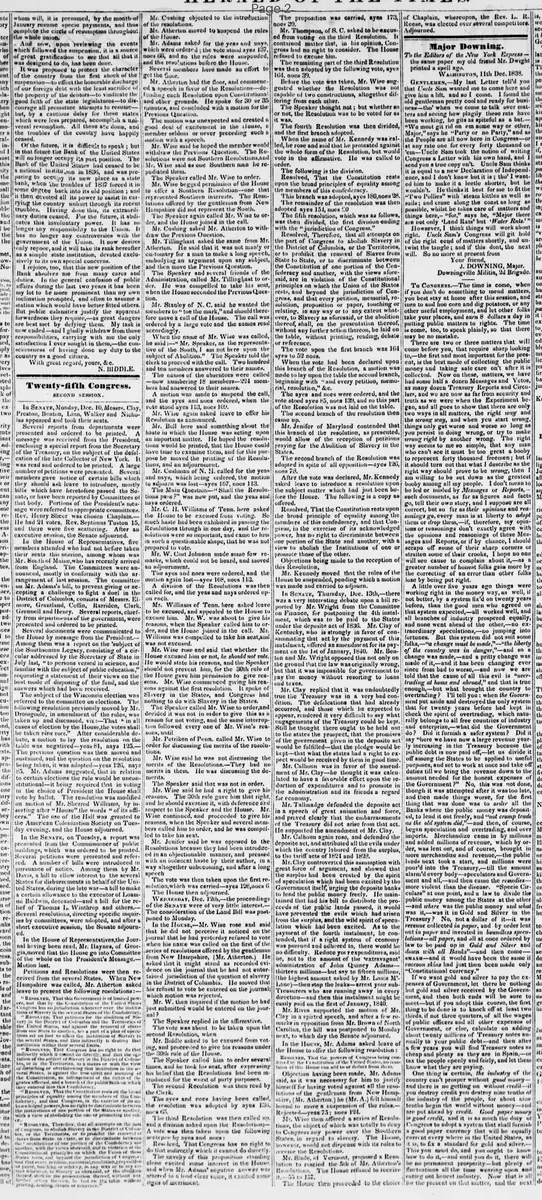
Report on the 25th Congress, 2nd Session proceedings from Dec. 10-13, 1838, in the Senate and House. Key events include selection of chaplains, committee announcements, presidential messages, and intense House debate and passage of Atherton's resolutions restricting slavery-related petitions, amid objections and procedural disputes.
Clipping
OCR Quality
Full Text
SECOND SESSION.
In Senate, Monday, Dec. 10, Messrs. Clay, Preston, Benton, Linn, Walker and Nicholas appeared and took their seats.
Several reports from departments were presented and ordered to be printed. A message was received from the President enclosing a special report from the Secretary of the Treasury, on the subject of the defalcation of the late Collector of New York. It was read and ordered to be printed. A large number of petitions were presented. Several members gave notice of certain bills which they should ask leave to introduce, mostly bills which have heretofore passed the Senate, or have been reported by Committees of that body. Portions of the President's message were referred to appropriate committees. Rev. Henry Slicer was chosen Chaplain.—He had 21 votes, Rev. Septimus Tuston 15, and there were five scattering. After an executive session, the Senate adjourned.
In the House of Representatives, five members attended who had not before taken their seats this session, among whom was Mr. Smith of Maine, who has recently arrived from England. The Committees were announced, mostly in conformity with the arrangement of last session. The committee on Mr. Adams's bill, to prevent giving or accepting a challenge to fight a duel in the District of Columbia, consists of Messrs. Elmore, Grantland, Coffin, Barriden, Clark Grennell and Henry. Several reports, chiefly from departments of the government, were presented and ordered to be printed.
Several documents were communicated to the House by message from the President.—Among them was a report on the subject of the Smithsonian Legacy, consisting of a circular addressed by the Secretary of State in July last, 'to persons versed in science, and familiar with the subject of public education,' requesting a statement of their views on the best mode of disposing of the fund, and the answers which had been received.
The subject of the Wisconsin election was referred to the committee on elections. The following resolution previously moved by Mr. Dromgoole, in amendment of the rules, was taken up and discussed, viz:—That 'in all cases of election by the House, the votes shall be taken viva voce.' After considerable debate, a motion to lay the resolution on the table was negatived—yeas 81, nays 125.—The previous question was then moved and sustained, and the question on the resolution being taken, it was adopted—yeas 126, nays 85. Mr. Adams suggested, that in relation to certain elections the rule would be unconstitutional—it being required that in voting in the choice of President the House shall vote by ballot. The resolution was modified on motion of Mr. Sherrod Williams, by inserting after 'House' the words 'of its officers.' The use of the Hall was granted to the American Colonization Society on Tuesday evening, and the House adjourned.
In the Senate, on Tuesday, a report was presented from the Commissioner of public buildings, which was ordered to be printed. Several petitions were presented and referred. A number of bills were introduced in pursuance of notice. Among them by Mr. Davis, a bill to allow interest to the several States for disbursements in behalf of the United States, during the late war—a bill to make a certain allowance to the executor of Loammi Baldwin, deceased—and a bill for the relief of Thomas L. Winthrop and others.—Several resolutions, directing specific inquiries by committees, were adopted, and after a short executive session, the Senate adjourned.
In the House of Representatives, the Journal having been read, Mr. Haynes, of Georgia, moved that the House go into Committee of the whole on the President's Message.—Motion lost.
Petitions and Resolutions were then received from the several States. When New Hampshire was called, Mr. Atherton asked leave to present the following resolutions:-
'REsolved, That this Government is of limited powers, and that by the Constitution of the United States Congress has no jurisdiction whatever over the institutions of Slavery in the several States of the Confederacy.
'Resolved, That petitions for the abolition of Slavery in the District of Columbia and the Territories of the United States, and against the removal of slaves from one State to another, are a part of a plan of operations set on foot to affect the institution of Slavery in the several States, and thus indirectly to destroy that institution within their several limits.
'Resolved, That Congress has no right to do that indirectly which it cannot do directly, and that the agitation of the subject of Slavery in the District of Columbia, or in the Territories, as a means or with the view of disturbing or overthrowing that institution in the several States, is against the true spirit and meaning of the Constitution, an infringement of the rights of the States affected, and a breach of the public faith on which They entered into this Confederacy.
'Resolved, That the Constitution rests on the broad principles of equality among the members of this Confederacy, and that Congress, in the exercise of its acknowledged powers, has no right to discriminate between the institutions of one portion of the States or another, with a view of abolishing the one or promoting the other.
'Resolved, Therefore, that all attempts on the part of Congress, to abolish Slavery in the District of Columbia, or the Territories, or to prohibit the removal of slaves from one State to another, or to discriminate between the Constitutions of one portion of the Confederacy and another, with the views aforesaid, and in violation of the Constitutional principles on which the Union of these States rests, and beyond the jurisdiction of Congress; and that every petition, memorial, resolution, proposition or paper, touching or relating, in any way or to any extent whatever, to Slavery as aforesaid, or the abolition thereof, shall, on the presentation thereof, without any further action thereon, be laid on the table without printing, reading, debate or reference.'
Mr. Cushing objected to the introduction of the resolutions.
Mr. Atherton moved to suspend the rules of the House.
Mr. Adams asked for the yeas and nays which were ordered; the vote stood ayes 137 noes 66, and so the rules were suspended, and the resolutions before the House.
Several members here made an effort to get the floor.
Mr. Atherton had the floor, and commenced a speech in favor of the Resolutions—defending each Resolution upon Constitutional and other grounds. He spoke for 30 or 35 minutes, and concluded with a motion for the Previous Question.
The motion was unexpected and created a good deal of excitement in the House, a member seldom or never preceding such a motion with a speech.
Mr. Wise said he hoped the member would withdraw the Previous Question. The Resolutions were not Southern Resolutions, and Mr. Wise said as one Southern man he repudiated them.
The Speaker called Mr. Wise to order.
Mr. Wise begged permission of the House to offer a Southern Resolution—one that represented Southern interests. The Resolutions offered by the gentleman from New Hampshire did not represent the South.
The Speaker again called Mr. Wise to order, and the House joined in the call.
Mr. Cushing asked Mr. Atherton to withdraw the Previous Question.
Mr. Tillinghast asked the same from Mr. Atherton. He said that it was not manly or customary for a man to make a long speech, embodying an argument upon any subject and then move the Previous Question.
The Speaker and several friends of the Administration, called Mr. Tillinghast to order. He was compelled to take his seat, when the House seconded the Previous Question.
Mr. Stanley of N. C. said he wanted the members to 'toe the mark,' and should therefore move a call of the House. The call was ordered by a large vote and the names read accordingly.
When the name of Mr. Wise was called, he said: 'Mr. Speaker, as the representative of the South, I am not here upon the subject of Abolition.' The Speaker told the clerk to proceed with the call. Two hundred and ten members answered to their names. The names of the absentees were called now numbering 18 members—224 members had answered to their names.
A motion was made to suspend the call and the ayes and noes ordered, when the vote stood ayes 118, noes 103.
Mr. Wise again asked leave to offer his Resolution as announced.
Mr. Bell here said something about the haste in which the House was acting upon an important matter. He hoped the resolutions would be printed, that the House could have time to examine them, and for this purpose he moved the printing of the Resolutions, and an adjournment.
Mr. Cushing of N. J. called for the yeas and nays, which being ordered, the motion to adjourn was lost—ayes 107, noes 113.
The Main Question—'Shall the Resolutions pass?' was now put, and the yeas and nays ordered.
Mr. C. J. Williams of Tenn. here asked the House to be excused from voting. So much haste had been exhibited in passing the Resolutions through in one day, and the resolutions were so important, and came to him in such a questionable shape, that he was not prepared to vote.
Mr. W. Cost Johnson made some few remarks, which could not be heard, and moved an adjournment.
The ayes and noes were ordered, and the motion again lost—ayes 108, noes 113.
A division of the Resolutions was then called for, and the yeas and nays ordered upon each.
Mr. Williams of Tenn. here asked leave to be excused, and appealed to the House to excuse him. Mr. W. was about to give his reasons, when the Speaker called him to order, and the House joined in the call. Mr. Williams was compelled to take his seat, and was not excused.
Mr. Wise rose and said that whether the House excused him or not, he should not vote. He would state his reasons, and the Speaker should not prevent him, for the 30th rule of the House gave him permission to give reasons. Mr. Wise commenced giving his reasons against the first resolution. It spoke of Slavery in the States, and Congress had nothing to do with Slavery in the States.
The Speaker called Mr. Wise to order, and decided it was not in order to give this as a reason for not voting, and the same interruption followed every one of Mr. Wise's reasons, until
Mr. Petriken of Penn. called Mr. Wise to order for discussing the merits of the resolutions.
Mr. Wise said he was not discussing the merits of the Resolutions—they had no merits in them. He was discussing the demerits.
The Speaker said that was not in order.
Mr. Wise said he had a right to give his reasons. The 30th rule gave him that right and he should exercise it, with deference and respect to the Speaker and the House. Mr. Wise continued, and proceeded to give his reasons, when the Speaker and several members called him to order, and he was compelled to take his seat.
Mr. Jenifer said he was opposed to the Resolutions because they had been introduced in an objectionable manner, and pressed with an indecent haste by their author, in a way altogether unbecoming, and after a long speech.
The vote was then taken upon the first resolution, which was carried—ayes 198, noes 6. The House then adjourned.
WEDNESDAY, Dec. 12th,—the proceedings of the Senate were of very little interest.—The consideration of the Land Bill was postponed to Monday.
In the House,—Mr. Wise rose and said that he did not perceive it noticed on the journal that he had yesterday refused to vote when his name was called on the first of the series of resolutions offered by the gentleman from New Hampshire. (Mr. Atherton.) He asked that it might stand as recorded evidence on the journal that he had not entertained jurisdiction of the question of slavery in the District of Columbia. He moved that his refusal to vote be entered on the journal; which motion was rejected.
Mr. W. then inquired if the motion he had just submitted would be entered on the journal?
The Speaker replied in the affirmative.
The vote was about to be taken upon the second Resolution, when
Mr. Biddle asked to be excused from voting, and proceeded to give his reasons under the 30th rule of the House.
The Speaker called him to order several times, and he took his seat, after expressing his belief that the Resolutions had been introduced for the worst of party purposes.
The second Resolution was then read by the Clerk,
The ayes and noes having been called, the resolution was adopted by ayes 136. noes 65,
The third Resolution was then called up and a division asked upon the Resolution;—A vote was then taken upon the following sentence by ayes and noes:
Resolved, That Congress has no right to do that indirectly which it cannot do directly.
The novelty of this proposition standing alone excited some interest in the House and when Mr. Adams' negative answer was uttered in a loud clear voice, it excited some signs of merriment.
The proposition was carried, ayes 173, noes 30.
Mr. Thompson, of S. C. asked to be excused from voting on the third Resolution. It contained matter that, in his opinion, Congress had no right to consider. The House refused to excuse him.
The remaining part of the third Resolution was then adopted by the following vote, ayes 164, noes 39.
Before the vote was taken, Mr. Wise suggested whether the Resolution was not capable of two constructions, altogether differing from each other.
The Speaker thought not; but whether so or not, the Resolution was to be voted for as it was.
The fourth Resolution was then divided, and the first branch adopted.
When the name of Mr. Kennedy was called, he rose and said that he protested against the whole form of the Resolution, but would vote in the affirmative. He was called to order.
The following is the division.
Resolved, That the Constitution rests upon the broad principles of equality among the members of this confederacy.
This branch was adopted, ayes 180, noes 28.
The remainder of the resolution was then adopted ayes 154, noes 20.
The fifth resolution, which was as follows, was then divided, the first division ending with the 'jurisdiction of Congress.'
Resolved, Therefore, that all attempts on the part of Congress to abolish Slavery in the District of Columbia, or the Territories, or to prohibit the removal of Slaves from State to State, or to discriminate between the Constitution of one portion of the Confederacy and another, with the views aforesaid, are in violation of the Constitutional principles on which the Union of the States rests, and beyond the jurisdiction of Congress, and that every petition, memorial, resolution, proposition or paper, touching or relating, in any way or to any extent whatever, to Slavery as aforesaid, or the abolition thereof, shall, on the presentation thereof, without any further action thereon, be laid on the table, without printing, reading, debate or reference.
The vote upon the first branch was 164 ayes to 52 noes.
When the vote had been declared upon this branch of the Resolution, a motion was made to lay upon the table the second branch, beginning with 'and every petition, memorial, resolution,' &c.
The ayes and noes were ordered, and the vote stood ayes 85, noes 139, and so this part of the Resolution was not laid on the table.
The second branch of the resolution then came up.
Mr. Jenifer of Maryland contended that this branch of the resolution, as presented, would allow of the reception of petitions praying for the Abolition of Slavery in the States.
The second branch of the Resolution was adopted in spite of all opposition—ayes 126, noes 78.
After the vote was declared, Mr. Kennedy asked leave to introduce a resolution upon the subject matter which had just been before the House. The following is a copy as offered.
Resolved, That the Constitution rests upon the broad principle of equality among the members of this confederacy, and that Congress, in the exercise of its acknowledged power, has no right to discriminate between one portion of the State and another, with a view to abolish the Institutions of one or promote those of the other.
Objections being made to the reception of this Resolution,
Mr. Kennedy moved that the rules of the House be suspended, pending which a motion was made and carried to adjourn.
In Senate, Thursday, Dec. 13th,—there was a very interesting debate upon a bill reported by Mr. Wright from the Committee on Finance, for postponing the 4th instalment, which was to be paid to the States under the deposite act of 1836. Mr. Clay of Kentucky, who is strongly in favor of consummating that act by the payment of this instalment, offered an amendment for its payment on the 1st of January, 1840. Mr. Benton and Mr. Wright opposed this not only on the ground that the law was originally wrong. but that it was impossible for government to pay the money without resorting to loans and taxes.
Mr. Clay replied that it was undoubtedly true the Treasury was in a very bad condition. The defalcations that had already occurred, and those which he expected to appear, rendered it very difficult to say what engagements of the Treasury could be kept. Still he thought there ought to be held out to the states the prospect, that the promises of the government given in the deposite act would be fulfilled—that the pledge would be kept—that what the states had a right to expect would be received by them in good time.
Mr. Calhoun was in favor of the amendment of Mr. Clay—he thought it was calculated to have a favorable effect upon the reduction of expenditures and to promote in the administration and its friends a regard for economy.
Mr. Tallmadge defended the deposite act in a speech of great animation and force and proved clearly that the embarrassments of the Treasury did not arise from that act. He supported the amendment of Mr. Clay.
Mr. Calhoun again rose, and defended the deposite act, and attributed all the evils under which the country labored from the surplus, to the tariff acts of 1824 and 1828.
Mr. Clay controverted this assumption with great force of argument, and showed that the surplus had been created by the spirit of speculation which had been excited by the Government itself, urging the deposite banks to lend the public money freely. He maintained that had his bill to distribute the proceeds of the public lands passed, it would have prevented the evils which had arisen from the surplus, and the wild spirit of speculation which had been excited. As to the payment of the fourth instalment, he contended, that if a right system of economy was pursued and adhered to, there would be no difficulty. Reduce your expenditures, said he, not to the amount of the extravagant administration of John Quincy Adams—thirteen millions—but say to fifteen millions. (the highest amount asked by Mr. Louis M. Lane)—then stop the leaks—arrest your sub Treasurers who are running away in every direction—and then this instalment might be easily paid on the first of January, 1840.
Mr. Rives supported the motion of Mr. Clay in a spirited speech, and after a few remarks in opposition from Mr. Brown of North Carolina, the bill was postponed to Monday next, to which day the Senate adjourned.
In the House, Mr. Adams asked leave of the House to offer the following resolution :
Resolved, That the powers of Congress being conferred by the Constitution of the United States, no resolution of this House can add to or deduct from them.
Objection having been made, Mr. Adams said, as it was necessary for him to justify himself for having voted against all the resolutions of the gentleman from New Hampshire, (Mr. Atherton.) he (Mr. A.) felt himself bound to move a suspension of the rules.—Rejected—yeas 75; noes 124.
Mr. Wise then offered a series of Resolutions, the object of which was totally to deny to Congress any power over the Southern States, in regard to slavery. The House, however, would not dispense with its rules to receive the Resolutions.
Mr. Slade, of Vermont, proposed a Resolution to rescind the 5th of Mr. Atherton's Resolutions. The House refused to receive it—55 to 157.
The House then proceeded to the choice of Chaplain, whereupon, the Rev. L. R. Reese, was elected over several competitors.
Adjourned.
What sub-type of article is it?
What keywords are associated?
What entities or persons were involved?
Where did it happen?
Domestic News Details
Primary Location
Washington
Event Date
Dec. 10 To Dec. 13, 1838
Key Persons
Outcome
atherton's five resolutions restricting debate and action on slavery petitions in congress were passed by the house with varying vote margins (e.g., first: 198-6; fifth branch: 126-78). senate debated but postponed bill on fourth installment to states under 1836 deposit act. chaplains elected in both chambers.
Event Details
The report details daily proceedings in the 25th Congress, 2nd Session. Senate handled reports, petitions, bills, and a debate on the deposit act installment. House focused on committees, messages, rule amendments, and heated debate over Atherton's resolutions asserting Congress's limited powers over slavery, limiting petitions on abolition in D.C. and territories; resolutions passed despite objections, calls to order, and attempts to excuse votes or adjourn.