Thank you for visiting SNEWPapers!
Sign up free
Daily National Intelligencer
Washington, District Of Columbia
What is this article about?
Biographical sketch praising General San Martin's disinterested patriotism in liberating Chile and his refusal of supreme power, modeling after Washington. Highlights similar self-denial among La Plata leaders like O'Higgins, Pueyrredon, Belgrano, Saavedra, and Alvarez in their independence struggle.
Clipping
OCR Quality
Full Text
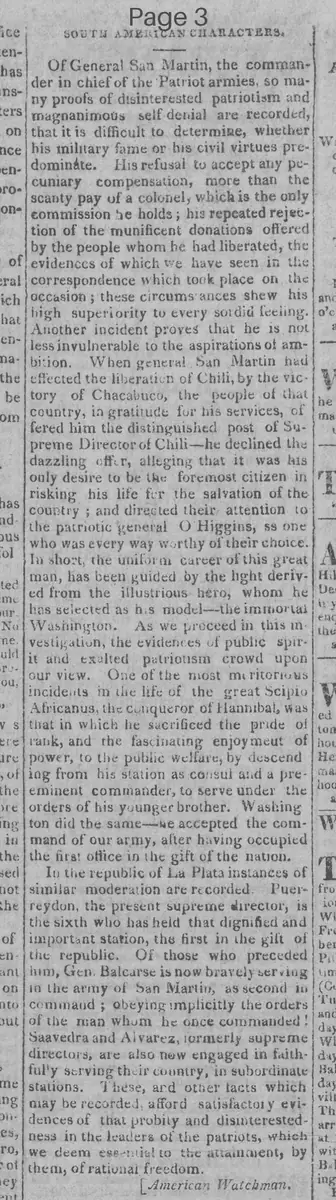
Of General San Martin, the commander in chief of the Patriot armies, so many proofs of disinterested patriotism and magnanimous self denial are recorded, that it is difficult to determine, whether his military fame or his civil virtues predominate. His refusal to accept any pecuniary compensation, more than the scanty pay of a colonel, which is the only commission he holds; his repeated rejection of the munificent donations offered by the people whom he had liberated, the evidences of which we have seen in the correspondence which took place on the occasion; these circumstances shew his high superiority to every sordid feeling. Another incident proves that he is not less invulnerable to the aspirations of ambition. When general San Martin had effected the liberation of Chili, by the victory of Chacabuco, the people of that country, in gratitude for his services, offered him the distinguished post of Supreme Director of Chili—he declined the dazzling offer, alleging that it was his only desire to be the foremost citizen in risking his life for the salvation of the country; and directed their attention to the patriotic general O'Higgins, as one who was every way worthy of their choice. In short, the uniform career of this great man, has been guided by the light derived from the illustrious hero, whom he has selected as his model—the immortal Washington. As we proceed in this investigation, the evidences of public spirit and exalted patriotism crowd upon our view. One of the most meritorious incidents in the life of the great Scipio Africanus, the Conqueror of Hannibal, was that in which he sacrificed the pride of rank, and the fascinating enjoyment of power, to the public welfare, by descending from his station as consul and a pre-eminent commander, to serve under the orders of his younger brother. Washington did the same—he accepted the command of our army, after having occupied the first office in the gift of the nation. In the republic of La Plata instances of similar moderation are recorded. Pueyrredon, the present supreme director, is the sixth who has held that dignified and important station, the first in the gift of the republic. Of those who preceded him, Gen. Belgrano is now bravely serving in the army of San Martin, as second in command; obeying implicitly the orders of the man whom he once commanded! Saavedra and Alvarez, formerly supreme directors, are also now engaged in faithfully serving their country, in subordinate stations. These, and other facts which may be recorded, afford satisfactory evidences of that probity and disinterestedness in the leaders of the patriots, which we deem essential to the attainment, by them, of rational freedom.
What sub-type of article is it?
What keywords are associated?
What entities or persons were involved?
Where did it happen?
Foreign News Details
Primary Location
South America
Key Persons
Outcome
leaders demonstrate probity and disinterestedness essential for attaining rational freedom through patriotic service and refusal of personal power.
Event Details
General San Martin exhibits superior patriotism by refusing pecuniary compensation beyond a colonel's pay, rejecting donations from liberated people, and declining the Supreme Directorship of Chile after the victory at Chacabuco, recommending O'Higgins instead. His career models after Washington. In La Plata, Pueyrredon serves as current supreme director; former directors Belgrano, Saavedra, and Alvarez now serve in subordinate roles, including Belgrano under San Martin.