Thank you for visiting SNEWPapers!
Sign up free
Editorial
February 13, 1800
Gazette Of The United States, & Philadelphia Daily Advertiser
Philadelphia, Philadelphia County, Pennsylvania
What is this article about?
Editorial in The Gazette criticizes the Senate's passage of a bill suspending army enlistments, lists voting senators, urges President Adams to veto it for national defense amid French threats and domestic political divisions, warning of dire consequences.
Clipping
OCR Quality
92%
Excellent
Full Text
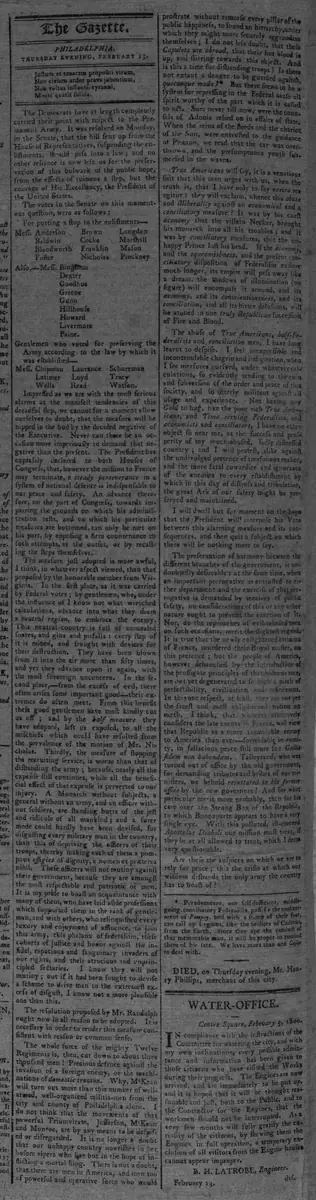
The Gazette.
PHILADELPHIA,
THURSDAY EVENING, FEBRUARY 13.
Justum et tenacem propositi virum,
Non civium ardor prava jubentium,
Non vultus instantis tyranni,
Mente quatit solida.
The Democrats have at length completely carried their point with respect to the Permanent Army. It was resolved on Monday in the Senate, that the bill sent up from the House of Representatives, suspending the enlistments, should pass into a law; and no other reliance is now left us for the preservation of this bulwark of the public hope, from the effects of ruinous as step, but the courage of His Excellency, the President of the United States.
The votes in the Senate on this momentous question, were as follows:
For putting a stop to the enlistments-
Mr. Anderson
Brown
Langdon
Baldwin
Cocke
Marshall
Bloodworth
Franklin
Mason
Foster
Nicholas
Pinckney
Also,—Mr. Bingham
Dexter
Goodhue
Greene
Gunn
Hillhouse
Howard
Livermore
Paine.
Gentlemen who voted for preserving the Army according to the law by which it was established—
Mr. Chipman Laurance Schureman
Latimer
Lloyd
Tracy, Wells
Read
Watson.
Impressed as we are with the most serious alarms at the manifest tendencies of this dreadful step, we cannot for a moment allow ourselves to doubt, that the measure will be nipped in the bud by the decided negative of the Executive. Never can there be an occasion more imperiously to demand that negative than the present. The President has expressly declared to both Houses of Congress, that, however the mission to France may terminate, a steady perseverance in a system of national defence is indispensable to our peace and safety. An advance therefore, on the part of Congress, towards impairing the grounds on which his administration rests, and on which his particular measures are bottomed, can only be met on his part, by opposing a firm countenance to such attempts, at the outset, or by recalling the steps themselves.
The measure just adopted is more awful, I think, in whatever aspect viewed, than that proposed by the honorable member from Virginia. In the first place, as it was carried by Federal votes; by gentlemen, who, under the influence of I know not what wretched calculations, advance into what they deem a neutral region, to embrace the enemy. This neutral country is full of concealed snares, and gins and pitfalls: every step of it is mined, and fraught with devices for their destruction. They have been blown from it into the air more than fifty times, and yet they advance upon it again, with the most sovereign unconcern. In the second place,—from the excess of evil, there often arises some important good their extremes do often meet. From this benefit these good gentlemen have most kindly cut us off; and by the half measure they have adopted, left us exposed, to all the mischiefs which could have resulted from the prevalence of the motion of Mr. Nicholas. Thirdly, the measure of stopping the recruiting service, is worse than that of disbanding the army; because, nearly all the expense still continues, while all the beneficial effect of that expense is perverted to our injury. A Monarch without subjects, a general without an army, and an officer without soldiers, are standing butts of the jest and ridicule of all mankind; and a surer mode could hardly have been devised, for disgusting every military man in the country, than this of depriving the officers of their troops, thereby making each of them a pompous effigies of dignity, a nomen et praeterea nihil. These officers will not mutiny against their government, because they are amongst the most respectable and patriotic of men. It is my pride to boast an acquaintance with many of them, who have laid aside professions which supported them in the rank of gentlemen, and with others, who relinquished every luxury and enjoyment of affluence, to join this army, this phalanx of federalism, these cohorts of justice and honor against the infidel, rapacious and sanguinary invaders of our rights, and their atrocious and unprincipled sectaries. I know they will not mutiny; but if it had been ought to devise a scheme to drive men to the extremest excesses of disgust, I know not a more plausible one than this.
The resolution proposed by Mr. Randolph ought now in all reason to be adopted. It is necessary in order to render this measure consistent with reason or common sense. The whole force of the mighty Twelve Regiments is, then, cut down to about three thousand men! Precious defence against the invasion of a foreign enemy, or the machinations of domestic treason. Why, M'Kean will turn out more than this number of well-armed, well-organized militia-men from the city and county of Philadelphia alone. I do not think that the movements of that powerful Triunvirate, Jefferson, M'Kean and Monroe, are by any means to be depreciated or disregarded. It is no longer a doubt that our unhappy country nourishes in her bosom vipers who live but in the hope of inflicting a mortal sting. There is not a doubt, that there are men in America, and men too of powerful and operative force who would prostrate without remorse every pillar of the public happiness, to found an hierarchy, under which they might more securely aggrandize themselves; I do not less doubt, that these Capulets are abroad, that their hot blood is up, and stirring towards this object. And is this a time for disbanding troops? Is there not extant a danger to be guarded against, quocunque modo?* But there seems to be a system for repressing in the Federal cause all spirit worthy of the part which it is called to act. Sure never till now, were the counsels of Adonis relied on in affairs of state. When the reins of the steeds and the chariot of the Sun, were entrusted to the guidance of Phaeton, we read that the car was overthrown, and the presumptuous youth submerged in the waves.
True Americans will say, it is a vexatious suit that this man urges with us, when the truth is, that I have only to say vestra res agitur: they will exclaim, whence this abuse and illiberality against an œconomical and a conciliatory measure? It was by his cursed œconomy that the villain Necker, brought his monarch into all his troubles; and it was by conciliatory measures, that the unhappy Prince lost his head. If the œconomy, and the squeamishness, and the present conciliatory disposition of Federalism endure much longer, its empire will pass away like a dream, the shadows of illumination (no figure) will encompass it around, and its œconomy, and its conscientiousness, and its conciliation, and all its bitter delusions, will be atoned in one truly Republican succession of Fire and Blood.
The abuse of True Americans, half-Federalists and conciliation men, I have long learnt to despise. I feel inexpressible and incontroulable chagrin and indignation, when I see measures pursued, under whatever calculations, so evidently tending to the ruin and subversion of the order and peace of this society, and so utterly militant against all usage and experience. Not having any Gold to hug, like the poor rich True Americans, and Time serving Federalists, and œconomists and conciliators, I have no other object so near me, as the success and prosperity of my much-abused, sadly distressed country; and I will protest, alike against the undivulged pretence of treasonous malice, and the more fatal cowardice and ignorance of the enemies to every establishment by which in this day of distress and tribulation, the great Ark of our safety might be preserved and maintained.
I will dwell but for moment on the hope that the President will interpose his Veto between this alarming measure and its consequences, and then quit a subject on which there will be nothing more to say.
The preservation of harmony between the different branches of the government, is undoubtedly desirable: at the same time, when an important prerogative is entrusted to either department and the exercise of that prerogative is demanded by motives of public safety, no considerations of this or any other nature ought to prevent the exertion of it. Nor, do the reproaches of evil-minded men on such occasions, merit the lightest regard. It is true that the newly enlightened citizens of France, murdered their Royal master, on this pretence; but the people of America, however debauched by the introduction of the profligate principles of that hideous race, are not yet degenerated to so high a pitch of perfectibility, civilization and refinement. In this one respect, at least, they are not yet the freest and most enlightened nation on earth. I think, that whoever attentively considers the late events in France, will view that Republic as a more formidable enemy to America than ever—formidable in enmity, in fallacious peace still more so: Gallis fidem non habendam. Talleyrand, who was turned out of office by the old government, for demanding tributes and bribes of our ministers, we behold reinstated in his former office by the new governors? And for what particular merit more probably, than for his care over the Strong Box of the Republic, to which Buonaparte appears to have a very single eye. With this polluted, ill-omened Apostolus Diaboli our mission must treat, if they be at all allowed to treat, which I deem very questionable.
Are these the auspices on which we are to rely for peace; this the crisis at which our wisdom disbands the only army the country has to boast of?
Peradventure, our self-sufficient, middle-going, conciliatory Federalists, possess the enchantment of Pompey, and with a stamp of their feet, from the Earth, Since they ape the conduct of that memorable man it will be proper to remind them of his fate. We have more than one Casar to deal with.
PHILADELPHIA,
THURSDAY EVENING, FEBRUARY 13.
Justum et tenacem propositi virum,
Non civium ardor prava jubentium,
Non vultus instantis tyranni,
Mente quatit solida.
The Democrats have at length completely carried their point with respect to the Permanent Army. It was resolved on Monday in the Senate, that the bill sent up from the House of Representatives, suspending the enlistments, should pass into a law; and no other reliance is now left us for the preservation of this bulwark of the public hope, from the effects of ruinous as step, but the courage of His Excellency, the President of the United States.
The votes in the Senate on this momentous question, were as follows:
For putting a stop to the enlistments-
Mr. Anderson
Brown
Langdon
Baldwin
Cocke
Marshall
Bloodworth
Franklin
Mason
Foster
Nicholas
Pinckney
Also,—Mr. Bingham
Dexter
Goodhue
Greene
Gunn
Hillhouse
Howard
Livermore
Paine.
Gentlemen who voted for preserving the Army according to the law by which it was established—
Mr. Chipman Laurance Schureman
Latimer
Lloyd
Tracy, Wells
Read
Watson.
Impressed as we are with the most serious alarms at the manifest tendencies of this dreadful step, we cannot for a moment allow ourselves to doubt, that the measure will be nipped in the bud by the decided negative of the Executive. Never can there be an occasion more imperiously to demand that negative than the present. The President has expressly declared to both Houses of Congress, that, however the mission to France may terminate, a steady perseverance in a system of national defence is indispensable to our peace and safety. An advance therefore, on the part of Congress, towards impairing the grounds on which his administration rests, and on which his particular measures are bottomed, can only be met on his part, by opposing a firm countenance to such attempts, at the outset, or by recalling the steps themselves.
The measure just adopted is more awful, I think, in whatever aspect viewed, than that proposed by the honorable member from Virginia. In the first place, as it was carried by Federal votes; by gentlemen, who, under the influence of I know not what wretched calculations, advance into what they deem a neutral region, to embrace the enemy. This neutral country is full of concealed snares, and gins and pitfalls: every step of it is mined, and fraught with devices for their destruction. They have been blown from it into the air more than fifty times, and yet they advance upon it again, with the most sovereign unconcern. In the second place,—from the excess of evil, there often arises some important good their extremes do often meet. From this benefit these good gentlemen have most kindly cut us off; and by the half measure they have adopted, left us exposed, to all the mischiefs which could have resulted from the prevalence of the motion of Mr. Nicholas. Thirdly, the measure of stopping the recruiting service, is worse than that of disbanding the army; because, nearly all the expense still continues, while all the beneficial effect of that expense is perverted to our injury. A Monarch without subjects, a general without an army, and an officer without soldiers, are standing butts of the jest and ridicule of all mankind; and a surer mode could hardly have been devised, for disgusting every military man in the country, than this of depriving the officers of their troops, thereby making each of them a pompous effigies of dignity, a nomen et praeterea nihil. These officers will not mutiny against their government, because they are amongst the most respectable and patriotic of men. It is my pride to boast an acquaintance with many of them, who have laid aside professions which supported them in the rank of gentlemen, and with others, who relinquished every luxury and enjoyment of affluence, to join this army, this phalanx of federalism, these cohorts of justice and honor against the infidel, rapacious and sanguinary invaders of our rights, and their atrocious and unprincipled sectaries. I know they will not mutiny; but if it had been ought to devise a scheme to drive men to the extremest excesses of disgust, I know not a more plausible one than this.
The resolution proposed by Mr. Randolph ought now in all reason to be adopted. It is necessary in order to render this measure consistent with reason or common sense. The whole force of the mighty Twelve Regiments is, then, cut down to about three thousand men! Precious defence against the invasion of a foreign enemy, or the machinations of domestic treason. Why, M'Kean will turn out more than this number of well-armed, well-organized militia-men from the city and county of Philadelphia alone. I do not think that the movements of that powerful Triunvirate, Jefferson, M'Kean and Monroe, are by any means to be depreciated or disregarded. It is no longer a doubt that our unhappy country nourishes in her bosom vipers who live but in the hope of inflicting a mortal sting. There is not a doubt, that there are men in America, and men too of powerful and operative force who would prostrate without remorse every pillar of the public happiness, to found an hierarchy, under which they might more securely aggrandize themselves; I do not less doubt, that these Capulets are abroad, that their hot blood is up, and stirring towards this object. And is this a time for disbanding troops? Is there not extant a danger to be guarded against, quocunque modo?* But there seems to be a system for repressing in the Federal cause all spirit worthy of the part which it is called to act. Sure never till now, were the counsels of Adonis relied on in affairs of state. When the reins of the steeds and the chariot of the Sun, were entrusted to the guidance of Phaeton, we read that the car was overthrown, and the presumptuous youth submerged in the waves.
True Americans will say, it is a vexatious suit that this man urges with us, when the truth is, that I have only to say vestra res agitur: they will exclaim, whence this abuse and illiberality against an œconomical and a conciliatory measure? It was by his cursed œconomy that the villain Necker, brought his monarch into all his troubles; and it was by conciliatory measures, that the unhappy Prince lost his head. If the œconomy, and the squeamishness, and the present conciliatory disposition of Federalism endure much longer, its empire will pass away like a dream, the shadows of illumination (no figure) will encompass it around, and its œconomy, and its conscientiousness, and its conciliation, and all its bitter delusions, will be atoned in one truly Republican succession of Fire and Blood.
The abuse of True Americans, half-Federalists and conciliation men, I have long learnt to despise. I feel inexpressible and incontroulable chagrin and indignation, when I see measures pursued, under whatever calculations, so evidently tending to the ruin and subversion of the order and peace of this society, and so utterly militant against all usage and experience. Not having any Gold to hug, like the poor rich True Americans, and Time serving Federalists, and œconomists and conciliators, I have no other object so near me, as the success and prosperity of my much-abused, sadly distressed country; and I will protest, alike against the undivulged pretence of treasonous malice, and the more fatal cowardice and ignorance of the enemies to every establishment by which in this day of distress and tribulation, the great Ark of our safety might be preserved and maintained.
I will dwell but for moment on the hope that the President will interpose his Veto between this alarming measure and its consequences, and then quit a subject on which there will be nothing more to say.
The preservation of harmony between the different branches of the government, is undoubtedly desirable: at the same time, when an important prerogative is entrusted to either department and the exercise of that prerogative is demanded by motives of public safety, no considerations of this or any other nature ought to prevent the exertion of it. Nor, do the reproaches of evil-minded men on such occasions, merit the lightest regard. It is true that the newly enlightened citizens of France, murdered their Royal master, on this pretence; but the people of America, however debauched by the introduction of the profligate principles of that hideous race, are not yet degenerated to so high a pitch of perfectibility, civilization and refinement. In this one respect, at least, they are not yet the freest and most enlightened nation on earth. I think, that whoever attentively considers the late events in France, will view that Republic as a more formidable enemy to America than ever—formidable in enmity, in fallacious peace still more so: Gallis fidem non habendam. Talleyrand, who was turned out of office by the old government, for demanding tributes and bribes of our ministers, we behold reinstated in his former office by the new governors? And for what particular merit more probably, than for his care over the Strong Box of the Republic, to which Buonaparte appears to have a very single eye. With this polluted, ill-omened Apostolus Diaboli our mission must treat, if they be at all allowed to treat, which I deem very questionable.
Are these the auspices on which we are to rely for peace; this the crisis at which our wisdom disbands the only army the country has to boast of?
Peradventure, our self-sufficient, middle-going, conciliatory Federalists, possess the enchantment of Pompey, and with a stamp of their feet, from the Earth, Since they ape the conduct of that memorable man it will be proper to remind them of his fate. We have more than one Casar to deal with.
What sub-type of article is it?
Military Affairs
Partisan Politics
Foreign Affairs
What keywords are associated?
Permanent Army
Enlistment Suspension
Presidential Veto
Senate Vote
French Threat
Federalist Division
National Defense
Domestic Treason
What entities or persons were involved?
President Of The United States
Democrats
Mr. Nicholas
Mr. Randolph
Jefferson
M'kean
Monroe
Talleyrand
Buonaparte
Federalists
Editorial Details
Primary Topic
Opposition To Suspending Permanent Army Enlistments
Stance / Tone
Strongly Pro Army Preservation And Presidential Veto, Anti Democratic And Conciliatory Federal Measures
Key Figures
President Of The United States
Democrats
Mr. Nicholas
Mr. Randolph
Jefferson
M'kean
Monroe
Talleyrand
Buonaparte
Federalists
Key Arguments
Senate Bill Suspending Enlistments Threatens National Defense
President Must Veto To Uphold His Administration's Policy
Measure Carried By Misguided Federal Votes, Worse Than Full Disbandment
Reduces Army To Ineffective 3000 Men Amid French And Domestic Threats
Disgusts Military Officers Without Cause
French Republic Remains Dangerous Foe Despite Changes
Conciliatory Economy Risks Federalism's Downfall Like French Monarchy