Thank you for visiting SNEWPapers!

Sign up free
Page thumbnail for The New Orleans Daily Democrat
Foreign News December 28, 1878

The New Orleans Daily Democrat

New Orleans, Orleans County, Louisiana

What is this article about?

Emperor William's palace is filled with military artifacts and paintings, including his 1848 charge against revolutionaries before fleeing to London, reflecting his deep fondness for militarism.

Clipping
OCR Quality

95% Excellent

Full Text

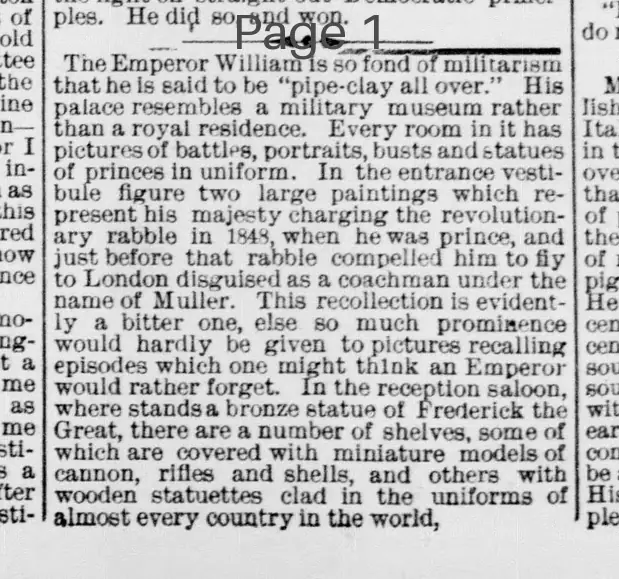
The Emperor William is so fond of militarism that he is said to be "pipe-clay all over." His palace resembles a military museum rather than a royal residence. Every room in it has pictures of battles, portraits, busts and statues of princes in uniform. In the entrance vestibule figure two large paintings which represent his majesty charging the revolutionary rabble in 1848, when he was prince, and just before that rabble compelled him to fly to London disguised as a coachman under the name of Muller. This recollection is evidently a bitter one, else so much prominence would hardly be given to pictures recalling episodes which one might think an Emperor would rather forget. In the reception saloon, where stands a bronze statue of Frederick the Great, there are a number of shelves, some of which are covered with miniature models of cannon, rifles and shells, and others with wooden statuettes clad in the uniforms of almost every country in the world.

What sub-type of article is it?

Court News

What keywords are associated?

Emperor William Militarism Palace Military Museum 1848 Revolution Frederick The Great

What entities or persons were involved?

Emperor William Frederick The Great

Foreign News Details

Key Persons

Emperor William Frederick The Great

Outcome

emperor william charged the revolutionary rabble in 1848 as prince, but was compelled to fly to london disguised as a coachman under the name of muller.

Event Details

The Emperor William is fond of militarism, described as "pipe-clay all over." His palace resembles a military museum with pictures of battles, portraits, busts and statues of princes in uniform. In the entrance vestibule are two large paintings of his majesty charging the revolutionary rabble in 1848, when he was prince, just before fleeing to London. In the reception saloon stands a bronze statue of Frederick the Great, with shelves of miniature models of cannon, rifles and shells, and wooden statuettes in uniforms of various countries.

Are you sure?