Thank you for visiting SNEWPapers!
Sign up free
Domestic News
November 29, 1824
Palladium Of Virginia And The Pacific Monitor
Lewisburg, Greenbrier County, West Virginia
What is this article about?
An essay from the Georgia Journal advocates for canal construction as internal improvements, emphasizing economic benefits like cheaper transportation compared to land carriage, referencing the Erie Canal's advantages and potential savings for Georgia, such as connecting Fort Hawkins and Augusta.
Clipping
OCR Quality
98%
Excellent
Full Text
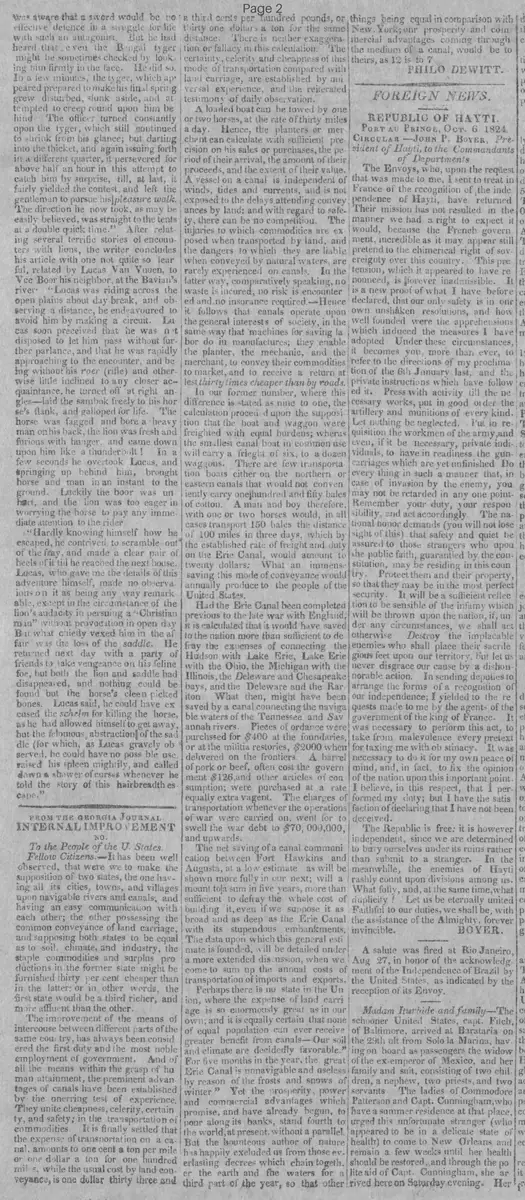
FROM THE GEORGIA JOURNAL
INTERNAL IMPROVEMENT
NO.
To the People of the U. States.
Fellow Citizens. It has been well
observed, that were we to make the
supposition of two states, the one having
all its cities, towns, and villages
upon navigable rivers and canals, and
having an easy communication with
each other; the other possessing the
common conveyance of land carriage,
and supposing both states to be equal
as to soil, climate, and industry, the
staple commodities and surplus productions in the former state might be
furnished thirty per cent cheaper than
in the latter: or in other words, the
first state would be a third richer, and
more affluent than the other.
The improvement of the means of
intercourse between different parts of the
same country, has always been considered the first duty and the most noble
employment of government. And of
all the means within the grasp of human attainment, the preeminent advantages of canals have been established
by the unerring test of experience.
They unite cheapness, celerity, certainty,
and safety; in the transportation of
commodities. It is finally settled that
the expense of transportation on a canal amounts to one cent a ton per mile
or one dollar a ton for one hundred
miles, while the usual cost by land conveyance, is one dollar thirty three and
a third cents per hundred pounds, or
thirty one dollars a ton for the same
distance. There is neither exaggeration
nor fallacy in this calculation. The
certainty, celerity and cheapness of this
mode of transportation compared with
land carriage, are established by universal experience, and the reiterated
testimony of daily observation.
A loaded boat can be towed by one
or two horses, at the rate of thirty miles
a day. Hence, the planters or merchants can calculate with sufficient precision on his sales or purchases, the period of their arrival, the amount of their
proceeds, and the extent of their value.
A vessel on a canal is independent of
winds, tides and currents, and is not
exposed to the delays attending conveyance by land: and with regard to safety,
there can be no competition. The
injuries to which commodities are exposed when transported by land, and
the dangers to which they are liable
when conveyed by natural waters, are
rarely experienced on canals. In the
latter way, comparatively speaking, no
waste is incurred, no risk is encountered
and no insurance required.--Hence
it follows that canals operate upon
the general interests of society, in the
same way that machines or saving labor do in manufactures; they enable
the planter, the mechanic, and the
merchant, to convey their commodities
to market, and to receive a return at
least thirty times cheaper than by roads.
In our former number, where this
difference is stated as nine to one, the
calculation proceeded upon the supposition that the boat and waggon were
freighted with equal burdens; whereas
the smallest canal boat in common use
will carry a freight of six, to a dozen
waggons. There are few transportation boats either on the northern or
eastern canals that would not conveniently carry one hundred and fifty bales
of cotton. A man and boy therefore,
with one or two horses would, in all
cases transport 150 bales the distance
of 100 miles in three days, which by
the established rate of freight and duty
on the Erie Canal, would amount to
twenty dollars: What an immense
saving this mode of conveyance would
annually produce to the people of the
United States.
Had the Erie Canal been completed
previous to the late war with England,
it is calculated that it would have saved
to the nation more than sufficient to defray the expenses of connecting the
Hudson with Lake Erie. Lake Erie
with the Ohio, the Michigan with the
Illinois, the Delaware and Chesapeake
bays, and the Delaware and the Raritan. What then, might have been
saved by a canal connecting the navigable waters of the Tennessee and Savannah rivers. Pieces of ordnance were
purchased for $400 at the foundries
or at the militia stores, $2000 when
delivered on the frontiers. A barrel
of pork or beef, often cost the government $126, and other articles of consumption; were purchased at a rate
equally extravagant. The charges of
transportation whenever the operations
of war were carried on, went far to
swell the war debt to $70,000,000,
and upwards.
The net saving of a canal communication between Fort Hawkins and
Augusta, at a low estimate as will be
shown more fully in our next; will amount to a sum in five years, more than
sufficient to defray the whole cost of
building it, even if we suppose it as
broad and as deep as the Erie Canal
with its stupendous embankments.
The data upon which this general estimate is founded, will be detailed under
a more extended discussion, when we
come to sum up the annual costs of
transportation of imports and exports.
Perhaps there is no state in the Union, where the expense of land carriage is so enormously great as in our
own; and it is equally certain that none
of equal population can ever receive
greater benefit from canals--Our soil
and climate are decidedly favorable.
For five months in the year, the great
Erie Canal is unnavigable and useless
by reason of the frosts and snows of
winter. Yet the prosperity, power
and commercial advantages which
promise, and have already begun, to
pour along its banks, stand forth to
the world, at present, without a parallel.
But the bounteous author of nature
has happily excluded us from those everlasting decrees which chain together the earth and the waters for a
third part of the year, so that other
things being equal in comparison with
New York; our prosperity and commercial advantages coming through
the medium of a canal, would be to
theirs, as 12 is to 7.
PHILO DEWITT.
INTERNAL IMPROVEMENT
NO.
To the People of the U. States.
Fellow Citizens. It has been well
observed, that were we to make the
supposition of two states, the one having
all its cities, towns, and villages
upon navigable rivers and canals, and
having an easy communication with
each other; the other possessing the
common conveyance of land carriage,
and supposing both states to be equal
as to soil, climate, and industry, the
staple commodities and surplus productions in the former state might be
furnished thirty per cent cheaper than
in the latter: or in other words, the
first state would be a third richer, and
more affluent than the other.
The improvement of the means of
intercourse between different parts of the
same country, has always been considered the first duty and the most noble
employment of government. And of
all the means within the grasp of human attainment, the preeminent advantages of canals have been established
by the unerring test of experience.
They unite cheapness, celerity, certainty,
and safety; in the transportation of
commodities. It is finally settled that
the expense of transportation on a canal amounts to one cent a ton per mile
or one dollar a ton for one hundred
miles, while the usual cost by land conveyance, is one dollar thirty three and
a third cents per hundred pounds, or
thirty one dollars a ton for the same
distance. There is neither exaggeration
nor fallacy in this calculation. The
certainty, celerity and cheapness of this
mode of transportation compared with
land carriage, are established by universal experience, and the reiterated
testimony of daily observation.
A loaded boat can be towed by one
or two horses, at the rate of thirty miles
a day. Hence, the planters or merchants can calculate with sufficient precision on his sales or purchases, the period of their arrival, the amount of their
proceeds, and the extent of their value.
A vessel on a canal is independent of
winds, tides and currents, and is not
exposed to the delays attending conveyance by land: and with regard to safety,
there can be no competition. The
injuries to which commodities are exposed when transported by land, and
the dangers to which they are liable
when conveyed by natural waters, are
rarely experienced on canals. In the
latter way, comparatively speaking, no
waste is incurred, no risk is encountered
and no insurance required.--Hence
it follows that canals operate upon
the general interests of society, in the
same way that machines or saving labor do in manufactures; they enable
the planter, the mechanic, and the
merchant, to convey their commodities
to market, and to receive a return at
least thirty times cheaper than by roads.
In our former number, where this
difference is stated as nine to one, the
calculation proceeded upon the supposition that the boat and waggon were
freighted with equal burdens; whereas
the smallest canal boat in common use
will carry a freight of six, to a dozen
waggons. There are few transportation boats either on the northern or
eastern canals that would not conveniently carry one hundred and fifty bales
of cotton. A man and boy therefore,
with one or two horses would, in all
cases transport 150 bales the distance
of 100 miles in three days, which by
the established rate of freight and duty
on the Erie Canal, would amount to
twenty dollars: What an immense
saving this mode of conveyance would
annually produce to the people of the
United States.
Had the Erie Canal been completed
previous to the late war with England,
it is calculated that it would have saved
to the nation more than sufficient to defray the expenses of connecting the
Hudson with Lake Erie. Lake Erie
with the Ohio, the Michigan with the
Illinois, the Delaware and Chesapeake
bays, and the Delaware and the Raritan. What then, might have been
saved by a canal connecting the navigable waters of the Tennessee and Savannah rivers. Pieces of ordnance were
purchased for $400 at the foundries
or at the militia stores, $2000 when
delivered on the frontiers. A barrel
of pork or beef, often cost the government $126, and other articles of consumption; were purchased at a rate
equally extravagant. The charges of
transportation whenever the operations
of war were carried on, went far to
swell the war debt to $70,000,000,
and upwards.
The net saving of a canal communication between Fort Hawkins and
Augusta, at a low estimate as will be
shown more fully in our next; will amount to a sum in five years, more than
sufficient to defray the whole cost of
building it, even if we suppose it as
broad and as deep as the Erie Canal
with its stupendous embankments.
The data upon which this general estimate is founded, will be detailed under
a more extended discussion, when we
come to sum up the annual costs of
transportation of imports and exports.
Perhaps there is no state in the Union, where the expense of land carriage is so enormously great as in our
own; and it is equally certain that none
of equal population can ever receive
greater benefit from canals--Our soil
and climate are decidedly favorable.
For five months in the year, the great
Erie Canal is unnavigable and useless
by reason of the frosts and snows of
winter. Yet the prosperity, power
and commercial advantages which
promise, and have already begun, to
pour along its banks, stand forth to
the world, at present, without a parallel.
But the bounteous author of nature
has happily excluded us from those everlasting decrees which chain together the earth and the waters for a
third part of the year, so that other
things being equal in comparison with
New York; our prosperity and commercial advantages coming through
the medium of a canal, would be to
theirs, as 12 is to 7.
PHILO DEWITT.
What sub-type of article is it?
Infrastructure
Economic
What keywords are associated?
Canals
Internal Improvements
Transportation Costs
Erie Canal
Georgia Canals
Economic Benefits
What entities or persons were involved?
Philo Dewitt
Where did it happen?
Georgia
Domestic News Details
Primary Location
Georgia
Key Persons
Philo Dewitt
Event Details
Essay arguing for the construction of canals in the United States, particularly in Georgia, to improve transportation, reduce costs, and boost economic prosperity, comparing favorably to land carriage and citing the Erie Canal as an example, with specific proposals for connections like Fort Hawkins to Augusta.