Thank you for visiting SNEWPapers!
Sign up free
Story
October 6, 1827
Phenix Gazette
Alexandria, Virginia
What is this article about?
An 1827 essay by 'Franklin' advocates for the Chesapeake and Ohio Canal, arguing its immediate and long-term economic benefits to the Potomac region, including attracting capital, improving trade, and ensuring supply security during war, countering local opposition in Virginia.
Clipping
OCR Quality
98%
Excellent
Full Text
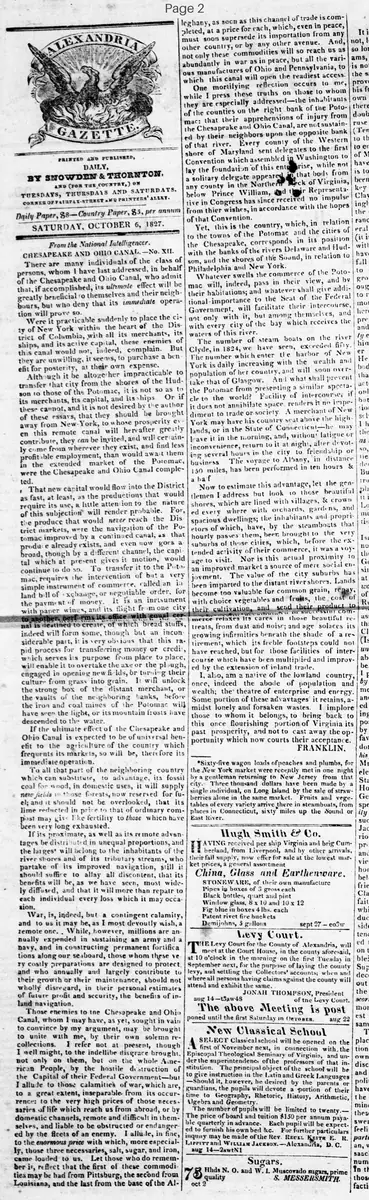
TUESDAYS, THURSDAYS AND SATURDAYS.
CORNER OF FAIRFAX-STREET AND PRINTERS' ALLEY.
Daily Paper, $8—Country Paper, $5, per annum
SATURDAY, OCTOBER 6, 1827.
From the National Intelligencer.
CHESAPEAKE AND OHIO CANAL.—NO. XII.
There are many individuals of the class of persons, whom I have last addressed, in behalf of the Chesapeake and Ohio Canal, who admit that, if accomplished, its ultimate effect will be greatly beneficial to themselves and their neighbors, but who deny that its immediate operation will prove so.
Were it practicable suddenly to place the city of New York within the heart of the District of Columbia, with all its merchants, its ships, and its active capital, these enemies of this canal would not, indeed, complain. But they are unwilling, it seems, to purchase a benefit for posterity, at their own expense.
Although it be altogether impracticable to transfer that city from the shores of the Hudson to those of the Potomac, it is not so as to its merchants, its capital, and its ships. Or if these cannot, and it is not desired by the author of these essays, that they should be brought away from New York, to whose prosperity every canal will hereafter greatly contribute, they can be invited, and will certainly come from wherever they exist, and find less profitable employment, than would await them in the extended market of the Potomac, were the Chesapeake and Ohio Canal completed.
That new capital would flow into the District as fast, at least, as the productions that would require its use, a little attention to the nature of this subjection will render probable. For, the produce that would never reach the District markets, were the navigation of the Potomac improved by a continued canal, as that produce already exists, and even now goes abroad, though by a different channel, the capital which at present gives it motion, would continue to do so. To transfer it to the Potomac, requires the intervention of but a very simple instrument of commerce, called an inland bill of exchange, or negotiable order for the payment of money. It is an instrument with paper wings, and its flight from one city to another performs its office with equal certainty, as the rapid process for transferring money or credit, which serves its purpose from place to place, will enable it to overtake the axe or the plough, engaged in opening new fields, or turning their culture from grass into grain. It will unlock the strong box of the distant merchant, or the vaults of the neighboring banks, before the iron and coal mines of the Potomac will have seen the light, or its mountain forests have descended to the water.
If the ultimate effect of the Chesapeake and Ohio Canal is expected to be of universal benefit to the agriculture of the country which frequents its markets, so will be, therefore, its immediate operation.
To all that part of the neighboring country which can substitute, to advantage, its fossil coal for wood, in domestic uses, it will supply new fuel in those forests, now reserved for fuel; and it should not be overlooked, that its lime reduced in price to that of ordinary compost may give the fertility to those which have been very long exhausted.
If its proximate, as well as its remote advantages be distributed in unequal proportions, and the largest will belong to the inhabitants of the river shores and of its tributary streams, who partake of its improved navigation, still it should suffice to allay all discontent, that its benefits will be, as we have seen, most widely diffused, and that it will more than repair to each individual every loss which it may occasion.
War, is, indeed, but a contingent calamity, and to us it may be, as I most devoutly wish, a remote one. While, however, millions are annually expended in sustaining an army and a navy, and in constructing permanent fortifications along our seaboard, those whom these very costly preparations are designed to protect, and who annually and largely contribute to their growth or their maintenance, should not wholly disregard, in their personal estimates of future profit and security, the benefits of inland navigation.
Those enemies to the Chesapeake and Ohio Canal, whom I may have, as yet, sought in vain to convince by my argument, may be brought to unite with me, by their own solemn recollections. I refer not at present, though I well might, to the indelible disgrace brought, not only on them, but on the whole American People, by the hostile destruction of the Capital of their Federal Government—but I allude to those calamities of war, which are, to a great extent, inseparable from its occurrence: to the very high prices of those necessaries of life which reach us from abroad, or by domestic channels, remote and difficult in themselves, and liable to be obstructed or endangered by the fleets of an enemy. I allude, in fine, to the enormous price with which, more especially, those three necessaries, salt, sugar, and iron, came loaded to us. Let those who do remember it, reflect that the first of these commodities may be had from Pittsburgh, the second from Louisiana, and the last from the base of the Alleghany, as soon as this channel of trade is completed, at a price for each, which, even in peace, must soon supersede its importation from any other country, or by any other avenue. And, not only these commodities will so reach us as abundantly in war as in peace, but all the various manufactures of Ohio and Pennsylvania, to which this canal will open the readiest access.
One mortifying reflection occurs to me, while I press these truths on those to whom they are especially addressed—the inhabitants of the counties on the right bank of the Potomac: that their apprehensions of injury from the Chesapeake and Ohio Canal, are not sustained by their neighbors upon the opposite bank of that river.
Every county of the Western shore of Maryland sent delegates to the first Convention which assembled in Washington to lay the foundation of this enterprise, while not a solitary delegate appeared from any county in the Northern neck of Virginia, below Prince William, to their Representative in Congress has since received no impulse from their wishes, in accordance with the hopes of that Convention.
Yet, this is the country, which, in relation with the banks of the rivers Delaware and Hudson, corresponds in its position to the towns of the Potomac and the cities of Philadelphia and New York.
Philadelphia and New York.
Whatever swells the commerce of the Potomac will, indeed, pass in their view, and by their habitations; and whatever shall give additional importance to the Seat of the Federal Government, will facilitate their intercourse, not only with it, but among themselves, and with every city of the bay which receives the waters of this river.
The number of steamboats on the river Clyde, in 1824, we have seen, exceeded fifty.
The number which enter the harbor of New York is daily increasing with the wealth and population of her country, and will soon overtake that of Glasgow. And what shall prevent the Potomac from presenting a similar spectacle to the world? Facility of intercourse, if it does not annihilate space, renders in no impediment to trade or society. A merchant of New York may have his country seat above the highlands, or in the State of Connecticut—he may leave it in the morning, and, without fatigue or inconvenience, return to it at night, after devoting several hours in the city to friendship or business.
The voyage to Albany, in distance 150 miles, has been performed in ten hours and a half.
Now to estimate this advantage, let the gentlemen I address but look to those beautiful shores, which are lined with villages, and crowned with spacious dwellings; the inhabitants and proprietors of which, have, by the steamboats that hourly pass them, been brought to the very suburbs of those cities, which, before the extended activity of their commerce, it was a voyage to visit. Nor is this actual proximity to an improved market a source of mere social enjoyment. The value of the city suburbs has been imparted to the distant river shores. Lands become too valuable for common grain, repay their cultivation with choice vegetables and fruits, and send their product to Paris streets.
Commerce relaxes its cares in those beautiful retreats, from dust and noise; and age solaces its growing infirmities beneath the shade of a retirement, which its feeble footsteps could not have reached, but for those facilities of intercourse which have been multiplied and improved by the extension of inland trade.
I, also, am a native of the lowland country, once, indeed the abode of population and wealth; the theatre of enterprise and energy.
Some portion of these advantages it retains, amidst lonely and forsaken wastes. I implore those to whom it belongs, to bring back to this once flourishing portion of Virginia its past prosperity and not to cast away the opportunity which now courts their acceptance.
FRANKLIN.
CORNER OF FAIRFAX-STREET AND PRINTERS' ALLEY.
Daily Paper, $8—Country Paper, $5, per annum
SATURDAY, OCTOBER 6, 1827.
From the National Intelligencer.
CHESAPEAKE AND OHIO CANAL.—NO. XII.
There are many individuals of the class of persons, whom I have last addressed, in behalf of the Chesapeake and Ohio Canal, who admit that, if accomplished, its ultimate effect will be greatly beneficial to themselves and their neighbors, but who deny that its immediate operation will prove so.
Were it practicable suddenly to place the city of New York within the heart of the District of Columbia, with all its merchants, its ships, and its active capital, these enemies of this canal would not, indeed, complain. But they are unwilling, it seems, to purchase a benefit for posterity, at their own expense.
Although it be altogether impracticable to transfer that city from the shores of the Hudson to those of the Potomac, it is not so as to its merchants, its capital, and its ships. Or if these cannot, and it is not desired by the author of these essays, that they should be brought away from New York, to whose prosperity every canal will hereafter greatly contribute, they can be invited, and will certainly come from wherever they exist, and find less profitable employment, than would await them in the extended market of the Potomac, were the Chesapeake and Ohio Canal completed.
That new capital would flow into the District as fast, at least, as the productions that would require its use, a little attention to the nature of this subjection will render probable. For, the produce that would never reach the District markets, were the navigation of the Potomac improved by a continued canal, as that produce already exists, and even now goes abroad, though by a different channel, the capital which at present gives it motion, would continue to do so. To transfer it to the Potomac, requires the intervention of but a very simple instrument of commerce, called an inland bill of exchange, or negotiable order for the payment of money. It is an instrument with paper wings, and its flight from one city to another performs its office with equal certainty, as the rapid process for transferring money or credit, which serves its purpose from place to place, will enable it to overtake the axe or the plough, engaged in opening new fields, or turning their culture from grass into grain. It will unlock the strong box of the distant merchant, or the vaults of the neighboring banks, before the iron and coal mines of the Potomac will have seen the light, or its mountain forests have descended to the water.
If the ultimate effect of the Chesapeake and Ohio Canal is expected to be of universal benefit to the agriculture of the country which frequents its markets, so will be, therefore, its immediate operation.
To all that part of the neighboring country which can substitute, to advantage, its fossil coal for wood, in domestic uses, it will supply new fuel in those forests, now reserved for fuel; and it should not be overlooked, that its lime reduced in price to that of ordinary compost may give the fertility to those which have been very long exhausted.
If its proximate, as well as its remote advantages be distributed in unequal proportions, and the largest will belong to the inhabitants of the river shores and of its tributary streams, who partake of its improved navigation, still it should suffice to allay all discontent, that its benefits will be, as we have seen, most widely diffused, and that it will more than repair to each individual every loss which it may occasion.
War, is, indeed, but a contingent calamity, and to us it may be, as I most devoutly wish, a remote one. While, however, millions are annually expended in sustaining an army and a navy, and in constructing permanent fortifications along our seaboard, those whom these very costly preparations are designed to protect, and who annually and largely contribute to their growth or their maintenance, should not wholly disregard, in their personal estimates of future profit and security, the benefits of inland navigation.
Those enemies to the Chesapeake and Ohio Canal, whom I may have, as yet, sought in vain to convince by my argument, may be brought to unite with me, by their own solemn recollections. I refer not at present, though I well might, to the indelible disgrace brought, not only on them, but on the whole American People, by the hostile destruction of the Capital of their Federal Government—but I allude to those calamities of war, which are, to a great extent, inseparable from its occurrence: to the very high prices of those necessaries of life which reach us from abroad, or by domestic channels, remote and difficult in themselves, and liable to be obstructed or endangered by the fleets of an enemy. I allude, in fine, to the enormous price with which, more especially, those three necessaries, salt, sugar, and iron, came loaded to us. Let those who do remember it, reflect that the first of these commodities may be had from Pittsburgh, the second from Louisiana, and the last from the base of the Alleghany, as soon as this channel of trade is completed, at a price for each, which, even in peace, must soon supersede its importation from any other country, or by any other avenue. And, not only these commodities will so reach us as abundantly in war as in peace, but all the various manufactures of Ohio and Pennsylvania, to which this canal will open the readiest access.
One mortifying reflection occurs to me, while I press these truths on those to whom they are especially addressed—the inhabitants of the counties on the right bank of the Potomac: that their apprehensions of injury from the Chesapeake and Ohio Canal, are not sustained by their neighbors upon the opposite bank of that river.
Every county of the Western shore of Maryland sent delegates to the first Convention which assembled in Washington to lay the foundation of this enterprise, while not a solitary delegate appeared from any county in the Northern neck of Virginia, below Prince William, to their Representative in Congress has since received no impulse from their wishes, in accordance with the hopes of that Convention.
Yet, this is the country, which, in relation with the banks of the rivers Delaware and Hudson, corresponds in its position to the towns of the Potomac and the cities of Philadelphia and New York.
Philadelphia and New York.
Whatever swells the commerce of the Potomac will, indeed, pass in their view, and by their habitations; and whatever shall give additional importance to the Seat of the Federal Government, will facilitate their intercourse, not only with it, but among themselves, and with every city of the bay which receives the waters of this river.
The number of steamboats on the river Clyde, in 1824, we have seen, exceeded fifty.
The number which enter the harbor of New York is daily increasing with the wealth and population of her country, and will soon overtake that of Glasgow. And what shall prevent the Potomac from presenting a similar spectacle to the world? Facility of intercourse, if it does not annihilate space, renders in no impediment to trade or society. A merchant of New York may have his country seat above the highlands, or in the State of Connecticut—he may leave it in the morning, and, without fatigue or inconvenience, return to it at night, after devoting several hours in the city to friendship or business.
The voyage to Albany, in distance 150 miles, has been performed in ten hours and a half.
Now to estimate this advantage, let the gentlemen I address but look to those beautiful shores, which are lined with villages, and crowned with spacious dwellings; the inhabitants and proprietors of which, have, by the steamboats that hourly pass them, been brought to the very suburbs of those cities, which, before the extended activity of their commerce, it was a voyage to visit. Nor is this actual proximity to an improved market a source of mere social enjoyment. The value of the city suburbs has been imparted to the distant river shores. Lands become too valuable for common grain, repay their cultivation with choice vegetables and fruits, and send their product to Paris streets.
Commerce relaxes its cares in those beautiful retreats, from dust and noise; and age solaces its growing infirmities beneath the shade of a retirement, which its feeble footsteps could not have reached, but for those facilities of intercourse which have been multiplied and improved by the extension of inland trade.
I, also, am a native of the lowland country, once, indeed the abode of population and wealth; the theatre of enterprise and energy.
Some portion of these advantages it retains, amidst lonely and forsaken wastes. I implore those to whom it belongs, to bring back to this once flourishing portion of Virginia its past prosperity and not to cast away the opportunity which now courts their acceptance.
FRANKLIN.
What sub-type of article is it?
Historical Event
What themes does it cover?
Triumph
Fortune Reversal
What keywords are associated?
Chesapeake Ohio Canal
Potomac Navigation
Economic Benefits
Inland Trade
War Security
Regional Prosperity
What entities or persons were involved?
Franklin
Where did it happen?
Potomac River, District Of Columbia, Maryland, Virginia
Story Details
Key Persons
Franklin
Location
Potomac River, District Of Columbia, Maryland, Virginia
Event Date
1827
Story Details
Essay argues for completing the Chesapeake and Ohio Canal to attract capital, enhance trade, provide war-time security for essentials like salt, sugar, iron, and boost regional prosperity, addressing opposition from Virginia counties while noting Maryland support.