Thank you for visiting SNEWPapers!
Sign up free
Farmers' Gazette, And Cheraw Advertiser
Cheraw, Chesterfield County, South Carolina
What is this article about?
A Scottish farmer reports two cases of cattle deaths after drenching: a quey calf died from liquid entering the windpipe due to tongue interference, and an Ayrshire cow from foreign matter in lungs possibly during gruel administration. Veterinary expert William Dick replies, attributing causes to improper handling and provides safe drenching method.
Clipping
OCR Quality
Full Text
March 1st, 1841,
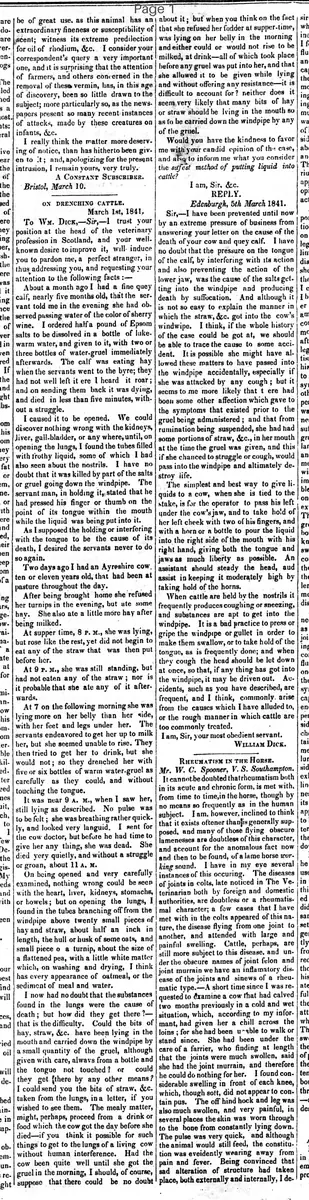
To Wm. Dick,—Sir,—I trust your position at the head of the veterinary profession in Scotland, and your well-known desire to improve it, will induce you to pardon me, a perfect stranger, in thus addressing you, and requesting your attention to the following facts :—
About a month ago I had a fine quey calf, nearly five months old, that the servant told me in the evening she had observed passing water of the color of sherry wine. I ordered half a pound of Epsom salts to be dissolved in a bottle of lukewarm water, and given to it, with two or three bottles of water-gruel immediately afterwards. The calf was eating hay when the servants went to the byre; they had not well left it ere I heard it roar; and on sending them back it was dying, and died in less than five minutes, without a struggle.
I caused it to be opened. We could discover nothing wrong with the kidneys, liver, gall-bladder, or anywhere, until, on opening the lungs, I found the tubes filled with frothy liquid, some of which I had also seen about the nostrils. I have no doubt that it was killed by part of the salts or gruel going down the windpipe. The servant man, in holding it, stated that he had pressed his finger or thumb on the point of its tongue within the mouth while the liquid was being put into it.
As I supposed the holding or interfering with the tongue to be the cause of its death, I desired the servants never to do so again.
Two days ago I had an Ayrshire cow, ten or eleven years old, that had been at pasture throughout the day. After being brought home she refused her turnips in the evening, but ate some hay. She also ate a little more hay after being milked. At supper time, 8 p. M., she was lying, but rose like the rest, yet did not begin to eat any of the straw that was then put before her. At 9 p. M., she was still standing, but had not eaten any of the straw; nor is it probable that she ate any of it afterwards.
At 7 on the following morning she was lying more on her belly than her side, with her feet and legs under her. The servants endeavored to get her up to milk her, but she seemed unable to rise. They then tried to get her to drink, but she would not; so they drenched her with five or six bottles of warm water-gruel as carefully as they could, and without touching the tongue.
It was near 9 A. M., when I saw her, still lying as described. No pulse was to be felt; she was breathing rather quickly, and looked very languid. I sent for the cow doctor, but before he had time to give her anything, she was dead. She died very quietly, and without a struggle or groan, about 11 A. M.
On being opened and very carefully examined, nothing wrong could be seen with the heart, liver, kidneys, stomachs, or bowels; but on opening the lungs, I found in the tubes branching off from the windpipe above twenty small pieces of hay and straw, about half an inch in length, the hull or husk of some oats, and small piece of a turnip, about the size of a flattened pea, with a little white matter which, on washing and drying, I think has every appearance of oatmeal, or the sediment of meal and water.
I now had no doubt that the substances found in the lungs were the cause of death; but how did they get there?— that is the difficulty. Could the bits of hay, straw, &c. have been lying in the mouth and carried down the windpipe by a small quantity of the gruel, although given with care, always from a bottle and the tongue not touched? or could they get there by any other means?
I could send you the bits of straw, &c. taken from the lungs, in a letter, if you wished to see them. The mealy matter, might, perhaps, proceed from a drink or food which the cow got the day before she died—if you think it possible for such things to get to the lungs of a living cow without human interference. Had the cow been quite well until she got the gruel in the morning, I should, of course, suppose that there could be no doubt about it; but when you think on the fact that she refused her fodder at supper-time, was lying on her belly in the morning and either could or would not rise to be milked, at drink—all of which took place before any gruel was put into her, and that she allowed it to be given while lying and without offering any resistance—it is difficult to account for? neither does it seem very likely that many bits of hay or straw should be lying in the mouth so as to be carried down the windpipe by any of the gruel.
Would you have the kindness to favor me with your candid opinion of the case, and also to inform me what you consider the safest method of putting liquid into cattle?
I am, Sir, &c.
REPLY.
Edinburgh, 5th March 1841.
Sir,—I have been prevented until now by an extreme pressure of business from answering your letter on the cause of the death of your cow and quey calf. I have no doubt that the pressure on the tongue of the calf, by interfering with its action and also preventing the action of the lower jaw, was the cause of the salts getting into the windpipe and producing death by suffocation. And although it is not so easy to explain the manner in which the straw, &c. got into the cow's windpipe, I think, if the whole history of the case could be got at, we should be able to trace the cause to some accident. It is possible she might have allowed these matters to have passed into the windpipe accidentally, especially if she was attacked by any cough; but it seems to me more likely that there had been some other affection which gave to the symptoms that existed prior to the gruel being administered; and that from rumination being suspended, she had had some portions of straw, &c., in her mouth at the time the gruel was given, and this if she chanced to struggle or cough, would pass into the windpipe and ultimately destroy life.
The simplest and best way to give liquids to a cow, when she is tied to the stake, is for the operator to pass his left hand under the cow's jaw, and to take hold of her left cheek with two of his fingers, and with a horn or a bottle to pour the liquid into the right side of the mouth with his right hand, giving both the tongue and jaws as much liberty as possible. An assistant should steady the head, and assist in keeping it moderately high by taking hold of the horns.
When cattle are held by the nostrils it frequently produces coughing or sneezing, and substances are apt to get into the windpipe. It is a bad practice to press or gripe the windpipe or gullet in order to make them swallow, or to take hold of the tongue, as is frequently done; and when they cough the head should be let down at once, so that, if anything has got into the windpipe, it may be driven out. Accidents, such as you have described, are frequent, and I think, commonly, arise from the causes which I have alluded to, or the rough manner in which cattle are too commonly treated.
I am, Sir, your most obedient servant,
William Dick.
What sub-type of article is it?
What keywords are associated?
What entities or persons were involved?
Where did it happen?
Foreign News Details
Primary Location
Scotland
Event Date
March 1st, 1841
Key Persons
Outcome
death of quey calf by suffocation from salts entering windpipe; death of ayrshire cow from hay, straw, and other matter in lungs.
Event Details
Farmer describes quey calf dying after Epsom salts due to servant pressing tongue, leading to liquid in windpipe. Ayrshire cow, unwell prior, died after warm water-gruel, with foreign matter found in lungs. William Dick replies from Edinburgh, explaining causes as improper handling and suspended rumination, and advises safe liquid administration method using hand under jaw without touching tongue.