Thank you for visiting SNEWPapers!
Sign up free
Editorial
March 22, 1831
Rhode Island American And Gazette
Providence, Providence County, Rhode Island
What is this article about?
Editorial defends unity between Rhode Island farmers and manufacturers against Fenner party's tactics to stir jealousy and prevent Arnold's election. Recalls past elections where farmers supported the American System despite deception, highlighting manufacturing's benefits to agriculture via markets, taxes, and employment.
Clipping
OCR Quality
95%
Excellent
Full Text
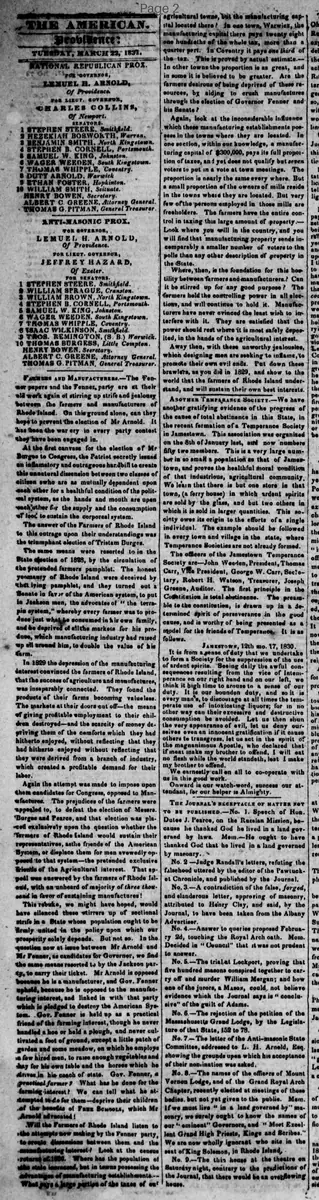
Farmers and Manufacturers.—The Fenner papers and the Fenner party are at their old work again of stirring up strife and jealousy between the farmers and manufacturers of Rhode Island. On this ground alone, can they hope to prevent the election of Mr. Arnold. It has been the war cry in every party contest they have been engaged in.
At the first canvass for the election of Mr. Burges to Congress, the Patriot secretly issued an inflammatory and outrageous handbill to create this unnatural dissension between two classes of citizens who are as mutually dependent upon each other for a healthful condition of the political system, as the hands and mouth are upon each other for the supply and the consumption of food to sustain the corporeal system.
The answer of the Farmers of Rhode Island to this outrage upon their understandings was the triumphant election of Tristram Burges.
The same means were resorted to in the State election of 1828, by the circulation of the pretended farmers' pamphlet. The honest yeomanry of Rhode Island were deceived by that lying pamphlet, and they turned out a Senate in favor of the American system, to put in Jackson men, the advocates of 'the tariff system,' whereby every farmer was to produce just what he consumed in his own family, and be deprived of all the markets for his produce, which manufacturing industry had raised up all around him, to double the value of his farm.
In 1829 the depression of the manufacturing interest convinced the farmers of Rhode Island, that the success of agriculture and manufactures, was inseparably connected. They found the products of their farms becoming valueless. The markets at their doors cut off—the means of giving profitable employment to their children destroyed—and the scarcity of money depriving them of the comforts which they had hitherto enjoyed, without reflecting that they were derived from a branch of industry, which created a profitable demand for their labor.
Again the attempt was made to impose upon them candidates for Congress, opposed to Manufactures. The prejudices of the farmers were appealed to, to defeat the election of Messrs. Burges and Pearce, and that election was placed exclusively upon the question whether the Farmers of Rhode Island would sustain their representatives, as the friends of the American System, or displace them for men avowedly opposed to that system—the pretended exclusive Friends of the Agricultural interest. That appeal was answered by the farmers of Rhode Island, with an unheard of majority of three thousand in favor of sustaining manufactures!
This rebuke, we might have hoped, would have silenced these stirrers up of sectional strife in a State whose population ought to be firmly united in the policy upon which our prosperity solely depends. But not so. In the question now at issue between Mr. Arnold and Mr. Fenner, as candidates for Governor, we find the same means resorted to by the Jackson party, to carry their ticket. Mr. Arnold is opposed because he is a manufacturer, and Gov. Fenner upheld, because he is opposed to the manufacturing interest, and linked in with that party which is pledged to destroy the American System. Gov. Fenner is held up as a practical friend of the farming interest, though he never handled a hoe or held a plough, and never cultivated a foot of ground, except a little patch of garden and some meadow, on which he employs a few hired men, to raise enough vegetables and hay for his own table and the horses which he drives in his coach of state. Gov. Fenner, a practical farmer? What has he done for the farming interest? We can tell what he attempted to do for them—deprive their children of the benefits of Free Schools, which Mr. Arnold advocated!
Will the Farmers of Rhode Island listen to the attempts now making by the Fenner party, to create dissensions between them and the manufacturing interest? Look at the census returns. Where has the population of the state increased, but in towns possessing the advantages of manufacturing establishments.
In agricultural towns, but the manufacturing capital located there? In one town, Warwick, the manufacturing capital there pays twenty eight one hundredths of the whole tax, more than a quarter part. In Coventry it pays one third of the tax. This is proved by actual estimate. In other towns the proportion is as great, and in some it is believed to be greater. Are the farmers desirous of being deprived of these resources, by aiding to crush manufactures through the election of Governor Fenner and his Senate?
Again, look at the inconsiderable influence which these manufacturing establishments possess in the towns where they are located. In one section, within our knowledge, a manufacturing capital of $300,000, pays its full proportion of taxes, and yet does not qualify but seven voters to put in a vote at town meetings. The proportion is nearly the same everywhere. But a small proportion of the owners of mills reside in the towns where they are located. But very few of the persons employed in those mills are freeholders. The farmers have the entire control in taxing this large amount of property.
Look where you will in the country, and you will find that manufacturing property sends incomparably a smaller number of voters to the polls than any other description of property in the State.
Where, then, is the foundation for this horrid hostility between farmers and manufacturers? Can it be stirred up for any good purpose? The farmers hold the controlling power in all elections, and will continue to hold it. Manufacturers have never evinced the least wish to interfere with it. They are satisfied that the power should rest where it is most safely deposited, in the hands of the agricultural interest.
Away then, with these unworthy jealousies, which designing men are seeking to inflame, to promote their own evil ends. Put down these brawlers, as you did in 1829, and show to the world that the farmers of Rhode Island understand, and will sustain their own best interests.
At the first canvass for the election of Mr. Burges to Congress, the Patriot secretly issued an inflammatory and outrageous handbill to create this unnatural dissension between two classes of citizens who are as mutually dependent upon each other for a healthful condition of the political system, as the hands and mouth are upon each other for the supply and the consumption of food to sustain the corporeal system.
The answer of the Farmers of Rhode Island to this outrage upon their understandings was the triumphant election of Tristram Burges.
The same means were resorted to in the State election of 1828, by the circulation of the pretended farmers' pamphlet. The honest yeomanry of Rhode Island were deceived by that lying pamphlet, and they turned out a Senate in favor of the American system, to put in Jackson men, the advocates of 'the tariff system,' whereby every farmer was to produce just what he consumed in his own family, and be deprived of all the markets for his produce, which manufacturing industry had raised up all around him, to double the value of his farm.
In 1829 the depression of the manufacturing interest convinced the farmers of Rhode Island, that the success of agriculture and manufactures, was inseparably connected. They found the products of their farms becoming valueless. The markets at their doors cut off—the means of giving profitable employment to their children destroyed—and the scarcity of money depriving them of the comforts which they had hitherto enjoyed, without reflecting that they were derived from a branch of industry, which created a profitable demand for their labor.
Again the attempt was made to impose upon them candidates for Congress, opposed to Manufactures. The prejudices of the farmers were appealed to, to defeat the election of Messrs. Burges and Pearce, and that election was placed exclusively upon the question whether the Farmers of Rhode Island would sustain their representatives, as the friends of the American System, or displace them for men avowedly opposed to that system—the pretended exclusive Friends of the Agricultural interest. That appeal was answered by the farmers of Rhode Island, with an unheard of majority of three thousand in favor of sustaining manufactures!
This rebuke, we might have hoped, would have silenced these stirrers up of sectional strife in a State whose population ought to be firmly united in the policy upon which our prosperity solely depends. But not so. In the question now at issue between Mr. Arnold and Mr. Fenner, as candidates for Governor, we find the same means resorted to by the Jackson party, to carry their ticket. Mr. Arnold is opposed because he is a manufacturer, and Gov. Fenner upheld, because he is opposed to the manufacturing interest, and linked in with that party which is pledged to destroy the American System. Gov. Fenner is held up as a practical friend of the farming interest, though he never handled a hoe or held a plough, and never cultivated a foot of ground, except a little patch of garden and some meadow, on which he employs a few hired men, to raise enough vegetables and hay for his own table and the horses which he drives in his coach of state. Gov. Fenner, a practical farmer? What has he done for the farming interest? We can tell what he attempted to do for them—deprive their children of the benefits of Free Schools, which Mr. Arnold advocated!
Will the Farmers of Rhode Island listen to the attempts now making by the Fenner party, to create dissensions between them and the manufacturing interest? Look at the census returns. Where has the population of the state increased, but in towns possessing the advantages of manufacturing establishments.
In agricultural towns, but the manufacturing capital located there? In one town, Warwick, the manufacturing capital there pays twenty eight one hundredths of the whole tax, more than a quarter part. In Coventry it pays one third of the tax. This is proved by actual estimate. In other towns the proportion is as great, and in some it is believed to be greater. Are the farmers desirous of being deprived of these resources, by aiding to crush manufactures through the election of Governor Fenner and his Senate?
Again, look at the inconsiderable influence which these manufacturing establishments possess in the towns where they are located. In one section, within our knowledge, a manufacturing capital of $300,000, pays its full proportion of taxes, and yet does not qualify but seven voters to put in a vote at town meetings. The proportion is nearly the same everywhere. But a small proportion of the owners of mills reside in the towns where they are located. But very few of the persons employed in those mills are freeholders. The farmers have the entire control in taxing this large amount of property.
Look where you will in the country, and you will find that manufacturing property sends incomparably a smaller number of voters to the polls than any other description of property in the State.
Where, then, is the foundation for this horrid hostility between farmers and manufacturers? Can it be stirred up for any good purpose? The farmers hold the controlling power in all elections, and will continue to hold it. Manufacturers have never evinced the least wish to interfere with it. They are satisfied that the power should rest where it is most safely deposited, in the hands of the agricultural interest.
Away then, with these unworthy jealousies, which designing men are seeking to inflame, to promote their own evil ends. Put down these brawlers, as you did in 1829, and show to the world that the farmers of Rhode Island understand, and will sustain their own best interests.
What sub-type of article is it?
Partisan Politics
Economic Policy
Agriculture
What keywords are associated?
Rhode Island
Farmers
Manufacturers
American System
Election
Fenner Party
Arnold
Tariff
Jackson Men
What entities or persons were involved?
Mr. Arnold
Mr. Fenner
Tristram Burges
Mr. Pearce
Fenner Party
Jackson Party
Patriot
Farmers Of Rhode Island
Editorial Details
Primary Topic
Opposition To Fenner Party's Tactics Stirring Jealousy Between Farmers And Manufacturers In Rhode Island Elections
Stance / Tone
Strongly Supportive Of Arnold And American System, Urging Farmer Manufacturer Unity
Key Figures
Mr. Arnold
Mr. Fenner
Tristram Burges
Mr. Pearce
Fenner Party
Jackson Party
Patriot
Farmers Of Rhode Island
Key Arguments
Fenner Party Stirs Strife Between Farmers And Manufacturers To Prevent Arnold's Election
Past Elections Showed Farmers Rejecting Such Tactics And Supporting American System
Manufacturing Creates Markets And Employment Benefiting Farmers
Census Shows Population Growth In Manufacturing Towns
Manufacturing Pays Significant Taxes But Has Little Voting Influence, Controlled By Farmers
Farmers Should Reject Jealousies And Sustain Their Interests By Supporting Arnold