Thank you for visiting SNEWPapers!
Sign up free
Gazette Of The United States
New York, New York County, New York
What is this article about?
An editorial from the Connecticut Courant criticizes the Pennsylvania assembly's vote cautioning its senators against supporting a federal excise act deemed potentially subversive of liberties. It defends Congress's constitutional authority, warns against state interference, and urges support for the union to preserve peace and prosperity.
Merged-components note: This is a single editorial continued across pages 1 and 2, with sequential reading orders and flowing text content.
Clippings
1 of 2
OCR Quality
Full Text
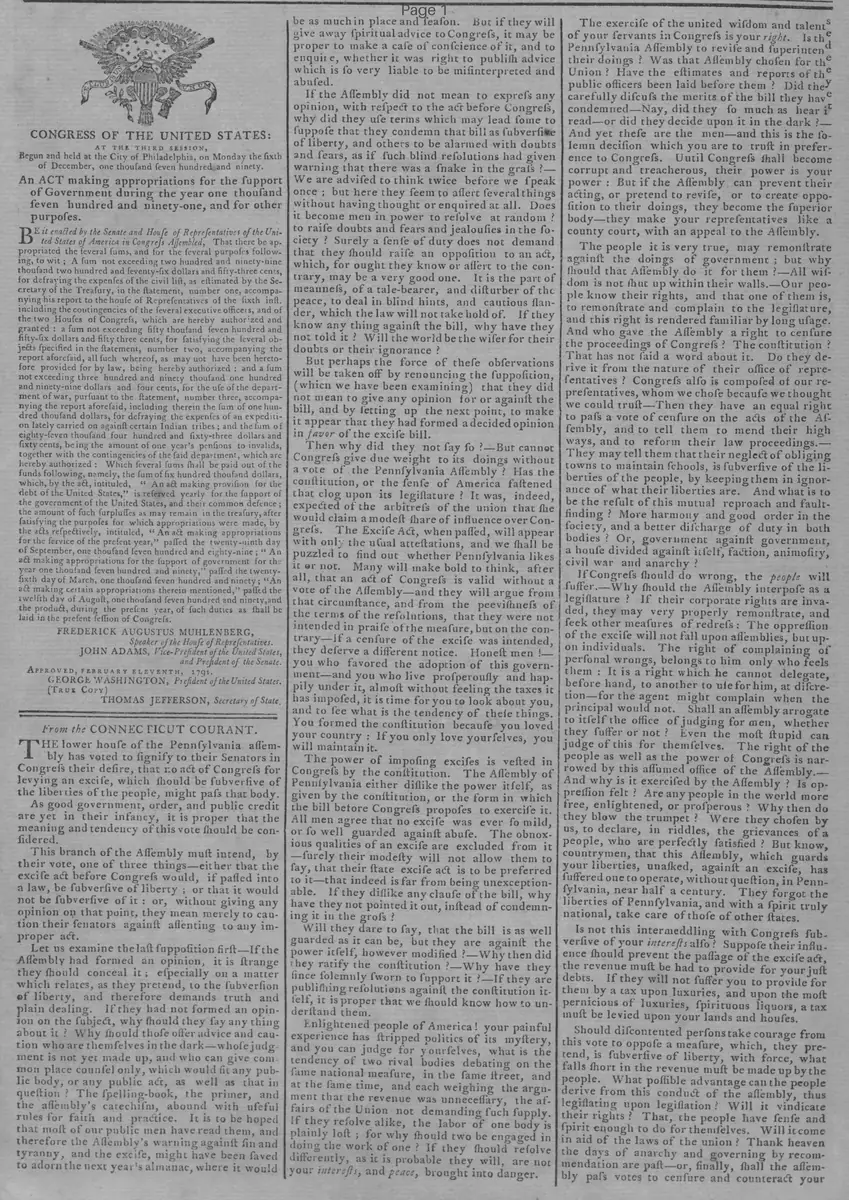
THE lower house of the Pennsylvania assembly has voted to signify to their Senators in Congress their desire, that no act of Congress for levying an excise, which should be subversive of the liberties of the people, might pass that body.
As good government, order, and public credit are yet in their infancy, it is proper that the meaning and tendency of this vote should be considered.
This branch of the Assembly must intend, by their vote, one of three things—either that the excise act before Congress would, if passed into a law, be subversive of liberty ; or that it would not be subversive of it : or, without giving any opinion on that point, they mean merely to caution their senators against assenting to any improper act.
Let us examine the last supposition first—If the Assembly had formed an opinion, it is strange they should conceal it; especially on a matter which relates, as they pretend, to the subversion of liberty, and therefore demands truth and plain dealing. If they had not formed an opinion on the subject, why should they say any thing about it ? Why should those offer advice and caution who are themselves in the dark—whose judgment is not yet made up, and who can give common place counsel only, which would fit any public body, or any public act, as well as that in question ? The spelling-book, the primer, and the assembly's catechism, abound with useful rules for faith and practice. It is to be hoped that most of our public men have read them, and therefore the Assembly's warning against sin and tyranny, and the excise, might have been saved to adorn the next year's almanac, where it would be as much in place and season. But if they will give away spiritual advice to Congress, it may be proper to make a case of conscience of it, and to enquire, whether it was right to publish advice which is so very liable to be misinterpreted and abused.
If the Assembly did not mean to express any opinion, with respect to the act before Congress, why did they use terms which may lead some to suppose that they condemn that bill as subversive of liberty, and others to be alarmed with doubts and fears, as if such blind resolutions had given warning that there was a snake in the grass ?— We are advised to think twice before we speak once ; but here they seem to assert several things without having thought or enquired at all. Does it become men in power to resolve at random ? to raise doubts and fears and jealousies in the society ? Surely a sense of duty does not demand that they should raise an opposition to an act, which, for ought they know or assert to the contrary, may be a very good one. It is the part of meanness, of a tale-bearer, and disturber of the peace, to deal in blind hints, and cautious slander, which the law will not take hold of. If they know any thing against the bill, why have they not told it ? Will the world be the wiser for their doubts or their ignorance ?
But perhaps the force of these observations will be taken off by renouncing the supposition, (which we have been examining) that they did not mean to give any opinion for or against the bill, and by setting up the next point, to make it appear that they had formed a decided opinion in favor of the excise bill.
Then why did they not say so ?—But cannot Congress give due weight to its doings without a vote of the Pennsylvania Assembly ? Has the constitution, or the sense of America fastened that clog upon its legislature ? It was, indeed, expected of the arbiters of the union that they would claim a modest share of influence over Congress. The Excise Act, when passed, will appear with only the usual attestations, and we shall be puzzled to find out whether Pennsylvania likes it or not. Many will make bold to think, after all, that an act of Congress is valid without a vote of the Assembly—and they will argue from that circumstance, and from the peevishness of the terms of the resolutions, that they were not intended in praise of the measure, but on the contrary—if a censure of the excise was intended, they deserve a different notice. Honest men ! you who favored the adoption of this government—and you who live prosperously and happily under it, almost without feeling the taxes it has imposed, it is time for you to look about you, and to see what is the tendency of these things. You formed the constitution because you loved your country : If you only love yourselves, you will maintain it.
The power of imposing excises is vested in Congress by the constitution. The Assembly of Pennsylvania either dislike the power itself, as given by the constitution, or the form in which the bill before Congress proposes to exercise it. All men agree that no excise was ever so mild, or so well guarded against abuse. The obnoxious qualities of an excise are excluded from it —surely their modesty will not allow them to say, that their state excise act is to be preferred to it—that indeed is far from being unexceptionable. If they dislike any clause of the bill, why have they not pointed it out, instead of condemning it in the gross ?
Will they dare to say, that the bill is as well guarded as it can be, but they are against the power itself, however modified ?—Why then did they ratify the constitution ?Why have they since solemnly sworn to support it ?—If they are publishing resolutions against the constitution itself, it is proper that we should know how to understand them.
Enlightened people of America! your painful experience has stripped politics of its mystery, and you can judge for yourselves, what is the tendency of two rival bodies debating on the same national measure, in the same street, and at the same time, and each weighing the argument that the revenue was unnecessary, the affairs of the Union not demanding such supply.
If they resolve alike, the labor of one body is plainly lost ; for why should two be engaged in doing the work of one ? If they should resolve differently, as it is probable they will, are not your interests, and peace, brought into danger.
The exercise of the united wisdom and talent of your servants in Congress is your right. Is the Pennsylvania Assembly to revise and superintend their doings ? Was that Assembly chosen for the Union? Have the estimates and reports of the public officers been laid before them ? Did they carefully discuss the merits of the bill they have condemned—Nay, did they so much as hear it read-or did they decide upon it in the dark ?— And yet these are the men-and this is the solemn decision which you are to trust in preference to Congress. Until Congress shall become corrupt and treacherous, their power is your power : But if the Assembly can prevent their acting, or pretend to revise, or to create opposition to their doings, they become the superior body-they make your representatives like a county court, with an appeal to the Assembly.
The people it is very true, may remonstrate against the doings of government; but why should that Assembly do it for them ?All wisdom is not shut up within their walls.-Our people know their rights, and that one of them is, to remonstrate and complain to the legislature, and this right is rendered familiar by long usage.
And who gave the Assembly a right to censure the proceedings of Congress ? The constitution ? That has not said a word about it. Do they derive it from the nature of their office of representatives ? Congress also is composed of our representatives, whom we chose because we thought we could trust-Then they have an equal right to pass a vote of censure on the acts of the Assembly, and to tell them to mend their high ways, and to reform their law proceedings.- They may tell them that their neglect of obliging towns to maintain schools, is subversive of the liberties of the people, by keeping them in ignorance of what their liberties are. And what is to be the result of this mutual reproach and fault-finding ? More harmony and good order in the society, and a better discharge of duty in both bodies ? Or, government against government, a house divided against itself, faction, animosity, civil war and anarchy ?
If Congress should do wrong, the people will suffer.-Why should the Assembly interpose as a legislature ? If their corporate rights are invaded, they may very properly remonstrate, and seek other measures of redress: The oppression of the excise will not fall upon assemblies, but upon individuals. The right of complaining of personal wrongs, belongs to him only who feels them : It is a right which he cannot delegate, beforehand, to another to use for him, at discretion-for the agent might complain when the principal would not. Shall an assembly arrogate to itself the office of judging for men, whether they suffer or not ? Even the most stupid can judge of this for themselves. The right of the people as well as the power of Congress is narrowed by this assumed office of the Assembly.- And why is it exercised by the Assembly ? Is oppression felt ? Are any people in the world more free, enlightened, or prosperous ? Why then do they blow the trumpet ? Were they chosen by us, to declare, in riddles, the grievances of a people, who are perfectly satisfied ? But know, countrymen, that this Assembly, which guards your liberties, unasked, against an excise, has suffered one to operate, without question, in Pennsylvania, near half a century. They forgot the liberties of Pennsylvania, and with a spirit truly national, take care of those of other states.
Is not this intermeddling with Congress subversive of your interests also? Suppose their influence should prevent the passage of the excise act, the revenue must be had to provide for your just debts. If they will not suffer you to provide for them by a tax upon luxuries, and upon the most pernicious of luxuries, spirituous liquors, a tax must be levied upon your lands and houses.
Should discontented persons take courage from this vote to oppose a measure, which, they pretend, is subversive of liberty, with force, what falls short in the revenue must be made up by the people. What possible advantage can the people derive from this conduct of the assembly, thus legislating upon legislation? Will it vindicate their rights ? That, the people have sense and spirit enough to do for themselves. Will it come in aid of the laws of the union? Thank heaven the days of anarchy and governing by recommendation are past-or, finally, shall the assembly pass votes to censure and counteract your representatives in Congress ?
national laws? Why shall a power be used at all which is always pernicious, when it is not useless?
What then will become of the peace of the country? Is it not scattering fire-brands among you, to send abroad your laws with a stigma upon them, to have an ill name go before them, such as the assembly shall think fit to give them? What is the first step towards overturning the government of this country? To destroy the confidence of the people—to convince them that their affairs go wrong, and are managed by men and upon principles which it is a virtue to oppose—a people in whose hands the government is, will delay acting only till they are so convinced. As soon as the county convention, in Massachusetts, in 1786, began to vote the measures of the government grievances, that state was shaken to its centre—It is turning the principle of life into a pestilence—it is arming the right hand against the left. Society cannot be managed but by representatives, chosen to act for the common good—The choice implies trust and confidence—But when one set of representatives set up a cry against another, as tyrants and oppressors, what but uncertainty and confusion can ensue? And what security is there that this cry will not be set up sometimes by an assembly without cause? Will Congress always be in the wrong? Will the body which has information from all parts of the union laid on its table, be more apt to err than another body, which has no such general information, and is not at all bound to make up any judgment upon it? Will the election of a senator or representative to Congress never tincture their resolutions with a party hue? Will envy or fear of the power of Congress, or the ambition to snatch a part of it, never find an entrance within the walls of the state-house? It is a sound principle to be jealous of power—it is equally true that power will be jealous for itself. If it is natural for every body to attempt extending its own jurisdiction, it seems to follow that the assemblies should not pass votes of censure on the acts of Congress—The people only will exercise that power of revision with impartiality—It is their province to watch all their public bodies—For, as the people must govern by their representatives, they will have no inducement to make encroachments upon any of them.
The question concerns the peace of this country—The people have a right to judge, and thanks to our forefathers who established schools, they have sense enough to decide it.—Shall the assembly of Pennsylvania, as it were, snatch the business off the table of Congress? Shall they like reviewers, draw before them a law of the union, and make it depend for its passage, and its execution when passed, on their criticism? Shall the whole be governed by its parts? Congress is a government over governments—Suppose they should all adopt the measures of Pennsylvania, and undertake to decide upon the acts of the nation, confusion of counsels would be the first effect, as dear experience has already taught us. If we escaped ruin before, it was because the adoption of the constitution saved us from it.-The people will readily see, that the peace of the country requires that the several governments should keep within their respective limits; without suffering one to encroach upon the business assigned by the constitution to the other.
A people, who have so long enjoyed liberty, would be wretched without it. Long may it endure—and what, but breaking the union, can destroy it? The best principle in the politics of this country is, the firm union of its parts under one efficient government. What other barrier is there between us and anarchy? It is our only chance for maintaining our liberties, and for becoming great. Things are in so prosperous a train, that if we preserve our present happy constitution, we can scarce fail of becoming the greatest and happiest nation that ever existed; but if we should so relax the government of the union that the band which binds the states together should be snapped asunder, we should probably become nests of petty barbarians, making spoil upon one another. So degraded and corrupted as to deserve all we should suffer, and sufficiently disposed to perform the work of vengeance for providence, by mutually inflicting all we should deserve.
What sub-type of article is it?
What keywords are associated?
What entities or persons were involved?
Editorial Details
Primary Topic
Criticism Of Pennsylvania Assembly's Interference With Federal Excise Act
Stance / Tone
Strongly Pro Federal Authority And Constitution, Anti State Overreach
Key Figures
Key Arguments