Thank you for visiting SNEWPapers!
Sign up free
Foster's Daily Democrat
Dover, Strafford County, New Hampshire
What is this article about?
In sweltering Budapest, Esme St. Maur informs her old flame Arthur of her impending marriage to elderly Lord Hillborough for financial reasons, despite their mutual love. On their final evening, a poignant love song prompts her to renounce the match, but Arthur has already poisoned himself in despair. (248 characters)
Clipping
OCR Quality
Full Text
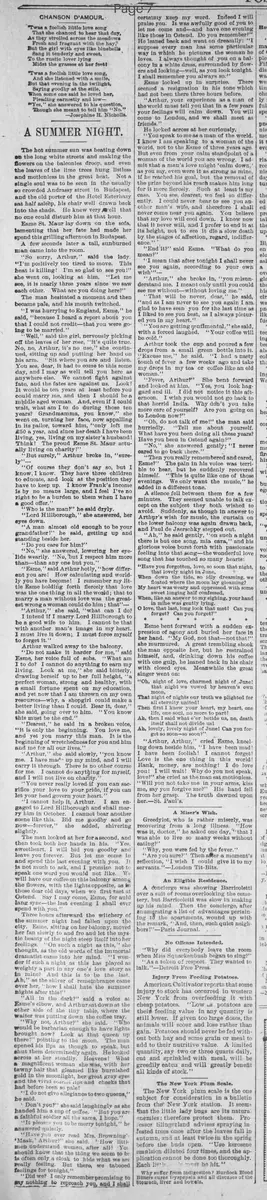
The hot summer sun was beating down on the long white streets and making the flowers on the balconies droop, and even the leaves of the lime trees hung listless and motionless in the great heat. Not a single soul was to be seen in the usually so crowded Andrassy street in Budapest, and the old porter of the Hotel Esterhazy sat half asleep, his chair well drawn back into the shade. He knew very well that no one could disturb him at that hour.
Esme St. Maur lay down on the sofa, lamenting that her fate had made her spend this grilling afternoon in Budapest. A few seconds later a tall, sunburned man came into the room.
"So sorry, Arthur," said the lady. "I'm positively too tired to move. This heat is killing! I'm so glad to see you!" she went on, looking at him. "Let me see, it is nearly three years since we saw each other. What are you doing here?"
The man hesitated a moment and then became pale, and his mouth twitched.
"I was hurrying to England, Esme," he said, "because I heard a report about you that I could not credit-that you were going to be married."
"Well," said the girl, nervously picking off the leaves of her rose, "it's quite true. No, no, Arthur, it's no use," she continued, sitting up and putting her hand on his arm. "Sit where you are and listen. You see, dear, it had to come to this some day, and I may as well tell you here as anywhere else. We cannot fight against fate, and the fates are against us. Look! It would be ten years at least before you could marry me, and then I should be a middle aged woman. And, even if I could wait, what am I to do during those ten years? Grandmamma, you know," she went on, turning her face, now appalling in its pallor, toward him, "only left me £50 a year, and since her death I have been living, yes, living on my sister's husband! Think! The proud Esme St. Maur actually living on charity!"
"But surely," Arthur broke in, "surely"-
"Of course they don't say so, but I know, I know. They have three children to educate, and look at the position they have to keep up. I know Frank's income is by no means large, and I feel I've no right to be a burden to them when I have a good offer."
"Who is the man?" he said dryly.
"Lord Hillborough," she answered, her eyes down.
"A man almost old enough to be your grandfather!" he said, getting up and standing beside her.
"Do you care for him?"
"No," she answered, lowering her eyelids wearily. "No, but I respect him more than-than any one but you."
"Esme," said Arthur hotly, "how different you are! How calculating and worldly you have become! I remember my little Esme holding forth fiercely that love was the one thing in all the world: that to marry a man without love was the greatest wrong a woman could do him; that"-
"Arthur," she said, "what can I do? I intend if I marry Lord Hillborough to be a good wife to him. I cannot be that with another man's image in my heart. I must live it down: I must force myself to forget it."
Arthur walked away to the balcony.
"Do not make it harder for me," said Esme, her voice full of sobs. "What am I to do? I cannot do anything to earn my living. Look at me," she said bitterly, drawing herself up to her full height, "a perfect woman, strong and healthy, with a small fortune spent on my education, and yet now that I am thrown on my own resources-why, a shopgirl could make a better living than I could. Bear it, dear," she said, going over to him. "You know this must be the end."
"Dearest," he said in a broken voice, "it is only the beginning. You love me, and yet you marry this man. It is the beginning of wretchedness for you and him and me for all our lives."
"Arthur," she said slowly, "you know me. I have made up my mind, and I will carry it through. There is no other course for me. I cannot do anything for myself, and I will not live on charity."
"You never really loved if you can sacrifice your love to your pride, if you can let your head govern your heart."
"I cannot help it, Arthur. I am engaged to Lord Hillborough and shall marry him in October. I cannot bear another scene like this. Bid me goodby and go now-forever," she added, shivering slightly.
The man looked at her for a second, and then took both her hands in his. "Yes, sweetheart. I will bid you goodby and leave you forever. But let me come in and spend this last evening with you. It is not much to ask, and I promise not to speak one word you would not like. We will have our coffee on this balcony among the flowers, with the lights opposite, as in those dear old days, when we first met at Ostend. Say I may come, Esme, for auld lang syne-the last evening I shall ever spend with you."
Three hours afterward the witchery of the summer night had fallen upon the city. Esme, sitting on her balcony, moved her fan slowly to and fro and let the mystic beauty of the night steep itself into her feelings. "On such a night as this," she thought, as the old words of the immortal dramatist came into her mind. "I wonder if such a night as this has played as weighty a part in any one's love story as in mine? And this is to be the last. Ah," as the shiver of remembrance came over her, "how I shall hate the summer nights after this!"
"All in the dark?" said a voice at Esme's elbow, and Arthur sat down at the other side of the tiny table, where the waiter was putting down the coffee tray.
"Why not, Arthur?" she said. "Who would be barbarian enough to have lights brought now? Look at that queen up there!" pointing to the moon. The man opened his lips as though to speak, but shut them determinedly again. He looked across at her steadily. Heavens! What a magnificent woman she was, with her tawny hair that gleamed like burnished gold in the moonlight, her great gray eyes and the vivid scarlet lips and cheeks that had before been so pale!
"I do not give allegiance to two queens," he said.
"Don't you?" she said laughingly as she handed him a cup of coffee. "But you are a faithful soldier all the same, I hope."
"It pleases you to be merry tonight," he answered quietly.
"Have you ever read Mrs. Browning's 'Mask,' Arthur?" she said. "How little men understand women, after all! You should know that the thing we seem to be is often only a cloak to hide what we are really feeling. But there, we tabooed feelings for tonight."
"Did we? I only remember promising to say nothing to reproach you, and I shall certainly keep my word. Indeed I will praise you. It was awfully good of you to let me come and-and have one evening like those in Ostend. Do you remember?"
He leaned back and went on dreamily: "I suppose every man has some particular way in which he pictures the woman he loves. I always thought of you on a balcony in a white dress, surrounded by flowers and looking-well, as you look tonight. I shall remember you always so."
Esme looked up in surprise. There seemed a resignation in his tone which had not been there three hours before.
"Arthur, your experience as a man of the world must tell you that in a few years your feelings will calm down. You will come to London, and we shall meet as friends."
He looked across at her curiously:
"You speak to me as a man of the world. I know I am speaking to a woman of the world, not to the Esme of three years ago. But even from your calm standpoint of a woman of the world you are wrong. I admit that a man's love might 'calm down,' as you say, even were it as strong as mine if he reached his goal, but the removal of the prize beyond his reach makes him long for it more fiercely. Such at least is my case. You see, dearest, we feel so differently. I could never bear to see you another man's wife, and therefore I shall never come near you again. You believe that my love will cool down. I know now that it never will, and I prefer to end it at its height, not to see it die a slow death by the stages of affection, regard, indifference."
"End it?" said Esme.
"What do you mean?"
"I mean that after tonight I shall never see you again, according to your own wish."
"Arthur," she broke in, "you misunderstand me. I meant only until you could see me without-without loving me."
"That will be never, dear," he said, "and as I am never to see you again I am glad to have seen you for the last time as I liked to see you best, as I always pictured you in my heart."
"You are getting sentimental," she said with a forced laugh. "Your coffee will be cold."
Arthur took the cup and poured a few drops from a small green bottle into it.
"Excuse me," he said. "I had a nasty touch of fever a few weeks ago and take my drops in my tea or coffee like an old woman."
"Fever, Arthur?" She bent forward and looked at him. "Yes, you look haggard and ill. I did not notice it this afternoon. I wish you would not go back to that horrid India. Why don't you take more care of yourself? Are you going on to London now?"
"Oh, do not talk of me!" the man said hurriedly. "Tell me about yourself. What have you been doing all these years? Have you been in Ostend again?"
"No," she answered gently; "I never cared to go back there."
"Then you really remembered and cared, Esme?" The pain in his voice was terrible to hear, but he suddenly recovered himself. "This is quite like one of those evenings. We only want the music," he added in a different tone.
A silence fell between them for a few minutes. They seemed unable to talk except on the subject they both wished to avoid. Suddenly, as though in answer to Arthur's wish for music, the curtain on the lower balcony was again drawn back, and Paul de Jaerschky stepped out.
"Ah," he said gently, "on such a night there is but one song, mia cara," and his glorious voice burst forth with passionate feeling into that song-the wonderful love song that has touched so many hearts:
"Have you forgotten, love, so soon that night that lovely night in June,
When down the tide, so idly dreaming, we floated where the moon lay gleaming
My heart was weary and oppressed with some sweet longing half confessed.
When, like an answer to my sighing, your hand in mine was gently lying.
O love, that last, long look that met! Can you forget? Can you forget?"
Esme bent forward with a sudden expression of agony and buried her face in her hands. "My God, not that-not that!" she murmured. A great trembling shook the man opposite her, but he restrained himself, and, drinking down his coffee with one gulp, he leaned back in his chair with closed eyes. Meanwhile the great singer went on:
"Oh, night of love, charmed night of June! that night we vowed by heaven's own moon,
That night of nights our troth we plighted for all eternity united!
Then first I knew your heart, my heart, one life, one soul, no more to part!
Ah, then I said what e'er betide us, no, death itself shall not divide us!
Ah, lovely, lovely night of June! Can you forget so soon—so soon?"
"Arthur, Arthur," cried Esme, kneeling down beside him, "I have been mad! I have been foolish! I cannot forget! Love is the one thing in this world. Rank, money, are nothing! I do love you! I will wait! Why do you not speak, love?" she cried as the man sat motionless. "Will you not take me in your arms, kiss me, say you forgive me?" His hand fell from her grasp. The truth dawned upon her.-St. Paul's.
What sub-type of article is it?
What themes does it cover?
What keywords are associated?
What entities or persons were involved?
Where did it happen?
Story Details
Key Persons
Location
Budapest
Event Date
Summer
Story Details
Esme St. Maur, facing financial dependence on her sister's family after inheriting only £50 a year, decides to marry the elderly Lord Hillborough despite her love for Arthur, whom she hasn't seen in three years. During their emotional farewell on a hot summer evening in Budapest, a singer's love song revives her passion, leading her to beg Arthur's forgiveness, but he has poisoned his coffee and dies.