Thank you for visiting SNEWPapers!
Sign up free
The Oklahoma Miner
Krebs, Pittsburg County, Oklahoma
What is this article about?
Article speculates on a potential 'tornado summer' in the Mississippi Valley, distinguishes tornadoes from cyclones, explores Kansas's historical reputation for such storms, and recounts bizarre effects from an official post-Civil War investigation.
Clipping
OCR Quality
Full Text
By John Dickinson Sherman
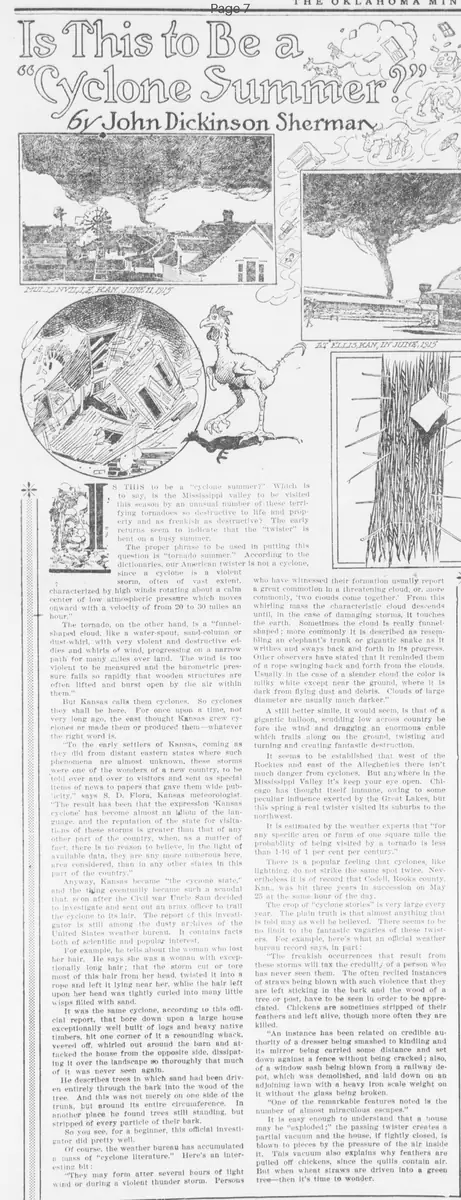
Is this to be a “cyclone summer?” Which is to say, is the Mississippi valley to be visited this season by an unusual number of these terrifying tornadoes so destructive to life and property and as freakish as destructive? The early returns seem to indicate that the “twister” is bent on a busy summer.
The proper phrase to be used in putting this question is “tornado summer.” According to the dictionaries, our American twister is not a cyclone, since a cyclone is a violent storm, often of vast extent.
who have witnessed their formation usually report a great commotion in a threatening cloud, or, more commonly, “two clouds come together.” From this whirling mass the characteristic cloud descends until, in the case of damaging storms, it touches the earth. Sometimes the cloud is really funnel-shaped; more commonly it is described as resembling an elephant’s trunk or gigantic snake as it writhes and sways back and forth in its progress. Other observers have stated that it reminded them of a rope swinging back and forth from the clouds. Usually in the case of a slender cloud the color is milky white except near the ground, where it is dark from flying dust and debris. Clouds of large diameter are usually much darker.
storm, often of vast extent. characterized by high winds rotating about a calm center of low atmospheric pressure which moves onward with a velocity of from 20 to 30 miles an hour.
The tornado, on the other hand, is a “funnel-shaped cloud, like a water-spout, sand-column or dust-whirl, with very violent and destructive eddies and whirls of wind, progressing on a narrow path for many miles over land. The wind is too violent to be measured and the barometric pressure falls so rapidly that wooden structures are often lifted and burst open by the air within them.”
But Kansas calls them cyclones. So cyclones they shall be here. For once upon a time, not very long ago, the east thought Kansas grew cyclones or made them or produced them—whatever the right word is.
“To the early settlers of Kansas, coming as they did from distant eastern states where such phenomena are almost unknown, these storms were one of the wonders of a new country, to be told over and over to visitors and sent as special items of news to papers that gave them wide publicity,” says S. D. Flora, Kansas meteorologist.
“The result has been that the expression ‘Kansas cyclone’ has become almost an idiom of the language, and the reputation of the state for visitations of these storms is greater than that of any other part of the country, when, as a matter of fact, there is no reason to believe, in the light of available data, they are any more numerous here, when considered, than in any other states in this part of the country.”
Anyway, Kansas became “the cyclone state,” and the thing eventually became such a scandal that, soon after the Civil war Uncle Sam decided to investigate and sent out an army officer to trail the cyclone to its lair. The report of this investigator is still among the dusty archives of the United States weather bureau. It contains facts both of scientific and popular interest.
For example, he tells about the woman who lost her hair. He says she was a woman with exceptionally long hair; that the storm cut or tore most of this hair from her head, twisted it into a rope and left it lying near her, while the hair left upon her head was tightly curled into many little wisps filled with sand.
It was the same cyclone, according to this official report, that bore down upon a large house exceptionally well built of logs and heavy native timbers, hit one corner of it a resounding whack, veered off, whirled out around the barn and attacked the house from the opposite side, dissipating it over the landscape so thoroughly that much of it was never seen again.
He describes trees in which sand had been driven entirely through the bark into the wood of the tree. And this was not merely on one side of the trunk, but around its entire circumference.
In another place he found trees still standing, but stripped of every particle of their bark.
So you see, for a beginner, this official investigator did pretty well.
Of course, the weather bureau has accumulated a mass of “cyclone literature.” Here’s an interesting bit:
“They may form after several hours of light wind or during a violent thunder storm. Persons
What sub-type of article is it?
What themes does it cover?
What keywords are associated?
What entities or persons were involved?
Where did it happen?
Story Details
Key Persons
Location
Mississippi Valley And Kansas
Event Date
Soon After The Civil War
Story Details
Article questions if the Mississippi Valley faces a busy tornado season, defines tornadoes versus cyclones, recounts Kansas's exaggerated reputation for such storms among early settlers, and details bizarre effects from a post-Civil War official investigation including a woman losing her hair twisted into a rope, a house demolished, and trees pierced or stripped by sand and wind.