Thank you for visiting SNEWPapers!
Sign up free
The Van Buren Press
Van Buren, Crawford County, Arkansas
What is this article about?
Detailed report of the 1868 Republican National Convention in Chicago, covering assembly, speeches, platform adoption on reconstruction and impeachment, nomination of Ulysses S. Grant for President and Schuyler Colfax for Vice President, amid party disappointments over Andrew Johnson's acquittal.
Merged-components note: Direct textual continuation of the Chicago Convention report across columns on page 1 and into page 2.
Clippings
1 of 2
OCR Quality
Full Text
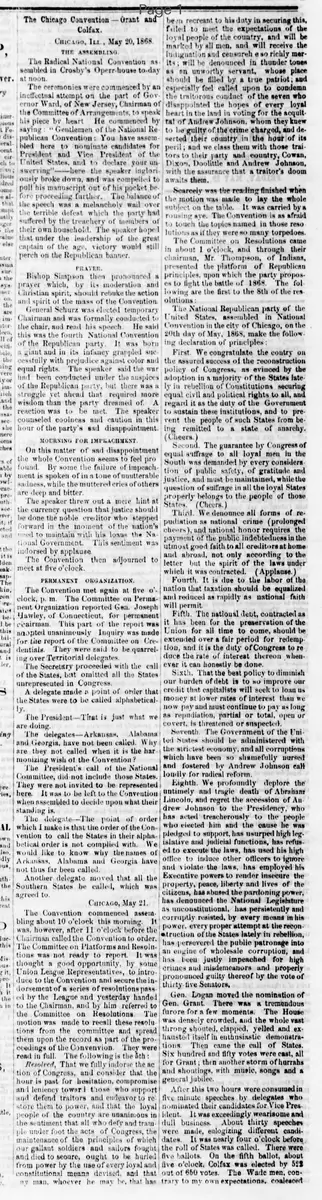
Colfax.
CHICAGO, ILL., May 20, 1868.
THE ASSEMBLING
The Radical National Convention assembled in Crosby's Opera-house to-day at noon.
The ceremonies were commenced by an ineffectual attempt on the part of Governor Ward, of New Jersey, Chairman of the Committee of Arrangements, to speak his piece by heart. He commenced by saying: "Gentlemen of the National Republican Convention: You have assembled here to nominate candidates for President and Vice President of the United States, and to declare your unswerving"—here the speaker ingloriously broke down, and was compelled to pull his manuscript out of his pocket before proceeding further. The balance of the speech was a melancholy wail over the terrible defeat which the party had suffered by the treachery of members of their own household. The speaker hoped that under the leadership of the great captain of the age, victory would still perch on the Republican banner.
PRAYER.
Bishop Simpson then pronounced a prayer which, by its moderation and Christian spirit, should rebuke the action and spirit of the mass of the Convention.
General Schurz was elected temporary Chairman and was formally conducted to the chair, and read his speech. He said this was the fourth National Convention of the Republican party. It was born a giant and in its infancy grappled successfully with prejudice against color and equal rights. The speaker said the war had been conducted under the auspices of the Republican party, but there was a struggle yet ahead that required more wisdom than the party dreamed of. A reaction was to be met. The speaker counseled coolness and caution in this hour of the party's sad disappointment.
MOURNING FOR IMPEACHMENT
On this matter of sad disappointment the whole Convention seems to feel profoundly. By some the failure of impeachment is spoken of in a tone of unutterable sadness, while the muttered cries of others are deep and bitter.
The speaker threw out a mere hint at the currency question that justice should be done the noble creditor who stepped forward in the moment of the nation's need to maintain with his loans the National Government. This sentiment was indorsed by applause.
The Convention then adjourned to meet at five o'clock.
PERMANENT ORGANIZATION
The Convention met again at five o'clock, p. m. The Committee on Permanent Organization reported Gen. Joseph Hawley, of Connecticut, for permanent chairman. This part of the report was adopted unanimously. Inquiry was made for the report of the Committee on Credentials. They were said to be quarreling over Territorial delegates.
The Secretary proceeded with the call of the States, but omitted all the States unrepresented in Congress.
A delegate made a point of order that the States were to be called alphabetically.
The President—That is just what we are doing.
The delegates—Arkansas, Alabama and Georgia have not been called. Why are they not called when it is the harmonizing wish of the Convention?
The President's call of the National Committee, did not include those States. They were not invited to be represented here. It was to be left to the Convention when assembled to decide upon what their standing is.
The delegate—The point of order which I make is that the order of the Convention to call the States in their alphabetical order is not complied with. We would like to know why the names of Arkansas, Alabama and Georgia have not thus far been called.
Another delegate moved that all the Southern States be called, which was agreed to.
CHICAGO, May 21.
The Convention commenced assembling about 10 o'clock this morning. It was, however, after 11 o'clock before the Chairman called the Convention to order.
The Committee on Platforms and Resolutions was not ready to report. It was thought a good opportunity, by some Union League Representatives, to introduce to the Convention and secure the indorsement of a series of resolutions passed by the League and yesterday handed to the Chairman, and by him referred to the Committee on Resolutions. The motion was made to recall these resolutions from the committee and spread them upon the record as part of the proceedings of the Convention. They were read in full. The following is the 8th:
Resolved, That we fully indorse the action of Congress, and consider that the hour is past for hesitation, compromise and leniency toward those who support and defend traitors and endeavor to restore them to power, and that the loyal people of the country are unanimous in the sentiment that all who defy and trample under foot the acts of Congress, the maintenance of the principles of which our gallant soldiers and sailors fought and died to secure, ought to be hurled from power by the use of every loyal and constitutional means devised, and that any man, whoever he may be, that has
been recreant to his duty in securing this, failed to meet the expectations of the loyal people of the country, and will be marked by all men, and will receive the indignation and censure he so richly merits; will be denounced in thunder tones as an unworthy servant, whose place should be filled by a true patriot; and especially feel called upon to condemn the traitorous conduct of the seven who disappointed the hopes of every loyal heart in the land in voting for the acquittal of Andrew Johnson, whom they knew to be guilty of the crime charged, and deserted their country in the hour of its peril; and we class them with those traitors to their party and country, Cowan, Dixon, Doolittle and Andrew Johnson, with the assurance that a traitor's doom awaits them.
Scarcely was the reading finished when the motion was made to lay the whole subject on the table. It was carried by a rousing aye. The Convention is as afraid to touch the topics named in those resolutions as if they were so many torpedoes.
The Committee on Resolutions came in about 1 o'clock, and through their chairman, Mr. Thompson, of Indiana, presented the platform of Republican principles, upon which the party proposes to fight the battle of 1868. The following are the first to the 8th of the resolutions:
The National Republican party of the United States, assembled in National Convention in the city of Chicago, on the 20th day of May, 1868, make the following declaration of principles:
First. We congratulate the country on the assured success of the reconstruction policy of Congress, as evinced by the adoption in a majority of the States lately in rebellion of Constitutions securing equal civil and political rights to all, and regard it as the duty of the Government to sustain these institutions, and to prevent the people of such States from being remitted to a state of anarchy. (Cheers.)
Second. The guarantee by Congress of equal suffrage to all loyal men in the South was demanded by every consideration of public safety, of gratitude and justice, and must be maintained, while the question of suffrage in all the loyal States properly belongs to the people of those States. (Cheers.)
Third. We denounce all forms of repudiation as a national crime (prolonged cheers), and national honor requires the payment of the public indebtedness in the utmost good faith to all creditors at home and abroad, not only according to the letter but the spirit of the laws under which it was contracted. (Applause.)
Fourth. It is due to the labor of the nation that taxation should be equalized and reduced as rapidly as national faith will permit.
Fifth. The national debt, contracted as it has been for the preservation of the Union for all time to come, should be extended over a fair period for redemption, and it is the duty of Congress to reduce the rate of interest thereon whenever it can honestly be done.
Sixth. That the best policy to diminish our burden of debt is to so improve our credit that capitalists will seek to loan us money at lower rates of interest than we now pay and must continue to pay as long as repudiation, partial or total, open or covert, is threatened or suspected.
Seventh. The Government of the United States should be administered with the strictest economy, and all corruptions which have been so shamefully nursed and fostered by Andrew Johnson call loudly for radical reform.
Eighth. We profoundly deplore the untimely and tragic death of Abraham Lincoln, and regret the accession of Andrew Johnson to the Presidency, who has acted treacherously to the people who elected him and the cause he was pledged to support, has usurped high legislative and judicial functions, has refused to execute the laws, has used his high office to induce other officers to ignore and violate the laws, has employed his Executive powers to render insecure the property, peace, liberty and lives of the citizens, has abused the pardoning power, has denounced the National Legislature as unconstitutional, has persistently and corruptly resisted, by every means in his power, every proper attempt at the reconstruction of the States lately in rebellion, has perverted the public patronage into an engine of wholesale corruption, and has been justly impeached for high crimes and misdemeanors and properly pronounced guilty thereof by the vote of thirty-five Senators.
Gen. Logan moved the nomination of Gen. Grant. There was a tremendous furore for a few moments. The House was densely crowded, and the whole vast throng shouted, clapped, yelled and exhausted itself in enthusiastic demonstrations. Then came the call of States. Six hundred and fifty votes were cast, all for Grant; then another storm of hurrahs and shoutings, with music, songs and a general jubilee.
After this two hours were consumed in five minute speeches by delegates who nominated their candidates for Vice President. It was exceedingly wearisome and dull business. About thirty speeches were made, eulogizing different candidates. It was nearly four o'clock before the roll of States was called. There were five ballots. On the fifth ballot, about five o'clock, Colfax was elected by 529 out of 650 votes. The Wade men, contrary to my own expectations, coalesced.
with the Colfax men. This is a sad disaster to Wade. It is a rebuke from his own party. It is a reflection on the whole impeachment business, and fully justifies the opinions of Senators and others who dreaded to see Mr. Wade in the Vice President's chair after the removal of Mr. Johnson. Mr. Wade was deserted early by some of his own Ohio friends in the Convention. Thus he received in 1868 a double punishment. In January, Ohio kicked him out of the Senate. In May his own national party declare that they will not have him in the Vice President's chair.
The nomination of Grant was received with apparent joy, but among Radicals there are outspoken ones who say he was forced upon them, that he never was their choice, and that they have no heart to work for him. Some have said already that they shall never cast a vote for him. The original men of their party have been set aside for an intruder, and they have no disposition to aid his aspirations and insure his success.
What sub-type of article is it?
What themes does it cover?
What keywords are associated?
What entities or persons were involved?
Where did it happen?
Story Details
Key Persons
Location
Chicago, Ill., Crosby's Opera House
Event Date
May 20, 1868; May 21, 1868
Story Details
The Republican National Convention assembles, discusses impeachment failure and reconstruction, adopts platform condemning Andrew Johnson, nominates Grant unanimously for President and Colfax for Vice President after ballots, rejecting Wade amid party divisions.