Thank you for visiting SNEWPapers!
Sign up free
The New Hampshire Gazette
Portsmouth, Rockingham County, New Hampshire
What is this article about?
The brig Mount Stone, bound from Plymouth to St. John's, Newfoundland, struck ice in dense fog on May 7, 1823, sinking and forcing survivors into a boat. Most perished from exposure; sole survivor seaman Olford lost both legs to frostbite and was rescued after 10 days.
Clipping
OCR Quality
Full Text
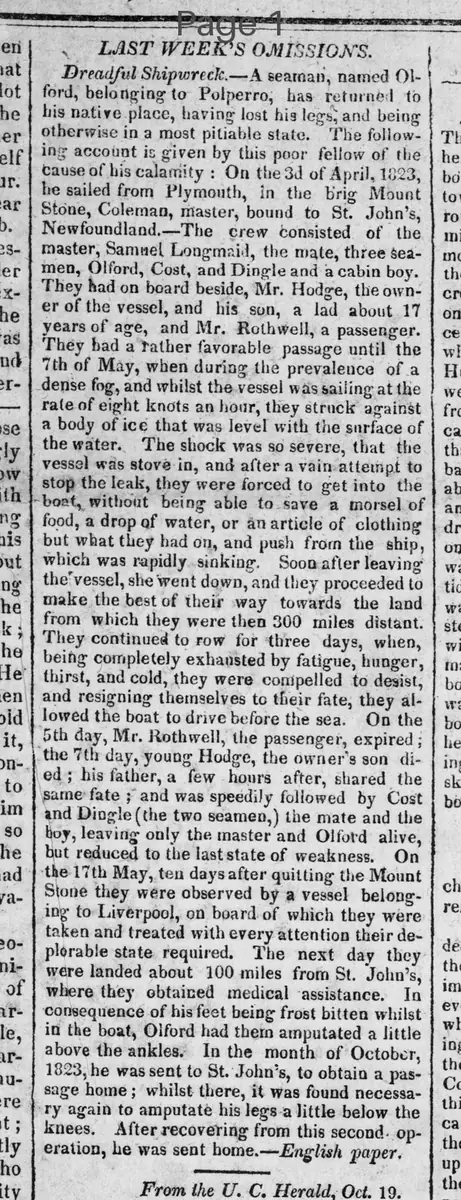
Dreadful Shipwreck.--A seaman, named Olford, belonging to Polperro, has returned to his native place, having lost his legs, and being otherwise in a most pitiable state. The following account is given by this poor fellow of the cause of his calamity: On the 3d of April, 1823, he sailed from Plymouth, in the brig Mount Stone, Coleman, master, bound to St. John's, Newfoundland. The crew consisted of the master, Samuel Longmaid, the mate, three seamen, Olford, Cost, and Dingle and a cabin boy. They had on board beside, Mr. Hodge, the owner of the vessel, and his son, a lad about 17 years of age, and Mr. Rothwell, a passenger. They had a rather favorable passage until the 7th of May, when during the prevalence of a dense fog, and whilst the vessel was sailing at the rate of eight knots an hour, they struck against a body of ice that was level with the surface of the water. The shock was so severe, that the vessel was stove in, and after a vain attempt to stop the leak, they were forced to get into the boat, without being able to save a morsel of food, a drop of water, or an article of clothing but what they had on, and push from the ship which was rapidly sinking. Soon after leaving the vessel, she went down, and they proceeded to make the best of their way towards the land from which they were then 300 miles distant.
They continued to row for three days, when, being completely exhausted by fatigue, hunger, thirst, and cold, they were compelled to desist, and resigning themselves to their fate, they allowed the boat to drive before the sea. On the 5th day, Mr. Rothwell, the passenger, expired; the 7th day, young Hodge, the owner's son died; his father, a few hours after, shared the same fate; and was speedily followed by Cost and Dingle (the two seamen,) the mate and the boy, leaving only the master and Olford alive, but reduced to the last state of weakness. On the 17th May, ten days after quitting the Mount Stone they were observed by a vessel belonging to Liverpool, on board of which they were taken and treated with every attention their deplorable state required. The next day they were landed about 100 miles from St. John's, where they obtained medical assistance. In consequence of his feet being frost bitten whilst in the boat, Olford had them amputated a little above the ankles. In the month of October, 1823, he was sent to St. John's, to obtain a passage home; whilst there, it was found necessary again to amputate his legs a little below the knees. After recovering from this second operation, he was sent home.--English paper.
What sub-type of article is it?
What keywords are associated?
What entities or persons were involved?
Where did it happen?
Foreign News Details
Primary Location
Newfoundland
Event Date
3d Of April, 1823 To 17th May, 1823
Key Persons
Outcome
vessel sank; mr. rothwell, young hodge, mr. hodge, cost, dingle, mate, cabin boy, and master died; olford survived but had both legs amputated due to frostbite.
Event Details
The brig Mount Stone sailed from Plymouth on April 3, 1823, bound for St. John's, Newfoundland. On May 7, in dense fog, it struck ice, sank, and the crew and passengers took to a boat without provisions. After three days rowing, they drifted; most died over the next days from exposure. On May 17, Olford and the master were rescued by a Liverpool vessel, landed near St. John's. Olford's frostbitten legs were amputated twice.