Thank you for visiting SNEWPapers!
Sign up free
New Hampshire Statesman And State Journal
Concord, Merrimack County, New Hampshire
What is this article about?
At a Whig festival in New Hampshire, Hon. Mr. Holmes praised the state's senator and delivered a lengthy critique of President Jackson's administration, accusing it of financial usurpations, corruption in departments like the Post Office, excessive spending, and unstable cabinet appointments, urging vigilance to restore liberty.
Clipping
OCR Quality
Full Text
WHIG FESTIVAL.
REMARKS OF HON. MR. HOLMES.
TOAST.
The Eastern Star of our Confederacy—A little obscured in the Maine—but,
"So sinks the day-star in the ocean bed,
" And yet anon repairs his drooping head,
" And tricks his beams, and with new-spangled ore,
" Flames in the forehead of the morning sky."
The talent and patriotism and energy of the sons of our Eastern sister, furnish a sure guarantee for her future security.
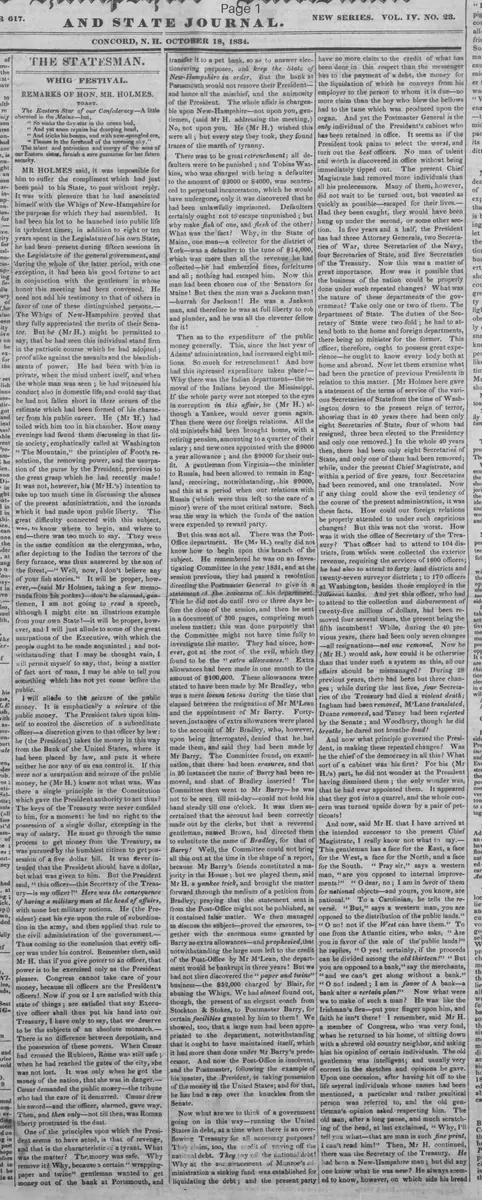
MR HOLMES said, it was impossible for him to suffer the compliment which had just been paid to his State, to pass without reply. It was with pleasure that he had associated himself with the Whigs of New-Hampshire for the purpose for which they had assembled. It had been his lot to be launched into public life in turbulent times; in addition to eight or ten years spent in the Legislature of his own State. he had been present during fifteen sessions in the Legislature of the general government, and during the whole of the latter period, with one exception, it had been his good fortune to act in conjunction with the gentlemen in whose honor this meeting had been convened. He need not add his testimony to that of others in favor of one of these distinguished persons.— The Whigs of New-Hampshire proved that they fully appreciated the merits of their Senator. But he (Mr H.) might be permitted to say, that he had seen this individual stand firm in the patriotic course which he had adopted ; proof alike against the assaults and the blandishments of power. He had been with him in private, when the mind unbent itself, and when the whole man was seen : he had witnessed his conduct also in domestic life, and could say that he had not fallen short in these scenes of the estimate which had been formed of his character from his public career. He (Mr H.) had toiled with him too in his chamber. How many evenings had found them discussing in that little society, emphatically called at Washington "The Mountain," the principles of Foot's resolution, the removing power, and the usurpation of the purse by the President, previous to the great grasp which he had recently made! It was not, however, his (Mr H.'s) intention to take up too much time in discussing the abuses of the present administration, and the inroads which it had made upon public liberty. 'The great difficulty connected with this subject, was, to know where to begin, and where to end-there was too much to say. They were in the same condition as the clergyman, who, after depicting to the Indian the terrors of the fiery furnace, was thus answered by the son of the forest,—" Well, now, I don't believe any of your fish stories." It will be proper, however,-(said Mr Holmes, taking a few memoranda from his pocket)-don't be alarmed, gentlemen, I am not going to read a speech, although I might cite an illustrious example from your own State!-it will be proper, however, and I will just allude to some of the great usurpations of the Executive, with which the people ought to be made acquainted ; and notwithstanding that I may be thought vain, I will permit myself to say, that, being a matter of fact sort of man, I may be able to tell you something which has not yet come before the public. I will allude to the seizure of the public money. It is emphatically a seizure of the public money. The President takes upon himself to control the discretion of a subordinate officer-a discretion given to that officer by law: he (the President) takes the money in this way from the Bank of the United States, where it had been placed by law, and puts it where neither he nor any of us can control it. If this were not a usurpation and seizure of the public money, he (Mr H.) knew not what was. Was there a single principle in the Constitution which gave the President authority to act thus? The keys of the Treasury were never confided to him, for a moment: he had no right to the possession of a single dollar, excepting in the way of salary. He must go through the same process to get money from the Treasury, as was pursued by the humblest citizen to get possession of a five dollar bill. It was never intended that the President should have a dollar, but what was given to him. But the President said, " this officer-this Secretary of the Treasury-is my officer!" Here was the consequence of having a military man at the head of affairs, with none but military notions. He (the President) cast his eye upon the rule of subordination in the army, and then applied that rule to the civil administration of the government,— Thus coming to the conclusion that every officer was under his control. Remember then, said Mr H. that if you give power to an officer, that power is to be exercised only as the President pleases. Congress cannot take care of your money, because all officers are the President's officers! Now if you or I are satisfied with this state of things; are satisfied that any Executive officer shall thus put his hand into our Treasury, I have only to say, that we deserve to be the subjects of an absolute monarch.— There is no difference between despotism, and the possession of these powers. When Caesar had crossed the Rubicon, Rome was still safe; when he had reached the gates of the city, she was not lost. It was only when he got the money of the nation, that she was in danger.— Caesar demanded the public money-the tribune who had the care of it demurred. Caesar drew his sword-and the officer, alarmed, gave way. Then, and then only—not till then, was Roman liberty prostrated in the dust.
One of the principles upon which the President seems to have acted, is that of revenge, and that is the characteristic of a tyrant. What was the matter? The money was safe. Why remove it? Why, because a certain " wrapping-paper and twine" gentleman wanted to get money out of the bank at Portsmouth, and transfer it to a new bank. so as to answer electioneering purposes, and keep the State of New-Hampshire in order. But the bank at Portsmouth would not remove their President- and hence all the mischief, and the animosity of the President. The whole affair is chargeable upon New-Hampshire-not upon you, gentlemen, (said Mr H. addressing the meeting,) No, not upon you. He (Mr H.) wished this were all ; but every step they took, they found traces of the march of tyranny. There was to be great retrenchment; all defaulters were to be punished ; and Tobias Watkins, who was charged with being a defaulter to the amount of $3000 or $4000, was sentenced to perpetual incarceration, which he would have undergone, only it was discovered that he had been unlawfully imprisoned. Defaulters certainly ought not to escape unpunished; but why make fish of one, and flesh of the other? What was the fact? Why, in the State of Maine, one man-a collector for the district of York—was a defaulter to the tune of $14,000, which was more than all the revenue he had collected-he had embezzled fines, forfeitures and all; nothing had escaped him. Now this man had been chosen one of the Senators for Maine! But then the man was a Jackson man! —hurrah for Jackson!! He was a Jackson man, and therefore he was at full liberty to rob and plunder, and he was all the cleverer fellow for it!
Then as to the expenditure of the public money generally. This, since the last year of Adams' administration, had increased eight millions, So much for retrenchment! And how had this increased expenditure taken place?— Why there was the Indian department-the removal of the Indians beyond the Mississippi. If the whole party were not steeped to the eyes in corruption in this affair, he (Mr H.) although a Yankee, would never guess again. Then there were our foreign relations. All the old ministers had been brought home, with a retiring pension, amounting to a quarter of their salary ; and new ones appointed with the $9000 a year allowance ; and the $9000 for their outfit. A gentleman from Virginia-the minister to Russia, had been allowed to remain in England,receiving, notwithstanding, his $9000. and this at a period when our relations with Russia (which were thus left to the care of a minor)were of the most critical nature. Such was the way in which the funds of the nation were expended to reward party. But this was not all. There was the Post-Office department. He (Mr H.) really did not know how to begin upon this branch of the subject. He remembered he was on an Investigating Committee in the year 1831, and at the session previous, they had passed a resolution directing the Postmaster General to give in a statement of the concerns of his department. This he did not do until two or three days before the close of the session, and then he sent in a document of 300 pages, comprising much useless matter: this was done purposely that the Committee might not have time fully to investigate the matter. They had since, however, got at the root of the evil, which they found to be the " extra allowances." Extra allowances had been made in one month to the amount of $100,000. These allowances were stated to have been made by Mr Bradley, who was a mere locum tenens during the time that elapsed between the resignation of Mr M'Lean and the appointment of Mr Barry. Forty-seven instances of extra allowances were placed to the account of Mr Bradley, who, however, upon being interrogated, denied that he had made them, and said they had been made by Mr Barry. The Committee found, on examination, that there had been erasures, and that in 50 instances the name of Barry had been removed, and that of Bradley inserted! The Committee then went to Mr Barry-he was not to be seen till mid-day-could not hold his hand steady till one o'clock. It was then ascertained that the account had been correctly made out by the clerks, but that a reverend gentleman, named Brown, had directed them to substitute the name of Bradley, for that of Barry! Well, the Committee could not bring all this out at the time in the shape of a report, because Mr Barry's friends constituted a majority in the House ; but we played them, said Mr H. a yankee trick, and brought the matter forward through the medium of a petition from Bradley, praying that the statement sent in from the Post-Office might not be published, as it contained false matter. We then managed to discuss the subject-proved the erasures, together with the enormous sums granted by Barry as extra allowances-and prophesied,that notwithstanding the large sum left to the credit of the Post-Office by Mr M'Lean, the department would be bankrupt in three years! But we had not then discovered the " paper and twine" business-the $52,000 charged by Blair, for abusing the Whigs. We had almost found out, though, the present of an elegant coach from Stockton & Stokes, to Postmaster Barry, for certain facilities granted by him to them! We showed, too, that a large sum had been appropriated to the department, notwithstanding that it ought to have maintained itself, which it had more than done under Mr Barry's predecessor. And now the Post-Office is insolvent, and the Postmaster, following the example of his master, the President, is taking possession of the money of the United States; and for that, he has had a rap over the knuckles from the Senate.
Now what are we to think of a government going on in this way-running the United States in debt, at a time when there is an over-flowing Treasury for all necessary purposes? They claim, too, the credit of paying off the national debt. They pay off the national debt! Why at the commencement of Monroe's administration a sinking fund was established for liquidating the debt; and the present party have no more claim to the credit of what has been done in this respect than the messenger has to the payment of a debt, the money for the liquidation of which he conveys from his employer to the person to whom it is due—no more claim than the boy who blew the bellows had to the tune which was produced upon the organ. And yet the Postmaster General is the only individual of the President's cabinet who has been retained in office. It seems as if the President took pains to select the worst, and turn out the best officers. No man of talent and worth is discovered in office without being immediately tipped out. The present Chief Magistrate had removed more individuals than all his predecessors. Many of them, however, did not wait to be turned out, but vacated as quickly as possible—escaped for their lives.— Had they been caught, they would have been hung up under the second, or some other section. In five years and a half, the President has had three Attorney Generals, two Secretaries of War, three Secretaries of the Navy, four Secretaries of State. and five Secretaries of the Treasury. Now this was a matter of great importance. How was it possible that the business of the nation could be properly done under such repeated changes? What was the nature of these departments of the government? Take only one or two of them. The department of State. The duties of the Secretary of State were two-fold ; he had to attend both to the home and foreign departments, there being no minister for the former. This officer, therefore, ought to possess great experience-he ought to know every body both at home and abroad. Now let them examine what had been the practice of previous Presidents in relation to this matter. [Mr Holmes here gave a statement of the terms of service of the various Secretaries of State from the time of Washington down to the present reign of terror, showing that in 40 years there had been only eight Secretaries of State, four of whom had resigned, three been elected to the Presidency and only one removed.1 In the whole 40 years then, there had been only eight Secretaries of State, and only one of them had been removed; while, under the present Chief Magistrate, and within a period of five years, four Secretaries had been removed, and one translated. Now if any thing could show the evil tendency of the course of the present administration, it was these facts. How could our foreign relations be properly attended to under such capricious changes? But this was not the worst. How was it with the office of Secretary of the Treasury? That officer had to attend to 104 districts, from which were collected the exterior revenue, requiring the services of 1600 officers; he had also to attend to forty land districts and twenty-seven surveyor districts; to 170 officers at Washington, besides those employed in the different banks. And yet this officer, who had to attend to the collection and disbursement of twenty-five millions of dollars, had been removed four several times, the present being the fifth incumbent! While, during the 40 previous years, there had been only seven changes -all resignations-not one removal. Now he (Mr H.) would ask, how could it be otherwise than that under such a system as this, all our affairs should be mismanaged? During 28 previous years, there had been but three changes; while during the last five, four Secretaries of the Treasury had died a violent death; Ingham had been removed, M'Lane translated, Duane removed, and Taney had been rejected by the Senate ; and Woodbury, though he did breathe, he dared not breathe loud! And now what principle governed the President, in making these repeated changes? Was he the chief of the democracy in all this? What sort of a cabinet was his first? For his (Mr H.'s) part, he did not wonder at the President having dismissed them ; the only wonder was, that he had ever appointed them. It appeared that they got into a quarrel, and the whole concern was turned upside down by a pair of petticoats! And now, said Mr H. that I have arrived at the intended successor to the present Chief Magistrate, I really know not what to say.- This gentleman has a face for the East, a face for the West, a face for the North, and a face for the South. " Pray sir," says a western man, "are you opposed to internal improvements?" " O dear, no; I am in favor of them for national objects-and yours, you know, are national." To a Carolinian, he tells the reverse. " But," says a western man, you are opposed to the distribution of the public lands." " O no! not if the West can have them." To one from the Atlantic cities, who asks, " Are you in favor of the sale of the public lands?" he replies, " O yes! certainly, if the proceeds can be divided among the old thirteen!" " But you are opposed to a bank," say the merchants, "and we can't get along without a bank." " O no! indeed: I am in favor of A bank-a bank after a certain plan!" Now what were we to make of such a man? He was like the Irishman's flea-put your finger upon him, and faith he isn't there! I remember, said Mr H. a member of Congress, who was very fond, when he returned to his home, of sitting down with a shrewd old country neighbor, and asking him his opinion of certain individuals. The old gentleman was intelligent; and usually very correct in the sketches and opinions he gave. Upon one occasion, after having hit off to the life several individuals whose names had been mentioned, a particular and rather jesuitical person was referred to, and the old gentleman's opinion asked respecting him. The old man, after a long pause, and much scratching of the head, at last exclaimed, " Why, I'll tell you what-that are man is such fine print, I can't read him!" Then, Mr H. continued, there was the Secretary of the Treasury. He had been a New-Hampshire man; but did any one know what he was now? He always seemed to know, however, on which side his bread was buttered, and took good care to feather his nest. He was now very likely a democrat -no matter what, in fact-"as you like it."
"Dick," said his master, " have you fed the pigs?" " Yes, massa, all fed." "Did you count them, Dick?" " Yes, massa, count 'em all-all but one little speckled feller, and he frisky frisky about so, can't count him at all."
Such was the present cabinet ; composed of materials as discordant as the mixture in the cauldron of Macbeth's witches. But it was said, there was a power behind the throne greater than the throne itself. This was true-there was Amos Kendall, Elijah Hayward, and this " Wrapping-Paper and Twine" here. These enacted the part of the three principal witches —the weird sisters: these were the " dark and midnight hags"the" kitchen cabinet"—who paced round the cauldron-occasionally stirred its contents, chanting incessantly their infernal ditty,
Double, double, toil and trouble.
Fire burn, and cauldron bubble.
Now with such a cabinet, and with a President at its head supported only by the strength of his own passions, what have the people to expect? How can the country be otherwise than ruined in the hands of such men? There is but one way of escape, and that is, by turning out these men. Let the people be vigilant; let them do like the people of New-York-keep their shops shut during the period of the election, and make politics for the time their sole business. That is the way to restore the liberty bequeathed to us by our forefathers. They should exert themselves to the utmost, and they could not but succeed. In his (Mr H.'s)State, great inroads had been made upon public liberty ; but her star had not yet set. He saw the light breaking through the clouds which had obscured her horizon. What had been recently done had saved her-they had scotched the snake, and would shortly kill it. They now knew their strength-and he would say to the people of New-Hampshire, " Go ye and do likewise." Let them but do their duty, and the time was not far distant, when the Whigs of Maine would take the Whigs of New-Hampshire by the hand!
Mr HOLMES concluded by offering the following toast :
The State of New-Hampshire—May she be speedily unwrapped of her " wrapping-paper," and disentangled of her " twine."
What sub-type of article is it?
What keywords are associated?
What entities or persons were involved?
Where did it happen?
Domestic News Details
Primary Location
New Hampshire
Key Persons
Event Details
At a Whig festival, Hon. Mr. Holmes responded to a toast to Maine, associating with New Hampshire Whigs, praising their senator's firmness, and criticizing the Jackson administration's usurpations including seizure of public money, revenge-driven removals, increased expenditures, Post-Office mismanagement, frequent cabinet changes, and the influence of the 'kitchen cabinet'. He concluded with a toast to New Hampshire.