Thank you for visiting SNEWPapers!
Sign up free
Editorial
May 31, 1834
Republican Herald
Providence, Providence County, Rhode Island
What is this article about?
An editorial denounces the horrors of war and despotism, citing Dr. Aikin's account of 70,000 Russian recruits dying in hospitals in one year. It contrasts this silent mass death with publicized individual crimes like the murders of Princess de Lamballe and Louis XVI, critiques exaggerated fears of sedition, and quotes Lucian, Vendome, and Wellington on war's futility.
Clipping
OCR Quality
98%
Excellent
Full Text
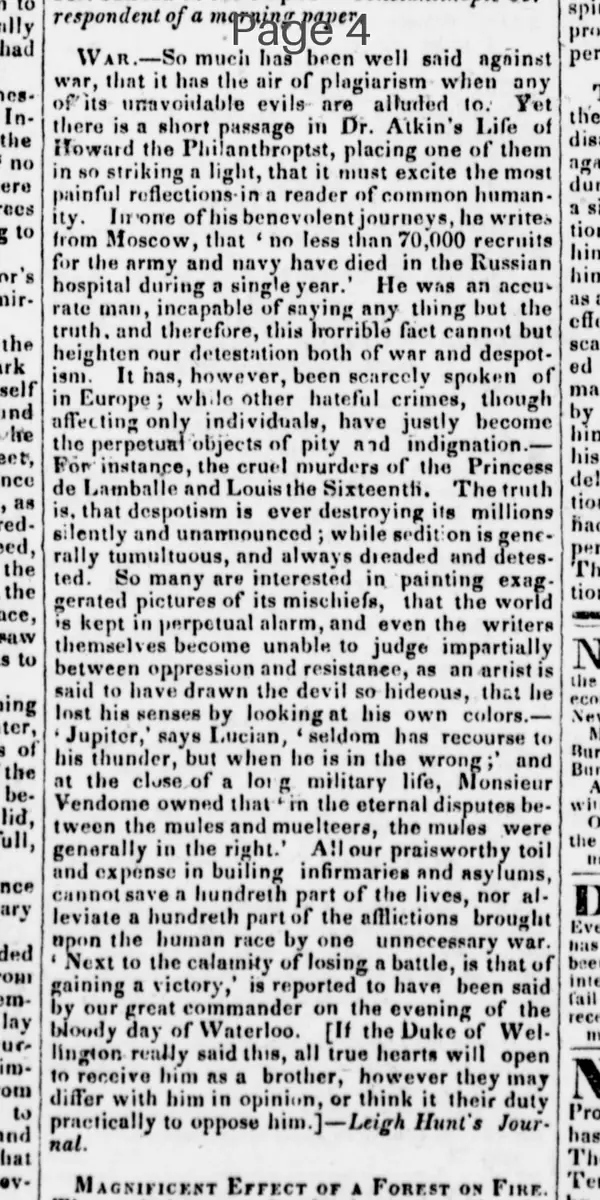
WAR.—So much has been well said against war, that it has the air of plagiarism when any of its unavoidable evils are alluded to: Yet there is a short passage in Dr. Aikin's Life of Howard the Philanthropist, placing one of them in so striking a light, that it must excite the most painful reflections in a reader of common humanity. In one of his benevolent journeys, he writes from Moscow, that 'no less than 70,000 recruits for the army and navy have died in the Russian hospital during a single year.' He was an accurate man, incapable of saying anything but the truth, and therefore, this horrible fact cannot but heighten our detestation both of war and despotism. It has, however, been scarcely spoken of in Europe; while other hateful crimes, though affecting only individuals, have justly become the perpetual objects of pity and indignation.—For instance, the cruel murders of the Princess de Lamballe and Louis the Sixteenth. The truth is, that despotism is ever destroying its millions silently and unannounced; while sedition is generally tumultuous, and always dreaded and detested. So many are interested in painting exaggerated pictures of its mischiefs, that the world is kept in perpetual alarm, and even the writers themselves become unable to judge impartially between oppression and resistance, as an artist is said to have drawn the devil so hideous, that he lost his senses by looking at his own colors.—'Jupiter,' says Lucian, 'seldom has recourse to his thunder, but when he is in the wrong;' and at the close of a long military life, Monsieur Vendome owned that 'in the eternal disputes between the mules and muleteers, the mules were generally in the right.' All our praiseworthy toil and expense in building infirmaries and asylums, cannot save a hundredth part of the lives, nor alleviate a hundredth part of the afflictions brought upon the human race by one unnecessary war. Next to the calamity of losing a battle, is that of gaining a victory,' is reported to have been said by our great commander on the evening of the bloody day of Waterloo. [If the Duke of Wellington really said this, all true hearts will open to receive him as a brother, however they may differ with him in opinion, or think it their duty practically to oppose him.]—Leigh Hunt's Journal.
What sub-type of article is it?
War Or Peace
Moral Or Religious
What keywords are associated?
War Evils
Despotism
Russian Recruits
Sedition
Waterloo
Wellington
Humanity
What entities or persons were involved?
Dr. Aikin
Howard The Philanthropist
Princess De Lamballe
Louis The Sixteenth
Lucian
Monsieur Vendome
Duke Of Wellington
Leigh Hunt
Editorial Details
Primary Topic
Evils Of War And Despotism
Stance / Tone
Anti War And Anti Despotism With Moral Reflections
Key Figures
Dr. Aikin
Howard The Philanthropist
Princess De Lamballe
Louis The Sixteenth
Lucian
Monsieur Vendome
Duke Of Wellington
Leigh Hunt
Key Arguments
70,000 Recruits Died In Russian Hospitals In A Single Year
War And Despotism Cause Massive Silent Deaths
Individual Crimes Like Murders Of Princess De Lamballe And Louis Xvi Receive More Attention
Despotism Destroys Millions Unannounced While Sedition Is Exaggerated
Unnecessary Wars Outweigh Benefits Of Infirmaries And Asylums
Gaining A Victory Is Nearly As Calamitous As Losing A Battle, Per Wellington