Thank you for visiting SNEWPapers!
Sign up free
Literary
December 13, 1823
Edwardsville Spectator
Edwardsville, Madison County, Illinois
What is this article about?
Oration by Dr. Charles Woodworth, delivered at a public exhibition in Belleville in 1823, extolling science as the true path to happiness over pursuits like wealth, fame, or vice. It praises science's role in navigation, astronomy, poetry, understanding nature's divine order, religious insight, and elevating the mind and society, urging Illinois youth to embrace it.
Clipping
OCR Quality
95%
Excellent
Full Text
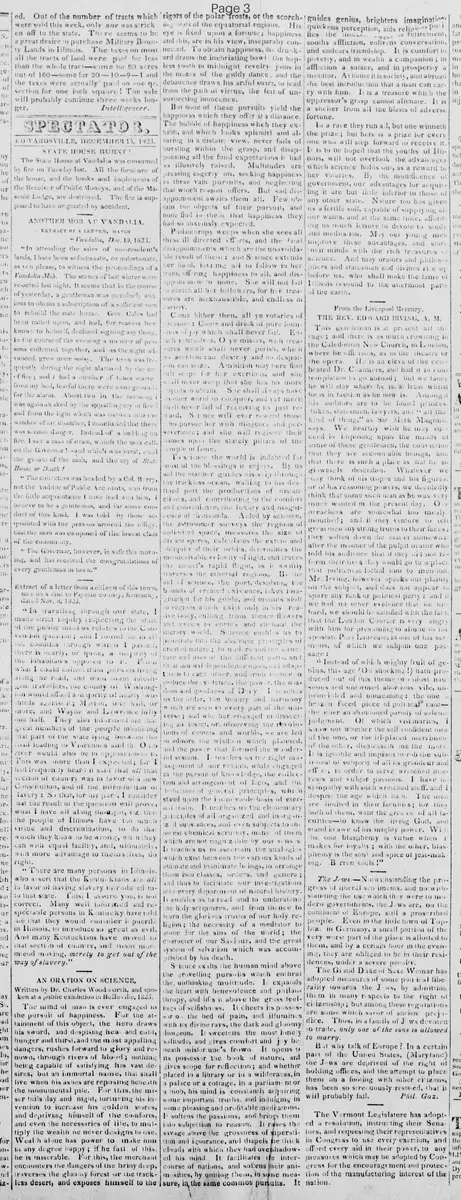
AN ORATION ON SCIENCE
Written by Dr. Charles Woodworth, and spoken at a public exhibition in Belleville, 1823.
The mind of man is ever engaged in the pursuit of happiness. For the attainment of this object, the hero draws his sword, and despising heat and cold, hunger and thirst, and the most appalling dangers, rushes forward to glory and renown, through rivers of blood; nothing being capable of satisfying his vast desires, but an immortal name, that shall live when his ashes are reposing beneath the monumental pile. For this, the miser toils day and night, torturing his invention to increase his golden stores, and depriving himself of the comforts, and even the necessaries of life, to multiply the wealth he never designs to use. Wealth alone has power to make him in any degree happy; if he fail of this, he is miserable. For this, the merchant encounters the dangers of the briny deep, traverses the gloomy forest or the trackless desert, and exposes himself to the rigors of the polar frosts, or the scorching heats of the equatorial regions. His eye is fixed upon a fortune; happiness and this, are in his view, inseparably connected. To obtain happiness, the drunkard drains the inebriating bowl; the hapless youth in midnight revelry, joins in the mazes of the giddy dance, and the debauchee draws his artful snare, to lead from the path of virtue, the feet of unsuspicious innocence.
But none of these pursuits yield the happiness which they offer at a distance. The bubble of happiness which they exhibit, and which looks splendid and alluring in a distant view, never fails of bursting within the grasp, and disappointing all the fond expectations it had so illusively raised. Multitudes are pressing eagerly on, seeking happiness in these vain pursuits, and neglecting that which reason offers. But sad disappointment awaits them all. Few obtain the objects of their pursuit, and none find in them that happiness they had so anxiously expected.
Philanthropy weeps when she sees all these ill directed efforts, and the fatal disappointments which are the unavoidable result of them: and Science extends her hand, inviting all to follow in her train, offering happiness to all, and disappointment to none. She will not fail to enrich all her followers, for her treasures are inexhaustible, and endless in variety.
Come hither then, all ye votaries of treasure: Come and drink of pure fountain, the flow of which shall never fail. Enrich yourselves, O ye misers, with treasures which shall never perish, which no alien can destroy and no despotism can seize. Ambition may here find full scope for her exertions, and she shall never weep that she has no more objects to obtain. She shall always have another world to conquer, and sentiment shall never fail of receiving its just reward. Science will ever reward those who pursue her with diligence and perseverance; and she will register their names upon the stately pillars of the temple of fame.
To science the world is indebted for most of the blessings it enjoys. By its aid the mariner guides his ship, through the trackless ocean, wafting to his destined port the productions of distant climes, and contributing to the comfort and convenience, the luxury and magnificence of thousands. Aided by science, the astronomer surveys the regions of unlimited space, measures the size of distant spheres, calculates the extent and obliquity of their orbits, determines the inconceivable velocity of light, and traces the comet's rapid flight, as it swiftly traverses the ethereal regions. By the aid of science, the poet, despising the bounds of created existence, takes immensity for his guide, and mounts aloft to regions which exist only in his creative fancy, culling from thence flowers of sweet to enrich and enchant the literary world. Science enables us to penetrate into the abstruse principles of created nature; to understand and admire the structure and designs of the different parts, and their mutual and general dependence upon, and adaptation to each other, and from thence to deduce the extent, the power, the wisdom and goodness of Divine benevolence which teaches us the order, the beauty and harmony which are seen in every part of the universe; and whether engaged in dissecting an insect, or observing the revolutions of comets and worlds, we are led to admire the wisdom which ordained, and the power that formed the vast system. It teaches us the right management of our reason, while engaged in the pursuit of knowledge, the collection and arrangement of facts, and the deduction of general principles, which stand upon the immovable basis of eternal truth. It teaches us the elementary principles of all organized and inorganic substances, and even subjects to the closest chemical scrutiny, many of them which are not cognizable by our senses. It teaches us to ascertain the analogies which exist between the various kinds of animate and inanimate beings, to arrange them into classes, orders, and genera; and thus to facilitate our investigations into every department of natural history. It enables us to read and to understand the holy scriptures, and from thence to learn the glorious truths of our holy religion; the necessity of a mediator to atone for the sins of the world; the character of our Saviour, and the great system of salvation which was accomplished by his death.
Science exalts the human mind above the grovelling pursuits which enthral the unthinking multitude. It expands the heart with benevolence and philanthropy, and lifts it above the gross feelings of selfishness. It cheers its possessor on the bed of pain, and illumines with its divine rays, the dark and gloomy dungeon. It sweetens the most lonely solitude, and gives comfort and joy beneath misfortune's frown. It opens to its possessor the book of nature, and gives scope for reflection; and whether placed in a library or in a wilderness, in a palace or a cottage, in a parliament or a mob, his mind is constantly acquiring some important truths, and indulging in some pleasing and profitable meditations. It softens the passions, and brings them into subjection to reason. It raises the savage above the grossness of superstition and ignorance, and dispels the thick clouds with which they had overshadowed his mind. It facilitates the intercourse of nations, and softens their animosities, by uniting them, in some measure, in the same common pursuits. It guides genius, brightens imagination, quickens perception, aids reflection, purifies the morals in retirement, soothes affliction, enlivens conversation, and endears friendship. It is comfort in poverty, and in wealth a companion; in affliction a solace, and in prosperity a monitor. At home it is society, and abroad the best introduction that a man can carry with him. It is a treasure which the oppressor's grasp cannot alienate. It is a shelter from all the blasts of adverse fortune.
In a race they run all, but one winneth the prize; but here is a prize for every one who will step forward to receive it. It is to be hoped that the youths of Illinois, will not overlook the advantages which science holds out, as a reward to her votaries. By the munificence of government, our advantages for acquiring it are but little inferior to those of any other state. Nature too has given us a fertile soil, capable of supplying all our wants, and at the same time, affording us much leisure to devote to study and meditation. May our young men improve these advantages, and store their minds with the rich treasures of science. And may orators and philosophers and statesmen and divines rise up before us, who shall make the name of Illinois resound to the utmost parts of the earth.
Written by Dr. Charles Woodworth, and spoken at a public exhibition in Belleville, 1823.
The mind of man is ever engaged in the pursuit of happiness. For the attainment of this object, the hero draws his sword, and despising heat and cold, hunger and thirst, and the most appalling dangers, rushes forward to glory and renown, through rivers of blood; nothing being capable of satisfying his vast desires, but an immortal name, that shall live when his ashes are reposing beneath the monumental pile. For this, the miser toils day and night, torturing his invention to increase his golden stores, and depriving himself of the comforts, and even the necessaries of life, to multiply the wealth he never designs to use. Wealth alone has power to make him in any degree happy; if he fail of this, he is miserable. For this, the merchant encounters the dangers of the briny deep, traverses the gloomy forest or the trackless desert, and exposes himself to the rigors of the polar frosts, or the scorching heats of the equatorial regions. His eye is fixed upon a fortune; happiness and this, are in his view, inseparably connected. To obtain happiness, the drunkard drains the inebriating bowl; the hapless youth in midnight revelry, joins in the mazes of the giddy dance, and the debauchee draws his artful snare, to lead from the path of virtue, the feet of unsuspicious innocence.
But none of these pursuits yield the happiness which they offer at a distance. The bubble of happiness which they exhibit, and which looks splendid and alluring in a distant view, never fails of bursting within the grasp, and disappointing all the fond expectations it had so illusively raised. Multitudes are pressing eagerly on, seeking happiness in these vain pursuits, and neglecting that which reason offers. But sad disappointment awaits them all. Few obtain the objects of their pursuit, and none find in them that happiness they had so anxiously expected.
Philanthropy weeps when she sees all these ill directed efforts, and the fatal disappointments which are the unavoidable result of them: and Science extends her hand, inviting all to follow in her train, offering happiness to all, and disappointment to none. She will not fail to enrich all her followers, for her treasures are inexhaustible, and endless in variety.
Come hither then, all ye votaries of treasure: Come and drink of pure fountain, the flow of which shall never fail. Enrich yourselves, O ye misers, with treasures which shall never perish, which no alien can destroy and no despotism can seize. Ambition may here find full scope for her exertions, and she shall never weep that she has no more objects to obtain. She shall always have another world to conquer, and sentiment shall never fail of receiving its just reward. Science will ever reward those who pursue her with diligence and perseverance; and she will register their names upon the stately pillars of the temple of fame.
To science the world is indebted for most of the blessings it enjoys. By its aid the mariner guides his ship, through the trackless ocean, wafting to his destined port the productions of distant climes, and contributing to the comfort and convenience, the luxury and magnificence of thousands. Aided by science, the astronomer surveys the regions of unlimited space, measures the size of distant spheres, calculates the extent and obliquity of their orbits, determines the inconceivable velocity of light, and traces the comet's rapid flight, as it swiftly traverses the ethereal regions. By the aid of science, the poet, despising the bounds of created existence, takes immensity for his guide, and mounts aloft to regions which exist only in his creative fancy, culling from thence flowers of sweet to enrich and enchant the literary world. Science enables us to penetrate into the abstruse principles of created nature; to understand and admire the structure and designs of the different parts, and their mutual and general dependence upon, and adaptation to each other, and from thence to deduce the extent, the power, the wisdom and goodness of Divine benevolence which teaches us the order, the beauty and harmony which are seen in every part of the universe; and whether engaged in dissecting an insect, or observing the revolutions of comets and worlds, we are led to admire the wisdom which ordained, and the power that formed the vast system. It teaches us the right management of our reason, while engaged in the pursuit of knowledge, the collection and arrangement of facts, and the deduction of general principles, which stand upon the immovable basis of eternal truth. It teaches us the elementary principles of all organized and inorganic substances, and even subjects to the closest chemical scrutiny, many of them which are not cognizable by our senses. It teaches us to ascertain the analogies which exist between the various kinds of animate and inanimate beings, to arrange them into classes, orders, and genera; and thus to facilitate our investigations into every department of natural history. It enables us to read and to understand the holy scriptures, and from thence to learn the glorious truths of our holy religion; the necessity of a mediator to atone for the sins of the world; the character of our Saviour, and the great system of salvation which was accomplished by his death.
Science exalts the human mind above the grovelling pursuits which enthral the unthinking multitude. It expands the heart with benevolence and philanthropy, and lifts it above the gross feelings of selfishness. It cheers its possessor on the bed of pain, and illumines with its divine rays, the dark and gloomy dungeon. It sweetens the most lonely solitude, and gives comfort and joy beneath misfortune's frown. It opens to its possessor the book of nature, and gives scope for reflection; and whether placed in a library or in a wilderness, in a palace or a cottage, in a parliament or a mob, his mind is constantly acquiring some important truths, and indulging in some pleasing and profitable meditations. It softens the passions, and brings them into subjection to reason. It raises the savage above the grossness of superstition and ignorance, and dispels the thick clouds with which they had overshadowed his mind. It facilitates the intercourse of nations, and softens their animosities, by uniting them, in some measure, in the same common pursuits. It guides genius, brightens imagination, quickens perception, aids reflection, purifies the morals in retirement, soothes affliction, enlivens conversation, and endears friendship. It is comfort in poverty, and in wealth a companion; in affliction a solace, and in prosperity a monitor. At home it is society, and abroad the best introduction that a man can carry with him. It is a treasure which the oppressor's grasp cannot alienate. It is a shelter from all the blasts of adverse fortune.
In a race they run all, but one winneth the prize; but here is a prize for every one who will step forward to receive it. It is to be hoped that the youths of Illinois, will not overlook the advantages which science holds out, as a reward to her votaries. By the munificence of government, our advantages for acquiring it are but little inferior to those of any other state. Nature too has given us a fertile soil, capable of supplying all our wants, and at the same time, affording us much leisure to devote to study and meditation. May our young men improve these advantages, and store their minds with the rich treasures of science. And may orators and philosophers and statesmen and divines rise up before us, who shall make the name of Illinois resound to the utmost parts of the earth.
What sub-type of article is it?
Essay
What themes does it cover?
Moral Virtue
Religious
Nature
What keywords are associated?
Science
Happiness
Pursuit
Philanthropy
Knowledge
Nature
Religion
Illinois
Youth
What entities or persons were involved?
Dr. Charles Woodworth
Literary Details
Title
An Oration On Science
Author
Dr. Charles Woodworth
Subject
Spoken At A Public Exhibition In Belleville, 1823
Form / Style
Prose Oration
Key Lines
The Mind Of Man Is Ever Engaged In The Pursuit Of Happiness.
Philanthropy Weeps When She Sees All These Ill Directed Efforts... And Science Extends Her Hand, Inviting All To Follow In Her Train, Offering Happiness To All, And Disappointment To None.
To Science The World Is Indebted For Most Of The Blessings It Enjoys.
Science Exalts The Human Mind Above The Grovelling Pursuits Which Enthral The Unthinking Multitude.
May Our Young Men Improve These Advantages, And Store Their Minds With The Rich Treasures Of Science.