Thank you for visiting SNEWPapers!
Sign up free
Editorial
November 30, 1847
The Daily Union
Washington, District Of Columbia
What is this article about?
Editorial critiques Henry Clay's speech and resolutions on the Mexican-American War, mocking proposals to withdraw without gains or indemnity, defending Democratic policy, and dismissing army slander as outdated fears. Signed 'SENEX.'
Clipping
OCR Quality
98%
Excellent
Full Text
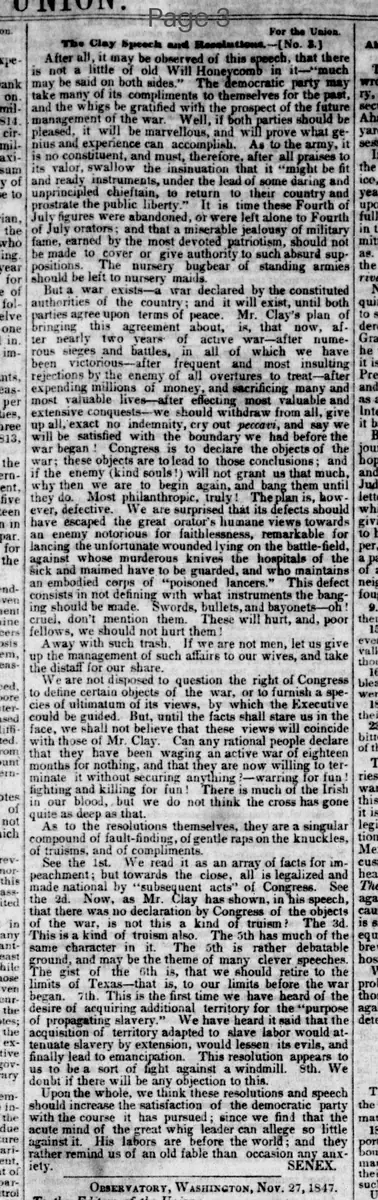
The Clay Speech and Resolutions.--[No. 3.]
After all, it may be observed of this speech, that there is not a little of old Will Honeycomb in it-"much may be said on both sides." The democratic party may take many of its compliments to themselves for the past, and the whigs be gratified with the prospect of the future management of the war. Well, if both parties should be pleased, it will be marvellous, and will prove what genius and experience can accomplish. As to the army, it is no constituent, and must, therefore, after all praises to its valor, swallow the insinuation that it "might be fit and ready instruments, under the lead of some daring and unprincipled chieftain, to return to their country and prostrate the public liberty." It is time these Fourth of July figures were abandoned, or were left alone to Fourth of July orators; and that a miserable jealousy of military fame, earned by the most devoted patriotism, should not be made to cover or give authority to such absurd suppositions. The nursery bugbear of standing armies should be left to nursery maids.
But a war exists-a war declared by the constituted authorities of the country; and it will exist, until both parties agree upon terms of peace. Mr. Clay's plan of bringing this agreement about, is, that now, after nearly two years of active war-after numerous sieges and battles, in all of which we have been victorious-after frequent and most insulting rejections by the enemy of all overtures to treat-after expending millions of money, and sacrificing many and most valuable lives-after effecting most valuable and extensive conquests-we should withdraw from all, give up all, exact no indemnity, cry out peccavi, and say we will be satisfied with the boundary we had before the war began! Congress is to declare the objects of the war; these objects are to lead to those conclusions; and if the enemy (kind souls!) will not grant us that much, why then we are to begin again, and hang them until they do. Most philanthropic, truly! The plan is, however, defective. We are surprised that its defects should have escaped the great orator's humane views towards an enemy notorious for faithlessness, remarkable for lancing the unfortunate wounded lying on the battle-field, against whose murderous knives the hospitals of the sick and maimed have to be guarded, and who maintains an embodied corps of "poisoned lancers." This defect consists in not defining with what instruments the hanging should be made. Swords, bullets, and bayonets-oh! cruel, don't mention them. These will hurt, and, poor fellows, we should not hurt them!
Away with such trash. If we are not men, let us give up the management of such affairs to our wives, and take the distaff for our share.
We are not disposed to question the right of Congress to define certain objects of the war, or to furnish a species of ultimatum of its views, by which the Executive could be guided. But, until the facts shall stare us in the face, we shall not believe that these views will coincide with those of Mr. Clay. Can any rational people declare that they have been waging an active war of eighteen months for nothing, and that they are now willing to terminate it without securing anything?-warring for fun! fighting and killing for fun! There is much of the Irish in our blood, but we do not think the cross has gone quite as deep as that.
As to the resolutions themselves, they are a singular compound of fault-finding, of gentle raps on the knuckles, of truisms, and of compliments.
See the 1st. We read it as an array of facts for impeachment; but towards the close, all is legalized and made national by "subsequent acts" of Congress. See the 2d. Now, as Mr. Clay has shown, in his speech, that there was no declaration by Congress of the objects of the war, is not this a kind of truism? The 3d. This is a kind of truism also. The 4th has much of the same character in it. The 5th is rather debatable ground, and may be the theme of many clever speeches.
The gist of the 6th is, that we should retire to the limits of Texas-that is, to our limits before the war began. 7th. This is the first time we have heard of the desire of acquiring additional territory for the "purpose of propagating slavery." We have heard it said that the acquisition of territory adapted to slave labor would attenuate slavery by extension, would lessen its evils, and finally lead to emancipation. This resolution appears to us to be a sort of fight against a windmill. 8th. We doubt if there will be any objection to this.
Upon the whole, we think these resolutions and speech should increase the satisfaction of the democratic party with the course it has pursued: since we find that the acute mind of the great whig leader can allege so little against it. His labors are before the world; and they rather remind us of an old fable than occasion any anxiety.
SENEX.
After all, it may be observed of this speech, that there is not a little of old Will Honeycomb in it-"much may be said on both sides." The democratic party may take many of its compliments to themselves for the past, and the whigs be gratified with the prospect of the future management of the war. Well, if both parties should be pleased, it will be marvellous, and will prove what genius and experience can accomplish. As to the army, it is no constituent, and must, therefore, after all praises to its valor, swallow the insinuation that it "might be fit and ready instruments, under the lead of some daring and unprincipled chieftain, to return to their country and prostrate the public liberty." It is time these Fourth of July figures were abandoned, or were left alone to Fourth of July orators; and that a miserable jealousy of military fame, earned by the most devoted patriotism, should not be made to cover or give authority to such absurd suppositions. The nursery bugbear of standing armies should be left to nursery maids.
But a war exists-a war declared by the constituted authorities of the country; and it will exist, until both parties agree upon terms of peace. Mr. Clay's plan of bringing this agreement about, is, that now, after nearly two years of active war-after numerous sieges and battles, in all of which we have been victorious-after frequent and most insulting rejections by the enemy of all overtures to treat-after expending millions of money, and sacrificing many and most valuable lives-after effecting most valuable and extensive conquests-we should withdraw from all, give up all, exact no indemnity, cry out peccavi, and say we will be satisfied with the boundary we had before the war began! Congress is to declare the objects of the war; these objects are to lead to those conclusions; and if the enemy (kind souls!) will not grant us that much, why then we are to begin again, and hang them until they do. Most philanthropic, truly! The plan is, however, defective. We are surprised that its defects should have escaped the great orator's humane views towards an enemy notorious for faithlessness, remarkable for lancing the unfortunate wounded lying on the battle-field, against whose murderous knives the hospitals of the sick and maimed have to be guarded, and who maintains an embodied corps of "poisoned lancers." This defect consists in not defining with what instruments the hanging should be made. Swords, bullets, and bayonets-oh! cruel, don't mention them. These will hurt, and, poor fellows, we should not hurt them!
Away with such trash. If we are not men, let us give up the management of such affairs to our wives, and take the distaff for our share.
We are not disposed to question the right of Congress to define certain objects of the war, or to furnish a species of ultimatum of its views, by which the Executive could be guided. But, until the facts shall stare us in the face, we shall not believe that these views will coincide with those of Mr. Clay. Can any rational people declare that they have been waging an active war of eighteen months for nothing, and that they are now willing to terminate it without securing anything?-warring for fun! fighting and killing for fun! There is much of the Irish in our blood, but we do not think the cross has gone quite as deep as that.
As to the resolutions themselves, they are a singular compound of fault-finding, of gentle raps on the knuckles, of truisms, and of compliments.
See the 1st. We read it as an array of facts for impeachment; but towards the close, all is legalized and made national by "subsequent acts" of Congress. See the 2d. Now, as Mr. Clay has shown, in his speech, that there was no declaration by Congress of the objects of the war, is not this a kind of truism? The 3d. This is a kind of truism also. The 4th has much of the same character in it. The 5th is rather debatable ground, and may be the theme of many clever speeches.
The gist of the 6th is, that we should retire to the limits of Texas-that is, to our limits before the war began. 7th. This is the first time we have heard of the desire of acquiring additional territory for the "purpose of propagating slavery." We have heard it said that the acquisition of territory adapted to slave labor would attenuate slavery by extension, would lessen its evils, and finally lead to emancipation. This resolution appears to us to be a sort of fight against a windmill. 8th. We doubt if there will be any objection to this.
Upon the whole, we think these resolutions and speech should increase the satisfaction of the democratic party with the course it has pursued: since we find that the acute mind of the great whig leader can allege so little against it. His labors are before the world; and they rather remind us of an old fable than occasion any anxiety.
SENEX.
What sub-type of article is it?
War Or Peace
Partisan Politics
What keywords are associated?
Clay Speech
War Resolutions
Mexican War
Whig Critique
Democratic Policy
Peace Terms
Military Valor
What entities or persons were involved?
Henry Clay
Democratic Party
Whig Party
Congress
Mexican Enemy
Editorial Details
Primary Topic
Critique Of Henry Clay's Speech And Resolutions On The War
Stance / Tone
Critical Of Clay's Proposals And Supportive Of Aggressive War Continuation
Key Figures
Henry Clay
Democratic Party
Whig Party
Congress
Mexican Enemy
Key Arguments
Clay's Speech Balances Compliments To Both Parties
Army Should Not Be Slandered As Potential Threat To Liberty
War Exists Until Peace Terms Agreed; Clay's Plan To Withdraw Without Indemnity Is Defective
Congress Can Define War Objects But Unlikely To Accept Clay's Views
Resolutions Mix Fault Finding, Truisms, And Compliments
Opposition To Acquiring Territory For Propagating Slavery Is Misguided
Resolutions Validate Democratic Course By Weak Whig Criticism