Thank you for visiting SNEWPapers!
Sign up free
Story
February 20, 1941
The Tri County News
Grand Rapids, Wood County, Ohio
What is this article about?
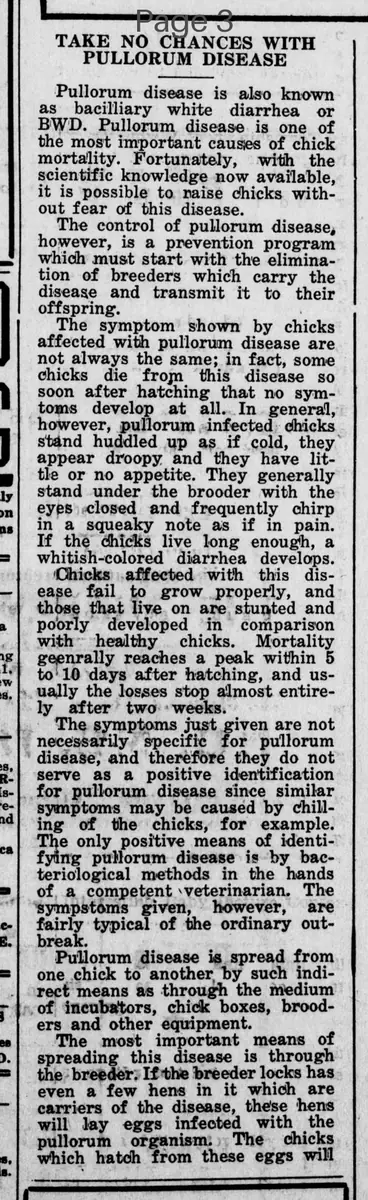
Article on Pullorum disease (bacillary white diarrhea) in chicks, a major cause of mortality. Describes symptoms like huddling, droopiness, lack of appetite, white diarrhea, and stunted growth. Prevention starts with eliminating carrier breeders; spread via equipment and infected eggs. Diagnosis requires veterinary bacteriological methods.
Clipping
OCR Quality
85%
Good
Full Text
TAKE NO CHANCES WITH
PULLORUM DISEASE
Pullorum disease is also known
as bacillary white diarrhea or
BWD. Pullorum disease is one of
the most important causes of chick
mortality. Fortunately, with the
scientific knowledge now available,
it is possible to raise chicks with-
out fear of this disease.
The control of pullorum disease
however, is a prevention program
which must start with the elimina-
tion of breeders which carry the
disease and transmit it to their
offspring.
The symptoms shown by chicks
affected with pullorum disease are
not always the same; in fact, some
chicks die from this disease so
soon after hatching that no sym-
toms develop at all. In general,
however, pullorum infected chicks
stand huddled up as if cold, they
appear droopy and they have lit-
tle or no appetite. They generally
stand under the brooder with the
eyes closed and frequently chirp
in a squeaky note as if in pain.
If the chicks live long enough, a
whitish-colored diarrhea develops.
Chicks affected with this dis-
ease fail to grow properly, and
those that live on are stunted and
poorly developed in comparison
with healthy chicks. Mortality
generally reaches a peak within 5
to 10 days after hatching, and us-
ually the losses stop almost entire-
ly after two weeks.
The symptoms just given are not
necessarily specific for pullorum
disease, and therefore they do not
serve as a positive identification
for pullorum disease since similar
symptoms may be caused by chill-
ing of the chicks, for example.
The only positive means of identi-
fying pullorum disease is by bac-
teriological methods in the hands
of a competent veterinarian. The
symptoms given, however, are
fairly typical of the ordinary out-
break.
Pullorum disease is spread from
one chick to another by such indi-
rect means as through the medium
of incubators, chick boxes, brood-
ers and other equipment.
The most important means of
spreading this disease is through
the breeder. If the breeder flock has
even a few hens in it which are
carriers of the disease, these hens
will lay eggs infected with the
pullorum organism. The chicks
which hatch from these eggs will
PULLORUM DISEASE
Pullorum disease is also known
as bacillary white diarrhea or
BWD. Pullorum disease is one of
the most important causes of chick
mortality. Fortunately, with the
scientific knowledge now available,
it is possible to raise chicks with-
out fear of this disease.
The control of pullorum disease
however, is a prevention program
which must start with the elimina-
tion of breeders which carry the
disease and transmit it to their
offspring.
The symptoms shown by chicks
affected with pullorum disease are
not always the same; in fact, some
chicks die from this disease so
soon after hatching that no sym-
toms develop at all. In general,
however, pullorum infected chicks
stand huddled up as if cold, they
appear droopy and they have lit-
tle or no appetite. They generally
stand under the brooder with the
eyes closed and frequently chirp
in a squeaky note as if in pain.
If the chicks live long enough, a
whitish-colored diarrhea develops.
Chicks affected with this dis-
ease fail to grow properly, and
those that live on are stunted and
poorly developed in comparison
with healthy chicks. Mortality
generally reaches a peak within 5
to 10 days after hatching, and us-
ually the losses stop almost entire-
ly after two weeks.
The symptoms just given are not
necessarily specific for pullorum
disease, and therefore they do not
serve as a positive identification
for pullorum disease since similar
symptoms may be caused by chill-
ing of the chicks, for example.
The only positive means of identi-
fying pullorum disease is by bac-
teriological methods in the hands
of a competent veterinarian. The
symptoms given, however, are
fairly typical of the ordinary out-
break.
Pullorum disease is spread from
one chick to another by such indi-
rect means as through the medium
of incubators, chick boxes, brood-
ers and other equipment.
The most important means of
spreading this disease is through
the breeder. If the breeder flock has
even a few hens in it which are
carriers of the disease, these hens
will lay eggs infected with the
pullorum organism. The chicks
which hatch from these eggs will
What sub-type of article is it?
Curiosity
Medical Curiosity
What themes does it cover?
Misfortune
Moral Virtue
What keywords are associated?
Pullorum Disease
Bacillary White Diarrhea
Chick Mortality
Disease Symptoms
Prevention
Veterinarian Diagnosis
Breeder Carriers
Story Details
Story Details
Pullorum disease causes high chick mortality with symptoms including huddling, droopiness, poor appetite, squeaky chirping, white diarrhea, and stunted growth. Prevention involves eliminating carrier breeders; spread via equipment and infected eggs. Diagnosis by veterinarian using bacteriological methods.