Thank you for visiting SNEWPapers!
Sign up free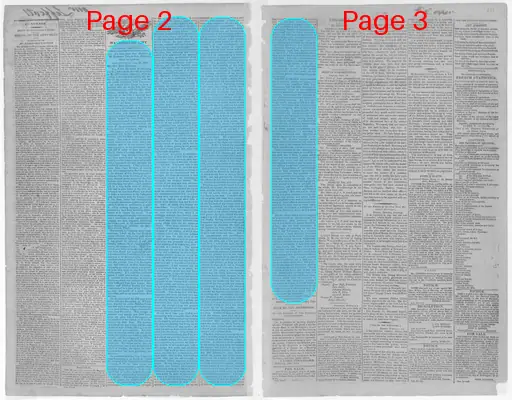
Daily National Intelligencer
Washington, District Of Columbia
What is this article about?
Andrew Jackson's January 1814 letter to Gen. Pinckney recounts his expedition with Tennessee volunteers and friendly Indians into Creek territory, defeating enemy forces in battles at Emuckfau on January 22 and repelling an ambush on January 24, achieving strategic diversion despite a rear guard retreat and casualties.
Merged-components note: Continuation of General Jackson's letter from page 2 to page 3, as the text flows directly from one component to the next.
Clippings
1 of 2
OCR Quality
Full Text
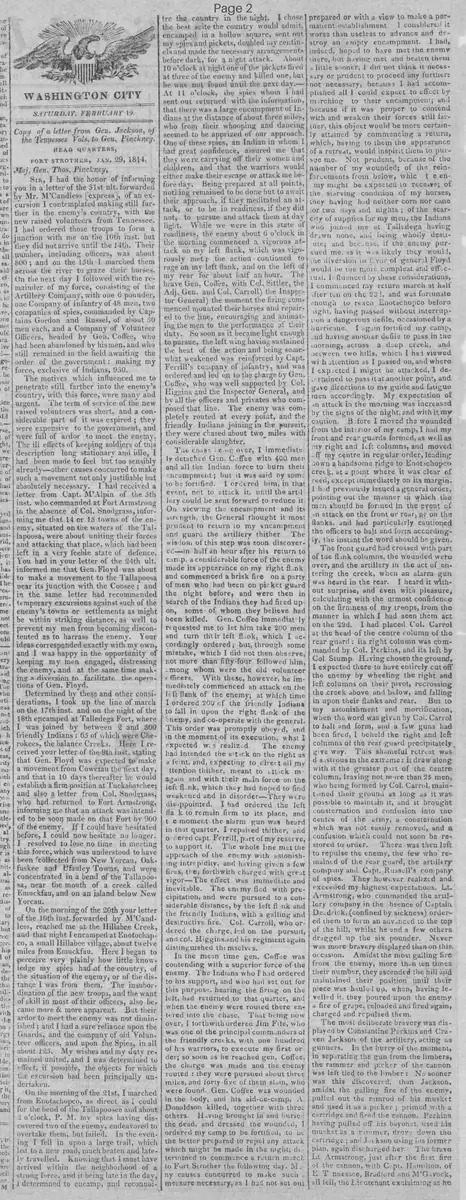
SATURDAY, FEBRUARY 19.
Copy of a letter from Gen. Jackson, of the Tennessee Vols, to Gen. Pinckney.
HEAD QUARTERS,
FORT STROTHER, JAN. 29, 1814.
Maj. Gen. Thos. Pinckney,
SIR, I had the honor of informing you in a letter of the 31st ult. forwarded by Mr. M'Candless [express], of an excursion I contemplated making still further in the enemy's country, with the new raised volunteers from Tennessee. I had ordered those troops to form a junction with me on the 10th inst. but they did not arrive until the 14th. Their number, including officers, was about 800; and on the 15th I marched them across the river to graze their horses. On the next day I followed with the remainder of my force, consisting of the Artillery Company, with one 6 pounder, one Company of Infantry of 48 men, two companies of spies, commanded by Captains Gordon and Russel, of about 30 men each, and a Company of Volunteer Officers, headed by Gen. Coffee, who had been abandoned by his men, and who still remained in the field awaiting the order of the government: making my force, exclusive of Indians, 930.
The motives which influenced me to penetrate still farther into the enemy's country, with this force, were many and urgent. The term of service of the new raised volunteers was short, and a considerable part of it was expired; they were expensive to the government, and were full of ardor to meet the enemy. The ill effects of keeping soldiers of this description long stationary and idle, I had been made to feel but too sensibly already—other causes concurred to make such a movement not only justifiable but absolutely necessary. I had received a letter from Capt. M'Alpin of the 5th inst. who commanded at Fort Armstrong in the absence of Col. Snodgrass, informing me that 14 or 15 towns of the enemy, situated on the waters of the Tallapoosa, were about uniting their forces and attacking that place, which had been left in a very feeble state of defence. You had in your letter of the 24th ult. informed me that Gen. Floyd was about to make a movement to the Tallapoosa near its junction with the Coosee; and in the same letter had recommended temporary excursions against such of the enemy's towns or settlements as might be within striking distance, as well to prevent my men from becoming discontented as to harass the enemy. Your ideas corresponded exactly with my own, and I was happy in the opportunity of keeping my men engaged, distressing the enemy, and at the same time making a diversion to facilitate the operations of Gen. Floyd.
Determined by these and other considerations, I took up the line of march on the 17th inst. and on the night of the 18th encamped at Talledega Fort, where I was joined by between 200 and 300 friendly Indians: 65 of which were Cherokees, the balance Creeks. Here I received your letter of the 9th inst. stating that Gen. Floyd was expected to make a movement from Cowetau the next day, and that in 10 days thereafter he would establish a firm position at Tuckabatchee: and also a letter from Col. Snodgrass, who had returned to Fort Armstrong informing me that an attack was intended to be soon made on that Fort by 900 of the enemy. If I could have hesitated before, I could now hesitate no longer. I resolved to lose no time in meeting this force, which was understood to have been collected from New Yorckau, Oakfuskee and Ufauley Towns, and were concentrated in a bend of the Tallapoosa, near the mouth of a creek called Emuckfau, and on an island below New Yorckau.
On the morning of the 20th your letter of the 10th inst. forwarded by M'Candless, reached me at the Hillabee Creek. and that night I encamped at Enotochapco, a small Hillabee village, about twelve miles from Emuckfau. Here I began to perceive very plainly how little knowledge my spies had of the country, of the situation of the enemy, or of the distance I was from them. The insubordination of the new troops, and the want of skill in most of their officers, also became more & more apparent. But their ardor to meet the enemy was not diminished; and I had a sure reliance upon the Guards, and the company of old Volunteer officers, and upon the Spies, in all about 125. My wishes and my duty remained united, and I was determined to effect, if possible, the objects for which the excursion had been principally undertaken.
On the morning of the 21st, I marched from Enotachopco, as direct as I could for the bend of the Tallapoosa and about 2 o'clock, P. M. my spies having discovered two of the enemy, endeavored to overtake them, but failed. In the evening I fell in upon a large trail, which led to a new road, much beaten and lately travelled. Knowing that I must have arrived within the neighborhood of a strong force, and it being late in the day, I determined to encamp, and reconnoitre the country in the night. I chose the best site the country would admit, encamped in a hollow square, sent out my spies and pickets, doubled my sentinels and made the necessary arrangements before dark, for a night attack. About 10 o'clock at night one of the pickets fired at three of the enemy and killed one, but he was not found until the next day.—At 11 o'clock, the spies whom I had sent out returned with the information, that there was a large encampment of Indians at the distance of about three miles, who from their whooping and dancing seemed to be apprized of our approach. One of these spies, an Indian in whom I had great confidence, assured me that they were carrying off their women and children, and that the warriors would either make their escape or attack me before day. Being prepared at all points, nothing remained to be done but to await their approach, if they meditated an attack, or to be in readiness, if they did not, to pursue and attack them at day light. While we were in this state of readiness, the enemy about 6 o'clock in the morning commenced a vigorous attack on my left flank, which was vigorously met; the action continued to rage on my left flank, and on the left of my rear for about half an hour. The brave Gen. Coffee, with Col. Sittler, the Adj. Gen. and Col. Carroll) the Inspector General) the moment the firing commenced mounted their horses and repaired to the line, encouraging and animating the men to the performance of their duty. So soon as it became light enough to pursue, the left wing having sustained the heat of the action and being somewhat weakened was reinforced by Capt. Ferrill's company of infantry, and was ordered and led on to the charge by Gen. Coffee, who was well supported by Col. Higgins and the Inspector General, and by all the officers and privates who composed that line. The enemy was completely routed at every point, and the friendly Indians joining in the pursuit, they were chased about two miles with considerable slaughter.
The chase being over, I immediately detached Gen. Coffee with 400 men and all the Indian force to burn their encampment; but it was said by some to be fortified. I ordered him, in that event, not to attack it, until the artillery could be sent forward to reduce it. On viewing the encampment and its strength, the General thought it most prudent to return to my encampment and guard the artillery thither. The wisdom of this step was soon discovered—in half an hour after his return to camp, a considerable force of the enemy made its appearance on my right flank and commenced a brisk fire on a party of men who had been on picket guard the night before, and were then in search of the Indians they had fired upon, some of whom they believe had been killed. Gen. Coffee immediately requested me to let him take 200 men and turn their left flank, which I accordingly ordered; but, through some mistake, which I did not then observe, not more than fifty-four followed him, among whom were the old volunteer officers. With these, however, he immediately commenced an attack on the left flank of the enemy; at which time I ordered 200 of the friendly Indians to fall in upon the right flank of the enemy, and co-operate with the general. This order was promptly obeyed, and in the moment of its execution, what I expected was realized. The enemy had intended the attack on the right as a feint, and, expecting to direct all my attention thither, meant to attack me again and with their main force on the left flank, which they had hoped to find weakened and in disorder—They were disappointed. I had ordered the left flank to remain firm to its place, and the moment the alarm gun was heard in that quarter, I repaired thither, and ordered capt. Ferrill, part of my reserve, to support it. The whole line met the approach of the enemy with astonishing intrepidity, and having given a few fires, they forthwith charged with great vigor—The effect was immediate and inevitable. The enemy fled with precipitation, and were pursued to a considerable distance, by the left flank and the friendly Indians, with a galling and destructive fire. Col. Carroll, who ordered the charge, led on the pursuit, and col. Higgins and his regiment again distinguished themselves.
In the mean time gen. Coffee was contending with a superior force of the enemy. The Indians who I had ordered to his support, and who had set out for this purpose, hearing the firing on the left, had returned to that quarter, and when the enemy were routed there entered into the chase. That being now over, I forthwith ordered Jim Fife, who was one of the principal commanders of the friendly creeks, with one hundred of his warriors, to execute my first order; so soon as he reached gen. Coffee, the charge was made and the enemy routed: they were pursued about three miles, and forty-five of them slain, who were found. Gen. Coffee was wounded in the body, and his aid-de-camp, A. Donaldson killed, together with three others. Having brought in and buried the dead, and dressed the wounded, I ordered my camp to be fortified, to be the better prepared to repel any attack which might be made in the night; determined to commence a return march to Fort Strother the following day. Many causes concurred to make such measure necessary, as I had not set out prepared or with a view to like a permanent establishment. I considered it worse than useless to advance and destroy an empty encampment. I had, indeed, hoped to have met the enemy there, but having met and beaten them a little sooner, I did not think it necessary or prudent to proceed any further: not necessary, because I had accomplished all I could expect to effect by marching to their encampment; and because if it was proper to contend with and weaken their forces still farther, this object would be more certainly attained by commencing a return, which, having to them the appearance of a retreat, would inspirit them to pursue me. Not prudent, because of the number of my wounded; of the reinforcements from below, which the enemy might be expected to receive; of the starving condition of my horses, they having had neither corn nor cane for two days and nights; of the scarcity of supplies for my men, the Indians who joined me at Talledega having drawn none, and being wholly destitute; and because, if the enemy pursued me, as it was likely they would, the diversion in favor of general Floyd would be the more complete and effectual. Influenced by these considerations, I commenced my return march at half after ten on the 23d, and was fortunate enough to reach Enotachopco before night, having passed without interruption a dangerous defile, occasioned by a hurricane. I again fortified my camp, and having another defile to pass in the morning, across a deep creek, and between two hills, which I had viewed with attention as I passed on, and where I expected I might be attacked, I determined to pass it at another point, and gave directions to my guide and fatigue men accordingly. My expectation of an attack in the morning was increased by the signs of the night, and with it my caution. Before I moved the wounded from the interior of my camp, I had my front and rear guards formed, as well as my right and left columns, and moved off my centre in regular order, leading down a handsome ridge to Enotuchopco creek, at a point where it was clear of reed, except immediately on its margin. I had previously issued a general order, pointing out the manner in which the men should be formed in the event of an attack on the front or rear, or on the flanks, and had particularly cautioned the officers to halt and form accordingly, the instant the word should be given. The front guard had crossed with part of the Rank columns, the wounded were over, and the artillery in the act of entering the creek, when an alarm gun was heard in the rear. I heard it without surprise, and even with pleasure; calculating with the utmost confidence on the firmness of my troops, from the manner in which I had seen them act on the 22d. I had placed Col. Carroll at the head of the centre column of the rear guard: its right column was commanded by Col. Perkins, and its left by Col. Stump. Having chosen the ground, I expected there to have entirely cut off the enemy by wheeling the right and left columns on their pivot, recrossing the creek above and below, and falling in upon their flanks and rear. But to my astonishment and mortification, when the word was given by Col. Carroll to halt and form, and a few guns had been fired, I beheld the right and left columns of the rear guard precipitately give way. This shameful retreat was disastrous in the extreme: it drew along with it the greater part of the centre column, leaving not more than 25 men who being formed by Col. Carroll, maintained their ground as long as it was possible to maintain it, and it brought consternation and confusion into the centre of the army, a consternation which was not easily removed, and a confusion which could not soon be restored to order. There was then left to repulse the enemy, the few who remained of the rear guard, the artillery company and Capt. Russell's company of spies. They however realized and exceeded my highest expectations. Lt. Armstrong, who commanded the artillery company in the absence of Captain Dedrick, (confined by sickness) ordered them to form an advanced to the top of the hill, whilst he and a few others dragged up the six pounder. Never was more bravery displayed than on this occasion. Amidst the most galling fire from the enemy, more than ten times their number, they ascended the hill and maintained their position until their piece was hauled up, when, having levelled it, they poured upon the enemy a fire of grape, reloaded and fired again, charged and repulsed them.
The most deliberate bravery was displayed by Constantine Perkins and Craven Jackson of the artillery, acting as gunners. In the hurry of the moment, in separating the gun from the limbers, the rammer and picker of the cannon was left tied to the limber: No sooner was this discovered, than Jackson, amidst the galling fire of the enemy, pulled out the ramrod of his musket and used it as a picker: primed with a cartridge and fired the cannon. Perkins having pulled off his bayonet, used his musket as a rammer, drove down the cartridge; and Jackson using his former plan, again discharged her. The brave Lt. Armstrong, just after the first fire of the cannon, with Capt. Hamilton, of Tennessee, Bradford and M'Gavock, all fell, the Lieutenant exclaiming as he
Lay, my brave fellows, some of you may fall, but you must save the cannon.
About this time, a number crossed the creek and entered into the chase. The brave Capt. Gordon of the spies, who had rushed from the front, endeavored to turn the left flank of the enemy, in which he partially succeeded, and Col. Carroll, Col. Higgins, and Capts. Elliott and Pipkins pursued the enemy for more than two miles, who fled in consternation, throwing away their packs and leaving 26 of their warriors dead on the field. This last defeat was decisive, and we were no more disturbed by their yells. I should do injustice to my feelings if I omitted to mention that the venerable Judge Cocke, at the age of 65, entered into the engagement, continued the pursuit of the enemy with youthful ardor, and saved the life of a fellow soldier by killing his savage antagonist.
Our loss in this affair was—killed and wounded; among the former was the brave Capt. Hamilton from East Tennessee, who had with his aged father and two others of his company, after the period of his engagement had expired, volunteered his services for this excursion, and attached himself to the artillery company. No man ever fought more bravely or fell more gloriously; and by his side fell with equal bravery and glory, Sgt. Evans of the same company. Captain Quarles who commanded the centre column of the rear guard, preferring death to the abandonment of his post, having taken a firm stand in which he was followed by 25 of his men, received a wound in his head of which he has since died.
In these several engagements our loss was 20 killed and 75 wounded, 4 of whom have since died. The loss of the enemy cannot be accurately ascertained: 189 of their warriors were found dead; but this must fall considerably short of the number really killed. Their wounded can only be guessed at.
Had it not been for the unfortunate retreat of the rear guard in the affair of the 24th inst. I think I could safely have said that no army of militia ever acted with more cool and deliberate bravery: undisciplined and inexperienced as they were, their conduct in the several engagements of the 22d could not have been surpassed by regulars. No men ever met the approach of an enemy with more intrepidity, or repulsed them with more energy. On the 24th, after the retreat of the rear guard, they seemed to have lost all their collectedness, and were more difficult to be restored to order than any troops I had ever seen. But this was no doubt owing in a great measure or altogether to that very retreat, and ought rather to be ascribed to the want of conduct in many of their officers than to any cowardice in the men, who on every occasion have manifested a willingness to perform their duty so far as they knew it.
All the effects which were designed to be produced by this excursion, it is believed have been produced. If an attack was meditated against Fort Armstrong, that has been prevented. If Gen. Floyd is operating on the east side of the Tallapoosa, as I suppose him to be, a most fortunate diversion has been made in his favor. The number of the enemy has been diminished, and the confidence they may have derived from the delays I have been made to experience, has been destroyed. Discontent has been kept out of my army, while the troops who would have been exposed to it have been beneficially employed: The enemy's country has been explored, and a road cut to the point where their force will probably be concentrated when they shall be driven from the country below. But in a report of this kind, and to you who will immediately perceive them, it is not necessary to state the happy consequences which may be expected to result from this excursion. Unless I am greatly mistaken, it will be found to have hastened the termination of the Creek War, more effectually than any measure I could have taken with the troops under my command.
I am, sir, with sentiments of high respect, your obedient servant,
ANDREW JACKSON, Maj. Gen.
What sub-type of article is it?
What themes does it cover?
What keywords are associated?
What entities or persons were involved?
Where did it happen?
Story Details
Key Persons
Location
Creek Territory Along The Tallapoosa River, Near Emuckfau
Event Date
January 17 24, 1814
Story Details
Gen. Jackson leads 930 troops and friendly Indians on an excursion into Creek territory to engage enemy forces, winning battles on January 22 by routing attackers on both flanks and on January 24 repelling an ambush despite a rear guard retreat, with artillery bravery saving the day; achieves diversion for Gen. Floyd and weakens the enemy.