Thank you for visiting SNEWPapers!
Sign up free
Alexandria Daily Gazette, Commercial & Political
Alexandria, Virginia
What is this article about?
In April 1810, a French privateer entered Charleston harbor under distress pretense, smuggled goods, sold cargo, then blockaded the port, threatened vessels, and fired on a packet boat, injuring a passenger. US authorities failed to act, drawing criticism of government subservience to France.
Clipping
OCR Quality
Full Text
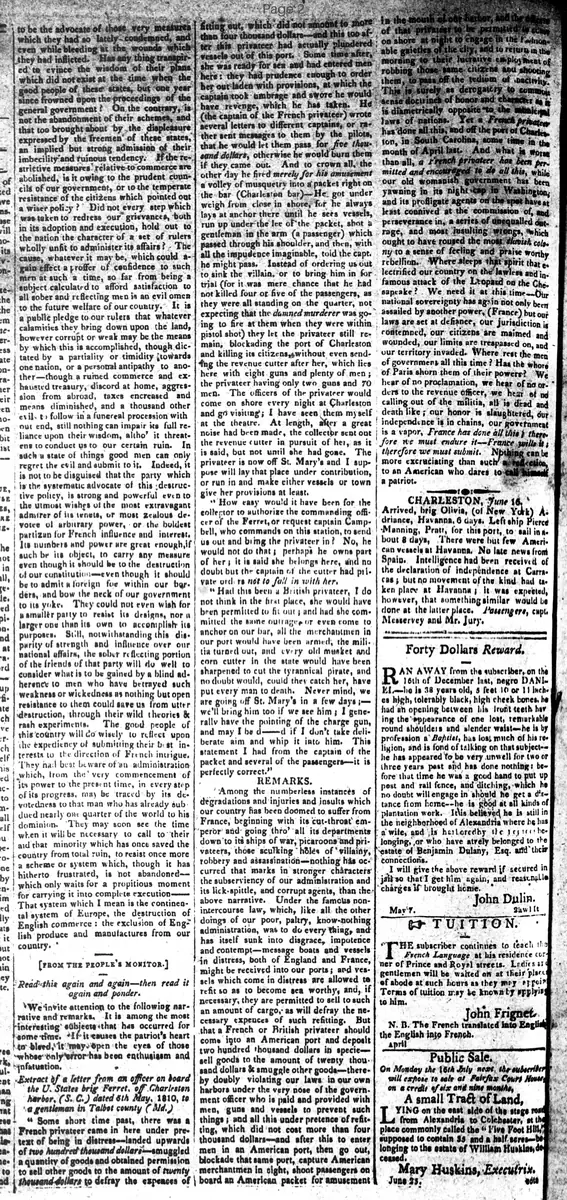
Read this again and again—then read it again and ponder.
We invite attention to the following narrative and remarks, It is among the most interesting subjects that has occurred for some time. If it causes the patriot's heart to bleed, it may open the eyes of those whose only error has been enthusiasm and infatuation.
Extract of a letter from an officer on board the U. States brig Ferret, off Charleston harbor, (S. C.) dated 5th May, 1810, to a gentleman in Talbot county (Md.)
Some short time past, there was a French privateer came in here under pretext of being in distress—landed upwards of three hundred thousand dollars—smuggled a quantity of goods and obtained permission to sell other goods to the amount of twenty thousand dollars to defray the expenses of fitting out which did not amount to more than four thousand dollars, and this too after this privateer had actually plundered vessels out of this port. Some time after she was ready for sea and had entered men here: they had prudence enough to order her out laden with provisions, at which the captain took umbrage and swore he would have revenge, which he has taken. He (the captain of the French privateer) wrote several letters to different captains, or rather sent messages to them by the pilots, that he would let them pass for five thousand dollars, otherwise he would burn them if they came out. And to crown all, the other day he fired merely for his amusement a volley of musketry into a packet right on the bar (Charleston bar)— He got under weigh from close in shore, for he always lays at anchor there until he sees vessels, run up under the lee of the packet, shot a gentleman in the arm (a passenger) which passed through his shoulder, and then, with all the impudence imaginable, told the capt. he might pass. Instead of ordering us out to sink the villain, or to bring him in for trial (for it was mere chance that he had not killed four or five of the passengers, as they were all standing on the quarter, not expecting that the damned murderer was going to fire at them when they were within pistol shot) they let the privateer still remain, blockading the port of Charleston and killing its citizens, without even sending the revenue cutter after her, which lies here with eight guns and plenty of men; the privateer having only two guns and 70 men. The officers of the privateer would come on shore every night at Charleston and go visiting'; I have seen them myself at the theatre. At length, after a great noise had been made, the collector sent out the revenue cutter in pursuit of her, as it is said, but not until she had gone. The privateer is now off St. Mary's and I suppose will lay that place under contribution, or run in and make either vessels or town give her provisions at least.
How easy would it have been for the collector to authorize the commanding officer of the Ferret, or request captain Campbell, who commands on this station, to send us out and bring the privateer in? No, he would not do that; perhaps he owns part of her; it is said she belongs here, and no doubt but the captain of the cutter had private orders not to fall in with her.
Had this been a British privateer, I do not think in the first place, she would have been permitted to fit out; and had she committed the same outrages or even come to anchor on our bar, all the merchantmen in our port would have been armed; the militia turned out, and every old musket and corn cutter in the state would have been sharpened to cut the tyrannical pirate, and no doubt would, could they catch her, have put every man to death. Never mind, we are going off St. Mary's in a few days;— we'll bring him too if we see him; I generally have the pointing of the charge gun, and may I be d—d if I don't take deliberate aim and whip it into him. This statement I had from the captain of the packet and several of the passengers—it is perfectly correct.
REMARKS.
Among the numberless instances of degradations and injuries and insults which our country has been doomed to suffer from France, beginning with its cut-throat emperor and going thro' all its departments down to its ships of war, picaroons and privateers, those skulking holes of villainy, robbery and assassination—nothing has occurred that marks in stronger characters the subserviency of our administration and its lick-spittle, and corrupt agents, than the above narrative. Under the famous non-intercourse law, which, like all the other doings of our poor, paltry, know-nothing administration, was to do every thing, and has itself sunk into disgrace, impotence and contempt—message boats and vessels in distress, both of England and France, might be received into our ports; and vessels which come in distress are allowed to refit so as to become sea worthy, and, if necessary, they are permitted to sell to such an amount of cargo, as will defray the necessary expenses of such refitting, But that a French or British privateer should come into an American port and deposit two hundred thousand dollars in specie—sell goods to the amount of twenty thousand dollars & smuggle other goods—thereby doubly violating our laws in our own harbors under the very nose of the government officer who is paid and provided with men, guns and vessels to prevent such things; and all this under pretence of refitting, which did not cost more than four thousand dollars—and after this to enter men in an American port, then go out, blockade that same port, capture American merchantmen in sight, shoot passengers on board an American packet for amusement in the mouth of our harbor and of that privateer to—come on shore at night to engage in the amiable gaities of the city, and to return in the morning to their lucrative employment of robbing those same citizens and shooting them, to pass off the tedium of inactivity. This is surely as derogatory to common sense doctrines of honor and character as it is diametrically opposite to the municipal laws of nations. Yet a French privateer has done all this, and off the port of Charleston, in South Carolina, some time in the month of April last. And what is worse than all, a French privateer has been permitted and encouraged to do all this, while our old womanish government has been yawning in its night cap at Washington, and its profligate agents on the spot have at least connived at the commission of, and perseverance in, a series of unequalled outrage, and most insulting wrongs, which ought to have roused the most slavish colony to a sense of feeling and praiseworthy rebellion. Where sleeps that spirit that electrified our country on the lawless and infamous attack of the Leopard on the Chesapeake? We need it at this time—Our national sovereignty has again not only been assailed by another power. (France) but our laws are set at defiance, our jurisdiction is contemned, our citizens are maimed and wounded, our limits are trespassed on, and our territory invaded. Where rest the men of government all this time? Has the whore of Paris shorn them of their powers? We hear of no proclamation, we hear of no orders to the revenue officer, we hear of no calling out of the militia, all is dead and death like; our honor is slaughtered, our independence is in chains, our government is a vapor, France has done all this therefore we must endure it—France wills it: therefore we must submit. Nothing can be more excruciating than such a reflection to an American who dares to call himself a patriot.
What sub-type of article is it?
What keywords are associated?
What entities or persons were involved?
Where did it happen?
Domestic News Details
Primary Location
Charleston Harbor, S. C.
Event Date
April 1810
Key Persons
Outcome
a passenger on the packet boat was shot in the arm, injury passing through his shoulder. privateer blockaded port, threatened vessels, then moved off st. mary's.
Event Details
A French privateer entered Charleston harbor under pretense of distress, landed $300,000, smuggled and sold goods, enlisted men, then blockaded the port, demanded passage fees from vessels, and fired musketry at a packet boat injuring a passenger before allowing it to pass. US authorities, including the collector and revenue cutter, failed to pursue or capture the privateer despite capability.