Thank you for visiting SNEWPapers!
Sign up free
Editorial
October 30, 1911
Rock Island Argus
Rock Island, Rock Island County County, Illinois
What is this article about?
Editorial opposes raising Rock Island saloon licenses from $600 to $1000, arguing it burdens the working class, creates monopolies, fails to boost revenue, and invites illegal alcohol sales, contrasting favorably with Moline's higher-license system.
Clipping
OCR Quality
95%
Excellent
Full Text
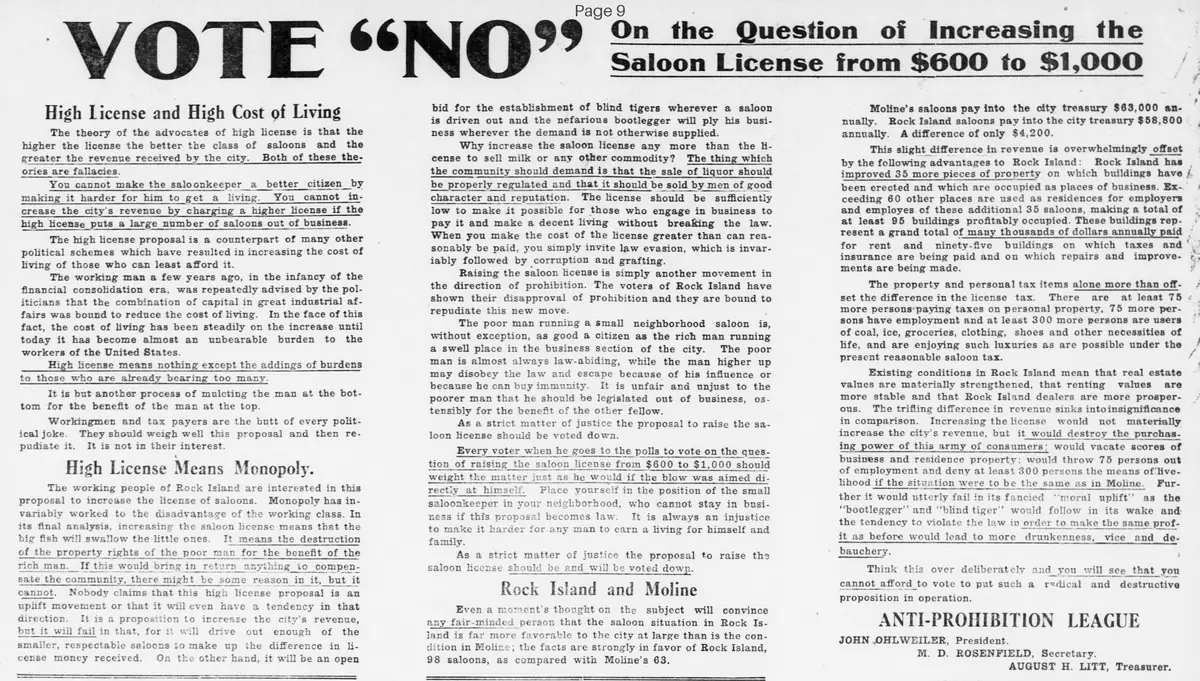
On the Question of Increasing the VOTE 66NO99 Saloon License from $600 to $1,000
High License and High Cost of Living
The theory of the advocates of high license is that the higher the license the better the class of saloons and the greater the revenue received by the city. Both of these theories are fallacies. You cannot make the saloonkeeper a better citizen by making it harder for him to get a living. You cannot increase the city's revenue by charging a higher license if the high license puts a large number of saloons out of business. The high license proposal is a counterpart of many other political schemes which have resulted in increasing the cost of living of those who can least afford it. The working man a few years ago, in the infancy of the financial consolidation era, was repeatedly advised by the politicians that the combination of capital in great industrial affairs was bound to reduce the cost of living. In the face of this fact, the cost of living has been steadily on the increase until today it has become almost an unbearable burden to the workers of the United States. High license means nothing except the adding of burdens to those who are already bearing too many. It is but another process of mulcting the man at the bottom for the benefit of the man at the top. Workingmen and tax payers are the butt of every political joke. They should weigh well this proposal and then repudiate it. It is not in their interest.
High License Means Monopoly.
The working people of Rock Island are interested in this proposal to increase the license of saloons. Monopoly has invariably worked to the disadvantage of the working class. In its final analysis, increasing the saloon license means that the big fish will swallow the little ones. It means the destruction of the property rights of the poor man for the benefit of the rich man. If this would bring in return anything to compensate the community, there might be some reason in it, but it cannot. Nobody claims that this high license proposal is an uplift movement or that it will even have a tendency in that direction. It is a proposition to increase the city's revenue, but it will fail in that, for it will drive out enough of the smaller, respectable saloons to make up the difference in license money received. On the other hand, it will be an open bid for the establishment of blind tigers wherever a saloon is driven out and the nefarious bootlegger will ply his business wherever the demand is not otherwise supplied. Why increase the saloon license any more than the license to sell milk or any other commodity? The thing which the community should demand is that the sale of liquor should be properly regulated and that it should be sold by men of good character and reputation. The license should be sufficiently low to make it possible for those who engage in business to pay it and make a decent living without breaking the law. When you make the cost of the license greater than can reasonably be paid, you simply invite law evasion, which is invariably followed by corruption and grafting. Raising the saloon license is simply another movement in the direction of prohibition. The voters of Rock Island have shown their disapproval of prohibition and they are bound to repudiate this new move. The poor man running a small neighborhood saloon is, without exception, as good a citizen as the rich man running a swell place in the business section of the city. The poor man is almost always law-abiding, while the man higher up may disobey the law and escape because of his influence or because he can buy immunity. It is unfair and unjust to the poorer man that he should be legislated out of business, ostensibly for the benefit of the other fellow. As a strict matter of justice the proposal to raise the saloon license should be voted down. Every voter when he goes to the polls to vote on the question of raising the saloon license from $600 to $1,000 should weight the matter just as he would if the blow was aimed directly at himself. Place yourself in the position of the small saloonkeeper in your neighborhood, who cannot stay in business if this proposal becomes law. It is always an injustice to make it harder for any man to earn a living for himself and family. As a strict matter of justice the proposal to raise the saloon license should be and will be voted down.
Rock Island and Moline
Even a moment's thought on the subject will convince any fair-minded person that the saloon situation in Rock Island is far more favorable to the city at large than is the condition in Moline: the facts are strongly in favor of Rock Island, 98 saloons, as compared with Moline's 63.
Moline's saloons pay into the city treasury $63,000 annually. Rock Island saloons pay into the city treasury $58,800 annually. A difference of only $4,200. This slight difference in revenue is overwhelmingly offset by the following advantages to Rock Island: Rock Island has improved 35 more pieces of property on which buildings have been erected and which are occupied as places of business. Exceeding 60 other places are used as residences for employers and employes of these additional 35 saloons, making a total of at least 95 buildings profitably occupied. These buildings represent a grand total of many thousands of dollars annually paid for rent and ninety-five buildings on which taxes and insurance are being paid and on which repairs and improvements are being made. The property and personal tax items alone more than offset the difference in the license tax. There are at least 75 more persons paying taxes on personal property, 75 more persons have employment and at least 300 more persons are users of coal, ice, groceries, clothing, shoes and other necessities of life, and are enjoying such luxuries as are possible under the present reasonable saloon tax. Existing conditions in Rock Island mean that real estate values are materially strengthened, that renting values are more stable and that Rock Island dealers are more prosperous. The trifling difference in revenue sinks into insignificance in comparison. Increasing the license would not materially increase the city's revenue, but it would destroy the purchasing power of this army of consumers; would vacate scores of business and residence property; would throw 75 persons out of employment and deny at least 300 persons the means of livelihood if the situation were to be the same as in Moline. Further it would utterly fail in its fancied 'moral uplift' as the 'bootlegger' and 'blind tiger' would follow in its wake and the tendency to violate the law in order to make the same profit as before would lead to more drunkenness, vice and debauchery. Think this over deliberately and you will see that you cannot afford to vote to put such a radical and destructive proposition in operation.
High License and High Cost of Living
The theory of the advocates of high license is that the higher the license the better the class of saloons and the greater the revenue received by the city. Both of these theories are fallacies. You cannot make the saloonkeeper a better citizen by making it harder for him to get a living. You cannot increase the city's revenue by charging a higher license if the high license puts a large number of saloons out of business. The high license proposal is a counterpart of many other political schemes which have resulted in increasing the cost of living of those who can least afford it. The working man a few years ago, in the infancy of the financial consolidation era, was repeatedly advised by the politicians that the combination of capital in great industrial affairs was bound to reduce the cost of living. In the face of this fact, the cost of living has been steadily on the increase until today it has become almost an unbearable burden to the workers of the United States. High license means nothing except the adding of burdens to those who are already bearing too many. It is but another process of mulcting the man at the bottom for the benefit of the man at the top. Workingmen and tax payers are the butt of every political joke. They should weigh well this proposal and then repudiate it. It is not in their interest.
High License Means Monopoly.
The working people of Rock Island are interested in this proposal to increase the license of saloons. Monopoly has invariably worked to the disadvantage of the working class. In its final analysis, increasing the saloon license means that the big fish will swallow the little ones. It means the destruction of the property rights of the poor man for the benefit of the rich man. If this would bring in return anything to compensate the community, there might be some reason in it, but it cannot. Nobody claims that this high license proposal is an uplift movement or that it will even have a tendency in that direction. It is a proposition to increase the city's revenue, but it will fail in that, for it will drive out enough of the smaller, respectable saloons to make up the difference in license money received. On the other hand, it will be an open bid for the establishment of blind tigers wherever a saloon is driven out and the nefarious bootlegger will ply his business wherever the demand is not otherwise supplied. Why increase the saloon license any more than the license to sell milk or any other commodity? The thing which the community should demand is that the sale of liquor should be properly regulated and that it should be sold by men of good character and reputation. The license should be sufficiently low to make it possible for those who engage in business to pay it and make a decent living without breaking the law. When you make the cost of the license greater than can reasonably be paid, you simply invite law evasion, which is invariably followed by corruption and grafting. Raising the saloon license is simply another movement in the direction of prohibition. The voters of Rock Island have shown their disapproval of prohibition and they are bound to repudiate this new move. The poor man running a small neighborhood saloon is, without exception, as good a citizen as the rich man running a swell place in the business section of the city. The poor man is almost always law-abiding, while the man higher up may disobey the law and escape because of his influence or because he can buy immunity. It is unfair and unjust to the poorer man that he should be legislated out of business, ostensibly for the benefit of the other fellow. As a strict matter of justice the proposal to raise the saloon license should be voted down. Every voter when he goes to the polls to vote on the question of raising the saloon license from $600 to $1,000 should weight the matter just as he would if the blow was aimed directly at himself. Place yourself in the position of the small saloonkeeper in your neighborhood, who cannot stay in business if this proposal becomes law. It is always an injustice to make it harder for any man to earn a living for himself and family. As a strict matter of justice the proposal to raise the saloon license should be and will be voted down.
Rock Island and Moline
Even a moment's thought on the subject will convince any fair-minded person that the saloon situation in Rock Island is far more favorable to the city at large than is the condition in Moline: the facts are strongly in favor of Rock Island, 98 saloons, as compared with Moline's 63.
Moline's saloons pay into the city treasury $63,000 annually. Rock Island saloons pay into the city treasury $58,800 annually. A difference of only $4,200. This slight difference in revenue is overwhelmingly offset by the following advantages to Rock Island: Rock Island has improved 35 more pieces of property on which buildings have been erected and which are occupied as places of business. Exceeding 60 other places are used as residences for employers and employes of these additional 35 saloons, making a total of at least 95 buildings profitably occupied. These buildings represent a grand total of many thousands of dollars annually paid for rent and ninety-five buildings on which taxes and insurance are being paid and on which repairs and improvements are being made. The property and personal tax items alone more than offset the difference in the license tax. There are at least 75 more persons paying taxes on personal property, 75 more persons have employment and at least 300 more persons are users of coal, ice, groceries, clothing, shoes and other necessities of life, and are enjoying such luxuries as are possible under the present reasonable saloon tax. Existing conditions in Rock Island mean that real estate values are materially strengthened, that renting values are more stable and that Rock Island dealers are more prosperous. The trifling difference in revenue sinks into insignificance in comparison. Increasing the license would not materially increase the city's revenue, but it would destroy the purchasing power of this army of consumers; would vacate scores of business and residence property; would throw 75 persons out of employment and deny at least 300 persons the means of livelihood if the situation were to be the same as in Moline. Further it would utterly fail in its fancied 'moral uplift' as the 'bootlegger' and 'blind tiger' would follow in its wake and the tendency to violate the law in order to make the same profit as before would lead to more drunkenness, vice and debauchery. Think this over deliberately and you will see that you cannot afford to vote to put such a radical and destructive proposition in operation.
What sub-type of article is it?
Temperance
Economic Policy
Labor
What keywords are associated?
Saloon License
High License
Rock Island
Moline
Working Class
Monopoly
Bootlegging
Cost Of Living
What entities or persons were involved?
Rock Island
Moline
Saloonkeepers
Workingmen
Politicians
Editorial Details
Primary Topic
Opposition To Increasing Saloon License From $600 To $1000 In Rock Island
Stance / Tone
Strongly Against The High License Proposal
Key Figures
Rock Island
Moline
Saloonkeepers
Workingmen
Politicians
Key Arguments
High License Does Not Improve Saloon Quality Or Increase City Revenue
It Raises Cost Of Living For The Poor And Working Class
Leads To Monopoly Where Big Operators Eliminate Small Ones
Drives Small Saloons Out Of Business, Inviting Bootlegging And Law Evasion
Rock Island's Current System Provides More Economic Benefits Than Moline's Higher License
Unfair To Small Saloonkeepers Compared To Wealthy Ones
Would Cause Unemployment And Reduced Consumer Spending